
George du Maurier
George Louis Palmella Busson du Maurier (lang; 6 March 1834 – 8 October 1896) was a French-British cartoonist, illustrator, and novelist. His first novel Peter Ibbetson was published in 1891 and has been adapted into films, an opera, and a play. He was known for his work in Punch and his 1894 Gothic novel Trilby, featuring the character Svengali.
Also recorded as George Louis Palmella Busson Du Maurier · George Du Maurier · George Busson Du Maurier · Gerard Du Maurier
George du Maurier
George du Maurier · Wellcome Collection, London · Wellcome Collection · Public Domain Mark
- Name
- George du Maurier
- Birth Name
- George Louis Palmella Busson du Maurier
- Born
- 6 March 1834
- Birthplace
- Paris, France
- Died
- 8 October 1896
- Place of death
- Hampstead, England
- Occupation
- Cartoonist, illustrator, novelist
- Full name
- George Louis Palmella Busson du Maurier.
- Nationality
- France and United Kingdom of Great Britain and Ireland.
- Known for
- Trilby.
- Languages
- English.
VALÉORINE Encyclopedia
VALÉORINE documentary reading
Documentary summary
George Louis Palmella Busson du Maurier (lang; 6 March 1834 – 8 October 1896) was a French-British cartoonist, illustrator, and novelist. His first novel Peter Ibbetson was published in 1891 and has been adapted into films, an opera, and a play. He was known for his work in Punch and his 1894 Gothic novel Trilby, featuring the character Svengali.
Admitted source layer · organised and presented by VALÉORINE
Reference Check
Propose documentary evidence for George du Maurier. A contribution is never written directly as fact: identity, source, rights and evidence gates still decide.
Sign in to contribute
World of VALÉORINE
Documentary connections
Only confirmed graph relationships appear here. Images are shown only when their identity and reuse rights both pass the documentary gate.


Documentary evidence
Documentary basis
Authority files
wikidata · Q949700 · wikipedia · George du Maurier
In this article
Biography
Biography
His son was the actor Sir Gerald du Maurier. The writers Angela du Maurier and Daphne du Maurier and the artist Jeanne du Maurier were all granddaughters of George. He was also father of Sylvia Llewelyn Davies and grandfather of the five boys who inspired J. Barrie's Peter Pan.
The recorded working language is English. Places of work recorded in the authority are London. Works named in the authority record are Trilby. Work by George du Maurier is recorded in the collections of Art Institute of Chicago, Auckland Art Gallery, National Gallery of Victoria, National Gallery of Canada and National Portrait Gallery.
Key facts
Key facts
• Name — George du Maurier • Birth Name — George Louis Palmella Busson du Maurier • Born — 6 March 1834 • Birthplace — Paris, France • Died — 8 October 1896 • Place of death — Hampstead, England • Occupation — Cartoonist, illustrator, novelist • Children — 5, including Guy, Sylvia, and Gerald • Relatives — * Mary Anne Clarke (grandmother) • Angela du Maurier (granddaughter) • Daphne du Maurier (granddaughter) • Jeanne du Maurier (granddaughter)
Early life
Early life
George du Maurier was born in Paris, son of Louis-Mathurin Busson du Maurier and wife Ellen Clarke, daughter of the Regency courtesan Mary Anne Clarke. He was brought up to believe his aristocratic grandparents had fled from France during the Revolution, leaving vast estates behind, to live in England as émigrés. In fact, du Maurier's grandfather, Robert-Mathurin Busson, was a tradesman who left Paris in 1789 to avoid charges of fraud and later changed the family name to the grander-sounding du Maurier. Du Maurier studied art in Paris, in the studio of Charles Gleyre, and moved to Antwerp, where he lost the vision in his left eye. He was reportedly studying chemistry at University College, London, in 1851. He is recorded in the 1861 England Census as a lodger at 85 Newman St in Marylebone.
Career
Career
• Illustration — George du Maurier's former home at 91 Great Russell Street, London
Cartoonist
Cartoonist
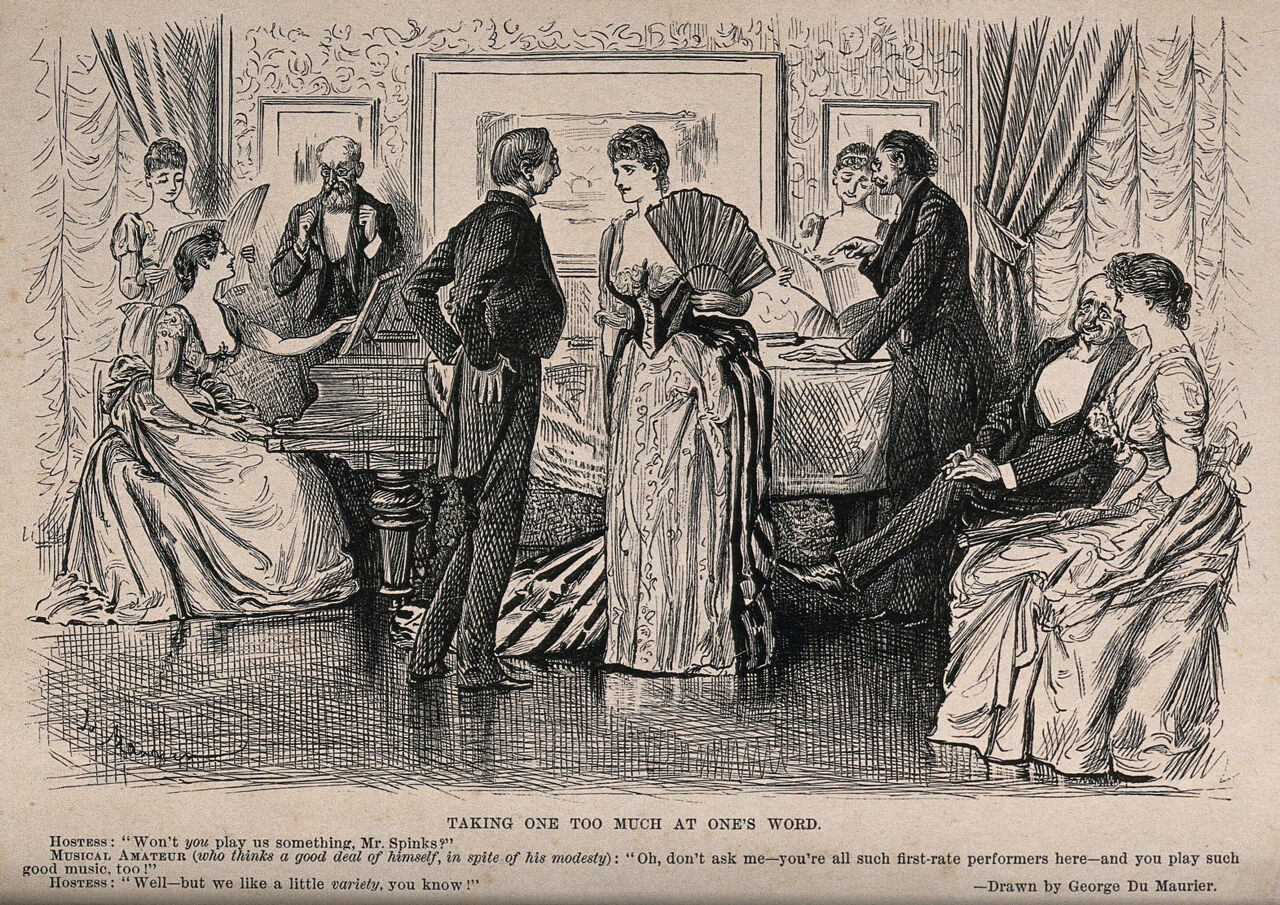
• Illustration — "Now then, Mossoo, your Form is of the Manliest Beauty, and you are altogether a most attractive Object; but you've stood there long enough. So jump in and have done with it!" Cartoon by du Maurier from Punch Du Maurier became a member of staff at the British satirical magazine Punch in 1865, drawing two cartoons a week. His commonest targets were the affected manners of Victorian society, the bourgeoisie and members of Britain's growing middle class in particular. His most enduring cartoon, True Humility (1895), popularised the expressions "good in parts" and "a curate's egg". In it, a bishop addresses a humble curate, whom he has invited to breakfast: "I'm afraid you've got a bad egg, Mr. Jones." The curate replies, "Oh no, my Lord, I assure you – parts of it are excellent!" The gag was not original to du Maurier, however, as it had appeared in a similar cartoon a few months earlier in Judy, a less widely read competitor to Punch. In an earlier (1884) cartoon, du Maurier coined the expression "bedside manner", with which he satirised medical care. Another of his notable cartoons depicted a fanciful videophone conversation in 1879, using a device he called "Edison's telephonoscope". While producing black-and-white drawings for Punch, du Maurier created illustrations for several other popular periodicals: Harper's, The Graphic, The Illustrated Times, The Cornhill Magazine, and the religious periodical Good Words. Furthermore, he did illustrations for the 1862-63 serialisation of Charles Warren Adams's The Notting Hill Mystery, which is often seen as the first detective story of novel length to have appeared in English. Among several other novels he illustrated was Misunderstood by Florence Montgomery in 1873.
Personal life
Personal life
Du Maurier met Emma Wightwick in 1853 and married her a decade later, on 3 January 1863, at St Marylebone, Westminster. Moving frequently over the course of their marriage, the couple first settled in Hampstead in 1869, initially at Gang Moor near the Whitestone Pond for three years, before moving to 27 Church Row and later at New Grove House in Hampstead Grove in 1881. In 1891, the family is recorded as residing at 2 Porchester Rd in Paddington. They had five children: Beatrix (known as Trixy), Guy, Sylvia, Marie Louise (known as May) and Gerald. • Illustration — New Grove House, George du Maurier's house in Hampstead Grove
Life and work
Life and work
George du Maurier was born on 6 March 1834 in Paris. Maurier held the nationality of France and United Kingdom of Great Britain and Ireland. Married to: Emma Wightwick. Recorded father: Louis-Mathurin Busson du Maurier. Recorded mother: Ellen Clarke. Recorded child: Gerald du Maurier, Guy du Maurier, Sylvia Llewelyn Davies and Beatrix du Maurier. Maurier died on 8 October 1896 in London. Maurier is buried at St John-at-Hampstead.
Writing
Writing
Maurier wrote as well as composed, and is recorded as writer and novelist. 5 books and published texts survive in the institutional catalogues, spanning 1862 to 1898. They are The Notting Hill Mystery (1862), Washington Square (1880), Peter Ibbetson (1891), Trilby (1894) and The Martian (1898).
Places
Named by the record
Places
Only places the record itself states, plotted where the house gazetteer settles their coordinates. Nothing is inferred from a name or a nationality.
Paris.
Birth place
London.
Death place
Writer
Writer
• Illustration — George du Maurier in the middle of his career His deteriorating eyesight caused du Maurier to reduce his involvement with Punch in 1891 and settle in Hampstead, where he wrote three novels. His first, Peter Ibbetson (1891), was a modest success at the time, and later adapted as a 1917 play, a 1931 opera, and a 1935 film. His second novel, Trilby, published in 1894, fitted into the gothic horror genre that was undergoing a revival. Hugely popular, it tells of a poor artist's model, Trilby O'Ferrall, transformed into a diva under the spell of an evil musical genius, Svengali. Soap, songs, dances, toothpaste, and even the city of Trilby, Florida, were named after her, as was the variety of soft felt hat with an indented crown worn in the London stage dramatisation of the novel. The plot inspired Gaston Leroux's 1910 novel Phantom of the Opera and innumerable works derived from it. Du Maurier eventually came to dislike the persistent attention the novel was given. The third novel was a long, largely autobiographical work entitled The Martian, published posthumously in 1898.
Books and published writings, as catalogued
Catalogued output
Books and published writings, as catalogued
These are texts written by the subject, distinct both from writings about the subject and from printed editions of other people's work. The 1890s are the densest part of the run, with 3 titles, and that concentration is a fact about what the registers have catalogued rather than a judgement on the work itself.
5 texts carry dates between 1862 and 1898
The run opens with The Notting Hill Mystery and closes with The Martian
The Notting Hill Mystery
1862
Washington Square
1880
Peter Ibbetson
1891
Trilby
1894
The Martian
1898
Writings and published texts
Catalogued output
Writings and published texts
These are catalogued publications carrying the name — editions and printings, distinct from the works they contain and from writing about the subject. The 2010s are the densest part of the run, with 13 titles, and that concentration is a fact about what the registers have catalogued rather than a judgement on the work itself. A selection is set out below and the complete run may be opened beneath it.
Peter Ibbetson, with an introduction by his cousin Lady *****("Madge Plunket") ed. And illustrated by George Du Maurier
1891
Novels of George Du Maurier
1947
39 editions carry dates between 1865 and 2022
The run opens with The Cornhill gallery and closes with Trilbyana, the Rise and Progress of a Popular Novel
The entries follow Open Library
The Cornhill gallery
1865
The Frozen Deep
1866
Songs of many seasons
1876
Ballads; and The rose and the ring
1879
The History of Henry Esmond, Esq.: A Colonel in the Service of Her Majesty
1879
English society at home
1881
Hand of Ethelberta
1882
Pictures of English society
1884
15 of series)
1884
The complete catalogue · 40
39 editions carry dates between 1865 and 2022
The run opens with The Cornhill gallery and closes with Trilbyana, the Rise and Progress of a Popular Novel
The entries follow Open Library
The Cornhill gallery
1865
The Frozen Deep
1866
Songs of many seasons
1876
Ballads; and The rose and the ring
1879
The History of Henry Esmond, Esq.: A Colonel in the Service of Her Majesty
1879
English society at home
1881
Hand of Ethelberta
1882
Pictures of English society
1884
15 of series)
1884
Trilly
1884
Society pictures
1888
Peter Ibbetson, with an introduction by his cousin Lady *****("Madge Plunket") ed. And illustrated by George Du Maurier
1891
Wives and Daughters
1893
Trilby [1/3]
1894
English society
1897
A legend of Camelot
1898
Punch in society
1910
Novels of George Du Maurier
1947
The young George du Maurier
1951
Svengali
1982
George Du Maurier 1834-1896
1986
History of Henry Esmond, Esq
2011
Complete Works, Volume 3
2015
Complete Works, Volume 5
2015
Complete Works, Volume 7
2015
Martian
2015
Martian a Novel
2015
Social Pictorial Satire
2015
George du Maurier - Trilby
2016
Stories by Famous Authors Illustrated #12: la Svengali
2017
A NOVEL. By: George du Maurier
Illustration by
2017
Martian; a Novel. By: George du Maurier
2017
Trilby; Volume 1
2018
A Rose in June
2019
Washington Square (novel) Illustrated
2021
Trilbyana, the Rise and Progress of a Popular Novel
2022
Film adaptations
Film adaptations
• Trilby (1914), starring Herbert Beerbohm Tree and Viva Birkett • Trilby (1915), starring Wilton Lackaye and Clara Kimball Young • Forever (1921), starring Wallace Reid and Elsie Ferguson • Trilby (1923), starring Arthur Edmund Carewe and Andrée Lafayette • Svengali (1927), starring Paul Wegener and Anita Dorris • Svengali (1931), starring John Barrymore and Marian Marsh • Peter Ibbetson (1935), starring Gary Cooper and Ann Harding • The Guilt of Janet Ames (1947), starring Melvyn Douglas and Rosalind Russell • Svengali (1954), starring Donald Wolfit and Hildegard Knef • Svengali (1983), starring Peter O'Toole and Jodie Foster
Paintings, drawings and prints, 1861–1880
Catalogued output
Paintings, drawings and prints, 1861–1880
These are objects catalogued as visual works, each held or recorded by the institution named against it. 14 works carry dates between 1861 and 1880. The 1860s are the densest part of the run, with 9 titles, and that concentration is a fact about what the registers have catalogued rather than a judgement on the work itself. They belong to a run of 18 titles in all, from 1861 to 1880.
The run opens with The Admiral's Daughters and closes with Distinguished Amateurs no
The Art Critic
The Admiral's Daughters
1861
"Only"
1862
Santa; or, A Woman's Tragedy
1862
A Fellow-Traveller's Story
1862
Out of the Body
1863
Eleanor's Victory
1863
Detur Digniori
1864
Philip Fraser's Fate
1864
"--And mist or glim, I'd sail with him, if he would sail with me--"
1865
Women and their Garments Artistically Described
1874
Paintings, drawings and prints without a settled date
Catalogued output
Paintings, drawings and prints without a settled date
4 further works are catalogued under Maurier's name without a date the collections agree on, which is why they are set apart from the dated run rather than placed in it. "The Woman That Was".
Two Children in the Snow
The Roof of Your Mouth
Brilliant Sky, Infinite Sky: I
Death and legacy
• Illustration — George du Maurier's grave at St John's at Hampstead churchyard. Also interred in the same grave are Emma, his wife and Gerald du Maurier, his son. Du Maurier died on 8 October 1896 and was buried in St John-at-Hampstead churchyard in Hampstead. The success of his writings and illustrations allowed du Maurier to leave a then staggering amount of £47,555 in his will. Du Maurier was a close friend of Henry James, the novelist; their relationship was fictionalised in David Lodge's Author, Author (2004). • Illustration — "A Legend of Camelot" Illustration by du Maurier for Punch, 17 March 1866, parodying Pre-Raphaelitism
Further digitised and archival material
Primary material
Further digitised and archival material
A further 28 rows were returned by the same open archives and are not shown here, because the only tie between them and this person was lexical: the name appeared in a title, a description or a series heading without the register stating any relation to Maurier. They are kept in the evidence layer and return the moment a relation is demonstrated. The register's own description is kept rather than reclassified, so a reader can see what each institution says it holds.
George Du Maurier, Artist and Author
1896
George Du Maurier, the satirist of the Victorians; a review of his art and personality
1913
George Du Maurier, the Satirist of the Victorians. Hand of Ethelberta
A comedy in chapters. With eleven illustrations by George du Maurier, Etc
2011
English society, sketched by George Du Maurier
1897
The Travellers' Library Peter Ibbetson
1931
The Notting Hill mystery: [the first detective novel]
2012
1862 The Notting Hill Mystery By Charles Felix Once A Week Parts 1-8
1862
Illustrated by the Author
1963
Lyric drama in three acts (nine scenes) from the novel by George du Maurier
1930
("Madge Plunket")
1891
Illustrated by George du Maurier
1881
Novels Of George Du Maurier With The Original Thustrations
1947
The young George Du Maurier; a selection of his letters, 1860-67
1952
Documents and archives
Primary material
Documents and archives
reference work
- “George du Maurier”, English Wikipedia, consulted as further reading
Reputable secondary · Wikipedia
authority record
- Wikidata, structured authority record Q949700: George du Maurier
General reference · Wikidata
Literature
Further cited scholarship
31 scholarly and reference publications are cited here, each one identified by title and by the publication, publisher or institution that carried it, with its year where the register states one. The cited literature runs from 1935 to 2022, which is a measure of how long Maurier has been a subject of scholarship rather than of how much has been written. The publications represented include Victorian Material Culture, Im Angesicht, George Du Maurier: Illustrator, Author, Critic, Cahiers victoriens et édouardiens, Victorians Institute Journal and The Life and Letters of Sir John Everett Millais. Peter Ibbetson and Du Maurier’s ‘French Voice’, George Du Maurier: Illustrator, Author, Critic, 2017. ‘My Pretty Woman’: The Presentation of Women in George Du Maurier’s Cartoons and Novels, George Du Maurier: Illustrator, Author, Critic, 2017. Du Maurier’s Paris: Peter Ibbetson, Haussmann and Industrial Memory, George Du Maurier: Illustrator, Author, Critic, 2017. ‘The Fountain of One’s Own Originality’: Du Maurier’s Theories of Illustration and How he Applied Them to His Work, George Du Maurier: Illustrator, Author, Critic, 2017. Ways of keeping love alive: Roland Barthes, George du Maurier, and Gilles Deleuze, Sign Systems Studies, 2008.
George du Maurier, ‘The Illustrating of Books’, Victorian Material Culture, 2022
George du Maurier, ‘The Six-Mark Tea-Pot’, Victorian Material Culture, 2022
Im Blick der Anderen: George du Maurier, Trilby (1894), Im Angesicht, 2022
George Du Maurier as a Draughtsman and Illustrator, George Du Maurier: Illustrator, Author, Critic, 2017
George Du Maurier as a Social Commentator, George Du Maurier: Illustrator, Author, Critic, 2017. ‘Splendacious’ Effects: George Du Maurier and Early Sensation Fiction, George Du Maurier: Illustrator, Author, Critic, 2017
Trilby’s ‘Kitchen’: the Displaced Domestic Spaces of George Du Maurier and Henry James, George Du Maurier: Illustrator, Author, Critic, 2017
Du Maurier and the ‘Oriental Israelite Hebrew Jew[s]’, George Du Maurier: Illustrator, Author, Critic, 2017
Illustrator, Author, Critic, 2017
George Du Maurier’s Illustrations for Thomas Hardy’s ‘The Hand of Ethelberta’ and ‘A Laodicean’, George Du Maurier: Illustrator, Author, Critic, 2017
Simon Cooke and Paul Goldman, eds, George Du Maurier: Illustrator, Author, Critic
Illustrator, Author, Critic Beyond Svengali, Victorians Institute Journal, 2015
GEORGE DU MAURIER, The Life and Letters of Sir John Everett Millais, 2012
To George Du Maurier (24 October 1880), The Collected Letters of Thomas Hardy, 2012
George Du Maurier, Oxford Bibliographies in Victorian Literature, 2011
Weibliche Stimmeffekte bei George Du Maurier, George Bernard Shaw und Isak Dinesen, Bild und Stimme, 2011
George Du Maurier (1834–1896), The Case of the Poisonous Socks: Tales from Chemistry, 2011
Whiteness in Charles Dana Gibson and George Du Maurier, Art History, 2011
Henry James, James Russell Lowell, and George Du Maurier in Whitby, Notes and Queries, 2009
Heroes, Hero-Worshippers and Jews: Music Masters, Slaves and Servants in Thomas Carlyle, Richard Wagner, George Eliot and George Du Maurier, Mastery and Slavery in Victorian Writing, 2003
The art of George du Maurier, Choice Reviews Online, 1996
To George Du Maurier (21 February 1880), The Collected Letters of Thomas Hardy, 1977
To George Du Maurier (22 June 1880), The Collected Letters of Thomas Hardy, 1977
George du Maurier and 'Trilby', The Musical Times, 1940
George du Maurier and Maryanne Clarke, Notes and Queries, 1935
Bulwer-Lytton, Marie Corelli et George du Maurier: Patrizia D’andrea, ‘Curious about France’: Visions littéraires victoriennes
Authority records
References
Citations
References
Each reference names the institution holding it, so a reader may go to the document itself.
reference work
Secondary witnessauthority record
General reference
People, houses and institutions
Knowledge graph
People, houses and institutions
Teachers, collaborators, publishers and institutions recorded against this person, each on a stated basis.
Born at
1- ParisPlace
Established from a fact already recorded on a verified source.
The Encyclopedia exists whether or not anything is for sale. Corrections are recorded rather than overwritten, and every version of this record is kept. Published 16 August 2026.
Elsewhere in Illustration
5,224 published records in this field, each with its sources named.
- George CattermoleIllustrator
- George Charles HaitéIllustrator
- George CruikshankIllustrator
- George Denholm ArmourIllustrator
- George Dunlop LeslieIllustrator
- George DunningIllustrator
- George FordIllustrator
- George Frederick BensellIllustrator
Best supported in this field
For owners
Own a work by George du Maurier?
A specialist will read what you send and tell you what the house can establish, what it cannot, and whether the object is suited to sale. There is no charge and no obligation. The object stays with you throughout; nothing is shipped to us unless it is arranged in writing beforehand.