
George Cruikshank
George Cruikshank or Cruickshank (27 September 1792 – 1 February 1878) was a British caricaturist and book illustrator, praised as the "modern Hogarth" during his life. His book illustrations for his friend Charles Dickens, and many other authors, reached an international audience.
Also recorded as George Cruickshank · George, I Cruikshank · George, I Cruickshank · Cruickshank
George Cruikshank
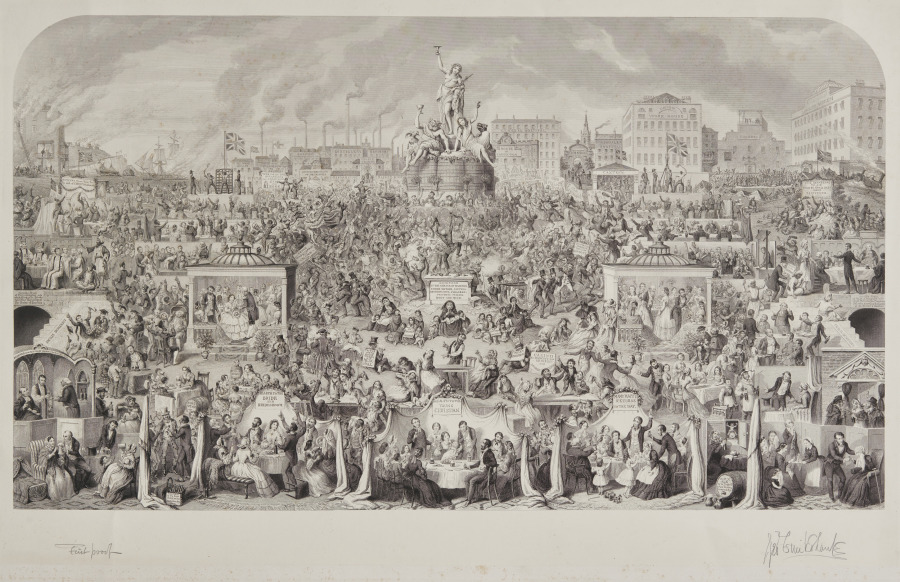
George Cruikshank · The Cleveland Museum of Art · Gift of Mrs. Coburn Haskell · CC0
- Name
- George Cruikshank
- Born
- 27 September 1792
- Birthplace
- London, England
- Died
- 1 February 1878
- Known for
- Cartoonist (caricaturist), children's literature
- Nationality
- United Kingdom
- Occupation
- caricaturist · artist · illustrator · photographer · painter · draftsperson
VALÉORINE Encyclopedia
VALÉORINE documentary reading
Documentary summary
George Cruikshank or Cruickshank (27 September 1792 – 1 February 1878) was a British caricaturist and book illustrator, praised as the "modern Hogarth" during his life. His book illustrations for his friend Charles Dickens, and many other authors, reached an international audience.
Admitted source layer · organised and presented by VALÉORINE
Reference Check
Propose documentary evidence for George Cruikshank. A contribution is never written directly as fact: identity, source, rights and evidence gates still decide.
Sign in to contribute
Documentary evidence
Documentary basis
Authority files
wikidata · Q360466 · wikipedia · George Cruikshank
In this article
Key facts
Key facts
• Name — George Cruikshank • Born — 27 September 1792 • Birthplace — London, England • Died — 1 February 1878 • Place of death — London, England • Known for — Cartoonist (caricaturist), children's literature • Partner — Adelaide Attree • Children — 11 • Parents — Isaac Cruikshank Mary MacNaughton • Relatives — Isaac Robert Cruikshank (brother)
Early life
Early life
Cruikshank was born in London. His father, Edinburgh-born Isaac Cruikshank, was one of the leading caricaturists of the late 1790s and Cruikshank started his career as his father's apprentice and assistant. His older brother, Isaac Robert, also followed in the family business as a caricaturist and illustrator. Cruikshank's early work was caricature; but in 1823, at the age of 31, he started to focus on book illustration. He illustrated the first, 1823 English translation (by Edgar Taylor and David Jardine) of Grimms' Fairy Tales, published in two volumes as German Popular Stories. On 16 October 1827, he married Mary Ann Walker (1807–1849). Two years after her death, on 7 March 1851, he married Eliza Widdison. The two lived at 263 Hampstead Road, north London. Cruikshank had fathered 11 illegitimate children with a mistress named Adelaide Attree, his former servant, who lived close to where he lived with his wife. Adelaide was ostensibly married and had taken the married surname 'Archibold'.
Charles Dickens
Charles Dickens
• Illustration — 1838 poster advertisement for Memoirs of Grimaldi For Charles Dickens, Cruikshank illustrated Sketches by Boz (1836), The Mudfog Papers (1837–38) and Oliver Twist (1838). He also illustrated Memoirs of Joseph Grimaldi (1838), which Dickens edited under his regular nom de plume, "Boz". Cruikshank even acted in Dickens's amateur theatrical company. On 30 December 1871, Cruikshank published a letter in The Times which claimed credit for much of the plot of Oliver Twist. The letter launched a fierce controversy around who created the work. Cruikshank was not the first Dickens illustrator to make such a claim. Robert Seymour who illustrated the Pickwick Papers suggested that the idea for that novel was originally his; however, in his preface to the 1867 edition, Dickens strenuously denied any specific input. The friendship between Cruikshank and Dickens soured further when Cruikshank became a fanatical teetotaler in opposition to Dickens's views of moderation. In Somerset Maugham's short story "Miss King", Cruickshank's influence is referenced: She wore a large white cotton nightcap (on entering Ashenden has noticed the brown wig on a stand on the dressing-table) tied under the chin and a white voluminous nightdress that came high up in the neck. Nightcap and nightdress belonged to a past age and reminded you of Cruickshank's illustrations to the novels of Charles Dickens.
Temperance and the Volunteers
Temperance and the Volunteers
In the late 1840s, Cruikshank's focus shifted from book illustration to an emphasis on alcohol temperance and anti-smoking. Formerly a heavy drinker, he now supported, lectured to, and supplied illustrations for the National Temperance Society and the Total Abstinence Society, among others. The best known of these are The Bottle, 8 plates (1847), with its sequel, The Drunkard's Children, 8 plates (1848), with the ambitious work, The Worship of Bacchus, published by subscription after the artist's oil painting, now in the Tate Gallery, London. For his efforts, he was made vice president of the National Temperance League in 1856. When the invasion scare of 1859 led to the creation of the Volunteer Movement, Cruikshank was one of those who organised Rifle Volunteer Corps (RVCs). At first his unit was the 24th Surrey RVC, which recruited from working men who were total abstainers and was named 'Havelock's Own' in honour of Major-General Sir Henry Havelock, a hero of the Indian Mutiny and pioneer of Temperance Clubs in the army. However, Cruikshank received little encouragement from the Lord-Lieutenant of Surrey, and was rebuked for crossing into Kent to recruit. Disgusted, he disbanded his unit in 1862 and began anew in Middlesex, organising the 48th Middlesex RVC (Havelock's Temperance Volunteers). The unit ran into financial difficulties and when Cruikshank was forced to retire due to age, he was replaced as commanding officer by Lt-Col Cuthbert Vickers, a wealthy shipowner. However, the Bath Chronicle and Weekly Gazette of 3 September 1868 reported that Cruikshank had resigned as Lieutenant-Colonel of the Volunteers "in consequence, it is said, of the reinstatement in the service of certain officers of his corps who some time since had a difference with their Lieutenant-Colonel and were cashiered". The 48th Middlesex merged with the 2nd City of London RVC, also a working-men's unit, composed mainly of printers from the Fleet Street area, and the combined unit had a long history as the City of London Rifles.
Later years
Later years
• Illustration — Cruikshank c. 1859–1870 • Illustration — Memorial to George Cruikshank in Kensal Green Cemetery After he developed palsy in later life, Cruikshank's health and work began to decline in quality. He died on 1 February 1878 and was originally buried in Kensal Green Cemetery. In November 1878 his remains were exhumed and reburied in St. Paul's Cathedral. Punch magazine, which presumably did not know of his large illegitimate family, said in its obituary: "There never was a purer, simpler, more straightforward or altogether more blameless man. His nature had something childlike in its transparency." In his lifetime he created nearly 10,000 prints, illustrations, and plates. There are collections of his works in the British Museum and the Victoria and Albert Museum. A Royal Society of Arts blue plaque commemorates Cruikshank at 293 Hampstead Road in Camden Town.
Samples of his work
Samples of his work
The Life and Opinions of Tristram Shandy, Gentleman • Illustration — Plate I • Illustration — Plate II • Illustration — Plate III • Illustration — Plate IV • Illustration — Plate V • Illustration — Plate VI • Illustration — Plate VII • Illustration — Plate VIII Others • Illustration — The Corsican Shuttlecock, 1814 • Illustration — The Allied Bakers, 1814 • Illustration — Twelfth Night, 1815. This depicts the Congress of Vienna redrawing the boundaries of Europe following the Napoleonic Wars. • Illustration — Two Green Bags, 1820. A satire on the Trial of Queen Caroline • Illustration — Jacco Macacco at the Westminster-Pit 1821 • Illustration — An unflattering 1819 caricature of the Prince Regent illustrating "The Political House that Jack Built" by William Hone • Illustration — A Splendid Spread, early satire on the crinoline from The Comic Almanack for 1850 • Illustration — George Cruikshank, Self-Portrait • Illustration — Engraving of George Cruikshank • Illustration — Humming-birds—or—a Dandy Trio. 1819. • Illustration — Royal Embarkation, 1819 • Illustration — Monstrosities of 1818, extravagant clothing styles of men's and women's fashions • Illustration — A group of servants gathered in a kitchen, ape the manners of their employers • Illustration — Caricature of the Old Bailey • Illustration — Caricature concerning the prices at the Covent Garden Theatre • Illustration — 1813 caricature showing the Americans as cowardly in face of the British • Illustration — Snuffing out Boney, 1814 • Illustration — December – A Swallow at Christmas (Rara avis in terris) • Illustration — The Assembly of the Gifted
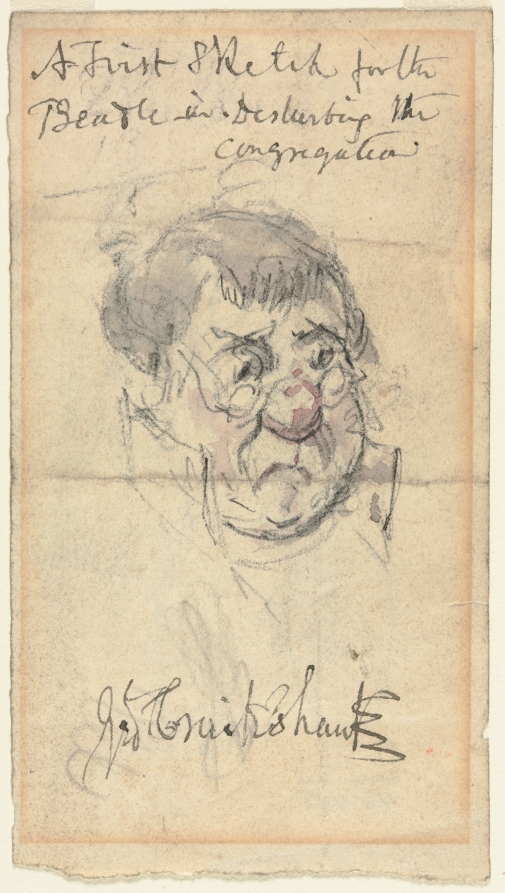
The Beadle, c. 1805–78, by George Cruikshank
George Cruikshank · The Cleveland Museum of Art · Gift of Gertrude Haskell Britton, Katherine Haskell Perkins, Mary Haskell Hunter and Melville Hanna Haskell in memory of Mrs. Coburn Haskell
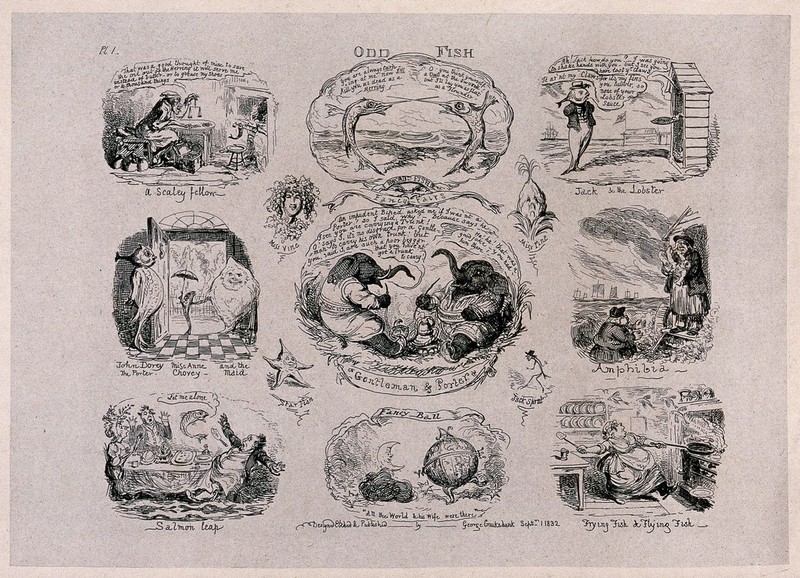
Fish in human situations. Etching by George Cruikshank, 1832., Sept. 1 1832, by George Cruikshank
George Cruikshank · Wellcome Collection, London · Wellcome Collection
Life and career
Dated record
Life and career
The full dated record · 2 entries
1792
George Cruikshank born at London.
1878
George Cruikshank died at London.
Sociopolitical caricatures and illustrations
• Illustration — Satirical Sketches, National Gallery of Art Cruikshank's early career was renowned for his social caricatures of English life for popular publications. He achieved early success collaborating with William Hone in his political satire The Political House That Jack Built (1819). In the same year he produced the now-infamous anti-abolitionist piece The New Union Club. It satirised a dinner party organised by abolitionists with black guests. While this piece was praised as "the finest of G.C.'s caricatures" during the 19th century, it is now viewed as one of the most racist prints of its era. His 1819 print, The Belle Alliance, or the Female Reformers of Blackburn!!!, criticised the role of women in the reform movement, portraying them as unfeminine and grotesque. • Illustration — The New Union Club dinner with black guests His first major work was Pierce Egan's Life in London (1821) in which the characters Tom and Jerry, two 'men about town' visit various London locations and taverns to enjoy themselves and carouse. This was followed by The Comic Almanack (1835–1853) and Omnibus (1842). Cruikshank gained notoriety with his political prints that attacked the royal family and leading politicians. In 1820 he received a royal bribe of £100 for a pledge "not to caricature His Majesty" (George IV) "in any immoral situation". His work included a personification of England named John Bull who was developed from about 1790 in conjunction with other British satirical artists such as James Gillray, and Thomas Rowlandson. • Illustration — Old Bumblehead the 18th trying on Napoleon Boots 1823 Cruikshank replaced one of his major influences, James Gillray, as England's most popular satirist. For a generation he delineated Tories, Whigs and Radicals impartially. Satirical material came to him from every public event – wars abroad, the enemies of Britain (he was highly patriotic), the frolic, among other qualities, such as the weird and terrible, in which he excelled. His hostility to enemies of Britain and a crude racism is evident in his illustrations commissioned to accompany William Maxwell's History of the Irish rebellion in 1798 (1845) where his lurid depictions of incidents in the rebellion were characterised by the simian-like portrayal of Irish rebels. Among the other racially engaged works of Cruikshank there were caricatures about the "legal barbarities" of the Chinese, the subject given by his friend, Dr. W. Gourley, a participant in the ideological battle around the Arrow War, 1856–60. • Illustration — Fagin in his cell. Etching, 1838
Literature
Literature
Cruikshank, George, Benezit Dictionary of Artists, 2011
Cruikshank, George, Oxford Art Online, 2003
George Cruikshank Papers, 2015
Cruikshank, George (1792–1878), Oxford Dictionary of National Biography, 2018
Cruikshank, George, Lexikon des gesamten Buchwesens Online
Notes from the source article
Cited by Wikipedia
Notes from the source article
These works are cited by the source article, in its own numbering. They are recorded as its citations, not as sources VALÉORINE has verified.
- 1.Niamh Chapelle, 2001, p. 72.
- 2.John Wardroper. The secret life of a virtuous artist: John Wardroper turned sleuth to find the startling truth about George Cruikshank, illustrator and friend of Dickens, and a man revered as a stern moralist. The Independent. 25 October 1992.
- 3.The caricature was devised in collaboration with Frederick Marryat (*Captain Marryat). See Temi Odumosu's article in The Slave in European Art: From Renaissance Trophy to Abolitionist Emblem, ed Elizabeth McGrath and Jean Michel Massing, London (The Warburg Institute) and Turin 2012.
- 4.Sotheby, Wilkinson & Hodge. Catalogue of the Collection of the Works of George Cruikshank, the Property of H.W. Bruton (of Gloucester). 1897.
- 5.Lindfors, Bernth. Early African Entertainments Abroad: From the Hottentot Venus to Africa's First Olympians. The University of Wisconsin Press. 44. 2014. 9780299301644.
- 6.The New Union Club, Being a Representation of what took place at a celebrated Dinner, given by a celebrated society Royal Museums Greenwich. www.rmg.co.uk.
- 7.Kitchener, Caitlin. Sisters of the Earth: The Landscapes, Radical Identities and Performances of Female Reformers in 1819. Journal for Eighteenth-Century Studies. 45. 1. 77–93. 2022. 1754-0208.
- 8.Gatrell, Vic. City of Laughter: Sex and Satire in Eighteenth-Century London. New York: Walker & Co., 2006
- 9.Beveridge, Allan. Psychiatry in pictures. The British Journal of Psychiatry. 188. 1. A2. 2006. 0007-1250.
- 10.Ian F.W. Beckett, Riflemen Form: A study of the Rifle Volunteer Movement 1859–1908, Aldershot: Ogilby Trusts, 1982, , pp. 24–5, 45–6, 61 95 and Appendix VII.
- 11.Ray Westlake, Tracing the Rifle Volunteers, Barnsley: Pen and Sword, 2010, , p. 179.
- 12.Capt E.G. Godfrey, The "Cast Iron Sixth": A History of the Sixth Battalion London Regiment (The City of London Rifles), London: Old Comrades' Association, 1935//Uckfield: Naval & Military Press, 2002, , pp. 1–3.
- 13.Falling off the Wagon at Fusiliers Museum.
- 14.Cuthbert Vickers probate, London Gazette 3 October 1922.
- 15."Memorials of St Paul's Cathedral" Sinclair, W. p. 468: London; Chapman & Hall, Ltd; 1909.
- 16.Victorianweb.org. Cruikshank's Grave Site on The Victorian Web. 2006-10-20.
- 17.English Heritage. CRUIKSHANK, GEORGE (1792-1878).
Bibliography printed in the source article · 8
- Evans, Hilary and Mary. The Man Who Drew the Drunkard's Daughter: Life and Art of George Cruikshank, 1792-1878. (London: Frederick Muller, 1978).
- Cruikshank, George. Graphic Works of George Cruikshank (New York: Dover Publications, 1980)
- George, Mary Dorothy. Catalogue of Political and Personal Satires Preserved in the Department of Prints and Drawings in the British Museum, vol. VI (1938), vol. VII (1942), vol. VIII (1947), vol. IX (1949).
- Bryant and Heneage. Dictionary of British Cartoonists and caricaturists 1730–1980 (Scolar Press, 1994).
- Buchanan-Brown, John. The Book Illustrations of George Cruikshank Charles Tuttle 1980
- Cohn, Albert M. "George Cruikshank: A Catalogue Raisonne of the Work Executed During the Years 1896–1977", Bookmans journal (London, 1924).
- Bates, William. George Cruikshank: The Artist, the Humourist, and the Man, with Some Account of his Brother Robert. A Critico-bibliographical Essay (Amsterdam: Emmering, 1972)
- Price, Chris. "'Pictorially Speaking, so Ludicrous': George IV on the Dance Floor", Music in Art: International Journal for Music Iconography XLIII/1-2 (2018), 49–65.
References
Citations
References
Each reference names the institution holding it, so a reader may go to the document itself.
reference work
Secondary witnessreference work
Secondary witness
The Encyclopedia exists whether or not anything is for sale. Corrections are recorded rather than overwritten, and every version of this record is kept. Published 14 August 2026.
Elsewhere in Illustration
5,224 published records in this field, each with its sources named.
- George Bouverie GoddardIllustrator
- George ButterworthIllustrator
- George CattermoleIllustrator
- George Charles HaitéIllustrator
- George Denholm ArmourIllustrator
- George du MaurierIllustrator
- George Dunlop LeslieIllustrator
- George DunningIllustrator
Best supported in this field
For owners
Own a work by George Cruikshank?
A specialist will read what you send and tell you what the house can establish, what it cannot, and whether the object is suited to sale. There is no charge and no obligation. The object stays with you throughout; nothing is shipped to us unless it is arranged in writing beforehand.