
Francesco Primaticcio
Illustration — 1648 woodcut portrait of Francesco Primaticcio • Illustration — Odysseus and Penelope, 1563 Francesco Primaticcio (franˈtʃesko primaˈtittʃo; April 30, 1504 – 1570) was an Italian Mannerist painter, architect and sculptor who spent most of his career in France.
Also recorded as Francesco Primatticio · Bologna Primaticcio · Francesco Primadizzi · Francesco Primaticci
Francesco Primaticcio
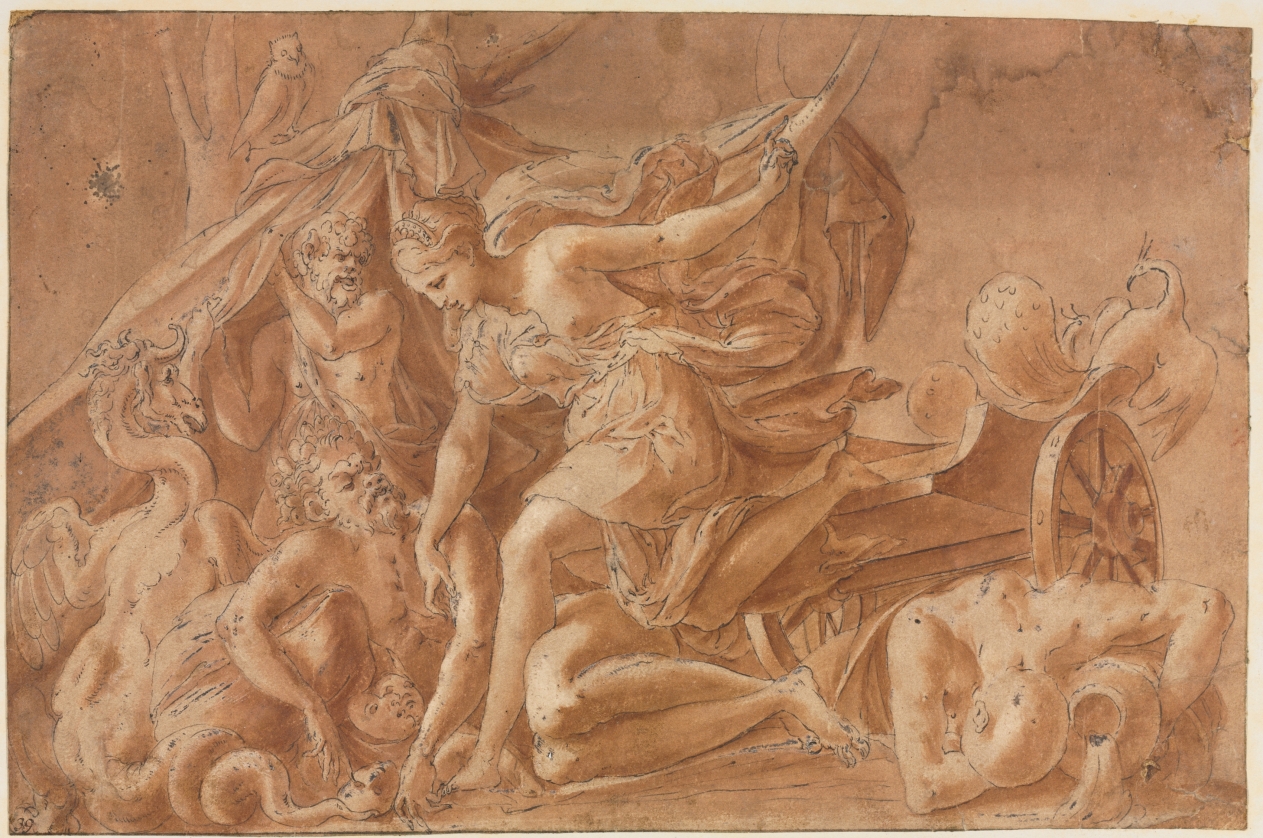
Francesco Primaticcio · The Cleveland Museum of Art · Dudley P. Allen Fund · CC0
- Born
- 1504. · Bologna.
- Died
- 1570. · Paris.
- Nationality
- France.
- Occupation
- painter, architect, decorator, sculptor, plasterer and artist.
- Movements
- School of Fontainebleau, Mantuan School and Mannerism.
- Teachers
- Giulio Romano and Innocenzo di Pietro Francucci da Imola.
- Languages
- Italian.
VALÉORINE Encyclopedia
VALÉORINE documentary reading
Documentary summary
Illustration — 1648 woodcut portrait of Francesco Primaticcio • Illustration — Odysseus and Penelope, 1563 Francesco Primaticcio (franˈtʃesko primaˈtittʃo; April 30, 1504 – 1570) was an Italian Mannerist painter, architect and sculptor who spent most of his career in France.
Admitted source layer · organised and presented by VALÉORINE
Note VALÉORINE
No house-authored Note is published until its assertions and sources pass the VALÉORINE evidence contract. The documentary article remains available in full while that enrichment is being consolidated.
Documentary enrichment in progress · no unsupported statement published
Reference Check
Propose documentary evidence for Francesco Primaticcio. A contribution is never written directly as fact: identity, source, rights and evidence gates still decide.
Sign in to contribute
World of VALÉORINE
Documentary connections
Only confirmed graph relationships appear here. Images are shown only when their identity and reuse rights both pass the documentary gate.
Born In · outgoing
Bologna
Place
Citizen Of · outgoing
France
Place

Died In · outgoing
Paris
Place
Wikimedia Commons

Associated With · outgoing
School of Fontainebleau
Movement
http://lapalettedecouleurs.eklablog.com/arte-7-les-petits-secrets-des-grands-tableaux-la-dame-au-bain-1571-fra-a119635836 lapalettedecouleurs.eklablog]
Documentary evidence
Evidence Panel
not yet certified
- Identity
- resolved
- Independent source families
- 0
- Admitted assertions
- 0
- Open conflicts
- 0
Authority files
wikidata · Q333366 · wikipedia · Francesco Primaticcio
In this article
Biography
Biography
Training under Giulio Romano and Innocenzo di Pietro Francucci da Imola is recorded. Ponce Jacquiot and Henri Lerambert are recorded as having studied under Francesco Primaticcio. The recorded working language is Italian. Positions recorded include Surintendant des Bâtiments. Work by Francesco Primaticcio is recorded in the collections of Museum Boijmans Van Beuningen, Städel Museum, Minneapolis Institute of Art, Museo del Prado and J. Paul Getty Museum.
Born in Bologna, he trained under Giulio Romano in Mantua and became a pupil of Innocenzo da Imola, executing decorations at the Palazzo Te before securing a position in the court of Francis I of France in 1532. • Illustration — Holy Family with St Elizabeth and John the Baptist, now in the Hermitage Museum, St Petersburg, Russia. • Illustration — Ulysses and His Companions Fighting the Cicones Before the City of Ismaros, Study for a destroyed fresco in the Galerie d'Ulysee, Chateau de Fontainebleau Together with Rosso Fiorentino he was one of the leading artists to work at the Chateau Fontainebleau (where he is grouped with the so-called "First School of Fontainebleau") spending much of his life there. Following Rosso's death in 1540, Primaticcio took control of the artistic direction at Fontainebleau, furnishing the painters and stuccators of his team, such as Nicolò dell'Abate, with designs. He made cartoons for tapestry-weavers and, like all 16th-century court artists, was called upon to design elaborate ephemeral decorations for masques and fêtes, which survive only in preparatory drawings and, sometimes, engravings. Francis I trusted his eye and sent him back to Italy on buying trips in 1540 and again in 1545. In Rome, part of Primaticcio's commission was to take casts of the best Roman sculptures in the papal collections, some of which were cast in bronze to decorate the parterres at Fontainebleau. Primaticcio retained his position as court painter to Francis' heirs, Henry II and Francis II. His masterpiece, the Salle d'Hercule at Fontainebleau, occupied him and his team from the 1530s to 1559. Primaticcio's crowded Mannerist compositions and his long-legged canon of beauty influenced French art for the rest of the century. Primaticcio turned to architecture towards the end of his life, his greatest work being the Valois Chapel at the Abbey of Saint-Denis, although this was not completed until after his death and was destroyed in 1719.
Gallery
Gallery
• Illustration — Alexander tames Bucephalus • Illustration — The rape of Helena, 1530-1539 • Illustration — Ceiling at Chaalis Abbey • Illustration — Annunciation at Chaalis
Ulysses Gallery at Fontainebleau
Ulysses Gallery at Fontainebleau
Engravings by Giorgio Ghisi after Francesco Primaticcio's designs for the ceiling of the Ulysses Gallery (destroyed 1738–39) at Fontainebleau • Illustration — Apollo, Pan, and a putto blowing a horn • Illustration — Three Muses and a Gesturing Putto • Illustration — Three Muses and a Putto with a Lyre, a cruciform composition • Illustration — Three Muses and a Putto with Cymbals • Illustration — Hercules, Bacchus, Pan, and Saturn(?) • Illustration — Ceres Seated on Clouds with Two Goddesses and Two Putti • Illustration — Pluto, Neptune, Minerva and Apollo • Illustration — Venus and Cupid, Two Other Goddesses, and a Putto
Identity
Identity
Francesco Primaticcio is recorded with the occupation visual artist. Recorded as painter, architect, decorator, sculptor and plasterer.
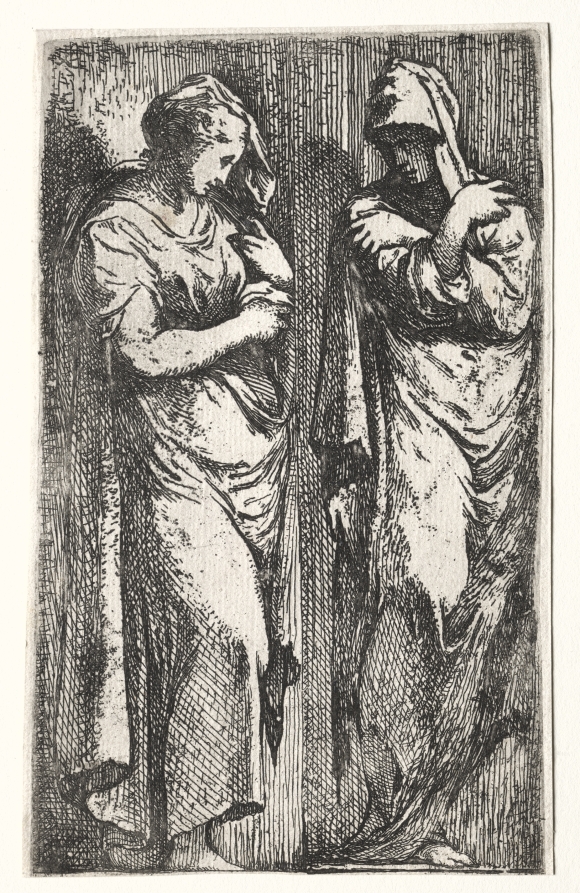
Two Roman Women, c. 1550–60, by Francesco Primaticcio
Francesco Primaticcio · The Cleveland Museum of Art · Dudley P. Allen Fund
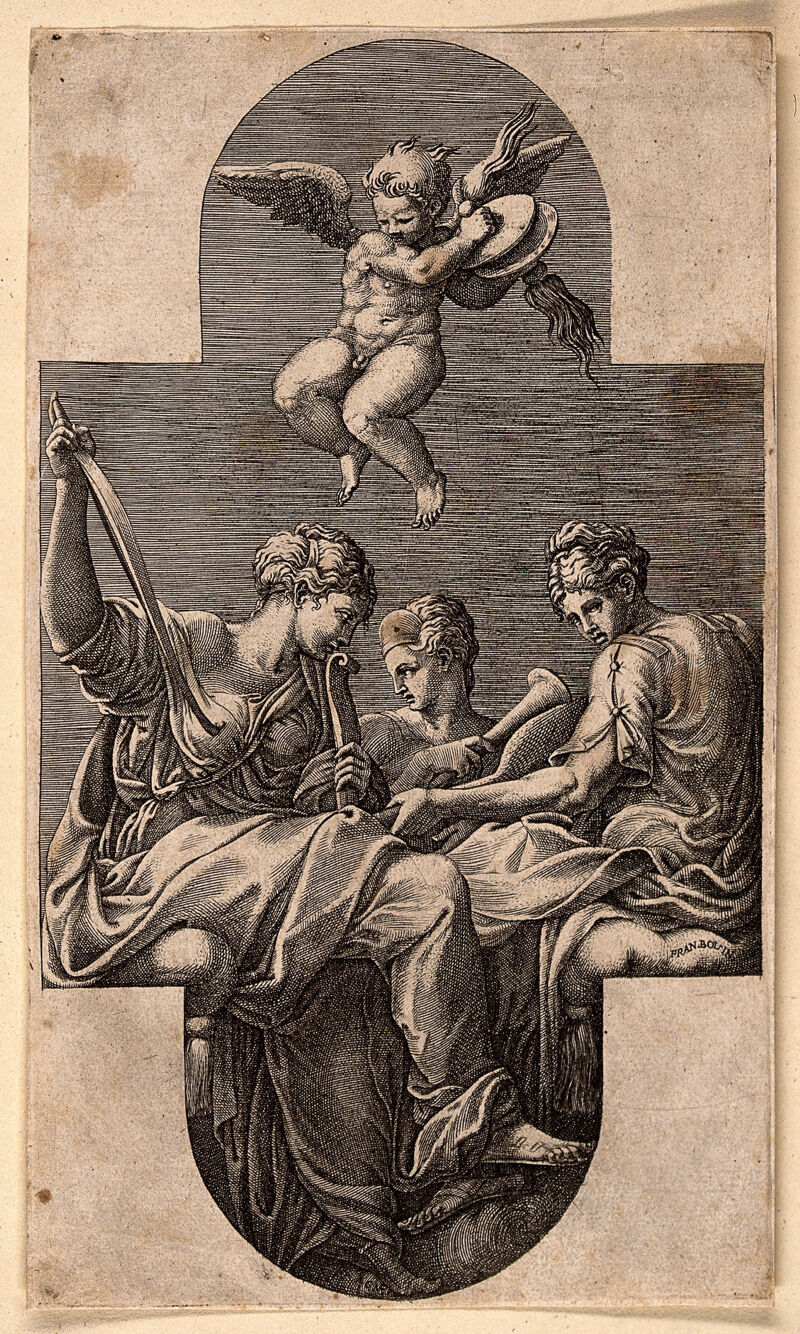
Three muses. Engraving by G. Ghisi after F. Primaticcio., by Francesco Primaticcio
Francesco Primaticcio · Wellcome Collection, London · Wellcome Collection
Life and career
Dated record
Life and career
The full dated record · 2 entries
1504
Francesco Primaticcio was born on 30 April 1504.
1560
Francesco Primaticcio died on 1 January 1560.
Places
Named by the record
Places
Only places the record itself states, plotted where the house gazetteer settles their coordinates. Nothing is inferred from a name or a nationality.
Bologna.
Birth place
Paris.
Death place
Context
Primary material
Context
Francesco Primaticcio is associated with School of Fontainebleau. Associated with Mannerism.
Documents and archives
Primary material
Documents and archives
scholarly publication
- Francesco Primaticcio, architetto Sabine Frommel Flaminia Bardati, Journal of the Society of Architectural Historians, 2006
Scholarly · Crossref registry · 2006
- Primaticcio, Francesco (C. 1504–1570), Historical Dictionary of Renaissance Art, 2016
Scholarly · Crossref registry · 2016
- Primaticcio, Francesco, Benezit Dictionary of Artists, 2011
Scholarly · Crossref registry · 2011
reference work
- Wikidata, structured authority record Q333366: Francesco Primaticcio
Reputable secondary · Wikimedia Foundation
- “Francesco Primaticcio”, English Wikipedia, consulted as further reading
Reputable secondary · Wikipedia
Notes from the source article
Cited by Wikipedia
Notes from the source article
These works are cited by the source article, in its own numbering. They are recorded as its citations, not as sources VALÉORINE has verified.
- 1.Van Thulden. gravures.
- 2.Carmelo Occhipinti, Primaticcio e l'arte di gettare le statue di bronzo. Il mito della 'seconda Roma' nella Francia del XVI secolo, Roma 2010
- 3.Enlèvement d'Hélène, Bowes Museum
- 4.La Ste Famille, peinture, Ermitage
- 5.Autrefois attribué à Parmigianino, à Pontormo, à Bertoja ou à Tibaldi, mais mentionné dès 1606 dans une collection parisienne sous le nom de Primatice, cette peinture est un des très rares tableaux conservés de l’artiste.
- 6.harvsp Babelon 2006 p=?
- 7.Description des fresques. Site du service pédagogique du domaine de Chaalis.
- 8.L'aile dite de la Belle Cheminée. www.chateau-fontainebleau-education.fr.
- 9.Dossier de presse de l'exposition L’Italie à la cour de France - Primatice, maître de Fontainebleau, 1504 -1570, Paris, musée du Louvre, 25 septembre 2004 - 3 janvier 2005 (les descriptions et compléments en sont repris quasi intégralement)
- 10.Grâce à une nouvelle interprétation des Comptes des Bâtiments du roi, publiés en 1877-1880 par Léon de Laborde, la date des travaux de décoration du cabinet du Roi a pu être restreinte à une fourchette 1543-1545, contre 1541-1546 auparavant. Thomas Clouet, « Fontainebleau de 1541 à 1547. Pour une relecture des Comptes des Bâtiments du roi », dans Bulletin monumental, 2012, (résumé)
- 11.Thomas Clouet, « Fontainebleau de 1541 à 1547. Pour une relecture des Comptes des Bâtiments du roi », dans Bulletin monumental, 2012, (résumé).
- 12.Le Primatice. Étude de drapé pour saint Paul. musée du Louvre. 12 avril 2025.
- 13.Le Primatice. Étude de drapé pour saint Thomas. musée du Louvre. 12 avril 2025.
- 14.Base Joconde 50510008157 .
Bibliography printed in the source article · 14
- Giorgio Vasari, Le Vite, 1568.
- Louis Dimier. Le Primatice, peintre, sculpteur et architecte des rois de France : Essai sur la vie et les ouvrages de cet artiste suivi d'un catalogue raisonné de ses dessins et de ses compositions gravées. Ernest Leroux éditeur. 1900.
- Vittoria Romani, Primaticcio, Tibaldi e la questione delle « cose del cielo », Padoue, Bertoncello Artigrafiche, 1997.
- Dominique Cordellier (dir.), Primatice, Maître de Fontainebleau, cat. exp. Paris, musée du Louvre, 22 septembre 2004-3 janvier 2005, Paris, éd. de la Réunion des musées nationaux, 2004. .
- Primatice à Chaalis. Nicolas Chaudun éditeur. 2006. 2-35039-027-6.
- Sabine Frommel (dir.), Primatice architecte, Paris, Picard, collection De Architectura, 2010.
- Michelangelo Gualandi, « Tenor Testamenti conditi per R. D. Abbate Primaditii talis est etc. », Memorie originali italiane risguardanti le belle arti, 1ère série, 1840, p. 55-59.
- Théophile Lhuillier, « Antoine Garnier de Fontainebleau, peintre et graveur ordinaire du roi. Les peintures du Primatice, à Fleury-en-Bière », Réunion des sociétés des Beaux-Arts des départements, 18e session, 1894, p. 747-762.
- Eugène Müntz. L'école de Fontainebleau et Le Primatice. À propos d'un livre récent. Gazette des beaux-arts. juillet-décembre 1902. 28. 151-167, 346-352, 412-418.
- Sylvie Béguin, « Primatice et Bologne », dans Giovanna Perini (dir.), Il luogo ed il ruolo della città di Bologna tra Europa continentale e Mediterranea, actes du colloque du CIHA, Bologne, , Bologne, Nuova Alfa, 1992, p.245-263.
- Bernadette Py, « Histoire des dessins de Primatice du XVIe au XVIIIe siècle », dans Dominique Cordellier (dir.), Primatice, Maître de Fontainebleau, cat. exp. Paris, musée du Louvre, 22 septembre 2004-3 janvier 2005, Paris, éd. de la réunion des musées nationaux, 2004, p. 54-59.
- Sylvie Béguin, « Primaticcio in France », The Burlington Magazine, vol. 147, n°1225, avril 2005, p. 240-244.
- Michaël Decrossas, « Primatice à Meudon : un chantier inachevé », Documents d'histoire parisienne, n°7, 2007.
- Dominique Cordellier, « Francesco Primaticcio, peintre et valet de chambre de François Ier : recherches conduites de 2006 à 2016 et nouvelles précisions », dans Luida Capodieci, Gaylord Brouhot (dir.), Il sogno d’arte di François Ier, L’Italie à la cour de France, Rome, L’Erma di Bretschneider, 2019, p. 133-158.
References
Citations
References
Each reference names the institution holding it, so a reader may go to the document itself.
scholarly publication
Francesco Primaticcio, architetto Sabine Frommel Flaminia Bardati, Journal of the Society of Architectural Historians, 2006Crossref registry
Verifiedscholarly publication
Primaticcio, Francesco (C. 1504–1570), Historical Dictionary of Renaissance Art, 2016Crossref registry
Verifiedscholarly publication
Primaticcio, Francesco, Benezit Dictionary of Artists, 2011Crossref registry
Verifiedreference work
Wikidata, structured authority record Q333366: Francesco PrimaticcioWikimedia Foundation
Partially resolvedreference work
Partially resolved
People, houses and institutions
Knowledge graph
People, houses and institutions
Teachers, collaborators, publishers and institutions recorded against this person, each on a stated basis.
Died at
1- ParisPlace
Established from a fact already recorded on a verified source.
Further particulars
Held on the record
Further particulars
Open the remaining particulars
He trained under Giulio Romano and Innocenzo di Pietro Francucci da Imola. Each of those relationships is stated by the authority record rather than inferred from style.
The authorities additionally record the headings Francesco Primatticio, Bologna Primaticcio, Francesco Primadizzi, Francesco Primaticci and Francesco Prematiccio. His recorded language was Italian. Connected to 2 other published records in the VALÉORINE Encyclopedia.
Identity and origins
Recognition and collections
Work by Francesco Primaticcio is
Museum Boijmans Van Beuningen, Städel Museum, Minneapolis Institute of Art and Museo del Prado
Within the Encyclopedia
The Encyclopedia exists whether or not anything is for sale. Corrections are recorded rather than overwritten, and every version of this record is kept. Published 14 August 2026.
Elsewhere in Design
11,558 published records in this field, each with its sources named.
- Francesco PeparelliDesigner
- Francesco PeverelliDesigner
- Francesco Pio DottiDesigner
- Francesco PiranesiDesigner
- Francesco RicchinoDesigner
- Francesco RighettiDesigner
- Francesco SabatiniDesigner
- Francesco SalviDesigner
Best supported in this field
For owners
Own a work by Francesco Primaticcio?
A specialist will read what you send and tell you what the house can establish, what it cannot, and whether the object is suited to sale. There is no charge and no obligation. The object stays with you throughout; nothing is shipped to us unless it is arranged in writing beforehand.