
Francesco Piranesi
Francesco Piranesi (Italian pronunciation: [franˈtʃesko piraˈneːzi; -eːsi]; 1758/59 – 23 January 1810) was an Italian engraver, etcher and architect. He was the son of the more famous Giovanni Battista Piranesi and continued his series of engravings representing monuments and ancient temples. He worked for a long period in France, where he lived during the French Revolution.
Also recorded as Franciscus Piranesius · François Piranesi · Francesco Cav. Piranesi · Franciscus Piranesi
Francesco Piranesi
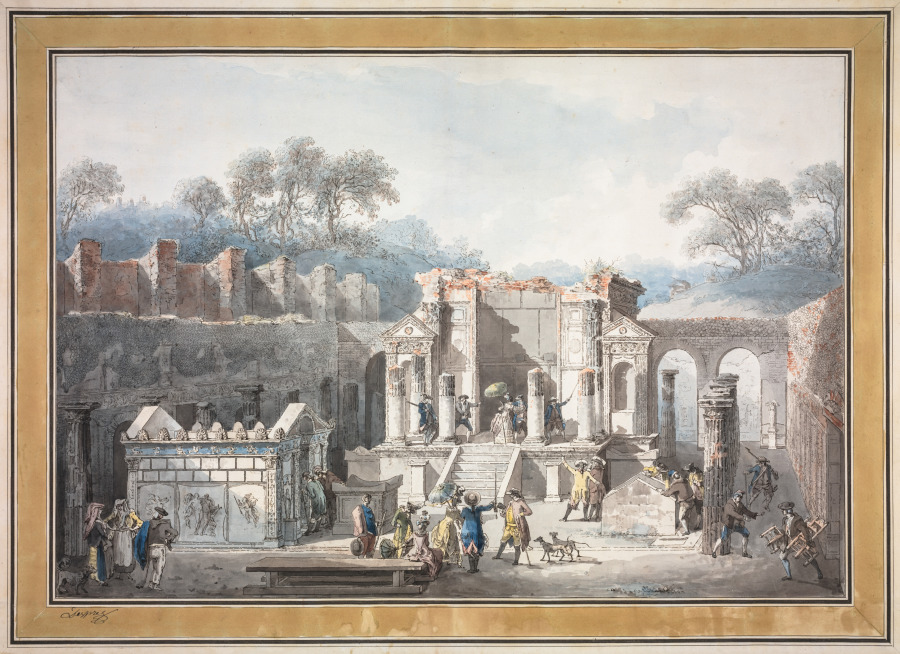
Francesco Piranesi · The Cleveland Museum of Art · John L. Severance Fund · CC0
- Born
- 1761. · Rome.
- Died
- 1810. · Paris.
- Nationality
- Italy and Papal States.
- Occupation
- architect, etcher, copper engraver, diplomat, graphic artist and printer.
- Languages
- Italian.
VALÉORINE Encyclopedia
VALÉORINE documentary reading
Documentary summary
Francesco Piranesi (Italian pronunciation: [franˈtʃesko piraˈneːzi; -eːsi]; 1758/59 – 23 January 1810) was an Italian engraver, etcher and architect. He was the son of the more famous Giovanni Battista Piranesi and continued his series of engravings representing monuments and ancient temples. He worked for a long period in France, where he lived during the French Revolution.
Admitted source layer · organised and presented by VALÉORINE
Note VALÉORINE
No house-authored Note is published until its assertions and sources pass the VALÉORINE evidence contract. The documentary article remains available in full while that enrichment is being consolidated.
Documentary enrichment in progress · no unsupported statement published
Reference Check
Propose documentary evidence for Francesco Piranesi. A contribution is never written directly as fact: identity, source, rights and evidence gates still decide.
Sign in to contribute
World of VALÉORINE
Documentary connections
Only confirmed graph relationships appear here. Images are shown only when their identity and reuse rights both pass the documentary gate.

Documentary evidence
Evidence Panel
not yet certified
- Identity
- resolved
- Independent source families
- 0
- Admitted assertions
- 0
- Open conflicts
- 0
Authority files
gnd · 1091536813 · wikidata · Q336028 · wikipedia · Francesco Piranesi
In this article
Life
Life
The recorded working language is Italian. Places of work recorded in the authority are Paris. Positions recorded include ambassador. Work by Francesco Piranesi is recorded in the collections of Museum Boijmans Van Beuningen, Auckland Art Gallery, Finnish National Gallery, Nationalmuseum and The Nelson-Atkins Museum of Art.
Francesco Piranesi was born in Rome, the eldest son of Giovanni Battista Piranesi and his wife, Angela Pasquini. He was instructed in engraving by his father, together with his older sister Laura (1754–1789), also a noted engraver by the time of her early death. He was both engraving his own works of art and assisting his father's work by 1775. He then started to study with other experts: engraving with Giovanni Volpato, landscape painting under the German Jacob Philipp Hackert and his brother Georg and architecture under Pierre-Adrien Pâris. Piranesi accompanied his father on two trips to the ancient Roman ruins in Paestum, Pompei and Ercolano, first in 1770, and again in 1778. In this he was part of a group of engravers which collaborated with Benedetto Mori and the architect Augusto Rosa, considered the inventor of felloplastica, the art of constructing scale models of ancient monuments in cork. Giovanni Battista created a series of preparatory drawings about Paestum, which were completed by Francesco. Upon his father's death, shortly after the second trip, Francesco acquired his father's publishing house and was responsible for printing most of the later editions of his prints. Piranesi collaborated with the French artist Louis Jean Desprez on a series of views of Naples, Pompeii and Rome, which were advertised in 1783 as dessins coloriés and sold at Piranesi's shop in Rome. Although the 1783 advertisement promised 48 views, the series was not completed before Desprez left Rome to enter the employ of King Gustav III of Sweden. In the following years, Piranesi built his reputation primarily upon his engravings of antique statuary. After the assassination of Gustav III in 1792 Piranesi was employed by Baron Gustaf Adolf Reuterholm, the head of the regent council which ruled Sweden during the minority of Gustav IV Adolf of Sweden. Reuterholm tasked Piranesi with spying on the favourite of the deceased king, Gustaf Mauritz Armfelt, who had been one of the men the king had appointed in the regent council in his will, but whom Reuterholm had deposed. Piranesi managed to steal Armfelt's letters which he had stored in the British embassy in Florence before beginning his work as foreign ambassador to the Kingdom of the Two Sicilies. These letters were the primary evidence used against Armfelt when he was tried in absentia for treason and sentenced to death, a sentence he managed to avoid, however, by fleeing to Russia. The occupation of the Italian peninsula in 1798 by the French Revolutionary Army led to the establishment of the short-lived Roman Republic. Piranesi soon won the admiration of the French officials directing the republic, becoming a government official. When the republic fell the following year, together with his younger brother, Pietro, he moved to Paris where he soon gained the admiration of Talleyrand. They opened a new branch of the family enterprise there, called Piranesi Frères, which decorated a line of terracotta vases manufactured in imitation of the ancient Etruscan works by Joseph Bonaparte. In 1807 Pietro Piranesi sold his share of the firm and returned to Rome. Francesco fell upon hard times after this. The Emperor Napoleon came to his help, issuing an imperial decree granting the sum of 300,000 French francs, upon the condition that Piranesi dedicate himself solely to his engraving work, then considered the best in Europe. He died unexpectedly in Paris, however, before he could fulfill his contract. In 1839, the surviving collection of his engravings was purchased by the Calcografia Camerale, founded by Pope Gregory XVI, and brought to Rome. That institution is now the Istituto Nazionale per la Grafica.
Works
Works
Raccolta de' tempj antichi, Volume I (1780) Il teatro di Ercolano (1785) Collezione delle più belle statue di Roma (1786) Raccolta de' tempj antichi, Volume II (1790) Ragguaglio ossia giornale della venuta e permanenza in Roma di S.A.R. Sofia Albertina Principessa di Svezia (1793) Antiquités de la Grande-Grèce, three volumes (1804–1807)
Life and career
Dated record
Life and career
The full dated record · 2 entries
1761
Francesco Piranesi born at Rome.
1810
Francesco Piranesi died at Paris.
Places
Named by the record
Places
Only places the record itself states, plotted where the house gazetteer settles their coordinates. Nothing is inferred from a name or a nationality.
Rome.
Birth place
Paris.
Death place
Primary material
Documents and archives
Institutional database
- Wikidata, structured authority record Q336028: Francesco Piranesi
Scholarly · Wikimedia Foundation
authority file
- Gemeinsame Normdatei 1091536813, Giambattista [&] Francesco Piranesi, Vedute e Antichità di Tivoli (1996 : Tivoli).
Unverified · Deutsche Nationalbibliothek
reference work
- “Francesco Piranesi”, English Wikipedia, consulted as further reading
Reputable secondary · Wikipedia
Notes from the source article
Cited by Wikipedia
Notes from the source article
These works are cited by the source article, in its own numbering. They are recorded as its citations, not as sources VALÉORINE has verified.
Bibliography printed in the source article · 5
- Rossana Caira Lumetti: La cultura dei lumi tra Italia e Svezia. Il ruolo di Francesco Piranesi. Bonacci Editore, Roma 1990.
- Vincenzo Monti: Lettera di Francesco Piranesi al signor generale D. Giovanni Acton(ed. Rossana Caira Lumetti). Sellerio Editore, Palermo 1991.
- M. Calvesi: Giovan Battista e Francesco Piranesi, catalogo mostra Calcografia Nazionale. De Luca Editore, Roma 1968.
- Alessandro Bettagno: Piranesi-incisioni-rami-legature-architetture, pp 71–76 "La calcografia Piranesi: I rami originali" (ed. Maria Catelli Isola). Neri Pozza Editore, Vicenza 1978.
- Pierluigi Panza: Museo Piranesi. Skira, 2017
References
Citations
References
Each reference names the institution holding it, so a reader may go to the document itself.
Institutional database
Wikidata, structured authority record Q336028: Francesco PiranesiWikimedia Foundation
Verifiedauthority file
Gemeinsame Normdatei 1091536813, Giambattista [&] Francesco Piranesi, Vedute e Antichità di Tivoli (1996 : Tivoli).Deutsche Nationalbibliothek
Partially resolvedreference work
Partially resolved
People, houses and institutions
Knowledge graph
People, houses and institutions
Teachers, collaborators, publishers and institutions recorded against this person, each on a stated basis.
Died at
1- ParisPlace
Established from a fact already recorded on a verified source.
The Encyclopedia exists whether or not anything is for sale. Corrections are recorded rather than overwritten, and every version of this record is kept. Published 14 August 2026.
Elsewhere in Design
11,558 published records in this field, each with its sources named.
- Francesco PaciottoDesigner
- Francesco PeparelliDesigner
- Francesco PeverelliDesigner
- Francesco Pio DottiDesigner
- Francesco PrimaticcioDesigner
- Francesco RicchinoDesigner
- Francesco RighettiDesigner
- Francesco SabatiniDesigner
Best supported in this field
For owners
Own a work by Francesco Piranesi?
A specialist will read what you send and tell you what the house can establish, what it cannot, and whether the object is suited to sale. There is no charge and no obligation. The object stays with you throughout; nothing is shipped to us unless it is arranged in writing beforehand.