
Flaminio Vacca
Flaminio Vacca or Vacchi (Rome, 1538 – Rome, 26 October 1605) was an Italian sculptor and archaeologist.
Also recorded as E. Flamenio di Vacca
Flaminio Vacca

Georges Jansoone (JoJan) · Self-photographed · CC BY 3.0
- Born
- 1538
- Birthplace
- Rome, Papal States
- Died
- 26 October 1605
- Known for
- * Sculpture
- Movement
- Late Renaissance
- Occupation
- sculptor · restorer
- Fields
- art of sculpture · restoration
- Languages
- Italian
VALÉORINE Encyclopedia
VALÉORINE documentary reading
Documentary summary
Flaminio Vacca or Vacchi (Rome, 1538 – Rome, 26 October 1605) was an Italian sculptor and archaeologist.
Admitted source layer · organised and presented by VALÉORINE
Note VALÉORINE
Flaminio Vacca (1538–1605) was a restorer and sculptor. The restorer was born and died in Rome.
Flaminio Vacca worked in Rome. Activity centred on art of sculpture and restoration. Languages used include Italian.
Composed from admitted, traceable facts · 01 October 2026
VALÉORINE
Reference Check
Propose documentary evidence for Flaminio Vacca. A contribution is never written directly as fact: identity, source, rights and evidence gates still decide.
Sign in to contribute
Documentary evidence
Documentary basis
Authority files
wikidata · Q527235 · wikipedia · Flaminio Vacca
In this article
Key facts
Key facts
• Born — 1538 • Birthplace — Rome, Papal States • Died — 26 October 1605 • Place of death — Rome, Papal States • Known for — * Sculpture • Archaeology • Notable Works — Medici lions • Movement — Late Renaissance
Early life and education
Early life and education
Flaminio Vacca was born in Rome, in 1538 to a family of Spanish descent. He studied with the Florentine Vincenzo de' Rossi, who was in Rome between 1546 and 1560, and at first worked on restorations and adaptations of antique sculptures. Around 1572, he was listed among the members of the Congregazione dei Virtuosi al Pantheon.
Career
Career
His period of greatest creative productivity began in the last years of the pontificate of Pope Gregory XIII. In 1583, he carved the Pope’s coat of arms in the two large marble escutcheons for the Collegio del Gesù, the rich curves of which are meticulously carved in the Florentine style of Bartolomeo Ammannati. In 1587–8, he worked with Pietro Paolo Olivieri to complete an Angel and a low relief of Joshua and his Army for the Acqua Felice fountain, the latter work showing his interest in late Roman reliefs.. The two sculptors, together with Domenico Fontana and Leonardo Sormani, also took part in the restoration (1588–90) of Castor and Pollux in the Monte Cavallo Fountain in Piazza del Quirinale. During this period, Vacca also sent a tabernacle (1589) to the church of San Lorenzo in Spello, outside Rome. In 1588, Vacca produced one of his most demanding works, the St. Francis of Assisi, for the Sistine Chapel in Santa Maria Maggiore, Rome. This work reveals a Mannerist taste, together with a certain stylized expressionism in the manner of de’ Rossi. In contrast, the signed figures of St. John the Baptist and St. John the Evangelist (1592–3) in Santa Maria in Vallicella (or Chiesa Nuova) display a soft, shadowy quality, modifying the Mannerist style that Vacca had learnt both from his teacher and from Baccio Bandinelli. On the other hand, the Angel in the Cappella degli Angeli in the Church of the Gesù, which dates from the end of the decade, is characterized by a freedom of modelling and an elegance of line; another Angel in the same chapel was begun by Olivieri and completed by Vacca. • Illustration — Vacca's Lion, Loggia dei Lanzi, Florence Vacca also executed one of the two marble Medici lions (between 1570 and 1590; now Florence, Loggia dei Lanzi), commissioned by Grand Duke Ferdinando I for the Villa Medici in Rome; it was moved to Florence in 1787. It is a finely made statue that shows a return to the classical mode, a work of great vitality and virtuoso realism. Vacca also produced highly admired portraits, with a concern for accuracy in physiognomy and psychology. His Self-portrait (signed and dated 1599; formerly Rome, Pantheon; now Rome, Protomoteca Capitolina) is modelled with great sensitivity to the play of light, revealing an expression of contained anxiety and a rigorous simplicity. The same characteristics appear in the bust of Baldassare Ginanni (c. 1599; Rome, Sant'Agostino), which has been attributed to Vacca. In 1599 he was elected head of the Accademia di San Luca in Rome.
Archaeology
Archaeology
Vacca’s passion for antiquity found expression in his Memorie di varie antichità trovate in diversi luoghi della città di Roma, written in 1594 and published in 1704 as an appendix to Famiano Nardini's Roma Antica. These notes are a primary source of information for the history of archaeology in the late-sixteenth century Rome.
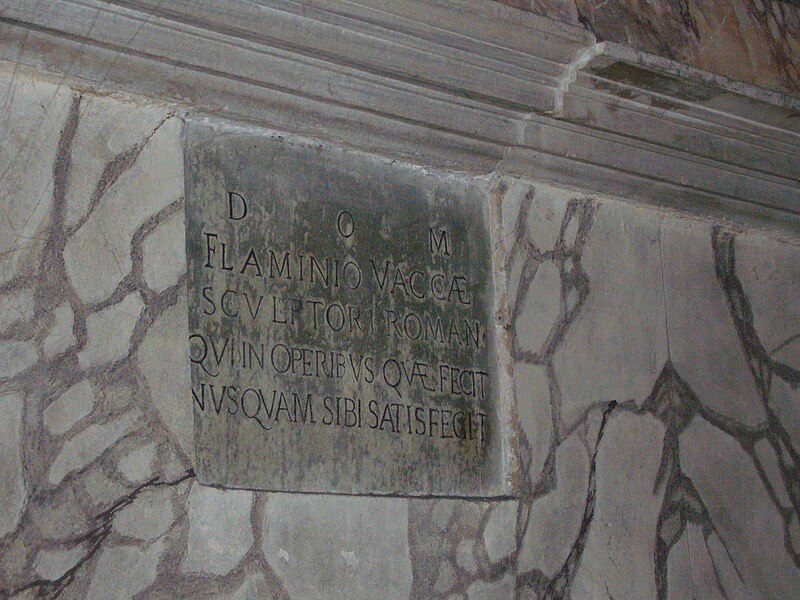
Roma, Pantheon: lapide di Flaminio Vacca (membro dell'Accademia dei virtuosi del Pantheon)
Lalupa

Sculptures in the Uffizi Gallery
Francesco Bini
Life and career
Dated record
Life and career
The full dated record · 2 entries
1538
Flaminio Vacca was born in 1538 at Rome.
1605
Flaminio Vacca died on 26 October 1605.
Primary material
Documents and archives
reference work
- “Flaminio Vacca”, English Wikipedia, consulted as further reading
Reputable secondary · Wikipedia
authority record
- Wikidata, structured authority record Q527235: Flaminio Vacca
General reference · Wikidata
Notes from the source article
Cited by Wikipedia
Notes from the source article
These works are cited by the source article, in its own numbering. They are recorded as its citations, not as sources VALÉORINE has verified.
- 1.Steven F. Ostrow, "The discourse of failure in seventeenth-century Rome: Prospero Bresciano's Moses", The Art Bulletin (June 2006) notes 4 and 5.
Bibliography printed in the source article · 2
- cite journal
- cite book
References
Citations
References
Each reference names the institution holding it, so a reader may go to the document itself.
reference work
Secondary witnessauthority record
General reference
The Encyclopedia exists whether or not anything is for sale. Corrections are recorded rather than overwritten, and every version of this record is kept. Published 16 August 2026.
Elsewhere in Sculpture
6,174 published records in this field, each with its sources named.
- Filippo ParodiArtist
- Fiona Margaret HallArtist
- Fiore de HenriquezArtist
- Flaminio del TurcoArtist
- Fletcher BentonArtist
- Florence FreemanArtist
- Florence WyleArtist
- Florijan MićkovićArtist
Best supported in this field
For owners
Own a work by Flaminio Vacca?
A specialist will read what you send and tell you what the house can establish, what it cannot, and whether the object is suited to sale. There is no charge and no obligation. The object stays with you throughout; nothing is shipped to us unless it is arranged in writing beforehand.