
Eugène Ysaÿe
Illustration — Eugène Ysaÿe, around 1915 Eugène-Auguste Ysaÿe (lang; 16 July 185812 May 1931) was a Belgian violinist, composer, and conductor. He was regarded as "The King of the Violin", or, as his former student Nathan Milstein put it, the "tsar".
Also recorded as Eugène Ysaye
Eugène Ysaÿe
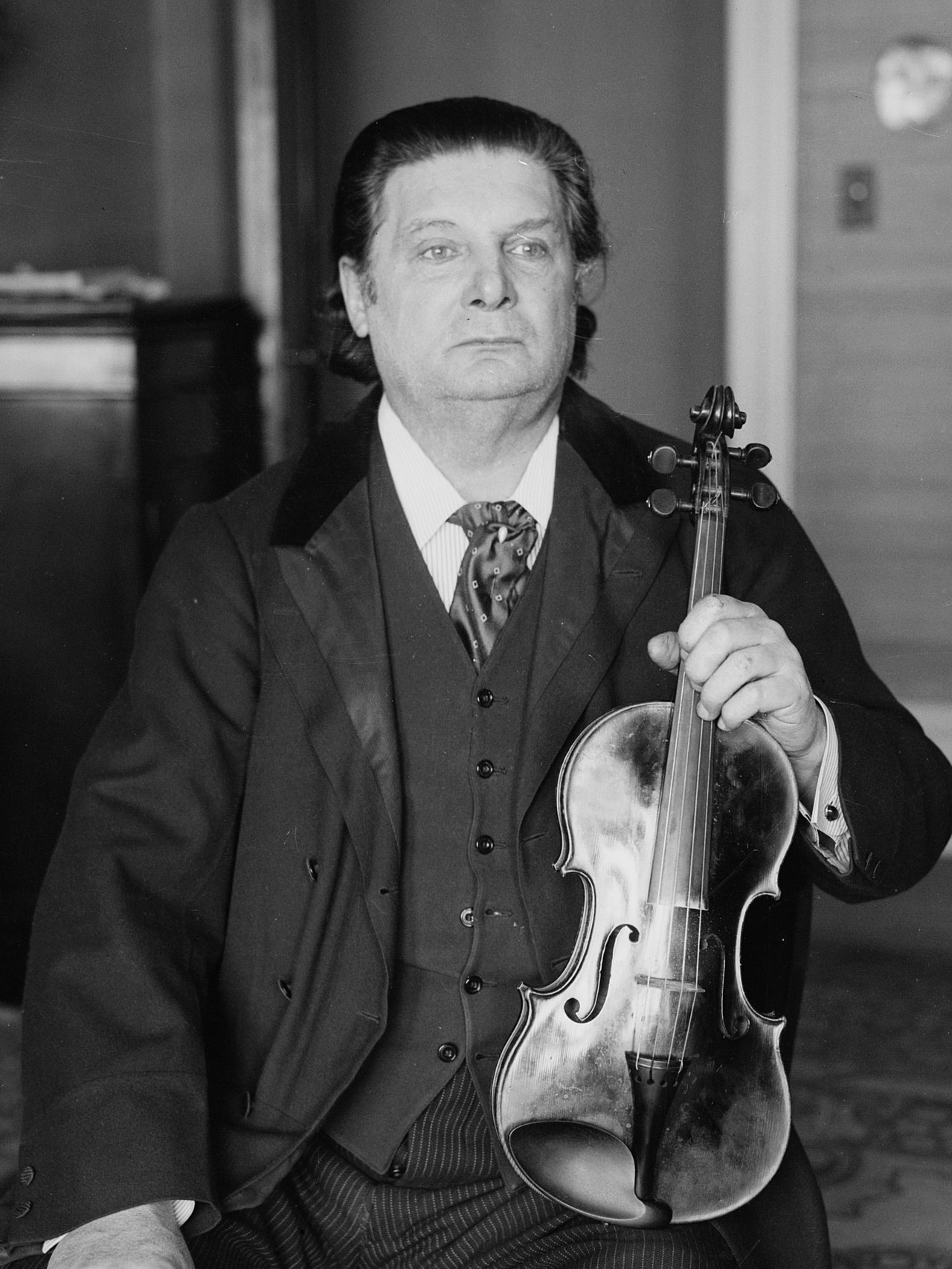
Bain News Service, publisher · Library of Congress Catalog: https: Image download: https: Original url · Public domain
- Born
- 1858. · Liège.
- Died
- 1931. · Brussels.
- Nationality
- Belgium.
- Occupation
- composer, conductor, violinist, music educator, university teacher, concertmaster and musician.
- Fields
- Romantic music.
- Education
- Royal Conservatory of Liège and Royal Conservatory of Brussels.
- Teachers
- Henri Vieuxtemps, Henri Wieniawski and Rodolphe Massart.
- Honours
- Royal Philharmonic Society Gold Medal, Grand Officer of the Order of Leopold, Knight of the Order of the Crown, Commander of the Legion of Honour, Grand Officer of the Order of the Nile and commander of the Order of the Crown of Italy.
- Languages
- French.
VALÉORINE Encyclopedia
VALÉORINE documentary reading
Documentary summary
Illustration — Eugène Ysaÿe, around 1915 Eugène-Auguste Ysaÿe (lang; 16 July 185812 May 1931) was a Belgian violinist, composer, and conductor. He was regarded as "The King of the Violin", or, as his former student Nathan Milstein put it, the "tsar".
Admitted source layer · organised and presented by VALÉORINE
Note VALÉORINE
Eugène Ysaÿe (1858–1931) was a Belgian composer, concertmaster and conductor, among other activities. Born in Liège, the composer died in Brussels.
Eugène Ysaÿe studied at Royal Conservatory of Brussels and Royal Conservatory of Liège. The composer worked for Royal Conservatory of Brussels and was a member of Quatuor Ysaÿe. Eugène Ysaÿe held the position of court chapel master. The composer was active in Romantic music.
Languages used include French. Eugène Ysaÿe received Commander of the Legion of Honour, Commander of the Order of Christ and Commander of the Order of Isabella the Catholic, among others.
Composed from admitted, traceable facts · 30 September 2026
VALÉORINE
Reference Check
Propose documentary evidence for Eugène Ysaÿe. A contribution is never written directly as fact: identity, source, rights and evidence gates still decide.
Sign in to contribute
World of VALÉORINE
Documentary connections
Only confirmed graph relationships appear here. Images are shown only when their identity and reuse rights both pass the documentary gate.
Documentary evidence
Documentary basis
Authority files
wikidata · Q312857 · wikipedia · Eugène Ysaÿe
In this article
Early years
Early years
Eugène Ysaÿe studied at Royal Conservatory of Liège and Royal Conservatory of Brussels. Training under Henri Vieuxtemps, Henri Wieniawski and Rodolphe Massart is recorded. Julia Klumpke is recorded as having studied under Eugène Ysaÿe. the recorded working language is French. The field of work recorded is Romantic music. Employment is recorded with Royal Conservatory of Brussels. Positions recorded include court chapel master. Distinctions recorded are Royal Philharmonic Society Gold Medal, Grand Officer of the Order of Leopold, Knight of the Order of the Crown and Commander of the Legion of Honour.
Born in Liège, Ysaÿe began violin lessons at age five with his father. He would later recognise his father's teaching as the foundation of everything he knew on his instrument, even though he went on to study with highly reputed masters. In 1867, Ysaÿe entered the Royal Conservatory of Liège to study with Désiré Heynberg, and in the process won a shared second prize with the Viotti 22nd Violin Concerto. He then went on to study with Henryk Wieniawski for two years in Brussels and Henri Vieuxtemps in Paris. Studying with these teachers meant that he was part of the Franco-Belgian school of violin playing, which dates back to the development of the modern violin bow by François Tourte. Qualities of this "École" included elegance, a full tone with a sense of drawing a "long" bow with no jerks, precise left hand techniques, and bowing using the whole forearm while keeping both the wrist and upper arm quiet (as opposed to Joseph Joachim's German school of wrist bowing and Leopold Auer's Russian concept of using the whole arm).
Early career
Early career
• Illustration — Ber Zalkind. "Cartoon of Violinist Eugène Ysaÿe" (1913) After his graduation from the Royal Conservatory of Liège, Ysaÿe was the principal violin of the Benjamin Bilse beer-hall orchestra, which later developed into the Berlin Philharmonic. Many musicians of note and influence came regularly to hear this orchestra and Ysaÿe in particular, among them Joseph Joachim, Franz Liszt, Clara Schumann, and Anton Rubinstein, who asked that Ysaÿe be released from his contract to accompany him on tour. When Ysaÿe was 27 years old, he was recommended as a soloist for one of the Concerts Colonne in Paris, which was the start of his great success as a concert artist. The next year, Ysaÿe received a professorship at the Brussels Conservatoire. His teaching career continued for the rest of his life, even after he left the Conservatory in 1898. Among his notable pupils were Josef Gingold, the viola virtuoso William Primrose, the violin virtuoso Nathan Milstein (who primarily studied with Pyotr Stolyarsky), Oskar Back, Ernest Bloch, Jascha Brodsky, Mathieu Crickboom, George Enescu, Aldo Ferraresi, Jonny Heykens, Nellie A. Hope, Charles Houdret, Julia Klumpke, Louis Persinger, Oscar Shumsky, and Jacques Thibaud. • Illustration — Eugène Ysaÿe in Russia, 1883 During his tenure as professor at the Conservatoire, Ysaÿe continued to tour ever more widely, visiting all of Europe, Russia, and the United States. Despite health concerns, particularly regarding the condition of his hands, Ysaÿe was at his best when performing, and many prominent composers dedicated major works to him, including Claude Debussy, Camille Saint-Saëns, César Franck, and Ernest Chausson. He arranged for violin and orchestra Saint-Saëns's Étude en forme de valse, which had originally been written for solo piano. Franck's Violin Sonata in A was written as a wedding present for Ysaÿe and his wife in 1886. Ysaÿe played it often for the rest of his life. Chausson's Poème was his response to Ysaÿe's request for a concerto. Joseph Szigeti thought those two dedications demonstrated the enormous respect in which Ysaÿe was held. In 1886, he established the Ysaÿe Quartet, which premiered Debussy's String Quartet.
Performing career
Performing career
• Illustration — Ysaÿe with violin As a performer, Ysaÿe was compelling and highly original. Pablo Casals claimed never to have heard a violinist play in tune before Ysaÿe, and Carl Flesch called him "the most outstanding and individual violinist I have ever heard in my life." Ysaÿe possessed a large and flexible tone, influenced by a considerable variety of vibrato — from no vibrato at all to very intense. He said, "Don't always vibrate, but always be vibrating". His modus operandi was, in his own words: "Nothing which wouldn't have for goal emotion, poetry, heart." The conductor Sir Henry Wood said, "The quality of tone was ravishingly beautiful.... He seemed to get more colour out of a violin than any of his contemporaries." Possibly the most distinctive feature of Ysaÿe's interpretations was his masterful rubato (in English: "stolen"). Sir Henry Wood said, "Whenever he stole time from one note, he faithfully paid it back within four bars", allowing his accompanist to maintain strict tempo under his free cantilena. Incidentally, this kind of rubato fits the description of Frédéric Chopin's rubato. Although Ysaÿe was a celebrated interpreter of late Romantic and early modern composers such as Max Bruch, Camille Saint-Saëns, and César Franck, who composed his Violin Sonata as a wedding present for Ysaÿe. He was also highly admired for his interpretations of Bach and Beethoven. An international violin competition in Brussels was created in his memory: in 1951, this became the violin section of the Queen Elisabeth Music Competition.
Personal life
Personal life
• Illustration — Eugène Ysaÿe's grave in Brussels (Ixelles Cemetery) • Illustration — Bust of Eugène Ysaÿe in Liège (gardens) Ysaÿe was married twice. His first marriage, on 28 September 1886 in Arlon, was to Louise Bourdau (from Dendermonde), with whom he had three sons and two daughters: Gabriel (1887–1961), Carry (1889–1930), Thérèse called Thésy (1890–1956), Antoine (1894–1979) and Théodore (1898–1934). César Franck presented his Violin Sonata in A to them as a gift on the morning of the wedding, and after a hurried rehearsal Ysaÿe performed the piece at the marriage celebration. The sonata had its formal concert premiere in Brussels on 15 December 1886 with Franck in the audience. After Louise's death (9 February 1924) he married a pupil of his, Jeanette Dincin (1902–1967), 44 years his junior. She was a violinist who in her teens had studied with prominent teachers such as Franz Kneisel, Leopold Auer, and Otakar Ševčík. Ysaÿe met her in 1922 while conductor of the Cincinnati Orchestra. She cared for him in his ailing years. Eugène's only request of her after he died was that she carry on her performances under his name. His brother was pianist and composer Théo Ysaÿe (1865–1918), and his great-grandson is Marc Ysaÿe, founder-controller of radio Classic 21 and drummer of rock band Machiavel. Eugène Ysaÿe was also close friends with Queen Elisabeth of Belgium, whom he taught violin despite her lack of talent. His widow took over the royal teaching herself after his death, and the queen began the competition in his honour. His granddaughter, Nadine Ysaye Mosbaugh, was a noted concert pianist who toured Europe with José Iturbi before settling down in Canada. She also hosted and performed on a classical radio show on CKAR Radio in Huntsville, Ontario. Ysaÿe's great-grandson, Franc Mosbaugh, is a Canadian musician/singer and award-winning commercial jingle composer. Ysaÿe was also a friend of Claude Debussy and would sometimes correspond with him by letter. The two had great respect for each other and Ysaÿe was a significant supporter of the younger composer's early career. Debussy dedicated his only string quartet to the violinist, who studied the score with great care. The quartet received its premiere on 29 December 1893 by the Ysaÿe Quartet at the Société Nationale in Paris, to mixed reviews. The virtuoso and the composer also corresponded during the writing of Debussy's Nocturnes.
Legend of the Ysaÿe violin
Legend of the Ysaÿe violin
Eugène Ysaÿe came from a background of "artisans", though a large part of his family played instruments. As violinist Arnold Steinhardt recounts, a legend was passed down through the Ysaÿe family about the first violin brought to the lineage: It was told of a boy whom some woodcutters found in the forest and brought to the village. The boy grew up to be a blacksmith. Once, at a village festival, he astonished everyone by playing the viol beautifully. From then on the villagers took pleasure in dancing and singing to the strains of his viol. One day an illustrious stranger stopped in front of the smithy to have his horse shod. The count's servant saw the viol inside and told the young smith that he had heard a new Italian instrument played by some minstrels at the count's court. That instrument, called the violin, was much better than the viol – its tone was like the human voice and could express every feeling and passion. From that moment the young man no longer took pleasure in his viol. Day and night he was thinking of that wonderful new instrument that could express joy and sorrow and whose tones went straight to the human heart. Then he had a dream: he saw before him a young woman of indescribable beauty, not unlike his own love, Biethline. She came to him and kissed his brow. The young man awoke and looked at the wall his broken and neglected viol used to hang on and could barely believe his eyes: there, instead of the viol, was a new instrument of beautiful proportions. He put it against his shoulder and drew the bow over the strings, producing sounds that were truly divine. The violin sang in a heartwarming tone: it rejoiced and wept for happiness – and so did the musician. Thus, goes the legend, came the first violin to the Ardennes and to the Ysaÿe family.
Works for solo violin
Works for solo violin
• 6 Sonatas for solo violin, Op. 27 (each dedicated to a different famous violinist and written in their corresponding styles) • Sonata No. 1 ("Joseph Szigeti") • Sonata No. 2 ("Jacques Thibaud") • Sonata No. 3 ("Georges Enescu") • Sonata No. 4 ("Fritz Kreisler") • Sonata No. 5 ("Mathieu Crickboom") • Sonata No. 6 ("Manuel Quiroga") • 10 Preludes (Exercises for violin), Op. 35 • Étude posthume • Cadenza for Beethoven, Violin Concerto in D major, Op. 61, 1st mov. (1888–89) • Cadenza for Mozart, Violin Concerto No. 3 in G major, K. 216, 1st, 2nd and 3rd mov. • Cadenza for Tchaikovsky, Violin Concerto in D major, Op. 35, 1st mov. • Cadenza for Brahms, Violin Concerto in D major, Op. 77, 1st mov.
Works for violin and piano
Works for violin and piano
• Scènes Sentimentales (1885) [ms discovered in 2012] • 2 Mazurkas de Salon, Op. 10 (c. 1893) • Dans le lointain (Tempo di Mazurka) • Mazurka, in A minor (Moderato) [orchestrated by Allan Wilson] • Lointain passé, Mazurka No. 3 in B minor, Op. 11 (1893) • Petite fantaisie romantique (c. 1901) • Poème élégiaque, for violin and piano (1892/3) [revised as Poème No. 1 in D minor, for violin and orchestra, Op. 12] • Rêve d'enfant, in A-flat major, for violin and piano (or orchestra) Op. 14 • Untitled piece in F-sharp minor (c. 1912) [ms discovered in 2012, ending missing, completed and entitled Élégie, by Sherban Lupu] • Trois Études-Poèmes (completed 1924) [mss discovered in 2012] • Sérénade, in G minor (Allegretto poco scherzando) [ms piano part missing, piano accompaniment written by Sabin Pautza] • Au ruisseau (Poco lento) • Cara memoria, in E-flat minor (Molto moderato alla marcia funèbre) • "Paganini Variations", on 24th Caprice (published 1960) • "Caprice after the Study in the form of a Waltz, Op. 52/6" (composed by Camille Saint-Saëns, arranged by Ysaÿe) • Deux célèbres Arias (composed by J.S. Bach and G.F. Handel, arranged by Ysaÿe) • Waltz in E minor Op. posth. [KKIVa/15] (composed by Frédéric Chopin, arranged by Ysaÿe) • Ballade No. 1 in G minor, Op. 23 (composed by Frédéric Chopin, arranged by Ysaÿe) • Légende norvégienne.
Chamber works
Chamber works
• String Quintet, in B minor, for 2 violins, 2 violas and cello "à mon frère Théophile" (1894) [Grave et lent – Allegro] [later arranged for violin and piano/orchestra Op. 15] • Sonata for solo cello, in C minor, Op. 28 (1924) [1. Grave; 2. Intermezzo; 3. In modo di Recitativo; 4. Finale. Con brio] • Sonata for two violins, in A minor, Op. posth. (1915) [1. Poco lento, maestoso – Allegro fermo; 2. Allegretto poco lento; 3. Finale. Allegro vivo e con fuoco) • String Trio No. 1, Op. 33, a.k.a. "Le Chimay" (1927) [Molto lento – Allegro non troppo – Lento ben sostenuto – Allegro non-troppo – Allegro poco presto] • String Trio No. 2, Op. 34 (1927) [Allegro assai – Lento] • Trio “Le Londres” for 2 violins and viola • String Quartet • "Paganini Variations" for String Quartet
Orchestral works
Orchestral works
• Brabançonne in D major, for orchestra (1918) • Exil, for string orchestra without double basses, Op. 25 (1917)
Concertante works
Concertante works
• Poème élégiaque (Poème No. 1) in D minor, for violin and orchestra Op. 12 (1902/3) [orchestrated by Jacques Ysaye] • Au rouet (Poème No. 2), for violin and orchestra, Op. 13 • Chant d'hiver (Poème No. 3), in B minor, for violin and orchestra (or piano), Op. 15 (1902) [same music of String Quintet] • Méditation, for cello and orchestra, Op. 16 • Violin Concerto No.?, in G minor, for violin and orchestra, Op. 17 (1893,1901,1908,1910) [mss discovered in 2012, reconstructed from 4 ms versions by Sherban Lupu and orchestrated by Sabin Pautza in 2017] • Berceuse, in F minor, for violin and orchestra, Op. 20 • Extase (Poème No. 4), for violin and orchestra, Op. 21 (dedicated to Mischa Elman) • Sérénade, for cello and orchestra, Op. 22 • Les neiges d'antan (Poème No. 5), for violin and orchestra, Op. 23 (1911) • Divertimento, for violin and orchestra (or piano) Op. 24 (1921) [1. Molto moderato; 2. Allegro non-troppo vivo] • Amitié (Poème No. 6), for 2 violins and orchestra, Op. 26 • Poème nocturne (Poème No. 7), for violin, cello and orchestra, Op. 29 • Harmonies du soir (Poème No. 8), for string quartet and orchestra, Op. 31 • Fantasia, for violin and orchestra, Op. 32 • Violin Concerto No. 8 (orchestrated by Jacques Ysaÿe) [I. Grave e lento poco mesto; II. Andante non-troppo; III. (with no tempo indication)] • Violin Concerto No.?, in E minor, for violin and orchestra [I. Allegro appassionato non troppo vivo] • Saltarelle carnavalesque, in A minor, for violin and orchestra (or piano), Op. posth
Operas
Operas
• Piére li houyeû (Pierre le mineur) 1931 (Original in Walloon language, perhaps the only opera composed for a libretto in that language) • The première of Piére li houyeû (the composer's only opera) took place at the Opéra de Liège on 4 March 1931, during a long evening dedicated to the composer's works, in the presence of Queen Elisabeth of Belgium who had been his pupil. Ysaÿe, very ill with diabetes, listened to the performance from his hospital room. The Queen, informed of the seriousness of Ysaÿe's condition, had organised a radio broadcast of the work and Ysaÿe addressed the audience from his room. The work was then performed in Brussels on 25 April. Ysaÿe, transported on a stretcher to a box in the theater, was able to view the performance. He died 18 days later. The critics were appreciative but the opera did not find a place in the standard repertoire. It was performed again by Opéra Royal de Wallonie in Liege, 25 November 2006. This performance was recorded and is published by the non-profit association in a two CD set accompanied by a book containing the Walloon text and its French, Dutch and English translations, and introductory texts in French, Dutch, German and English. The story is based on an incident that occurred in 1877 during a miners' strike in the Liège region. During clashes with the police, some shots were fired. The wife of a foreman rushed forward to seize a grenade which had been placed in the offices by a striker, but the grenade exploded and she was killed. • L’avièrge di pièr (La vierge de pierre) – not completed, not performed A complete list of available orchestral works, including concerto works, is available on the Symphony Orchestra Library Center.
Camille de Creus, piano accompaniment
Camille de Creus, piano accompaniment
Source: • R. Wagner: Prize Song from Die Meistersinger Von Nürnberg, recorded 1 Feb.1912 • E. Chabrier: Pièce pittoresque No.10 from Scherzo-Valse, recorded 20 Dec.1912 • R. Schumann: Abendlied, Op.85, No.12 by Schumann, recorded 24 Dec.1912 • H. Wieniawski: Obertass, Mazurka Op.19, No.1 in G major, recorded 26 Dec.1912 • H. Wieniawski: Dudziarz, Mazurka Op.19, No.2 in D major, recorded 26 Dec.1912 • G. Fauré: Berceuse Op.16, recorded 27 Dec.1912 • F. Mendelssohn: Concerto for Violin and Orchestra in E minor Op.64 (III: Allegro molto vivace), recorded 27 Dec.1912 • H. Vieuxtemps: Rondino Op.32, No.2, recorded 30 Dec.1912 • J. Brahms: Hungarian Dance No.5, in F-sharp minor (arr. Joachim), recorded 30 Dec.1912 • F. Kreisler: Caprice Viennois, Op.2, recorded 30 Dec.1912 • R. Wagner: Albumblatt in C major, recorded 30 Dec.1912 • E. Ysaÿe: Lointain passé, Mazurka No.3 in B minor Op.11, recorded 1 Feb.1913 • E. Ysaÿe: Rêve d'Enfant Op.14, recorded 1 Feb.1913 • A. Dvořák: Humoresque in G-flat major Op.101, No.7 (arr. Kreisler), recorded 9 Mar.1914 • F. Schubert: Ave Maria D.839, recorded 9 Mar.1914 • E. Chabrier: Marche Joyeuse, recorded 30 Nov.1919
Conducting the Cincinnati Symphony Orchestra, recorded 28 Nov 1919
Conducting the Cincinnati Symphony Orchestra, recorded 28 Nov 1919
• L. Delibes: Intermezzo from 'Naila' (Pas Des Fleurs, Grande Valse) • Aimé Maillart: Overture to Les Dragons De Villars • J. Massenet: Navarraise from 'Le Cid', by Massenet • Eduard Lassen: Festival Overture • E. Chabrier: Marche Joyeuse • N. Rimsky-Korsakov: Scheherazade • J. Offenbach: Orpheus in Hades
Career and activity
Career and activity
Eugène Ysaÿe worked in Romantic music. He was employed by Royal Conservatory of Brussels. Recorded position is court chapel master. He belonged to Quatuor Ysaÿe.

La classe de Rodolphe Massart a Liege en 1874. De gauche a droite et de bas en haut: O.Dossin, L.Charlier, R.Massart, A. Marchot, E. Ysaye,?,?, O. Musin,?, A. Guidé, A. Voncken
Eugene Isaye

Eugène Ysaÿe and Fritz Blumer in Lausanne
Life and career
Dated record
Life and career
The full dated record · 1 entries
1931
Eugène Ysaÿe died at Brussels.
Places
Named by the record
Places
Only places the record itself states, plotted where the house gazetteer settles their coordinates. Nothing is inferred from a name or a nationality.
Liège.
Birth place
Brussels.
Death place
Teaching and composing
As his physical ailments grew more prohibitive, Ysaÿe turned more to teaching, conducting and an early love, composition. Among his most famous works are the six Sonatas for Solo Violin op. 27, the unaccompanied Sonata for Cello, op. 28, one Sonata for Two Violins, eight Poèmes for various instruments (one or two violins, violin and cello, string quartet) and orchestra (Poème élégiaque, Poème de l'Extase, Chant d'hiver, Poème nocturne, among others), pieces for string orchestra without basses (including Exil), several violin concertos, various shorter pieces for violin and piano, two string trios, an early string quintet, and an opera, Peter the Miner, written near the end of his life in the Walloon language. Ysaÿe had been offered the post of music director of the New York Philharmonic in 1898, but declined it due to his busy solo performance schedule. In 1918, he accepted the music director's position with the Cincinnati Symphony Orchestra, where he remained until 1922 and with which he made several recordings. Finally, in 1931, suffering from the extreme ravages of diabetes that had necessitated the amputation of his left foot, Eugène Ysaÿe died in his house in Forest, Belgium, 48 Avenue Brugmann, and was interred in the Ixelles Cemetery in Brussels.
Selected discography
• Illustration — Eugène Ysaÿe [Released on CD, Sony Classical MHK 62337, 1996]
The Eugène Ysaÿe Collection
The Eugène Ysaÿe Collection
The Eugène Ysaÿe Collection, housed in the Music Division of the Royal Library of Belgium, combines four decades of purchases with a donation made by the Ysaÿe family in 2007. An essential source for the study of musician's life and works, it includes some 700 letters and autograph scores, over 1,000 printed scores and books, abundant collection of photographs, four films, and about fifty 78 RPM and 33 RPM recordings. A second collection of handwritten and printed scores is conserved in New York at the Juilliard School.
Recognition and collections
Where the work is held
Recognition and collections
Eugène Ysaÿe received Royal Philharmonic Society Gold Medal, Grand Officer of the Order of Leopold, Knight of the Order of the Crown, Commander of the Legion of Honour, Grand Officer of the Order of the Nile and commander of the Order of the Crown of Italy.
Honours
• 1900: Officer in the Order of Leopold. • 1919: Commander of the Order of Leopold.
Notes from the source article
Cited by Wikipedia
Notes from the source article
These works are cited by the source article, in its own numbering. They are recorded as its citations, not as sources VALÉORINE has verified.
- 1.Stokes, Frederick A. Violin Mastery. Dover Publications. 1–7. 2006. 978-0-486-45041-4.
- 2.Masin, Gwendolyn Carolina Helena. 'Violin Teaching in the New Millennium: In Search of the Lost Instructions of Great Masters - an Examination of Similarities and Differences Between Schools of Playing and How These Have Evolved, or Remembering the Future of Violin Performance'. Trinity College Dublin. 2012.
- 3.MISS NELLIE A. HOPE. The Saint Paul Globe. 40. 3 July 1904.
- 4.Sir Henry Wood, My Life of Music (Victor Gollancz 1938), pp171, 173.
- 5.Sonata in A major for Violin and Piano, César Franck. LA Phil.
- 6.The text on the front side of the tomb stone reads: Monument érigé par le Comité National Belge de la Société des Auteurs Compositeurs et Editeurs de Musique. This translates to: "Monument erected by the Belgian National Committee of the Society of authors, composers and music publishers".
- 7.Classical Net – Composers – Ysaÿe. Classical Net.
- 8.Weintraub, Stanley (2001). Whistler: A Biography. New York: Da Capo Press, p. 351. .
- 9.Seroff, Victor (1957). Debussy: Musician of France. New York: Putnam, p. 117.
- 10.Arnold Steinhardt, Violin Dreams (Mariner Books 2008), pp. 33, 34.
- 11.Fonds Eugène Ysaÿe. kbr.be. 24 June 2016.
- 12.Juilliard School, Eugène Ysaÿe Collection. juilliard.edu.
- 13.Handelsblad (Het) 09-05-1900
- 14.RD of 14.11.1919
- 15.This work, written by Ysaÿe during a tour of Norway in the Spring of 1882, was discovered in 2013 by the Music Division of the Royal Library of Belgium. It was performed for the first time since the 19th century by the violinist Marc Bouchkov and the pianist Georgiy Dubko on 17 October 2014 in the 2014–15 season of the Royal Library's concert series "Musical Treasures of the Royal Library of Belgium"
- 16.CD booklet for the album Eugène Ysaÿe: Violin Discoveries, Divine Art (UK) DDA-25222 (2021).
- 17.Channel, The Violin. NEW MUSIC TUESDAY VC Artist Nikita Boriso-Glebsky – Ysaye Violin Concerto [RECENT DISCOVERY]. The World's Leading Classical Music News Source. Est 2009. 2020-02-18.
- 18.Ysaÿe, rediscovered concerto - Music Chapel Festival.
- 19.Musique en Wallonie.
- 20.Ysaÿe: Pier Li Houyeu. prestoclassical.co.uk.
- 21.Eugène Ysaÿe: an inventory of the available orchestra materials. Orchestralibrary.com.
- 22.De Creus (aka: Creus, Decreus), Camille Leo Ernest Jules (born: 23 Sep 1876, Paris, France – died: 26 Sep 1939, Fontainebleau, France), pianist and composer.
References
Citations
References
Each reference names the institution holding it, so a reader may go to the document itself.
reference work
Secondary witnessreference work
Secondary witness
Further particulars
Held on the record
Further particulars
Open the remaining particulars
Eugène Ysaÿe studied at Royal Conservatory of Liège and Royal Conservatory of Brussels. He trained under Henri Vieuxtemps, Henri Wieniawski and Rodolphe Massart. Each of those relationships is stated by the authority record rather than inferred from style.
The Encyclopedia exists whether or not anything is for sale. Corrections are recorded rather than overwritten, and every version of this record is kept. Published 14 August 2026.
Elsewhere in Music memorabilia
42,307 published records in this field, each with its sources named.
- Eugène ReuchselPerson
- Eugène SauzayPerson
- Eugene ThackerPerson
- Eugene WrightPerson
- Eugénia Melo e CastroPerson
- Eugenia OsterbergerPerson
- Eugenia ScarpaPerson
- Eugenia ZukermanPerson
Best supported in this field
For owners
Own a work by Eugène Ysaÿe?
A specialist will read what you send and tell you what the house can establish, what it cannot, and whether the object is suited to sale. There is no charge and no obligation. The object stays with you throughout; nothing is shipped to us unless it is arranged in writing beforehand.