
Ermenegildo Luppi
Ermenegildo Luppi (1877–1937) was an Italian sculptor. Ermenegildo Luppi was born in Modena, Luppi studied at the Academy of Fine Arts in his hometown under sculptor Giuseppe Gibellini. He moved to Rome in 1901, studying under Ettore Ferrari, and began exhibiting around 1903.
Ermenegildo Luppi
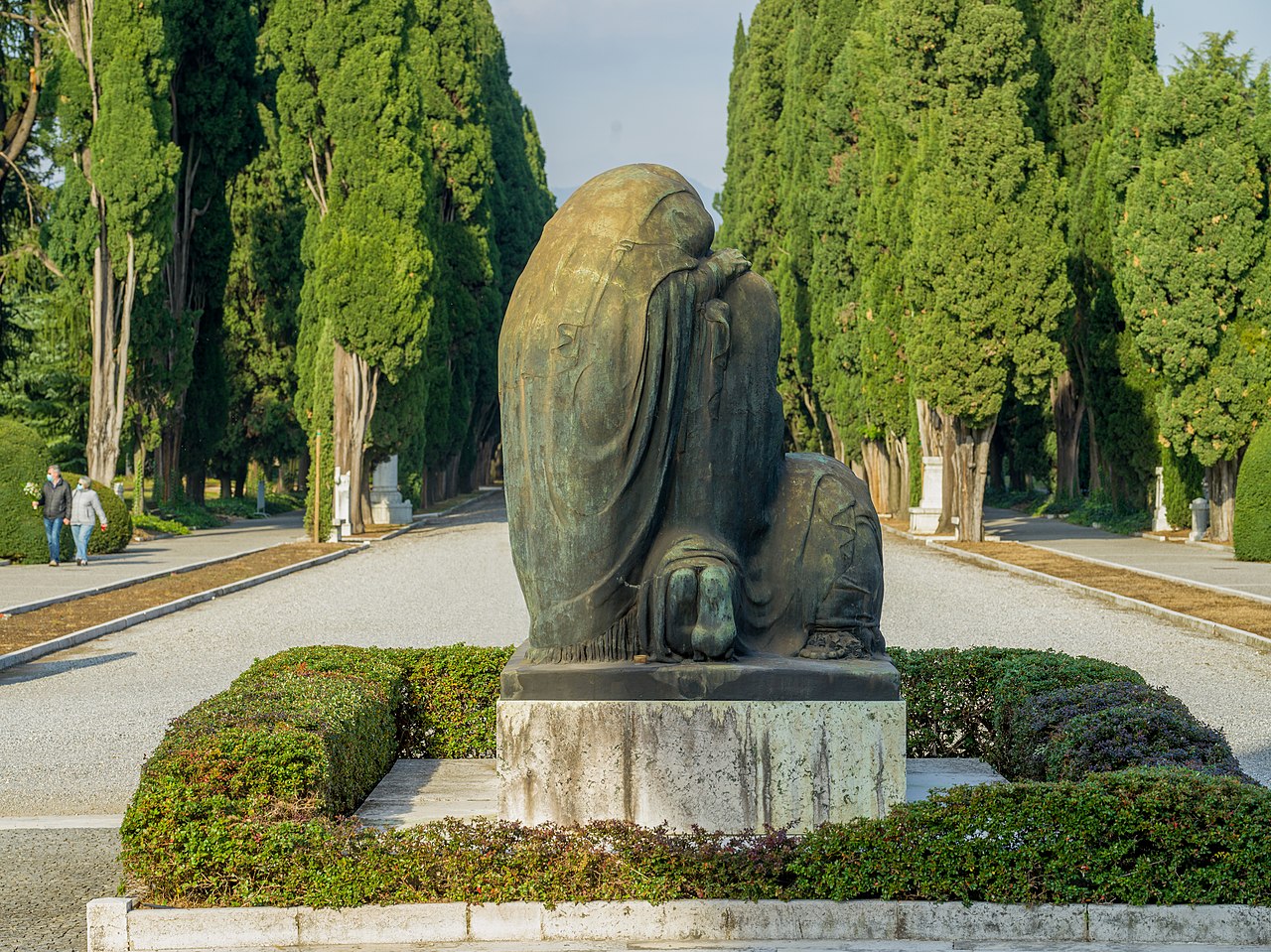
This Photo was taken by Wolfgang Moroder. Feel free to use my photos, but please mention me as the author and send me a message. This image is not in the public domain. Please respect the copyright · CC BY-SA 3.0
- Born
- 1877 · Modena.
- Died
- 1937 · Rome.
- Nationality
- Kingdom of Italy
- Occupation
- sculptor
VALÉORINE Encyclopedia
VALÉORINE documentary reading
Documentary summary
Ermenegildo Luppi (1877–1937) was an Italian sculptor. Ermenegildo Luppi was born in Modena, Luppi studied at the Academy of Fine Arts in his hometown under sculptor Giuseppe Gibellini. He moved to Rome in 1901, studying under Ettore Ferrari, and began exhibiting around 1903.
Admitted source layer · organised and presented by VALÉORINE
Reference Check
Propose documentary evidence for Ermenegildo Luppi. A contribution is never written directly as fact: identity, source, rights and evidence gates still decide.
Sign in to contribute
World of VALÉORINE
Documentary connections
Only confirmed graph relationships appear here. Images are shown only when their identity and reuse rights both pass the documentary gate.
Documentary evidence
Documentary basis
Authority files
wikidata · Q16268481 · wikipedia · Ermenegildo Luppi
In this article
Work
Work
After continuing his education in Florence in 1906 and 1907, Luppi returned to Rome permanently in 1907. Winning increasingly important government commissions, Luppi graduated from producing freestanding statues for exhibition into architectural sculpture and war memorials. A tendency towards Fascist imagery and style is clear in his mid-1920s memorials for Modena and Avezzano, both with powerful central figures of Victory. Political content becomes explicit in 1934 at the Palazzo del Podestà, now the City Hall of Foggia, where Luppi contributed two sculpted exterior panels which both feature a muscular Mussolini in heroic poses. Among other honours, Luppi was made a commander of the Order of the Crown of Italy and was elected to the Accademia di San Luca. He died in 1937.
Luppi's work includes: • exterior frieze Corteo della Bellezza e della Forza, for the Galleria Nazionale d'Arte Moderna building, Rome, architect Cesare Bazzani (1911) • Pieta, Cimitero di Brescia, Brescia (1922) • Monument to the Fallen of Modena in the First World War, along Viale Martiri della Libertà, Modena (1923–1926; unveiled 1929) • Monumento ai Caduti in Avezzano (1925–1928) • seven of the historical busts in the gardens of the Janiculum, Rome (Gabriele Martucci della Spada, Luigi Miceli, Paolo Narducci, Domenico Piva, Ricciotti Garibaldi, Bernardino Serafini, and Augusto Valenzani, completed between 1925 and 1937) • Dublin Lamentation, Dublin, Ireland, with sculptor A. Gardini (1930) • Mussolini panels, Palazzo del Podestà, Foggia, for architect Armando Brasini (1932) • Angel of Memory: a ten-foot-tall white marble statue by Luppi stands in the "Great Mausoleum" of Forest Lawn Memorial Park, Los Angeles, California, close to the grave of Elizabeth Taylor
Gallery
Gallery
• Illustration — Modena war memorial • Illustration — Avezzano war memorial • Illustration — Pietà in the monumental cemetery in Brescia

Bronze Pietà by Ermenegildo Luppi on the entrance of Saint Michael church in the Monumental cemetery in Brescia.
This Photo was taken by Wolfgang Moroder. Feel free to use my photos, but please mention me as the author and send me a message. This image is not in the public domain. Please respect the copyright

Bronze Pietà by Ermenegildo Luppi on the entrance of Saint Michael church in the Monumental cemetery in Brescia.
This Photo was taken by Wolfgang Moroder. Feel free to use my photos, but please mention me as the author and send me a message. This image is not in the public domain. Please respect the copyright
Life and career
Dated record
Life and career
The full dated record · 2 entries
1877
Ermenegildo Luppi was born on 21 October 1877.
1937
Ermenegildo Luppi died on 19 October 1937.
Places
Named by the record
Places
Only places the record itself states, plotted where the house gazetteer settles their coordinates. Nothing is inferred from a name or a nationality.
Modena.
Birth place
Rome.
Death place
Primary material
Documents and archives
reference work
- “Ermenegildo Luppi”, English Wikipedia, consulted as further reading
Reputable secondary · Wikipedia
authority record
- Wikidata, structured authority record Q16268481: Ermenegildo Luppi
General reference · Wikidata
Citations
References
Each reference names the institution holding it, so a reader may go to the document itself.
reference work
Secondary witnessauthority record
General reference
The Encyclopedia exists whether or not anything is for sale. Corrections are recorded rather than overwritten, and every version of this record is kept. Published 17 August 2026.
Elsewhere in Sculpture
6,174 published records in this field, each with its sources named.
- Erik ReimhultArtist
- Erik ThommesenArtist
- Erika RothenbergArtist
- Erika Stürmer-AlexArtist
- Ernest C. BairstowArtist
- Ernest ChristopheArtist
- Ernest DurigArtist
- Ernest GillickArtist
Best supported in this field
For owners
Own a work by Ermenegildo Luppi?
A specialist will read what you send and tell you what the house can establish, what it cannot, and whether the object is suited to sale. There is no charge and no obligation. The object stays with you throughout; nothing is shipped to us unless it is arranged in writing beforehand.