
Emma Soyer
Elizabeth Emma Soyer, née Jones (5 September 1813 – 30 August 1842) was an English painter, known as Emma Jones or Emma Soyer.
Also recorded as Emma nee Jones Soyer · Emma Jones Soyer · Elizabeth Emma, Miss Jones · Emma E. Soyer
Emma Soyer
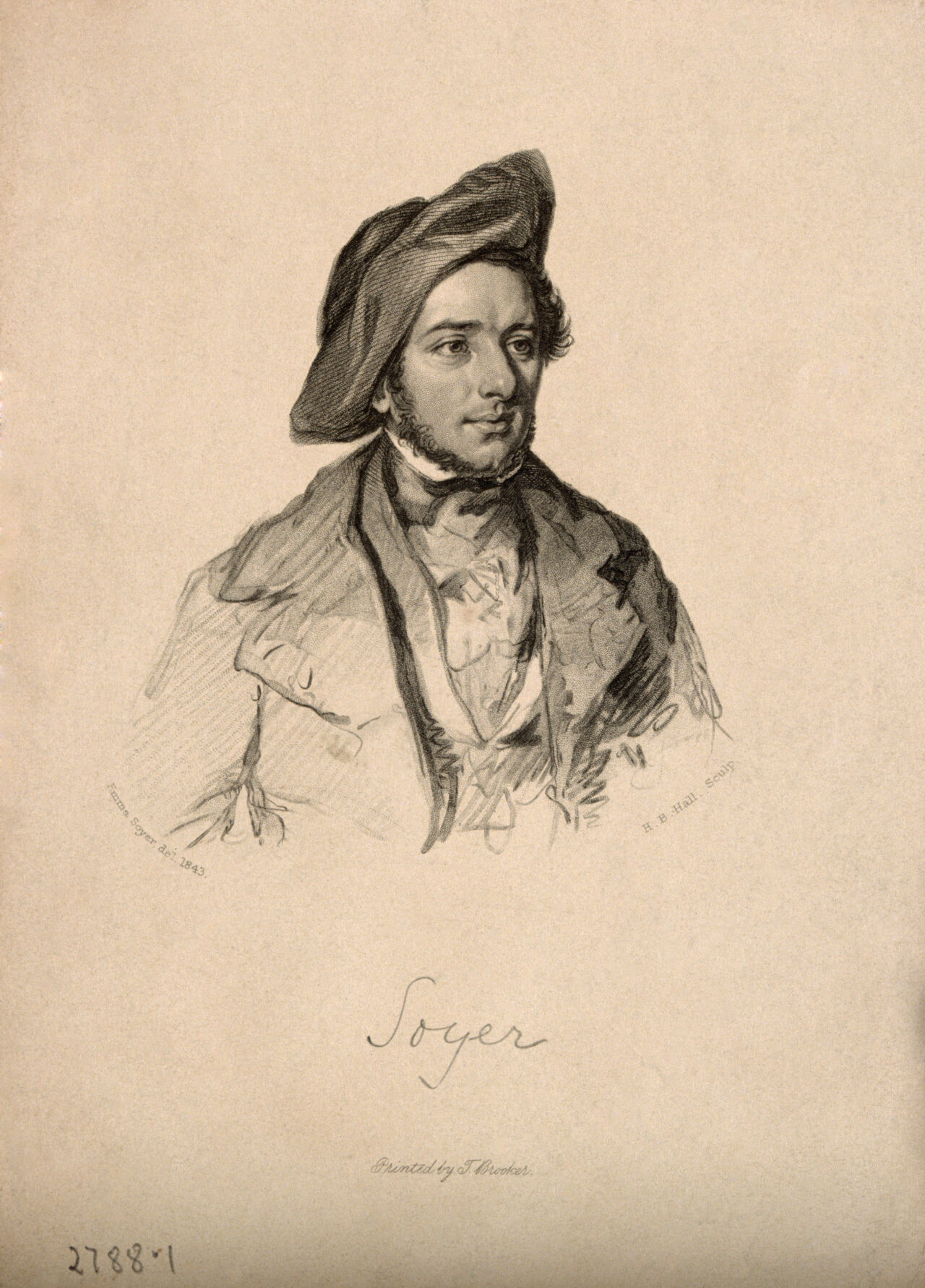
Emma Soyer · Wellcome Collection, London · Wellcome Collection · Public Domain Mark
- Name
- Emma Jones Soyer
- Birth Name
- Elizabeth Emma Jones
- Born
- 5 September 1813
- Birthplace
- London, England
- Died
- 30 August 1842
- Known for
- Portraiture, genre scene
- Spouse
- Alexis Soyer (m. 1837)
- Nationality
- United Kingdom of Great Britain and Ireland
- Occupation
- painter
- Teachers
- François Simonau
- Languages
- English
Reference Check
Propose documentary evidence for Emma Soyer. A contribution is never written directly as fact: identity, source, rights and evidence gates still decide.
Sign in to contribute
World of VALÉORINE
Documentary connections
Only confirmed graph relationships appear here. Images are shown only when their identity and reuse rights both pass the documentary gate.

Documentary evidence
Documentary basis
Authority files
wikidata · Q5362724 · wikipedia · Emma Soyer
VALÉORINE Encyclopedia
The documentary record
Statements marked “Documentary record” are set in the article beside the passage they confirm. Each is read from the authority records of the institutions named here; select “Prove” to see the record it was read from, where in that record, and when.
Institutions cited
Bibliothèque nationale de France
Complete reading chain (JSON)In this article
Key facts
Key facts
• Name — Emma Jones Soyer • Birth Name — Elizabeth Emma Jones • Born — 5 September 1813 • Birthplace — London, England • Died — 30 August 1842 • Place of death — London, England • Resting Place — Kensal Green Cemetery, London • Known for — Portraiture, genre scene • Notable Works — * Two Black Children with a Book • Watercress Woman • Portrait of Alexis Soyer • The Grandmother at Her Spinning Wheel • Spouse — Alexis Soyer (m. 1837) • Relatives — François Simonau, teacher and stepfather
Documentary record
Emma Soyer lived from 1813 to 1842 and is documented in the authority records of the Bibliothèque nationale de France. The birth of Emma Soyer is recorded in 1813, and the death in 1842.
Biography
Biography
• Illustration — Emma Soyer, Portrait of Alexis Soyer, 1841 (private collection, on loan to the Reform Club) Elizabeth Emma Jones was born in London in 1813, and was instructed in French, Italian, and music. At a very early age she became a pupil of the Belgian painter François Simonau (1783–1859), who in 1820 married her mother, Mrs. Jones. Finding that Emma had talents for drawing, Simoneau devoted the whole of his time to her instruction, and before the age of twelve she "had drawn more than a hundred portraits from life with great fidelity". She also became a talented pianist under the tutelage of Jean Ancot. On 12 April 1837, she married Alexis Soyer, the first senior chef at the Reform Club. She then turned her attention to portraits in oil, and, with Simoneau, travelled in the provinces, working in Canterbury, Ramsgate and Shrewsbury and gained great popularity. Upon her return to London, she produced "The Blind Boy", "The Crossing Sweeper", "The Bavarians", "Taglioni" and the "Kentish Ceres". In 1842 she completed her last work, "The Two Organ Boys". She also showed two paintings at the 1842 Paris Salon ("L'aveugle de la tour de Londres" and "Portrait de M. Soyer" - Nos. 1729–30). Her portrait of Soyer was engraved by Henry Bryan Hall. • Illustration — Monument at Kensal Green Cemetery On 29–30 August 1842, she had complications with her pregnancy, owing to fright produced by a thunderstorm, and she died the same night at her residence near Charing Cross, London. She was buried at Kensal Green Cemetery, London, on 8 September, where her husband erected a large monument to her memory. It is now Grade II* listed, giving it legal protection from unlawful modification or demolition. In her obituary, The Gentleman's Magazine described her as "Cut off when her reputation was about to make her fortune, and when, in spite of all obstacles, her merits were become known to her countrymen". Between 1823 and 1843, fourteen of her pictures were exhibited at the Royal Academy, thirty-eight at the British Institution, and fourteen at the Suffolk Street Gallery (Graves, Dictionary of Artists, pp. 130, 221). In June 1848, one hundred and forty of her works were exhibited at the Prince of Wales's bazaar, under the name of Soyer's Philanthropic Gallery, on behalf of the Spitalfields soup kitchen, and a catalogue was printed. Among these pictures was "The Young Savoyards Resting", a work which obtained for Madame Soyer the name of the "English Murillo". Two of her pieces, "The Jew Lemon Boys" and "The English Ceres", were engraved by Gérard. In Paris, where many of her pictures were exhibited, her reputation stood higher than in her native country.
Gallery
Gallery
• Illustration — A Young Italian with a Bust of William IV, 1831, exhibited at the British Institution, 1832 (black and white reproduction). • Illustration — Young Mariner and Dog, 1833 (New Haven, Yale Center for British Art) • Illustration — The Grandmother at her Spinning Wheel, 1835 (private collection) • Illustration — Two Children with Flowers, 1836 (private collection) • Illustration — The Escape, 1836 (Melbourne, National Gallery of Victoria) • Illustration — A girl with a basket of tulips, lilacs and other flowers, on a balcony before a landscape, c. 1836, (Melbourne, National Gallery of Victoria) • Illustration — The Two Inseparables, 1837 (private collection) • Illustration — Portrait of William Timms, the Waterman, aged 95, 1838 (Syon House, Duke of Northumberland's collection) • Illustration — Young Bavarians, c. 1838, Rollins Museum of Art • Illustration — Portrait of a woman, 1839 (private collection) • Illustration — Girl Nursing a Skye Terrier (Young Girl with a Dog), Towneley Hall Art Gallery And Museum • Illustration — The Young Israelites, engraving after Soyer's painting • Illustration — The English Ceres, engraving after Soyer's painting • Illustration — Young Bavarians or A Buy-a-Broom Girl and Her Brother, engraving after Soyer's painting
Legacy
• Illustration — Emma Jones (later Soyer), Two Children with a Book, 1831, (private collection, on loan to the Tate Britain since 2022) In September 2018 Soyer's painting of two black girls, in a tropical landscape, possibly painted for the slavery abolitionist cause in Britain, was featured on the BBC One television programme Fake or Fortune?. The picture is on long term loan to the Tate Britain since 2022. The artwork and Soyer herself are mentioned in Zadie Smith's 2023 novel The Fraud. Her portrait of Alexis Soyer is in the collection of the Reform club (on loan from a private collection).
Primary material
Documents and archives
reference work
- “Emma Soyer”, English Wikipedia, consulted as further reading
Reputable secondary · Wikipedia
authority record
- Wikidata, structured authority record Q5362724: Emma Soyer
General reference · Wikidata
Text attribution
Licensing
Text attribution
Part of the biographical narrative on this page reuses licensed material. Its origin, revision and licence are recorded here.
The biographical narrative on this page is based on the Wikipedia article Emma Soyer, revision 1369777691 (EN edition), by its contributors. VALÉORINE has edited that text and built its own documentary record around it. The reused material is available under CC BY-SA 4.0, and this page's reuse of it is offered under the same licence. Everything else on this page — the chronology, the holdings, the evidence, the plates and the connections — is VALÉORINE's own record. Sources and licences.
Notes from the source article
Cited by Wikipedia
Notes from the source article
These works are cited by the source article, in its own numbering. They are recorded as its citations, not as sources VALÉORINE has verified.
- 1.Ruth Cowen. Relish: The Extraordinary Life of Alexis Soyer, Victorian Celebrity Chef. Orion Publishing. 2010.
- 2.Brian Stewart & Mervyn Cutten. The Dictionary of Portrait Painters in Britain up to 1920. Antique Collectors' Club. 1997. 1-85149-173-2.
- 3.Obituary – Madame Soyer. The Gentleman's Magazine. 53. 666–8. July 1842.
- 4.National Portrait Gallery. NPG D6822; Alexis Benoît Soyer. Portrait.
- 5.Friends of Kensal Green Cemetery. Paths of Glory. 94. 1997.
- 6.1191060. Tomb of Elizabeth and Alexis Soyer.
- 7.Boase, George Clement. 53.
- 8.BBC One – Fake or Fortune?, Series 7, A Double Whodunnit. BBC.
- 9.'Two Children with a Book', Emma Soyer (née Jones), 1831. Tate.
- 10.Sanchez-Cabello, Dominic. Rediscovered Painting by Emma Soyer at Rollins Museum of Art. Dominic Fine Art. 23 August 2025.
- 11.Sanchez-Cabello, Dominic. Rediscovered Emma Soyer at the Towneley Museum. Dominic Fine Art. 8 March 2026.
- 12.Khan, Shuiab. Burnley gallery rediscovers painting by rare female artist. Lancashire Telegraph. 8 March 2026.
Bibliography printed in the source article · 2
- Brokenborough, Sarah. Envisioning “Negro Education” in the British West Indies: Emma Soyer’s Two Children with a Book. Nineteenth Century Studies. 37. 1–18. 17 December 2025. 10.5325/ninecentstud.37.0001.
- Soyer, Elizabeth Emma.
References
Citations
References
Each reference names the institution holding it, so a reader may go to the document itself.
reference work
Secondary witnessauthority record
General reference
The Encyclopedia exists whether or not anything is for sale. Corrections are recorded rather than overwritten, and every version of this record is kept. Published 16 August 2026.
Elsewhere in Paintings
19,456 published records in this field, each with its sources named.
- Emma ReyesArtist
- Emma RichardsonArtist
- Emma Richardson CherryArtist
- Emma SandysArtist
- Emma ThomsenArtist
- Emmanouil LampakisArtist
- Emmanouil ZairisArtist
- Emmanuel BennerArtist
Best supported in this field
For owners
Own a work by Emma Soyer?
A specialist will read what you send and tell you what the house can establish, what it cannot, and whether the object is suited to sale. There is no charge and no obligation. The object stays with you throughout; nothing is shipped to us unless it is arranged in writing beforehand.