
Edward Ihnatowicz
Edward Ihnatowicz (14 February 1926 in Chełm – 1988 in London) was a Polish cybernetic art sculptor active in the late 1960s and early 1970s. His sculptures explored the interaction between his robotic works and the audience. He was a pioneer of the use of computers in art and especially robots as art.
Edward Ihnatowicz
384 · CC BY-SA 4.0
- Nationality
- Soviet Union
- Occupation
- artist · sculptor
- Fields
- cybernetic art · computer art
- Education
- Ruskin School of Drawing and Fine Art
- Known for
- Senster
VALÉORINE Encyclopedia
VALÉORINE documentary reading
Documentary summary
Edward Ihnatowicz (14 February 1926 in Chełm – 1988 in London) was a Polish cybernetic art sculptor active in the late 1960s and early 1970s. His sculptures explored the interaction between his robotic works and the audience. He was a pioneer of the use of computers in art and especially robots as art.
Admitted source layer · organised and presented by VALÉORINE
Note VALÉORINE
Edward Ihnatowicz (1926–1988) was an artist and sculptor, of Soviet nationality. The artist was born in Chełm and died in London.
Edward Ihnatowicz was educated at Ruskin School of Drawing and Fine Art. The artist worked for University College London and was a member of Computer Arts Society. Activity centred on computer art and cybernetic art. Among the works is Senster.
Composed from admitted, traceable facts · 26 September 2026
VALÉORINE
Reference Check
Propose documentary evidence for Edward Ihnatowicz. A contribution is never written directly as fact: identity, source, rights and evidence gates still decide.
Sign in to contribute
World of VALÉORINE
Documentary connections
Only confirmed graph relationships appear here. Images are shown only when their identity and reuse rights both pass the documentary gate.

Documentary evidence
Documentary basis
Authority files
wikidata · Q5343589 · wikipedia · Edward Ihnatowicz
In this article
SAM
SAM
While these works are very significant in their own right, they acquire a particular meaning when re-considered today, since seen together they also configure a triangle of new aesthetic issues that has continually informed the main directions in robotic art. He was an active member of the Computer Arts Society.
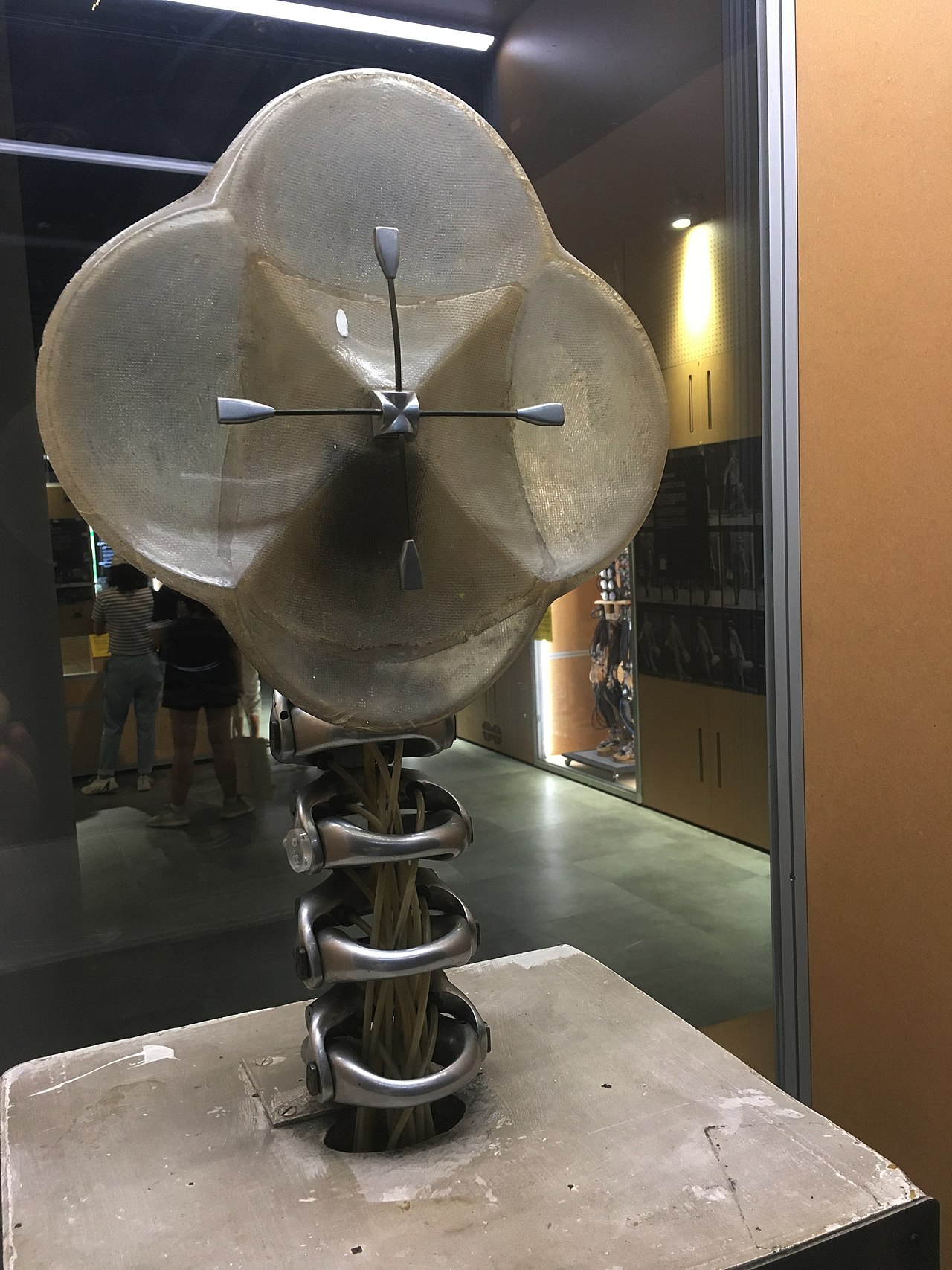
• Illustration — Sound Activated Mobile (1968) His first cybernetic work that moved directly and recognisably in response to what was going on around it was the Sound Activated Mobile (SAM). It had four microphones mounted in front of fiberglass parabolic reflectors (reminiscent of a flower) on top of a spine-like column of aluminium castings. Hydraulic pistons in the vertebra-like units allowed the neck to twist from side-to-side and bend forwards and backwards. An analogue circuit was used to control the hydraulics to move the robot to face the direction of the predominant sound. It was exhibited at the Cybernetic Serendipity exhibition which was held initially at the Institute of Contemporary Arts in London in 1968 and later toured Canada and the US ending at the Exploratorium in San Francisco. SAM's behaviour, that of turning to face people as they talked and tracking their movement if they continued to make a sound, together with its sensitivity to quiet but sustained noise, rather than loud shouts, encouraged many people to spend time in front of it, trying to attract its attention.
The Senster
The Senster
His most significant work was The Senster, a large hydraulically actuated robot that followed the sound and motion of the people around it, giving the impression of being alive. The Senster was the first robotic sculpture to be controlled by a computer. It used an array of four microphones to detect the direction of the sound around it and two Doppler radar arrays to measure the motion of people. A computer program controlled the hydraulic actuators to move the body so that the Senster was attracted by sound and movement but repelled by loud noises and violent motion. The program bears a strong resemblance to that used in behavior-based robotics developed a decade later.
The Bandit
The Bandit
His final work of Cybernetic Art was The Bandit, which was exhibited at the Computer Arts Society exhibition at the Edinburgh Festival, UK in 1973. It was a hydraulically actuated lever controlled by a computer and had two modes: one where it was position controlled and one where it was force controlled. When a visitor first held onto the lever, it was force controlled, with a demand value of zero. The person could thus move the arm as he/she pleased. The computer system recorded the series of motions, then switched to position control mode, where it played the series of positions back to the person. The way the person reacted to the motion of the arm was statistically analysed and the computer program printed out its classification of the gender and temperament of the person.
Biography
Biography
From 1939 to 1943 Ihnatowicz was a war refugee in Romania and Algiers. In 1943 he arrived in Britain and from 1945 to 1949 he attended The Ruskin School of Drawing and Fine Art, Oxford. From 1971 to 1986 he worked as a Research Assistant in the Department of Mechanical Engineering at University College London.
Identity and overview
Identity and overview
The following is established of the heading itself.
Works and production
Works and production
The following works and productions are recorded by name or by count. It is also recorded that edward Ihnatowicz is recorded with the occupation visual artist.
Places
Named by the record
Places
Only places the record itself states, plotted where the house gazetteer settles their coordinates. Nothing is inferred from a name or a nationality.
Chełm.
Birth place
London.
Death place
Primary material
Documents and archives
scholarly publication
- Elegant motion: The Senster and other cybernetic sculptures by Edward Ihnatowicz, Kybernetes, 2011
Scholarly · Crossref registry · 2011
authority record
- Wikidata, structured authority record Q5343589: Edward Ihnatowicz
General reference · Wikidata
reference work
- “Edward Ihnatowicz”, English Wikipedia, consulted as further reading
Reputable secondary · Wikipedia
Notes from the source article
Cited by Wikipedia
Notes from the source article
These works are cited by the source article, in its own numbering. They are recorded as its citations, not as sources VALÉORINE has verified.
- 1.Reffin Smith, Brian. Soft Computing: art and design. Addison-Wesley. 1984.
- 2.Brown, Paul. Emergent Behaviours towards computational aesthetics. Artlink. 16. 2 & 3. 75–83. July 1996.
- 3.Zivanovic, Aleksandar. The Development of a Cybernetic Sculptor: Edward Ihnatowicz and The Senster. Creativity and Cognition Conference. 586–591. April 12–15, 2005.
- 4.Zivanovic, Aleksandar. SAM, The Senster and The Bandit: Early Cybernetic Sculptures by Edward Ihnatowicz. Robotics, Mechatronics and Animatronics in the Creative and Entertainment Industries and Arts Symposium, AISB 2005 Convention. April 13, 2005.
- 5.Reichardt, Jasia. Art at large. New Scientist. May 4, 1972.
- 6.Kac, Eduardo. Origin and Development of Robotic Art. Art Journal. 56. 3. 60–67. 1997. 10.1080/00043249.1997.10791834.
- 7.Reichardt, Jasia. Cybernetic Serendipity: the computer and the arts. Studio International. 1968.
- 8.Reichardt, Jasia. Cybernetics, Art and Ideas. Studio Vista London. 1971.
- 9.Benthall, Jonathan. Science and Technology in Art Today. Thames and Hudson. 1972.
- 10.Reichardt, Jasia. Robots: Fact, Fiction + Prediction. Thames and Hudson. 1978.
- 11.Simons, Geoff. Are Computers Alive?. Harvester. 1983. 0-7108-0501-2.
- 12.Michie, Donald. The Creative Computer: Machine Intelligence and Human Knowledge. Penguin Books. 1984.
References
Citations
References
Each reference names the institution holding it, so a reader may go to the document itself.
scholarly publication
Elegant motion: The Senster and other cybernetic sculptures by Edward Ihnatowicz, Kybernetes, 2011Crossref registry
Institutional witnessauthority record
Secondary witnessreference work
Secondary witness
Further particulars
Held on the record
Further particulars
Open the remaining particulars
This entry is compiled from 5 catalogued sources across 4 independent registers. The registers consulted are Crossref registry, Wikipedia, Wikimedia Foundation and DOAJ. Every statement above is held against the register that stated it; where the registers are silent, the entry is silent.
The Encyclopedia exists whether or not anything is for sale. Corrections are recorded rather than overwritten, and every version of this record is kept. Published 17 August 2026.
Elsewhere in Sculpture
6,174 published records in this field, each with its sources named.
- Edward ChiwawaArtist
- Edward Clark PotterArtist
- Edward DelaneyArtist
- Edward Hodges BailyArtist
- Edward LeedskalninArtist
- Edward M. BrownleeArtist
- Edward MaeneArtist
- Edward MarshallArtist
Best supported in this field
For owners
Own a work by Edward Ihnatowicz?
A specialist will read what you send and tell you what the house can establish, what it cannot, and whether the object is suited to sale. There is no charge and no obligation. The object stays with you throughout; nothing is shipped to us unless it is arranged in writing beforehand.