
Edward Hodges Baily
Edward Hodges Baily (10 March 1788 – 22 May 1867; sometimes misspelled Bailey) was a prolific British sculptor responsible for numerous public monuments, portrait busts, statues and exhibition pieces as well as works in silver. He carved friezes for both the Marble Arch and Buckingham Palace in London. His numerous statues of public figures include that of Horatio Nelson on top of Nelson's Column and Charles Grey, 2nd Earl Grey on Grey's Monument in Newcastle upon Tyne.
Also recorded as Edward Hodges Bailey · E. H. Baily
Edward Hodges Baily
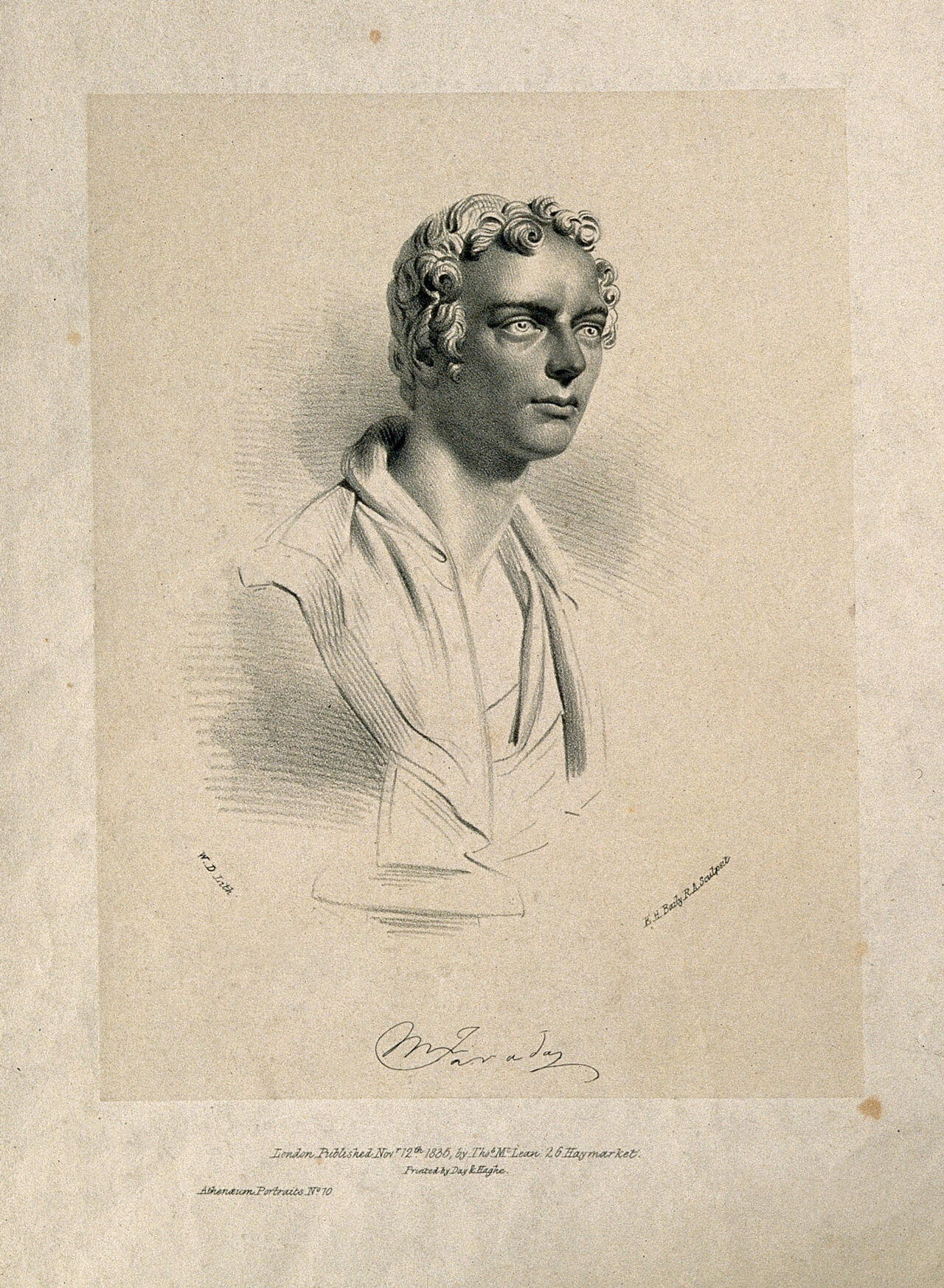
Edward Hodges Baily · Wellcome Collection, London · Wellcome Collection · Public Domain Mark
- Born
- 10 March 1788
- Birthplace
- Bristol, England
- Died
- 22 May 1867
- Place of death
- London, England
- Awards
- FRS, Turner Gold Medal
- Known for
- Sculpting
- Nationality
- United Kingdom of Great Britain and Ireland · Kingdom of Great Britain
- Occupation
- sculptor · artist
VALÉORINE Encyclopedia
VALÉORINE documentary reading
Documentary summary
Edward Hodges Baily (10 March 1788 – 22 May 1867; sometimes misspelled Bailey) was a prolific British sculptor responsible for numerous public monuments, portrait busts, statues and exhibition pieces as well as works in silver. He carved friezes for both the Marble Arch and Buckingham Palace in London. His numerous statues of public figures include that of Horatio Nelson on top of Nelson's Column and Charles Grey, 2nd Earl Grey on Grey's Monument in Newcastle upon Tyne.
Admitted source layer · organised and presented by VALÉORINE
Reference Check
Propose documentary evidence for Edward Hodges Baily. A contribution is never written directly as fact: identity, source, rights and evidence gates still decide.
Sign in to contribute
Documentary evidence
Documentary basis
Authority files
wikidata · Q204363 · wikipedia · Edward Hodges Baily
In this article
Biography
Biography
Throughout his career Baily was responsible for creating a number of monuments and memorials for British churches and cathedrals, including several in St Paul's Cathedral.
Key facts
Key facts
• Born — 10 March 1788 • Birthplace — Bristol, England • Died — 22 May 1867 • Place of death — London, England • Awards — FRS, Turner Gold Medal • Known for — Sculpting • Notable Works — Nelson's Column
Biography
Biography
Baily was born on 10 March 1788, at Downend in Gloucestershire, to Martha Hodges (1755–1836) and William Hillier Baily (1763–1834), a woodcutter who specialised in carving ship's figureheads. At the age of fourteen he was placed as an accounts clerk in a mercantile house, where he worked for two years, though he continued to produce wax models and busts, his childhood hobby. In 1804, aged sixteen, he abandoned his job and set himself up as a professional wax portraitist. Two Homeric studies, executed for a friend, were shown to the sculptor John Flaxman who was so impressed, that in 1807, he accepted Baily as a pupil in his London studio and subsequently employed him as an assistant. In 1808, Baily won the silver medal of the Society of Arts for a plaster figure of Laocoön and the next year entered the Royal Academy Schools. At the academy he won a silver medal in 1809 and in 1811 he gained their gold medal for a model of Hercules restoring Alcestis to Admetus, and soon after exhibited Apollo discharging his Arrows against the Greeks and Hercules casting Lichas into the Sea. • Illustration — Eve at the Fountain, 1822 From 1816 to 1846, Baily was the Chief Modeller for Rundell, Bridge and Rundell, goldsmiths to the royal family, where he was responsible for creating the Doncaster Cup trophy in 1843 and the Ascot Gold Cup in 1844. Baily also produced designs for the silversmith Paul Storr. For a soup tureen commission in 1821, Baily designed a pair of ornamental handles which became the basis of his large scale marble sculpture Eve at the Fountain, which was acquired by the Bristol Literary Institute and is now in the Bristol Museum & Art Gallery. Widely reproduced at reduced sizes in both Parian ware and bronze, the work was among the most popular individual sculptures in Britain at the time. Baily returned to Eve as a subject in 1842 with the work Eve listening to the Voice. Baily was elected an Associate member of the Royal Academy in 1817 and, on the strength of Eve at the Fountain, a full Academician in 1821. • Illustration — Baily's statue of Nelson on Nelson's Column From the 1820s until 1858, Baily had a series of high-profile public commissions and was also responsible for numerous portrait busts, statues and exhibition pieces. He carved the bas-reliefs on the facade of the Masonic Hall on Park Street in Bristol and those on the south side of the Marble Arch in Hyde Park in 1826. When changes were made to the size and design of the Marble Arch, a number of friezes that Baily had carved were considered surplus to requirements but were installed on the facade of Buckingham Palace. He also designed the models of the stone figures installed on the pediment of Buckingham Palace when the building was enlarged and carved the frieze Britannia Rewarding Arts and Sciences for the Palace's throne room. He created the prominent statue of Horatio Nelson for the top of Nelson's Column, in Trafalgar Square. For the facade of the National Gallery facing onto Trafalgar Square he created a series of statues and friezes. Baily exhibited at the Royal Academy regularly from 1810 to 1862 and at the British Institution from 1812 to 1840. His exhibition pieces often represented aspects of family life with titles such as Maternal Affection and Mother and Child. For Saint Stephen's Hall in the Palace of Westminster he created statues of Charles James Fox and Lord Mansfield. Subjects of his portrait busts included the Duke of Wellington, his mentor John Flaxman and Lord Byron. Several of his designs for monuments were cast as small scales bronzes for the domestic retail market, notably his equestrian statue of George IV. Financial insecurity was a recurring theme in Baily's life. He was first declared bankrupt in 1831, and again in 1838. On the first occasion questions were asked in Parliament on his behalf because his financial distress had resulted from delays in receiving payment for sculptures at Buckingham Palace. Fortunately his appeals to the Royal Academy for financial assistance, were successful in the 1830s, as again in the 1860s, when they provided him with a pension of £200 a year as an honorary retired Academician. Baily's election as a fellow of the Royal Society (FRS) came in 1842. Among his final works was the design for the Turner medal in 1857, the Royal Academy's award for landscape painting. • Illustration — Baily's grave in Highgate Cemetery Baily married Elizabeth Wardley (1786–1836) in Bristol during 1806 and the couple had four children. Their daughter, Caroline, married Edgar George Papworth Senior one of Baily's assistants. Among his other assistants and pupils were John Henry Foley, Musgrave Watson, Joseph Durham, Edward Bowring Stephens and William Theed. Baily's nephew was William Hellier Baily, the paleontologist. Baily died at 99 Devonshire Road in Holloway, London, on 22 May 1867, aged 79, and is buried on the western side of Highgate Cemetery.
Other works
Other works
• The Victoria and Albert Museum in London has Baily's Marius among the ruins of Carthage, a plaster model for a full-size marble sculpture he exhibited at the Royal Academy in 1833. The museum also has a marble bust by Baily of an unidentified man from 1850. • Lord Byron, 1826, Harrow School; and Newstead Abbey, Nottinghamshire • Michael Faraday, 1830, University Museum, Oxford • Philip John Miles, Holy Trinity, Abbots Leigh • Richard Owen, 1846, Royal College of Surgeons • Sir John Herschel, 1850, St. John's College, Cambridge • Busts of Thomas Bewick and Sir James Knott – Literary and Philosophical Society of Newcastle upon Tyne • Charles Metcalfe, 1st Baron Metcalfe, a marble bust from 1844 in the Victoria Memorial, Kolkata • Justice – Old Council House, Bristol • Five statues in niches representing Christ and the Evangelists, after originals by Bertel Thorvaldsen, in the Church of St Margaret at Grittleton, Wiltshire. • Marble bust of John Flaxman in the Royal Academy with a copy, c. 1836 in Coade stone in the British Museum.
Life and career
Dated record
Life and career
The full dated record · 2 entries
1788
Edward Hodges Baily was born in 1788.
1867
Edward Hodges Baily died at Holloway.
Church monuments and memorials
Throughout his career Baily was responsible for creating a number of monuments and memorials for British churches and cathedrals. Examples include • Illustration — Memorial to Robert Gray, Bristol Cathedral • A tablet with two marble full-length angels, to Samuel Paynter, of Richmond at St Mary Magdalene, Richmond. • Several memorials in the Church of St Nicholas, Lintn Hill, Maidstone, at St James, Uttoxeter Road, Stoke-on-Trent and at St John the Baptist, Devizes • Memorial with kneeling female figure, Church of the Holy Trinity, Ardington, Oxfordshire • Memorials to Peter Denys, died 1816, and to Lady Charlotte Denys, died 1835, Church of St Mary, Easton Neston, Northamptonshire • Two memorials, to Benjamin Newcombe (1818) and to George Gostling (1854) in Church of St John the Baptist, Egham High Street • Memorial plaque to A Walker Heneage, died 1828, in the Church of St Swithin, Compton Bassett • Memorial tablet for Elizabeth Bell (1829), Church of St James, Lincolnshire • Large memorial to J. Spearing, died 1831, Church of St Mary, Potterne, Wiltshire • Memorials to John Ogle, died 1831, and to Sara Ogle, died 1846, in the Church of Saint Mary Magdalene, Whalton • Memorial, with medallion bust, to Bishop John Jebb, died 1833, in the Church of the Holy Trinity, Clapham Common, London • A chancel wall plaque 1836, Church of St Andrew, Heddington, Wiltshire • Wall monument to Thomas Botfield, died 1843, Church of St Michael, Hopton Wafers, Shropshire • A memorial with carved figure, 1846, Church of St Mary, Hertfordshire • A sculpture group memorial to John Thackeray, died 1851, Church of St Mary the Virgin, Lewisham High Street, London
Notes from the source article
Cited by Wikipedia
Notes from the source article
These works are cited by the source article, in its own numbering. They are recorded as its citations, not as sources VALÉORINE has verified.
- 1.Katharine Eustice. Baily, Edward Hodges. 8 April 2021. 10.1093/ref:odnb/1076.
- 2.Rupert Gunnis. Dictionary of British Sculptors 1660–1851. The Abbey Library.
- 3.James Mackay. The Dictionary of Western Sculptors in Bronze. Antique Collectors' Club. 1977. 0902028553.
- 4.3. 221.
- 5.Eve listening to the Voice. Victoria & Albert Museum.
- 6.Ernest Radford. 2. 427.
- 7.1239534. The Marble Arch.
- 8.Jo Darke. The Monument Guide to England and Wales. Macdonald Illustrated. 1991. 0-356-17609-6.
- 9.Frederick Teague Cansick. The Monumental Inscriptions of Middlesex Vol 2. J Russell Smith. 128. 1872.
- 10.1355309. Cathedral of St Nicholas.
- 11.Memorial to Calverly Berwick. The Courtauld Institute of Art.
- 12.St Paul's Cathedral. Church Monument Gazetter.
- 13.Monument to Sir William Ponsonby. The Courtauld Institute of Art.
- 14.Diane Bilbey with Marjorie Trusted. British Sculpture 1470 to 2000 A Concise Catalogue of the Collection at the Victoria and Albert Museum. V&A Publications. 2002. 1851773959.
- 15.1282205. Freemasons' Hall and Attached Cast Iron Railings.
- 16.Mary Ann Steggles & Richard Barnes. British Sculpture in India: New Views & Old Memories. Frontier Publishing. 2011. 9781872914411.
- 17.Henry Fuseli. National Portrait Gallery.
- 18.Statue of John, Earl of St Vincent. The Courtauld Institute of Art.
- 19.The Battle of St Vincent Frieze. Art UK.
- 20.1330416. Parish Church of St Mary.
- 21.War Memorials Register: Sir T Picton. Imperial War Museum.
- 22.9503. Picton Monument.
- 23.Philip Ward-Jackson. Public Sculpture of Britain Volume 1: Public Sculpture of Historic Westminster. Liverpool University Press / Public Monuments & Sculpture Association. 2011. 978-1-84631-662-3.
- 24.1225842. The Athenaeum.
- 25.Sir Thomas Lawrence. National Portrait Gallery.
- 26.Monument to Sir Pulteney Malcolm. The Courtauld Institute of Art.
- 27.1224199. The Parish Church of St Mary.
- 28.1329931. Earl Grey Monument.
- 29.Thomas Telford. Westminster Abbey.
- 30.1276052. The Nelson Monument (Nelson's Column).
- 31.Charles James Fox and Henry V. Fox, Lord Holland. Westminster Abbey.
- 32.Monument to Sir Astley Paston Cooper. The Courtauld Institute of Art.
- 33.Dictionary of Sydney: Sir Richard Bourke statue. State Library of New South Wales.
- 34.1235434. Monument to Isaac Watts in Abney Park Cemetery.
- 35.1099160. Statue of Sir Nicholas Conyngham Tindal.
- 36.1218041. Cathedral Church of St Mary.
- 37.University of Glasgow History of Art / HATII. Statue, in marble, of the late Thomas Fleming, Esq of Manchester. Mapping the Practice and Profession of Sculpture in Britain & Ireland 1851–1951. 2011.
- 38.1356807. Statue of Sir Robert Peel.
- 39.Marble statue of George Stephenson, 1852. Science Museum Group.
- 40.William Murray 1st Earl of Mansfield 1705-99 Speaker 1760 1770-1. UK Parliament.
- 41.Charles James Fox 1749-1806 Whig Reformer. UK Parliament.
- 42.Malcolm Hay & Jacqueline Riding. Art in Parliament - The Permanent Collection of the House of Commons. Jarrod Publishing & The Palace of Westminster. 1996. 0-7117-0898-3.
- 43.1250235. Church of St Nicholas.
- 44.1210730. Church of St James.
- 45.1262359. Church of St John the Baptist.
- 46.1048189. Church of Holy Trinity.
- 47.1189210. Church of St Mary.
- 48.1189321. Church of Saint John the Baptist.
- 49.1363781. Church of St Swithin.
- 50.1379386. Church of St James.
- 51.1258968. Church of St Mary.
- 52.1247805. Church of Saint Mary Magdalene.
- 53.1080491. Church of Holy Trinity.
- 54.1261202. Church of St Andrew.
- 55.1383537. Church of St Michael.
- 56.1347611. Church of St Mary.
- 57.1193297. Church of St Mary the Virgin.
- 58.1207433. The Old Council House & attached front gates.
- 59.1022289. Church of St Margaret.
- 60.Aileen Dawson. Portrait Sculpture A Catalogue of the British Museum collection c. 1675-1975. British Museum Press. 1999. 0714105988.
Bibliography printed in the source article · 1
References
Citations
References
Each reference names the institution holding it, so a reader may go to the document itself.
reference work
Secondary witnessreference work
Secondary witness
Further particulars
Held on the record
Further particulars
Open the remaining particulars
Edward Hodges Baily received Fellow of the Royal Society.
Recognition and collections
Work by Edward Hodges Baily is
Tate, Victoria Memorial and Yale Center for British Art
The Encyclopedia exists whether or not anything is for sale. Corrections are recorded rather than overwritten, and every version of this record is kept. Published 14 August 2026.
Elsewhere in Sculpture
6,174 published records in this field, each with its sources named.
- Edward Buk UlreichArtist
- Edward ChiwawaArtist
- Edward Clark PotterArtist
- Edward DelaneyArtist
- Edward IhnatowiczArtist
- Edward LeedskalninArtist
- Edward M. BrownleeArtist
- Edward MaeneArtist
Best supported in this field
For owners
Own a work by Edward Hodges Baily?
A specialist will read what you send and tell you what the house can establish, what it cannot, and whether the object is suited to sale. There is no charge and no obligation. The object stays with you throughout; nothing is shipped to us unless it is arranged in writing beforehand.