
Dong Qichang
Dong • Illustration — Portrait of Dong Qichang Dong Qichang (courtesy name Xuanzai (玄宰); 1555–1636) was a Chinese art theorist, calligrapher, painter, and politician of the later period of the Ming dynasty.
Also recorded as Qichang Dong · Kishō Tō · Xuanzai Dong · Wen-min Tung
Dong Qichang
Dong Qichang · The Cleveland Museum of Art · Leonard C. Hanna Jr. Fund · CC0
- Born
- 1555 · Songjiang.
- Died
- 1636
- Nationality
- Ming dynasty
- Occupation
- painter · calligrapher · writer · poet · politician · art historian · art theorist
- Fields
- painting · shan shui
- Languages
- Classical Chinese · Old Mandarin
VALÉORINE Encyclopedia
VALÉORINE documentary reading
Documentary summary
Dong • Illustration — Portrait of Dong Qichang Dong Qichang (courtesy name Xuanzai (玄宰); 1555–1636) was a Chinese art theorist, calligrapher, painter, and politician of the later period of the Ming dynasty.
Admitted source layer · organised and presented by VALÉORINE
Note VALÉORINE
No house-authored Note is published until its assertions and sources pass the VALÉORINE evidence contract. The documentary article remains available in full while that enrichment is being consolidated.
Documentary enrichment in progress · no unsupported statement published
Reference Check
Propose documentary evidence for Dong Qichang. A contribution is never written directly as fact: identity, source, rights and evidence gates still decide.
Sign in to contribute
World of VALÉORINE
Documentary connections
Only confirmed graph relationships appear here. Images are shown only when their identity and reuse rights both pass the documentary gate.
Documentary evidence
Evidence Panel
not yet certified
- Identity
- resolved
- Independent source families
- 0
- Admitted assertions
- 0
- Open conflicts
- 0
Authority files
getty · 500125621 · gnd · 11862458X · wikidata · Q537211 · wikipedia · Dong Qichang
In this article
Life as a scholar and calligrapher
Life as a scholar and calligrapher
Wang Shimin is recorded as having studied under Dong Qichang. The recorded working language is Classical Chinese and Old Mandarin. The field of work recorded is painting and shan shui. Mi Fu, Dong Yuan and Juran are recorded as an influence. Positions recorded include Hanlin Academy bianxiu and Minister of Rites. Work by Dong Qichang is recorded in the collections of The Nelson-Atkins Museum of Art, National Gallery of Victoria, Metropolitan Museum of Art, Fralin Museum of Art and Yale University Art Gallery.
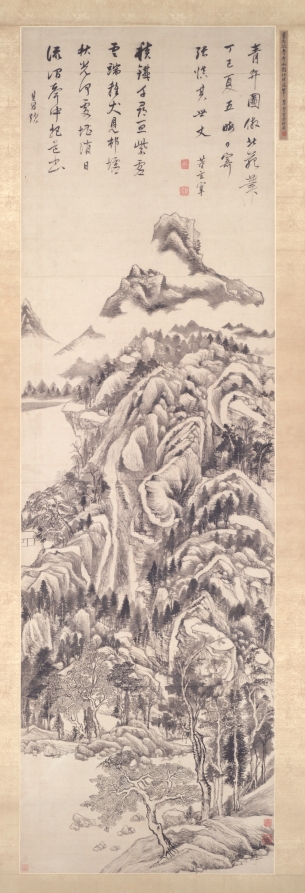
Dong Qichang was a native of Hua Ting (located in modern-day Shanghai), the son of a teacher and somewhat precocious as a child. At 12, he passed the prefectural Civil service entrance examination and won a coveted spot at the prefectural Government school. He first took the imperial civil service exam at seventeen, but placed second to a cousin because his calligraphy was clumsy. This led him to train until he became a noted calligrapher. Once this occurred, he rose up the ranks of the imperial service passing the highest level at the age of 35. He rose to an official position with the Ministry of Rites. Qichang's calligraphy drew inspiration from prominent calligraphers Wen Zhengming and Zhao Mengfu and of the masters of the Jin and Tang dynasties. • Illustration — Landscape with Calligraphy, Tokyo National Museum. His positions in the bureaucracy were not without controversy. In 1605 he was giving the exam when the candidates demonstrated against him causing his temporary retirement. In other cases he insulted and beat women who came to his home with grievances. That led to his house being burned down by an angry mob. He also had tense relations with the eunuchs common to the scholar bureaucracy. Dong's tomb in Songjiang District was vandalized during the Cultural Revolution, and his body dressed in official Ming court robes, was desecrated by Red Guards.
Painter
Painter
His work favored expression over formal likeness. He also avoided anything he deemed to be slick or sentimental. This led him to create landscapes with intentionally distorted spatial features. Still his work was in no way abstract as it took elements from earlier Yuan masters, specifically, the Four Masters of the Yuan Dynasty. His views on expression had importance to later "individualist" painters.
Life and career
Dated record
Life and career
The full dated record · 2 entries
1555
Dong Qichang born at Songjiang.
1636
Dong Qichang died.
Art theory
In his art theoretical writings, Dong developed the theory that Chinese painting could be divided into two schools: the "Northern" school, characterized by fine lines and colors, and the "Southern", school noted for its quick calligraphic strokes, as first suggested to him by his friend and older contemporary Mo Shilong. These names are misleading as they refer to Northern and Southern schools of Chan Buddhism thought rather than geographic areas (hence a Northern painter could be geographically from the south and a Southern painter geographically from the north). He strongly favored the Southern school and dismissed the Northern school as superficial or merely decorative. Maintaining that the Northern school realized truth gradually, while the Southern school intuitively brought the actualization of such insight. His ideal of Southern school painting was one where the artist forms a new style of individualistic painting by building on and transforming the style of traditional masters. This was to correspond with sudden enlightenment, as favored by Southern Chan Buddhism. He was a great admirer of Mi Fu and Ni Zan. By relating to the ancient masters' style, artists are to create a place for themselves within the tradition, not by mere imitation, but by extending and even surpassing the art of the past. Dong's theories, combining veneration of past masters with a creative forward looking spark, would be very influential on Qing dynasty artists as well as collectors, "especially some of the newly rich collectors of Sungchiang, Huichou in Southern Anhui, Yangchou, and other places where wealth was concentrated in this period". Together with other early self-appointed arbiters of taste known as the Nine Friends, he helped determine which painters were to be considered collectible (or not). As Cahill points out, such men were the forerunners of today's art historians. His classifications were quite perceptive and he is credited with being "the first art historian to do more than list and grade artists."

River and Mountains on a Clear Autumn Day, c. 1624–27, by Dong Qichang
Dong Qichang · The Cleveland Museum of Art · Purchase from the J. H. Wade Fund
Primary material
Documents and archives
authority file
- Gemeinsame Normdatei 11862458X, Dong, Qichang.
Unverified · Deutsche Nationalbibliothek
- Getty Union List of Artist Names 500125621, Dong Qichang.
Unverified · The Getty Research Institute
reference work
- Wikidata, structured authority record Q537211: Dong Qichang
Reputable secondary · Wikimedia Foundation
- “Dong Qichang”, English Wikipedia, consulted as further reading
Reputable secondary · Wikipedia
scholarly publication
- 董其昌扇面繪畫 (Fan Painting by Dong Qichang), 2018
Scholarly · Crossref registry · 2018
Citations
References
Each reference names the institution holding it, so a reader may go to the document itself.
scholarly publication
董其昌扇面繪畫 (Fan Painting by Dong Qichang), 2018Crossref registry
Verifiedauthority file
Gemeinsame Normdatei 11862458X, Dong, Qichang.Deutsche Nationalbibliothek
Partially resolvedauthority file
Getty Union List of Artist Names 500125621, Dong Qichang.The Getty Research Institute
Partially resolvedreference work
Wikidata, structured authority record Q537211: Dong QichangWikimedia Foundation
Partially resolvedreference work
Partially resolved
The Encyclopedia exists whether or not anything is for sale. Corrections are recorded rather than overwritten, and every version of this record is kept. Published 14 August 2026.
Elsewhere in Paintings
18,705 published records in this field, each with its sources named.
- Donato VenezianoArtist
- Doncho DonchevArtist
- Dong GaoArtist
- Dong HaoArtist
- Dong XiaowanArtist
- Dong XiwenArtist
- Dong YuanArtist
- Dong-shin BaeArtist
Best supported in this field
For owners
Own a work by Dong Qichang?
A specialist will read what you send and tell you what the house can establish, what it cannot, and whether the object is suited to sale. There is no charge and no obligation. The object stays with you throughout; nothing is shipped to us unless it is arranged in writing beforehand.