
Camille Roqueplan
Illustration — Camille Roqueplan; portrait lithograph by Jacques Auguste Regnier (1855) Camille Joseph Etienne Roqueplan (18 February 1802/03 – 29 September 1855) was a French Romantic painter of landscapes, genre and historical scenes.
Also recorded as Camille-Joseph-Etienne Rocoplan · Camille Joseph Étienne Roqueplan · Camille Roquesolan · Camille Joseph Etienne Roqueplan
Camille Roqueplan
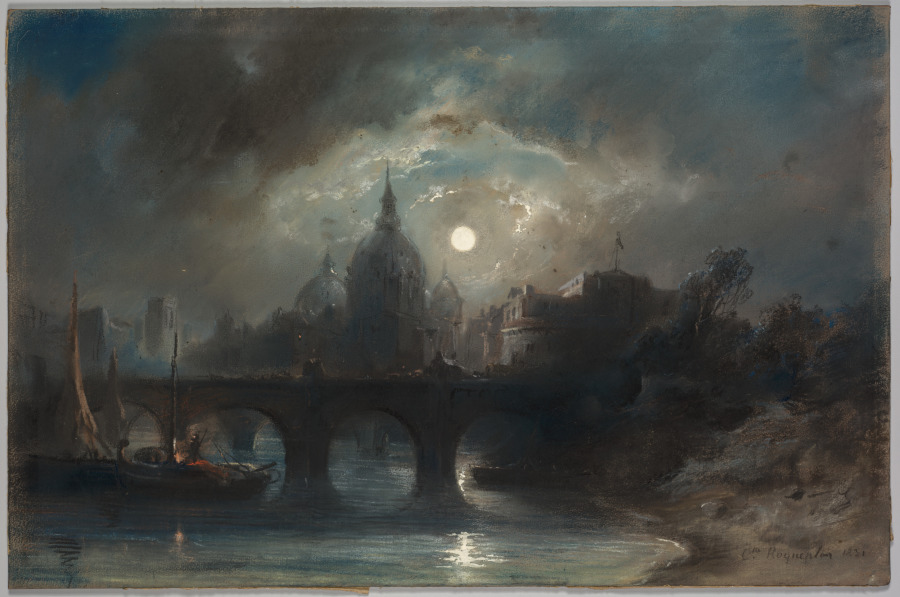
Camille Roqueplan · The Cleveland Museum of Art · Gift of Carole W. and Charles B. Rosenblatt · CC0
- Full name
- Camille Joseph Étienne Rocoplan.
- Born
- Camille Roqueplan was born, sources differ on the date (on 18 February 1803 and on 18 February 1802).
- Died
- 1855.
VALÉORINE Encyclopedia
VALÉORINE documentary reading
Documentary summary
Illustration — Camille Roqueplan; portrait lithograph by Jacques Auguste Regnier (1855) Camille Joseph Etienne Roqueplan (18 February 1802/03 – 29 September 1855) was a French Romantic painter of landscapes, genre and historical scenes.
Admitted source layer · organised and presented by VALÉORINE
Reference Check
Propose documentary evidence for Camille Roqueplan. A contribution is never written directly as fact: identity, source, rights and evidence gates still decide.
Sign in to contribute
World of VALÉORINE
Documentary connections
Only confirmed graph relationships appear here. Images are shown only when their identity and reuse rights both pass the documentary gate.
Documentary evidence
Documentary basis
Authority files
wikidata · Q1029257 · wikipedia · Camille Roqueplan
In this article
Biography
Biography
He was born in Mallemort. From an early age, he displayed an aptitude for drawing, and would often correct his classmates. Around the age of eighteen, he began to take painting lessons. When his father encouraged him to take up art as a profession, Camille hesitated because he wanted it to remain a pleasant pastime, not become a job. Soon, the lessons he felt forced to take caused him disgust and he took up the study of medicine. He got as far as the anatomy classes, which he found unappealing, and failed the examination. He then became a clerk in the Ministry of Finance, where his father worked, but this was also short-lived. He decided to return to painting, studying landscape and figure drawing with some local artists. Following their advice, he found a position in the studios of Abel de Pujol at the École des Beaux-arts. One day, however, Pujol showed him a painting that he admired so much he despaired of ever being able to do as well and became discouraged enough to quit. It was only with great difficulty that his friends convinced him to continue. After leaving Pujol, he studied with Antoine Gros, who gave him very little encouragement, or even attention, but he remained with Gros for three years, perhaps because he was under less stress there. After competing for the Prix de Rome, he decided to strike out on his own. At that time, he concentrated on landscape painting, which inspired him to take a trip to the Dauphiné. Many of his works are set there.
Later career
Later career
Upon his return to Paris, he held his first exhibit at the Salon of 1822, eventually winning a gold medal there. Despite his bad experiences as a student, he became a teacher at the École himself. Among his best-known students were Charles-Théodore Frère, Prosper Marilhat, Marie-Alexandre Alophe, Eugène Lami, Constant Troyon and Marie-Élisabeth Blavot. Later, in the 1830s, he produced historical paintings inspired by the novels of Walter Scott and painted battle-scenes at Versailles. In 1841, he created decorations for the ceiling of the library at the Palais du Luxembourg. From 1843, he returned to landscape painting and lived in the Pyrenees for several years for health reasons, where he produced scenes of peasant life. He died in Paris in 1855. His brother Nestor was a writer and theatrical director.
Gallery
Gallery
• Illustration — The Death of the Spy, Morris, 1827 • Illustration — View of a City at Night, 1831 • Illustration — Coast Scene with Figures, 1831 • Illustration — The Lion in Love (1836). Wallace Collection, London • Illustration — Van Dyck in London, 1837 • Illustration — A Sentimental Conversation, 1843 • Illustration — Girl with Flowers (1843). Hermitage Museum, St. Petersburg • Illustration — Peasants of Béarn, 1846 • Illustration — Vue du Val-Fleury (between 1825 and 1848, Musée Condé, Chantilly • Illustration — Rousseau and Mademoiselle Galley Gathering Cherries, 1851
Identity and origins
Identity and origins
Camille Roqueplan was recorded at birth as Camille Joseph Étienne Rocoplan. The authorities additionally record the headings Camille-Joseph-Etienne Rocoplan, Camille Joseph Étienne Roqueplan, Camille Roquesolan, Camille Joseph Etienne Roqueplan and Camille Rocoplan. His recorded language was French. Other recorded relations include Henri Prevost.
Life and career
Dated record
Life and career
The full dated record · 2 entries
1803
Camille Roqueplan born at Mallemort.
1855
Camille Roqueplan died at former 2nd arrondissement of Paris.
Context
Primary material
Context
The circumstances in which Camille Roqueplan stands. Rousseau and Mlle.
Documents and archives
Primary material
Documents and archives
scholarly publication
- 22686, 1855-12-14, ROQUEPLAN (Camille), peintre†, Art Sales Catalogues Online
Scholarly · Crossref registry
Institutional database
- Wikidata, structured authority record Q1029257: Camille Roqueplan
Scholarly · Wikimedia Foundation
reference work
- “Camille Roqueplan”, English Wikipedia, consulted as further reading
Reputable secondary · Wikipedia
Notes from the source article
Cited by Wikipedia
Notes from the source article
These works are cited by the source article, in its own numbering. They are recorded as its citations, not as sources VALÉORINE has verified.
Bibliography printed in the source article · 1
- Germain Hédiard, Camille Roqueplan, L'Artiste (1893)
References
Citations
References
Each reference names the institution holding it, so a reader may go to the document itself.
scholarly publication
Institutional witnessInstitutional database
Wikidata, structured authority record Q1029257: Camille RoqueplanWikimedia Foundation
Institutional witnessreference work
Secondary witness
Further particulars
Held on the record
Further particulars
Open the remaining particulars
He trained under Abel de Pujol and Antoine-Jean Gros. His recorded influences include Emile Loubon. Each of those relationships is stated by the authority record rather than inferred from style.
Works and catalogued output.
Recognition and collections
Work by Camille Roqueplan is
Art Institute of Chicago, Palais des Beaux-Arts de Lille, M Leuven and Wallace Collection
The Lion in Love
1836 · Wallace Collection
The Encyclopedia exists whether or not anything is for sale. Corrections are recorded rather than overwritten, and every version of this record is kept. Published 17 August 2026.
Elsewhere in Paintings
18,452 published records in this field, each with its sources named.
- Camilla LundénArtist
- Camille BerlinArtist
- Camille BomboisArtist
- Camille Cornelie IsbertArtist
- Camille Rose GarciaArtist
- Camille SouterArtist
- Camille van MuldersArtist
- Camille-Auguste GastineArtist
Best supported in this field
For owners
Own a work by Camille Roqueplan?
A specialist will read what you send and tell you what the house can establish, what it cannot, and whether the object is suited to sale. There is no charge and no obligation. The object stays with you throughout; nothing is shipped to us unless it is arranged in writing beforehand.