
Bishandas
Bishandas, also Bishan Das or Bishn Das, was an Indian painter during the Mughal era. He a court painter emperor Jahangir (1569–1627), specializing in portraits. Though little is known of Bishandas’ life, his name suggests he was a Hindu, like several others in the imperial workshop.
Bishandas
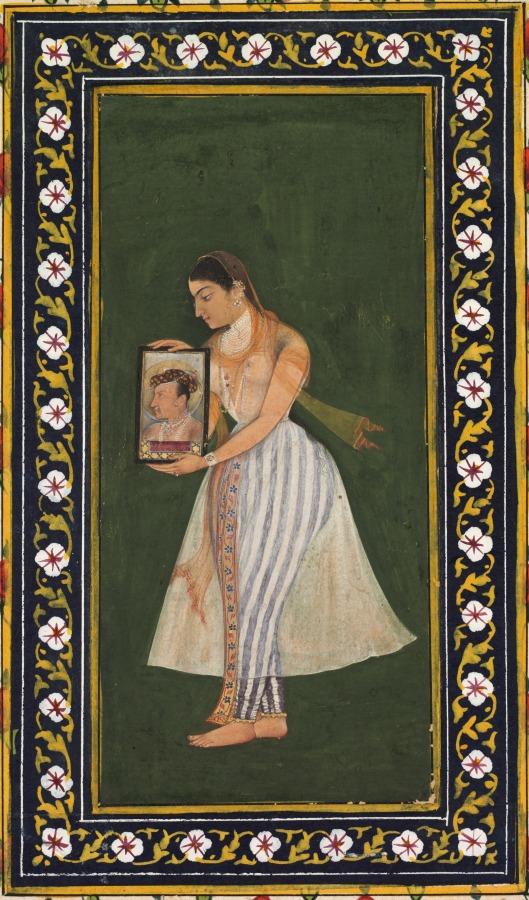
Bishandas · The Cleveland Museum of Art · Gift in honor of Madeline Neves Clapp · CC0
- Nationality
- Mughal Empire.
- Occupation
- painter, illuminator and miniaturist.
Reference Check
Propose documentary evidence for Bishandas. A contribution is never written directly as fact: identity, source, rights and evidence gates still decide.
Sign in to contribute
World of VALÉORINE
Documentary connections
Only confirmed graph relationships appear here. Images are shown only when their identity and reuse rights both pass the documentary gate.
Documentary evidence
Documentary basis
Authority files
wikidata · Q866302 · wikipedia · Bishandas
In this article
Biography
Biography
Bishandas had the reputation of being unequalled for his ability to create a realistic likeness of his models. He created realistic court and battle scenes. Jahangir especially sponsored realistic paintings and accurate portraiture. He praised Bishandas as "unrivalled in the art of portraiture". Jahangir was so keen on obtaining realistic depictions of his contemporaries, possibly as a way to better understand their character and intentions, that in 1613 Bishandas was sent to accompany on a diplomatic mission to Persia led by Khan ‘Alam, to paint the portraits of Shah Abbas I of Persia (1571–1629) and other leading Persian figures such as Abbas's second son Soltan Mohammad Mirza, Saru Taqi or Isa Khan. There he was so successful that he remained until 1620, and on his return Jahangir gave him an elephant. The portraits of the period are known to have been painted from life, because of the direct sketches made of their subjects, and because of the realistic, non-idealized, style their adopted. Clearly influenced by the realistic European portraits he had seen in miniatures and engravings. Still, his creations were to some extent hampered by technical conventions, such as the regular need for full-length portraits, which gave less importance to the depiction of the face itself compared to European portraits, or the regular requirement to paint in profile.
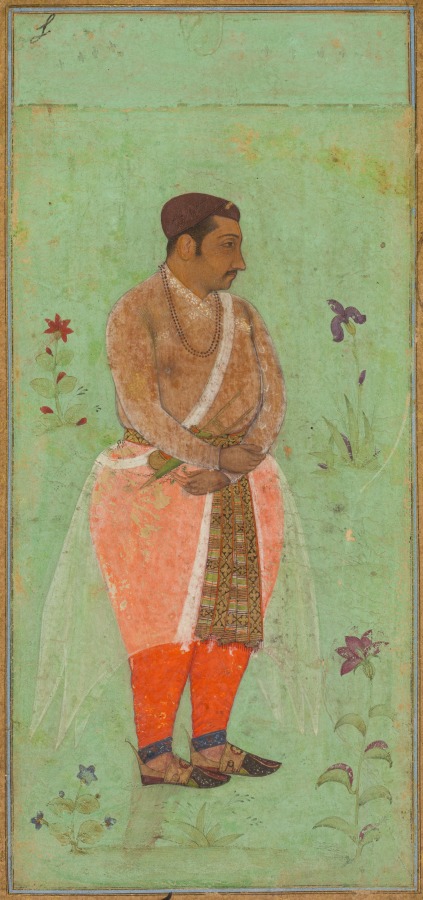
Portrait of Suraj Singh Rathor, Raja of Marwar and Maternal Uncle of Shah
Bishandas · The Cleveland Museum of Art · Gift in honor of Madeline Neves Clapp
Key facts
Key facts
• Patrons — Jahangir and Shah Abbas I • Style — Mughal
Gallery
Gallery
• Illustration — Portrait of Raja Suraj Singh of Jodhpur, Jahangir's brother in law. • Illustration — Shaikh Phul in His Hermitage, c. 1610 • Illustration — The Birth of a Prince, c. 1610–15, from a Jahangirnama (Tuzk-e-Jahangiri) • Illustration — Nur Jahan holding a portrait of Jahangir, c. 1627 (detail) • Illustration — Vasiṣṭha Greets Shiva and Parvati, c. 1602 • Illustration — Portraits of Shah Abbas I by Bishandas (1615-1620).
Life and career
Dated record
Life and career
The full dated record · 2 entries
1600
Bishandas born.
1700
Bishandas died.
Primary material
Documents and archives
Institutional database
- Wikidata, structured authority record Q866302: Bishandas
Scholarly · Wikimedia Foundation
reference work
- “Bishandas”, English Wikipedia, consulted as further reading
Reputable secondary · Wikipedia
Text attribution
Licensing
Text attribution
Part of the biographical narrative on this page reuses licensed material. Its origin, revision and licence are recorded here.
The biographical narrative on this page is based on the Wikipedia article Bishandas, revision 1351150176 (EN edition), by its contributors. VALÉORINE has edited that text and built its own documentary record around it. The reused material is available under CC BY-SA 4.0, and this page's reuse of it is offered under the same licence. Everything else on this page — the chronology, the holdings, the evidence, the plates and the connections — is VALÉORINE's own record. Sources and licences.
Notes from the source article
Cited by Wikipedia
Notes from the source article
These works are cited by the source article, in its own numbering. They are recorded as its citations, not as sources VALÉORINE has verified.
- 1.Mahajan, V. D. History of Medieval India. S. Chand Publishing. 263. 2007. 978-81-219-0364-6.
- 2.Mahajan, V. D. History of Medieval India. S. Chand Publishing. 263. 2007. 978-81-219-0364-6.
- 3.Quinn, Sholeh. Shah Abbas: The King Who Refashioned Iran. Simon and Schuster. 110. 6 August 2015. 978-1-78074-568-8.
- 4.Balabanlilar, Lisa. The Emperor Jahangir: Power and Kingship in Mughal India. Bloomsbury Publishing. 91. 16 April 2020. 978-1-83860-044-0.
- 5.Pal, Pratapaditya. Indian Painting, Volume 1. Los Angeles County Museum of Art. 32. 1993. 978-0-8109-3465-8.
- 6.Crill and Jariwala, 88
- 7.Metropolitan page
- 8.Floor, Willem. Jan Lucasz. van Hasselt: A Dutch Painter in Safavid Isfahan. Iranian Studies. 54. 3–4. 399–426. July 2021. 10.1080/00210862.2020.1787127.
References
Citations
References
Each reference names the institution holding it, so a reader may go to the document itself.
Institutional database
Wikidata, structured authority record Q866302: BishandasWikimedia Foundation
Institutional witnessreference work
Secondary witness
People, houses and institutions
Knowledge graph
People, houses and institutions
Teachers, collaborators, publishers and institutions recorded against this person, each on a stated basis.
Citizenship
1- Mughal EmpirePlace
Established from a fact already recorded on a verified source.
The Encyclopedia exists whether or not anything is for sale. Corrections are recorded rather than overwritten, and every version of this record is kept. Published 16 August 2026.
Elsewhere in Paintings
19,456 published records in this field, each with its sources named.
- Birger SimonssonArtist
- Birgit Ståhl-NybergArtist
- Biruta BaumaneArtist
- Biruta DelleArtist
- BissiettaArtist
- Bistra VinarovaArtist
- Bjarne MelgaardArtist
- Bjarne NessArtist
Best supported in this field
For owners
Own a work by Bishandas?
A specialist will read what you send and tell you what the house can establish, what it cannot, and whether the object is suited to sale. There is no charge and no obligation. The object stays with you throughout; nothing is shipped to us unless it is arranged in writing beforehand.