
Shah Abdul Latif Bhittai
Shah Abdul Latif Bhittai (c. 1689 or 1690 – 21 December 1752, also known as Lakhino Latif, Latif Ghot, Bhittai, and Bhit Jo Shah) was a Sindhi Sufi and poet who is widely considered to be the greatest poet in the Sindhi language. Born to a Kazmi Sayyid family of Hala Haweli originating from Herat, near modern-day Hala, Bhittai grew up in the nearby town of Kotri Mughal.
Also recorded as Bhittai · Shah Latif
Shah Abdul Latif Bhittai
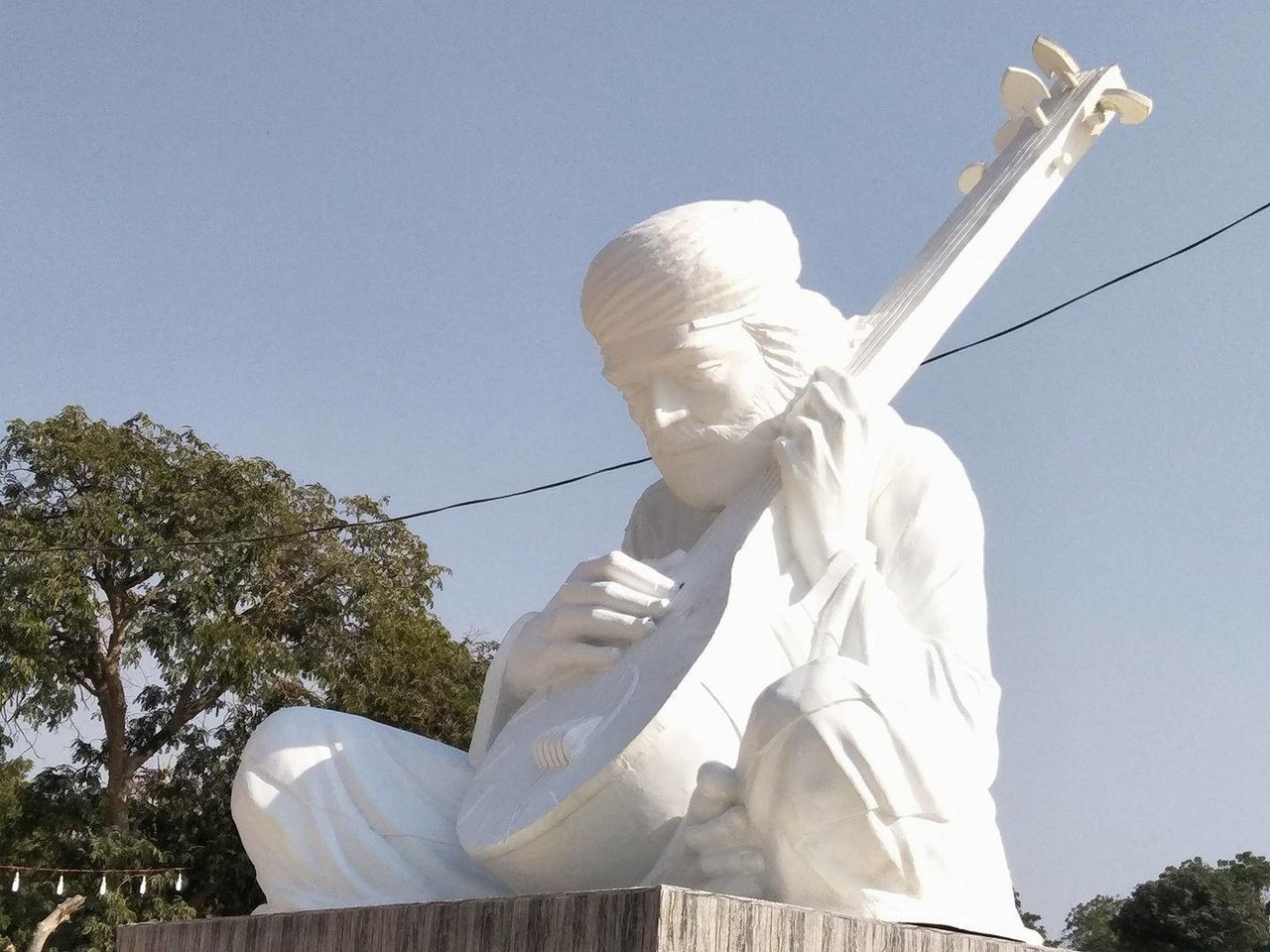
Fitrat69 · CC BY-SA 4.0
- Name
- Shah Abdul Latif Bhittai
- Born
- c. 1689 or 1690
- Birthplace
- Hala Haweli, Thatta Subah, Mughal Empire (present-day Sindh, Pakistan)
- Died
- 21 December 1752 (aged 63)
- Place of death
- Bhit, Sind State (present-day Sindh, Pakistan)
- Nationality
- Mughal Empire
- Occupation
- poet
- Known for
- Shah Jo Risalo
- Languages
- Sindhi
Reference Check
Propose documentary evidence for Shah Abdul Latif Bhittai. A contribution is never written directly as fact: identity, source, rights and evidence gates still decide.
Sign in to contribute
World of VALÉORINE
Documentary connections
Only confirmed graph relationships appear here. Images are shown only when their identity and reuse rights both pass the documentary gate.
Documentary evidence
Documentary basis
Authority files
wikidata · Q1396312 · wikipedia · Shah Abdul Latif Bhittai
In this article
Biography
Biography
At the age of around 20, he left home and traveled throughout Sindh and neighboring lands, and met many mystics and Jogis, whose influence is evident in his poetry. Returning home after three years, he was married into an aristocratic family, but was widowed shortly afterwards and did not remarry. His piety and spirituality attracted a large following as well as the hostility of a few. Spending the last years of his life at Bhit (Bhit Shah), he died in 1752. A mausoleum was built over his grave in subsequent years and became a popular pilgrimage site. His poems were compiled by his disciples in his Shah Jo Risalo. It was first published in 1866. Several Urdu and English translations of the work have been published since. Bhittai's poetry is popular among the people of Sindh and he is venerated throughout the province.

This is Latif Award by Government of Sindh
Indusian1236
Key facts
Key facts
• Name — Shah Abdul Latif Bhittai • Born — c. 1689 or 1690 • Birthplace — Hala Haweli, Thatta Subah, Mughal Empire (present-day Sindh, Pakistan) • Died — 21 December 1752 (aged 63) • Place of death — Bhit, Sind State (present-day Sindh, Pakistan) • Resting Place — Shrine of Shah Abdul Latif Bhittai, Bhit Shah • Father — Syed Habib Shah • Children — 1 child (died in childhood or miscarried) • Flourished — Mughal period Kalhora period • Religion — Islam • Denomination — Sunni • Jurisprudence — Hanafi • Lineage — Sayyid through Musa al-Kazim • Tariqa — Qadiri Owaisi • Disciples — Notably, Tamar Faqir, Muhammad Alim, Mahabat Faqir • Successor — Syed Jamal Shah, inheritor to the Gaddi • Notable Works — Shah Jo Risalo • Influences — * Khawaja Muhammad Zaman of Luari • Muhammad Hashim Thattvi • Jalal ad-Din Muhammad Rumi • Shah Abdul Karim Bulri • Shah Inat Rizvi • Influenced — * Ghulam Shah Kalhoro • Sachal Sarmast • Elsa Kazi • Allama I. I. Kazi • Nabi Bux Baloch • Hotchand Molchand Gurbakhshani • Tanveer Abbasi • Bedil • Shaikh Ayaz • Makhdoom Muhammad Zaman Talib-ul-Mola • Syed Ghulam Murtaza Shah
Life
Life
Tuhfat al-Kiram and Maqalat al-shu'ara, written by Mir Ali Sher Qani Thattvi, a contemporary of Shah Abdul Latif, some fifteen years after the death of the Muslim Saint, gives some basic details of his life. Other than these, however, few written records exist from the early period and most of what has been reported about his ife was transmitted orally through generations. The oral traditions were collected and documented in the late 19th century by Mirza Qalich Beg and Mir Abd al-Husayn Sangi. Together with Thattwi's works, these form the basis for the outline of the poet's life. Bhittai was born in 1689 or 1690 in Hala Haweli near modern-day Hala, to Shah Habib, a great-grandson of the Sufi poet Shah Abdul Karim Bulri. His ancestors traced their lineage back to the fourth caliph Ali and Fatima, the daughter of the Islamic prophet Muhammad. They had emigrated to Sindh from Herat during the late 14th century. He was born as one of the privileged classes treated with reverence and superstition. Bhittai spent the early years of his childhood in Hala Haweli, but the family then relocated to the nearby town of Kotri Mughal. Local tradition holds that he was illiterate, however his use of Arabic and Persian in his poetry and the evident influence of the Persian poet Rumi on his thought show that he was well educated. According to Nabi Bakhsh Baloch, Bhittai was socialized in a religious culture dominated by Sayyid sages and in spaces dotted with graves and tombs of saints. At the age of around 20, he fell in love with Saida Begum, a daughter of an Arghun aristocrat of Kotri Mughal, Mirza Mughal Beg, which landed Bhittai's family in trouble and caused them return to Hala Haweli. Her love, however, had a deep impact on young Bhittai and he left home wandering deserts and embarking on travel through Sindh and adjacent lands. However this unorthodox view of Bhittai's life has been challenged by Nabi Bakhsh Baloch who has said that Bhittai did not fall in love but his father had already married from this Arghun clan, this is more in line with the era and Bhittai's sociality. According to Motilal Jotwani, it was perhaps during these travels that his poetic nature came to the fore. He mentions the places he visited in his poems. First he went to Ganjo Hill near what is now Hyderabad, thereafter traveling to Kalachi (modern Karachi) through Thatta and Banbhore. On the journey he met Jogis and accompanied them to Hinglaj in the mountains of southern Balochistan. On his return east, he visited Lahut in Lasbela, and then travelled across to Dwarka, Porbandar, Junagadh, and several other places in the Kutch region. Returning west, he visited Karoonjhar Mountains in Nagarparkar. Parting ways with the Jogis in Thar, he went to Jaisalmer before returning to Thatta and then home. His travels seem to have had a strong influence on his poetry. Those who get acquainted with Ganja Hill, Become Yogis, forsaking all books and scriptures. • Illustration — Entry to the shrine Bhittai returned home after three years. In 1713 Mirza Mughal Beg (son of Mirza Jani Beg), was killed while in pursuit of robbers who had looted his house. After this incident, Bhittai was married to Saida Begum, the woman whom he had been in love with. The marriage did not result in any offspring and Saida Begum died a few years into the marriage. Bhittai did not remarry and remained childless his entire life. He now seems to have settled down and devoted to prayer and worship. His piety attracted a large following, which reportedly earned him the hostility of nobles and Noor Mohammad Kalhoro, the ruler of Sindh, who is said to have unsuccessfully tried to assassinate him by poisoning. Noor Mohammad later repented of his treacherous acts and became his disciple. He also provided Bhittai with a copy of Masnavi-e-Ma'navi. It was through Bhittai's blessings that Ghulam Shah was born to Noor Mohammad. Some ten years before his death, Bhittai left his home, relocating to a sandhill a few miles from Hala Haweli, which later became known as Bhit Shah (Mound of Shah), hence his title Bhittai (the dweller of Bhit). Bhittai died at Bhit on 21 December 1752 (14 Safar 1166 AH) at the age of 63 and was buried there. A tomb was built over his grave by the then ruler of Sindh Mian Ghulam Shah Kalhoro in 1754, or 1765.
Accquaintances
Accquaintances
During his life, Bhittai visited and frequented many orthodox Sunni theologians such as Muhammad Hashim Thattvi (a Qadri), Khawaja Muhammad Zaman of Luari (a Naqshbandi), and Muhammad Muin Thattvi (a Naqshbandi). Muhammad Muin Thattvi was a Murid in the Naqshbandi Tariqa of Mian Abu'l Qasim Naqshbandi. He was a great theologian, scholar and Sufi of his time. Muhammad Muin Thattvi and Bhittai were close friends. Bhittai often relied and trusted on Muin's theological, jurisprudential and Shari'i knowledge.
Risalah-i-Owaisi
Risalah-i-Owaisi
Nabi Bakhsh Baloch during his academic career and research on Bhittai reproduced this Persian letter known as "Risalah-i-Owaisi" which Bhittai sent to Muhammad Muin Thattvi asking about jurisprudential matters. In the letter, Bhittai asks Muhammad Muin regarding if the Islamic law (Shari'ah) allows the Owaisi type of transmission in silsila without need for the presence of a physical Murshid to receive silsila from. Bhittai presents five questions in the letter. Bhittai starts off by addressing and asking Muhammad Muin about the opinion of the "Ulama-i-Kiram" regarding the word "Owaisi" which appears in some poems of the Sufis. Bhittai asks in the second question if it is logical and allowed by Shari'ah to take one who is already in the Barzakh as a Murshid. In the third question, Bhittai asks if the "Ulama (theologians)" are opposed to the perspectives of Faqr (asceticism) and Sulook (Sufi path) or not. Bhittai in the fourth question asks regarding and providing an example of a great Wali who does miracles (karamat) and has Murids but he is not associated to any major tariqah (Bhittai gives the example of Naqshbandi and Qadri), so he questions if this can be seen as the Wali's weakness and no foundation within Tariqa. In the fifth question, Bhittai concludes by saying that he asks the scholars of the faith who separate falsehood from truth regarding these questions and hopes for an answer. He also states he has written the letter in simple Persian so that common people may benefit from the letter and makes a short prayer of well-being for Muhammad Muin. Muhammad Muin begins his response to Bhittai's letter by sending blessings upon Muhammad, his family and his Sahabah (companions). He answers the first question by stating that the term "Owaisi" is for those who gain spiritual guidance from souls. His answer to the second question states that it is allowed by logic and Shari'ah to take someone who has passed away as a Murshid and states many great Saints have done such and this is common among Sufis. He states in the third question's answer that opposition of the sayings of theologians to the perspectives of "Faqr" and "Sulook" are meaningless as in the Shari'ah there is an exception for "Faqr" and "Sulook". In the fourth question's answer, he states that many saints have been in history who did not have a notable silsila and states that these "friends of Allah" spent their life in no fame or notability but were saints, he continues and speaks of Imam Ya'fi's book "Rawdh al-Riyaheen" and says that there is much mention of such saints in the book along with their silsilahs, he also states that men like Hafez's Murshids are not well known and cites Jami to say that there is no obligation for a saint or Sufi to have a manifest Murshid and to say that these saint's Turooq are without foundation is blasphemy. In the answer to the fifth question, he states that research in theology is good to clarify matters and ends off his letter response with his name and mention of himself as a unknowledgeable one.
Poetry
Poetry
• Illustration — The shrine's inner sanctum is the site of the poet's tomb. Bhittai's poetry is mainly Sufi in nature and deeply religious. He connects the traditional folk tales with the divine love. The poems, known locally as bayt (pl. abyat) and similar in form to the Indian doha, are lyrical, are intended for a musical performance, and are usually compact. Today clouds hang in the north like long black tresses To signal the rain, flashes of lightning have come like brides in scarlet clothes. My beloved is far away, but the rain has brought me close to him. (Sur Sarang 1–6) In addition, he has also used a bit more relaxed format called wa'i. Use your eyes as your feet and go to him, oh go to him Do not speak about the beloved to anyone Hide him from everyone, and take him home in secret Do not reveal to anyone the pain caused by your beloved Mehar. (Sur Suhni 5 wa'i) Bhittai is said to have always kept with him the Qur'an, Karim jo Risalo, and the Mathnawi of Rumi. He seems to have been significantly influenced by the latter; sometimes he reflects his ideas and sometimes translates his verses in his poems. Come, Come on towards Kaak place, where there is pull of love And there is no prohibition (discrimination on any basis) all may have opportunity to love, to hope. Bhittai has emphasized that the Sufi should stick to Shari'ah and Ma'arifah (gnosis) in his poetry: Proceed on the path of Tariqat, Recognize the bounds of Shariat, Acquaint your heart with Haqiqat, Identify your goal as Marifat, Be in touch with the proof (Murshid), So that you do not go wayward. Abu Sa'id Abu'l-Khayr, a Persian poet and Sufi mystic (967–1049), has expressed similar idea in his verses which is also quite famously attributed to Rumi: Come, come, whoever you are, Wanderer, idolater, worshipper of fire, Come, and come yet again, Ours is not a caravan of despair. • Illustration — Dervishes singing Shah jo Rag at his shrine During Bhittai's lifetime, Sindh transitioned from Delhi-based Mughal rule to the local Kalhora dynasty. During the later part of Bhittai's life, Nadir Shah Afshar sacked Delhi and made Sindh his tributary. Bhittai also witnessed Ahmad Shah Durrani's attack on Delhi and his subjection of Sindh to Afghan rule. Despite all this, his poetry is devoid of any mention of these upheavals or the political landscape of his time in general. H. T. Sorley has attributed this to his interest in "eternal verities" and indifference to "transient phenomena" and "petty wars".
Risalo
Risalo
Bhittai's poetry was not written down during his lifetime, but was sung and memorized by his disciples during the musical sessions (Rag) that he used to hold. The poems were compiled after his death into a collection called Shah Jo Risalo (the Book of Shah). The Risalo was first published in 1866 by the German philologist Ernest Trumpp. It contains thirty chapters, called Sur, each focusing on a particular musical mode. Each Sur is further divided into sections, dastan (story) or fasl (chapter), which contain similarly themed abyat. Each section ends with one or more wa'is. Some Surs focus on folk tales of Sindh such as Sassui Punhun, Sohni Mehar, Umar Marui, and Lilan Chanesar, whereas others, like Sur Asa and Sur Yaman Kalyan, describe the mystical moods and ideal traditional lover. Sur Sarang is devoted to the praise of the Muhammad, while Sur Kedaro laments the death of Muhammad's grandson, and Bhittai's ancestor, Husayn ibn Ali at the Battle of Karbala in 680. Sur Kedaro has been said by some prominent scholars of Shah's poetry such as Nabi Bakhsh Baloch, Din Muhammad Wafai and Ghulam Muhammad Shahwani to have come from an external source rather than Shah himself. Since the first edition of the Risalo, several other editions have been published by various scholars including Mirza Qalich Beg, Hotchand Molchand Gurbakhshani, Ghulam Muhammad Shahvani, Kalyan Advani, and Nabi Bakhsh Baloch. Urdu translations have been published by Shaikh Ayaz, and Ayaz Husayn Qadiri and Sayyid Vaqar Ahmad Rizvi. The first partial English translation of the Risalo was published by H. T. Sorley in 1940, followed by Elsa Kazi, and Ghulam Ali Allana. Complete translations have been published by Muhammad Yakoob Agha, Amena Khamisani, and others. Early manuscripts of the Risalo as well as published editions show considerable differences in the content. The most widely accepted version has some 3,000 abyat and 200 wa'is.
Religious beliefs
Religious beliefs
Bhittai's poetry gives great indications and explicit words of what he believed in, regarding theological and religious matters. The very first verses of his Risalo in Sur Kalyan state his explicit monotheistic beliefs and belief that this world was made only for Muhammad, a common belief among Sunni Sufis. He states: Those who in Lord’s peerless Oneness believe. Accept Muhammad's guidance, with heart and speech. Theirs is abode of bliss, for they abide God's decree Never misled are they to paths that dubious be. It also shows that he believes that none of the early Muslims went astray after accepting Islam directly from the Muhammad. In another excerpt from Sur Kalyan, he talks about the "4 companions", Abu Bakr, Umar, Uthman, and Ali, he states: In another excerpt from Sur Kalyan, Bhittai talks about true lovers of God solely being Muslims, having been immersed in God and declared the prophethood of Muhammad. He states: Bhittai in a long verse also expresses his adamant hope in the intercession of Muhammad and talks about how all shalt be saved by his intercession and given refuge in him. He states: In an excerpt from Sur Bilawal, Bhittai talks through the perspective of a oppressed and weak man. He calls for Ali Shah to come and behead "the fire-worshipper". He states: The devious and accursed is bent upon mischief, The blind is harassing a weakling like me, Come, o Ali Shah, attack the infidel, Behead him the fire-worshipper. Bhittai also expresses admiration for the bravery and chivalry of Ali in his poems, glorifying his battle-stance and bravery in the battlefield. He states: Wherever he put his feet, whatever he saw, Ali the lion came and smashed the forts of infidels, As he came in the courtyard, all the path glittered, Whatever places he touched with his feet, Sorrows changed into joys, it was time of felicitations. In apparent manner (prayer, and beliefs), like his forefathers, he was a Sunni and held respect and consideration for all sects. He revered the Muhammad immensely, and he revered the companions of him and revered the Imams as well. Bhittai also prayed with his hands on his chest like a Hanafi Sunni.
Tariqah
Tariqah
Bhittai gave Bay'ah in the Qadiriyyah Tariqah to his father Shah Habib. His Silsilah is as follows: • • Muhammad • • Caliph Ali ibn Abi Talib • • Imam Husayn • • Imam Ali Zayn al-Abidin • • Imam Muhammad Baqir • • Imam Ja'far as-Sadiq • • Imam Musa al-Kazim • • Imam Ali Musa Rida • • Ma'ruf Karkhi • • Sari al-Saqati • • Junayd al-Baghdadi • • Shaikh Abu Bakr Shibli • • Shaikh Abdul Aziz Tamimi • • Abu al-Fadl al-Tamimi • • Abu al-Farah Tartusi • • Abul Hasan Hankari • • Mubarak Makhzoomi • • Abdul Qadir Jilani • • Abdul Razzaq Gilani • • Sayyid Imad ud-Din Abu Saleh Abdullāh Nasr Jilani • • Sayyid Shams ud-Din Abu Nasr Muhammad • • Sayyid Zahir ud-Din Ahmad • • Sayyid Saifuddin Yahya • • Sayyid Shamsuddin Muhammad • • Sayyid Alauddin Ali • • Sayyid Nuruddin Hussain • • Sayyid Badruddin Yahya • • Sayyid Sharafuddin Qasim • • Sayyid Shihabuddin Ahmad • • Sayyid Ali Hashimi • • Sayyid Ahmad Qadiri Habib Hamvi • • Sultan Ibrahim Shah Bukhari • • Shah Abdul Karim Bulri • • Sayyid Jalal Shah • • Sayyid Abdul Quddus Shah • • Sayyid Habibullah Shah (known as "Shah Habib") • • Shah Abdul Latif Bhittai The Qadiri Silsilah of the family of Bhittai began with Shah Abdul Karim Bulri's bay'ah to a Qadiri sage and Saint, "Sultan Ibrahim Shah Bukhari". It becomes clear that after this bay'ah to Sultan Ibrahim Shah Bukhari, the family remained Qadiri onwards.
Genealogy
Genealogy
Bhittai's genealogy goes back to Musa al-Kazim. The Sayyids of Matiari (Sadaat Matiari) descend from Syed Haider Ali whose ancestors migrated from Herat sometime around the Timurid era, Syed Haider Ali initially settled in Hala, Sindh but his descendants migrated to Matiari predominantly, during the period of settlement in Matiari, the Sayyids of Matiari divided into 4 branches (due to rivalry and disputes), namely: Jarar Pota, Baqeel Pota, Moosa Pota, Moeen Pota. Bhittai and his ancestor Shah Abdul Karim Bulri belonged to the Jararpota Branch of the Sayyids of Matiari, this branch also produced many other holy men and Saints. His genealogy is as follows: • • Caliph Ali ibn Abi Talib • • Imam Husayn • • Imam Ali Zayn al-Abidin • • Imam Muhammad Baqir • • Imam Ja'far as-Sadiq • • Imam Musa al-Kazim • • Sayyid Ja'far ibn Musa • • Sayyid Hussain al-Akbari • • Sayyid Ali Jawari Shah • • Sayyid Ibrahim Shah • • Sayyid Hussain Shah • • Sayyid Yousuf Shah • • Sayyid Ali Shah • • Sayyid Hussain Shah • • Sayyid Muhammad Shah • • Sayyid Mir Ali Shah • • Syed Haider Ali Shah (moved to Hala) • • Syed Mir Ali Shah II • • Syed Sharafdin Shah • • Syed Jamal Muhammad Shah • • Syed Haji Shah • • Syed Hashim Shah • • Syed Abdul Momin Shah • • Syed Laal Muhammad Shah • • Syed Shah Abdul Karim Bulri • • Syed Jalal Shah • • Syed Abdul Quddus Shah • • Syed Habib Shah • • Shah Abdul Latif Bhittai
Among Hindus
Among Hindus
He is also revered by Sindhi Hindu communities. During his lifetime, he had visited the Hinglaj Mata temple and also mentioned about the shrine in his poetry. The Sur Ramkali was composed by him is in reverence to the Hinglaj Mata and the visiting jogis. There is a legend that the Shah Abdul Latin Bhittai took on the arduous journey to visit the Hinglaj Mata Mandir to pay tribute to the Hinglaj Mata and offered milk to the Hinglaj Mata. It is also believed that after he offered the milk, the Hinglaj Mata appeared in front of him.
Popular culture
Popular culture
Bhittai's poetry is popular among the Sindhi people, including both Muslims and Hindus. Bhittai's own connections with Jogis and Sanyasis may have contributed to this. The folk tales narrated in the Surs of the Risalo are frequently recounted and sung to children. Many anecdotes about Bhittai of a haigographical nature are famous among the locals. One such story holds that when he was being taught the alphabet, he refused to learn anything beyond the letter Alif for it signifies the name of God (Allah) and there is nothing of value beyond it. Another story of this kind asserts that his followers presented him a written copy of the Risalo, which he threw away in the nearby Kirar lake after having read it. When the followers protested, he allowed them to rewrite the entire Risalo by narrating it from his memory. His tomb is a popular pilgrimage site in Sindh.
Urs
Urs
The Urs, an annual commemoration of his death, occurs on 14 Safar, the second month of the Hijra calendar. The ceremony, which lasts for three days, features prayers, music, exhibitions, literary conferences, and horse races. People visit the shrine from all over the province. A 16-foot-high statue of Bhittai was erected in front of the Bhit Shah rest house on the occasion of his 274th Urs in 2017.
Places
Named by the record
Places
Only places the record itself states, plotted where the house gazetteer settles their coordinates. Nothing is inferred from a name or a nationality.
Hala.
Birth place
Bhit.
Death place
Legacy
Bhittai is regarded as the greatest Sufi poet of the Sindhi language and the national poet of Sindh. According to the orientalist Annemarie Schimmel, he is "The most outstanding master of popular Sufi poetry in Pakistan." According to Seyyed Hossein Nasr, Bhittai's Risalo has been compared with Rumi's Mathnawi, and Bhittai represents "direct emanations of Rūmī's spirituality in the Indian world." Every Thursday evening, Bhittai's poetry is sung by traditional musicians and dervishes at the shrine in a typical ecstatic style. The performance is commonly referred to as Shah jo Rag (Shah's music).
Primary material
Documents and archives
reference work
- “Shah Abdul Latif Bhittai”, English Wikipedia, consulted as further reading
Reputable secondary · Wikipedia
authority record
- Wikidata, structured authority record Q1396312: Shah Abdul Latif Bhittai
General reference · Wikidata
Text attribution
Licensing
Text attribution
Part of the biographical narrative on this page reuses licensed material. Its origin, revision and licence are recorded here.
The biographical narrative on this page is based on the Wikipedia article Shah Abdul Latif Bhittai, revision 1368437349 (EN edition), by its contributors. VALÉORINE has edited that text and built its own documentary record around it. The reused material is available under CC BY-SA 4.0, and this page's reuse of it is offered under the same licence. Everything else on this page — the chronology, the holdings, the evidence, the plates and the connections — is VALÉORINE's own record. Sources and licences.
Notes from the source article
Cited by Wikipedia
Notes from the source article
These works are cited by the source article, in its own numbering. They are recorded as its citations, not as sources VALÉORINE has verified.
- 1.Life Of Shah Abdul Latif Bhitai. 1980.
- 2.Sufis of Sindh.
- 3.Life Of Shah Abdul Latif Bhitai. 1980.
- 4.Life Of Shah Abdul Latif Bhitai. 1980.
- 5.Jotwani, Motilal Wadhumal. Sufis of Sindh. Publications Division, Ministry of Information and Broadcasting, Government of India. 1996. 978-81-230-0508-9.
- 6.Burton, Richard F. Sindh, And The Races That Inhabit The Valley Of The Indus, With Notices Of The Topography And History Of The Province. 1851.
- 7.Sufi Foundation. shahabdullatifbhittai.com.
- 8.Shah Abdul Latif and His Sufistic Thought.
- 9.Bayan-ul-Arifeen (Sindhi) Malfuzat Shah Kareem Bulri Waro. 32/38.
- 10.Lataif-e-Latifi. 28–29/29–30. 2012.
- 11.Life Of Shah Abdul Latif Bhitai. 1980.
- 12.Life Of Shah Abdul Latif Bhitai. 1980.
- 13.Life Of Shah Abdul Latif Bhitai. 1980.
- 14.Jotwani, Motilal Wadhumal. Sufis of Sindh. Publications Division, Ministry of Information and Broadcasting, Government of India. 1996. 978-81-230-0508-9.
- 15.Burton, Richard F. Sindh, And The Races That Inhabit The Valley Of The Indus, With Notices Of The Topography And History Of The Province. 1851.
- 16.Hussain, Ghulam. Anti-politics of the Heterodox Poetry and Life history of Shah Abdul Latif: Ambedkarian Perspective.
- 17.مھراڻ اڪيڊمي شڪارپور. شاھہ عبداللطيف (تحقيقي مضمون) - ڊاڪٽر نبي بخش بلوچ سنڌسلامت ڪتاب گهر.
- 18.Bullo, Momin. Matiari: The Cultural Capital of Sindh. 2011.
- 19.The Shah’s Shrine. The Friday Times. 2020-08-28.
- 20.Sindhica Academy. Shah jo Risalo. 2009.
- 21.Jotwani, Motilal Wadhumal. Sufis of Sindh. Publications Division, Ministry of Information and Broadcasting, Govt. of India. 1996. 81-230-0508-3.
- 22.Sindhica Academy. Shah jo Risalo. 60. 2009.
- 23.Hussain, Ghulam. Anti-politics of the Heterodox Poetry and Life history of Shah Abdul Latif: Ambedkarian Perspective.
- 24.Sindhica Academy. Shah jo Risalo. 42–44. 2009.
- 25.Sindhica Academy. Shah jo Risalo. 42–44. 2009.
- 26.Sindhica Academy. Shah jo Risalo. 42–44. 2009.
- 27.Abdul Ghaffar Soomro. Shah Abdul Latif and His Sufistic Thought. University of Sindh. 17. 1998.
- 28.سُر آسا.
- 29.Controversy over Kedaro rages at literary meeting. Dawn. 7 March 2007.
- 30.Sanai, Muhammad Habib. POLEMICS: THE FORGOTTEN SCHOLAR. Dawn. 23 July 2017.
- 31.Parekh, Rauf. An authentic version of Shah jo risalo. Dawn. 28 December 2012.
- 32.Department of Culture, Sindh. لطف اللطيف. 2012.
- 33.Did God create the world for the love of Prophet Muhammad?. دار الإفتاء المصرية.
- 34.سُر ڪلياڻ. 1.
- 35.شاھ جو رسالو - مرزا قليچ بيگ.
- 36.Shah Jo Risalo Alias Ganje Latif - Vol I. 1985.
- 37.Shah Jo Risalo Alias Ganje Latif - Vol I. 1985.
- 38.سُر بلاول وايون وائي BhittaiPedia.
- 39.Shah Jo Risalo Alias Ganje Latif - Vol I. 1985.
- 40.سُر بلاول مجوسِي، ڄام ۽ جادم بيت 1 BhittaiPedia.
- 41.Shah Jo Risalo Alias Ganje Latif - Vol I. 1985.
- 42.سُر بلاول وايون وائي BhittaiPedia.
- 43.شاهه عبداللطيف ڀٽائي : (Sindhianaسنڌيانا). www.encyclopediasindhiana.org.
- 44.Life Of Shah Abdul Latif Bhitai. 1980.
- 45.Culture Department Sindh. شاھہ عبداللطيف ڀٽائيءَ جي دور ۾ تصوف جا سلسلا - ڊاڪٽر عابد مظھر سنڌسلامت ڪتاب گهر. 28.
- 46.Bayan-ul-Arifeen (Sindhi) Malfuzat Shah Kareem Bulri Waro. 32/38.
- 47.Culture Department Sindh. شاھہ عبداللطيف ڀٽائيءَ جي دور ۾ تصوف جا سلسلا - ڊاڪٽر عابد مظھر سنڌسلامت ڪتاب گهر. 28.
- 48.Lataif-e-Latifi. 28–29/29–30. 2012.
- 49.Patron Saint of Bulri. The Friday Times. 2 October 2020.
- 50.Shah Abdul Latif and His Sufistic Thought.
- 51.Shah Latif and His Family Tree.
- 52.Bayan-ul-Arifeen (Sindhi) Malfuzat Shah Kareem Bulri Waro. 32/38.
- 53.Shah Latif and His Family Tree.
- 54.Shah Latif and His Family Tree.
- 55.Shah Latif and His Family Tree.
- 56.Shah Jo Risalo Alias Ganje Latif - Vol I. 100–101/110–112. 1985.
- 57.Abbas, Shemeem Burney. The Female Voice in Sufi Ritual: Devotional Practices of Pakistan and India. University of Texas Press. 34. 2010. 9780292784505.
- 58.For the sake of faith.
- 59.Historical look at Hingol. 13 March 2009.
- 60.A pilgrimage to history. 8 April 2016.
- 61.The Express Tribune. Urs celebrations of Hazrat Shah Abdul Latif Bhitai commence. 5 November 2017.
- 62.Bhitai's statue on display. Dawn. 5 November 2017.
Bibliography printed in the source article · 17
- Advani, K. B. Makers of Indian Literature: Shah Latif. Sahitya Akademi. 1970.
- Ahmed, Vaqar. Bhit Shah: After the dhamaal. Dawn. 10 April 2015.
- Baqir, M. ʿAbd-al-Laṭīf Bheṭāʾī. Encyclopaedia Iranica. Encyclopædia Iranica Foundation. 1. 1982.
- Baloch, Nabi Bakhsh. Life and Thought of Shah Abdul Latif Bhittai. Culture Department, Government of Sindh. 2010.
- Fatimi, S. Q. Shah ʿAbd al-Laṭīf Ḇẖiṭāʾī and the East India Company. Islamic Studies. 41. 3. 495–505. 2002. 20837213.
- Jotwani, Motilal. Sufis of Sindh. Ministry of Information and Broadcasting, Government of India. 1986. 9788123023410.
- Khamisani, Amena. The Risalo Of Shah Abdul Latif Bhitai. 2012.
- Lashari, Mubarak Ali. The Concept of Love: A Comparative Study of Maulana Rumi and Shah Abdul Latif Bhittai. 1st Mediterranean Interdisciplinary Forum on Social Sciences and Humanities, MISFS 2014, vol.2, 23–26 April 2014, Beirut, Lebanon. European Scientific Institute. 2. 52–59. 2014. 978-608-4642-21-3.
- Muhammad Yakoob Agha. Shah Jo Risalo Alias Ganje Latif - Vol I. 1985.
- Nasr, Seyyed Hossein. The Scholar and the Saint: Studies in Commemoration of Abuʼl-Rayhan Al-Bīrūni and Jalal Al-Din Al-Rūmī. New York University Press. 169–185. 1975. 9780814713600.
- Saleem, Agha. Melodies of Shah Abdul Lateef Bhittai. 2015.
- Schimmel, Annemarie. Mystical Dimensions of Islam. The University of North Carolina Press. 1975. 978-0-8078-1271-6.
- Schimmel, Annemarie. Pain and Grace: A Study of Two Mystical Writers of Eighteenth-Century Muslim India. E. J. Brill. 1976. 9789004378544.
- Smith, Paul. Shah Latif: Selected Poems. New Humanity Books, Book Heaven. 2012. 978-1480039933.
- Sorley. H. T. Bhitāʾī. 1194–1195.
- Sorley, H. T. Shah Abdul Latif of Bhit: His Poetry, Life and Times: A Study of Literary, Social and Economic Conditions in Eighteenth Century Sind. Oxford University Press. 1966. 978-0196360294.
- Shackle. Christopher. Christopher Shackle. 2013. ʿAbd al-Laṭīf. 10.1163/1573-3912_ei3_COM_24149.
References
Citations
References
Each reference names the institution holding it, so a reader may go to the document itself.
reference work
Secondary witnessauthority record
General reference
People, houses and institutions
Knowledge graph
People, houses and institutions
Teachers, collaborators, publishers and institutions recorded against this person, each on a stated basis.
Citizenship
1- Mughal EmpirePlace
Established from a fact already recorded on a verified source.
The Encyclopedia exists whether or not anything is for sale. Corrections are recorded rather than overwritten, and every version of this record is kept. Published 16 August 2026.
Elsewhere in Books
39,529 published records in this field, each with its sources named.
- Shad AzimabadiAuthor
- Shade, the Changing ManAuthor
- Shadhli ibn JadidAuthor
- Shah Abdul Aziz DehlaviAuthor
- Shah Abdur RaufAuthor
- Shah Alam IIAuthor
- Shah BadakhshiAuthor
- Shah HussainAuthor
Best supported in this field
For owners
Own a work by Shah Abdul Latif Bhittai?
A specialist will read what you send and tell you what the house can establish, what it cannot, and whether the object is suited to sale. There is no charge and no obligation. The object stays with you throughout; nothing is shipped to us unless it is arranged in writing beforehand.