
Alfred Stevens
Alfred Émile Léopold Stevens (11 May 182324 August 1906) was a Belgian painter, known for his paintings of elegant modern women. In their realistic style and careful finish, his works reveal the influence of 17th-century Dutch genre painting. After gaining attention early in his career with a social realist painting depicting the plight of poor vagrants, he achieved great critical and popular success with his scenes of upper-middle class Parisian life.
Also recorded as Alfred Émile Léopold Stevens · Alfred-Émile-Léopold Stevens · Alfred Emile Leopold Joseph Victor Stevens · Alfred Emile-Léopold Stevens
Alfred Stevens
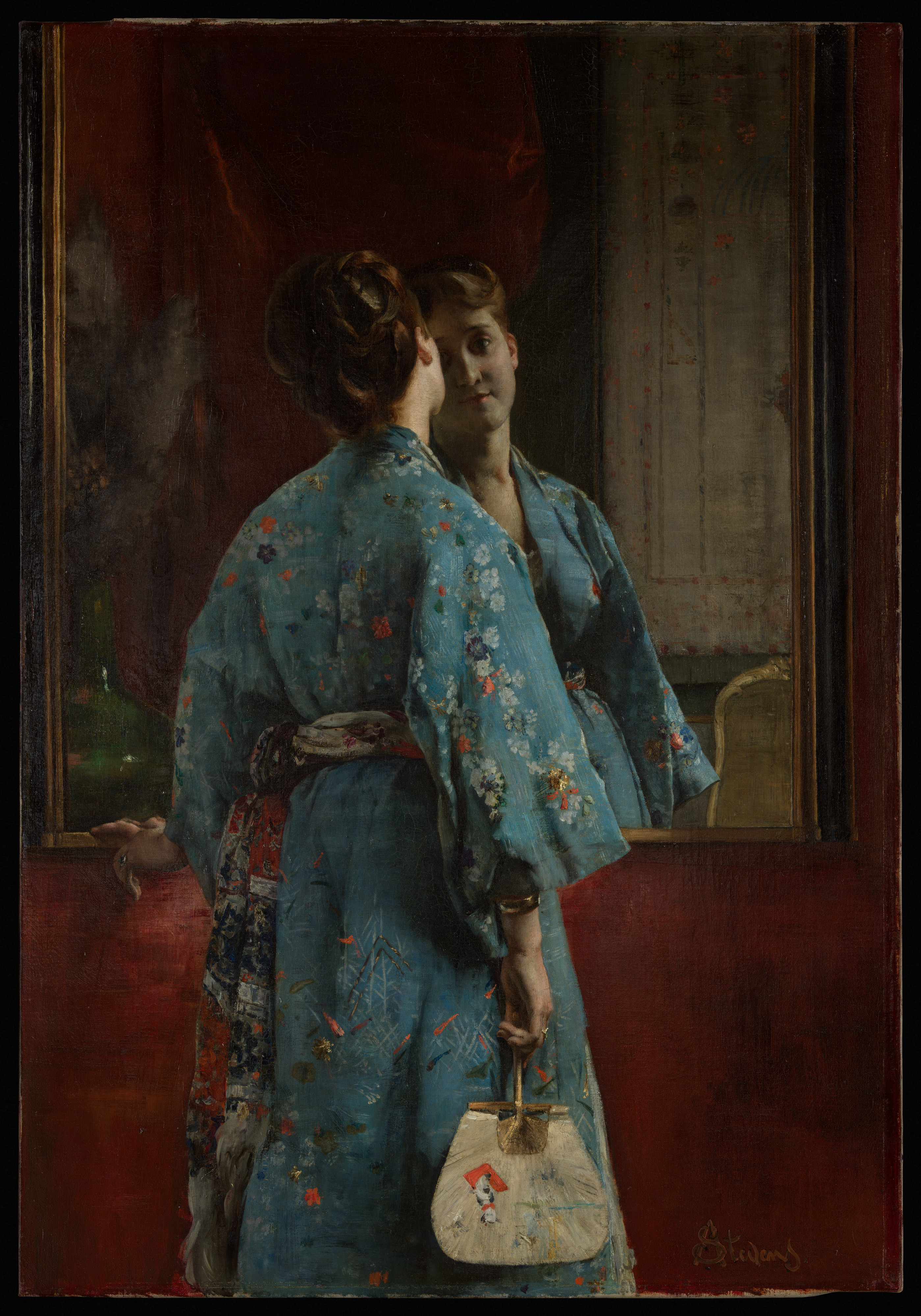
Alfred Stevens · The Metropolitan Museum of Art, New York · Catharine Lorillard Wolfe Collection, Bequest of Catharine Lorillard Wolfe, 1887 · Public domain (CC0, Met Open Access)
- Name
- Alfred Stevens
- Birth Name
- Alfred Émile Léopold Stevens
- Born
- 11 May 1823
- Birthplace
- Brussels, United Kingdom of the Netherlands
- Died
- 24 August 1906
- Place of death
- Paris, France
- Field
- Painting
- Movement
- Social realism, Realism, Orientalism, Dutch realism style
- Nationality
- Belgium · France
- Occupation
- painter
- Fields
- portrait
- Movements
- French Realism
VALÉORINE Encyclopedia
VALÉORINE documentary reading
Documentary summary
Alfred Émile Léopold Stevens (11 May 182324 August 1906) was a Belgian painter, known for his paintings of elegant modern women. In their realistic style and careful finish, his works reveal the influence of 17th-century Dutch genre painting. After gaining attention early in his career with a social realist painting depicting the plight of poor vagrants, he achieved great critical and popular success with his scenes of upper-middle class Parisian life.
Admitted source layer · organised and presented by VALÉORINE
Reference Check
Propose documentary evidence for Alfred Stevens. A contribution is never written directly as fact: identity, source, rights and evidence gates still decide.
Sign in to contribute
World of VALÉORINE
Documentary connections
Only confirmed graph relationships appear here. Images are shown only when their identity and reuse rights both pass the documentary gate.
Documentary evidence
Documentary basis
Authority files
wikidata · Q773855
In this article
Biography
Biography
Alfred Stevens studied at Beaux-Arts de Paris. Training under François-Joseph Navez, Camille Roqueplan and Jean-Auguste-Dominique Ingres is recorded. Mathilde Dupré-Lesprit, Augusta Dohlmann and Marie Henriques are recorded as having studied under Alfred Stevens. The recorded working language is French. Subjects and genres recorded for the work are portrait. Johannes Vermeer is recorded as an influence. Places of work recorded in the authority are Brussels and Paris. Works named in the authority record are the widow, What is Called Vagrancy and Histoire du siècle. Work by Alfred Stevens is recorded in the collections of Minneapolis Institute of Art, Art Institute of Chicago, Nationalmuseum, Metropolitan Museum of Art and Royal Museums of Fine Arts of Belgium. Distinctions recorded are Commander of the Legion of Honour and Grand Officer of the Order of Leopold.
Key facts
Key facts
• Name — Alfred Stevens • Birth Name — Alfred Émile Léopold Stevens • Born — 11 May 1823 • Birthplace — Brussels, United Kingdom of the Netherlands • Died — 24 August 1906 • Place of death — Paris, France • Field — Painting • Movement — Social realism, Realism, Orientalism, Dutch realism style • Works — What is Called Vagrancy, The Psyché, The Parisian Sphinx • Illustration — Le Bain, 1873–74
Family background
Family background
Stevens was born in Brussels. He came from a family involved with the visual arts: his older brother Joseph (1816–1892) and his son Léopold (1866–1935) were painters, while another brother Arthur (1825–1899) was an art dealer and critic. His father, who had fought in the Napoleonic wars in the army of William I of the Netherlands, was an art collector who owned several watercolors by Eugène Delacroix, among other artists. His mother's parents ran Café de l'Amitié in Brussels, a meeting place for politicians, writers, and artists. All the Stevens children benefited from the people they met there, and the social skills they acquired in growing up around important people.
Education
Education
After the death of his father in 1837, Stevens left middle school to begin study at the Académie Royale des Beaux-Arts in Brussels, where he knew François Navez, the Neo-Classical painter and former student of Jacques-Louis David who was its director and an old friend of Stevens's grandfather. Following a traditional curriculum, he drew from casts of classical sculpture for the first two years, and then drew from live models. In 1843, Stevens went to Paris, joining his brother Joseph who already was there. He was admitted to the École des Beaux-Arts, the most important art school in Paris. Although it is said that he became a student of its director Jean Auguste Dominique Ingres, this is likely not true. An early picture by Stevens, The Pardon or Absolution (Hermitage, St. Petersburg), signed and dated 1849, shows his mastery of a conventional naturalistic style which owes much to 17th-century Dutch genre painting. Like the Belgian painter and friend with whom he stayed in Paris, Florent Willems (1823–1905), Stevens carefully studied works by painters such as Gerard ter Borch and Gabriel Metsu.
Career beginnings
Career beginnings
• Illustration — What is Called Vagrancy, 1854 Stevens's work was shown publicly for the first time in 1851, when three of his paintings were admitted to the Brussels Salon. He was awarded a third-class medal at the Paris Salon of 1853, and a second-class medal at the Salon of 1855 during the Universal Exposition in Paris in 1855. His [[What is Called Vagrancy|Ce qu'on appelle le vagabondage [What is called vagrancy]]] (Musée d'Orsay, Paris) attracted the attention of Napoleon III who, as a result of the scene in the picture, ordered that soldiers no longer be used to pick up the poor from the streets. Two other paintings he exhibited at the Antwerp Salon that year, Chez soi or At Home (present location unknown) and The Painter and his Model (Walters Art Museum, Baltimore), introduced subjects from "la vie moderne" for which he became known: an elegant young woman in contemporary dress and the artist in his studio. In 1857, Stevens made his first important sale to a private collector, when Consolation was bought for a rumored 6,000 francs by the Berlin collector and dealer Ravéné. At the same time, he and his brother were becoming part of the art world of Paris, meeting people such as the Goncourt brothers, Théophile Gautier, and Alexandre Dumas at the salons of Princess Mathilde as well as popular cafés. • Illustration — Memories and Regrets, ca. 1874, Clark Art Institute, Williamstown In 1858, Stevens married Fanny Juliette Albertine Marie Hortense Blanc (1836–1891), who came from a rich Belgian family. Eugène Delacroix was a witness at the ceremony. The couple would have four children together—Leopold, Jean, Catherine, and Pierre. Stevens painted his wife's portrait many times, including Memories and Regrets (ca. 1874).
Mature career
Mature career
• Illustration — La parisienne japonaise, 1872, Musée d'art moderne et d'art contemporain, Liège • Illustration — The Psyché (My Studio), ca. 1871, Princeton University Art Museum During the 1860s, Stevens became an immensely successful painter, known for his paintings of elegant modern women. His exhibits at the Salons in Paris and Brussels attracted favorable critical attention and buyers. An excellent example of his work during this time is La Dame en Rose or Woman in Pink (Royal Museums of Fine Arts of Belgium, Brussels), painted in 1866, which combines a view of a fashionably dressed woman in an interior with a detailed examination of Japanese objects, a fashionable taste called Japonisme of which Stevens was an early enthusiast. He tended to use the same models over and over again, and not all of them were aristocratic. "At least three of his frequent models can be identified in the infamous Book of the Courtesans, a top secret leather bound book containing the surveillance files of the Paris vice squad", writes author Summer Brennan. In 1863, he received the Legion of Honor (Chevalier) from the French government. In 1867, he won a first-class medal at the Universal Exposition in Paris, where he and Jan August Hendrik Leys were the stars of the Belgian section, and was promoted to Officer of the Legion of Honor. His friends included Édouard Manet, Edgar Degas, Charles Baudelaire, Berthe Morisot, James Abbott McNeill Whistler, Frédéric Bazille, and Puvis de Chavannes, and he was a regular in the group that gathered at the Café Guerbois in Paris. Stevens fought for the French during the siege of Paris in the Franco-Prussian War, but returned to Belgium with his wife and family before the Paris Commune. They returned after the war, and Stevens continued to achieve critical acclaim as well as great success with collectors. In 1875, he bought a grand house and garden in Paris on rue des Martyrs, which appeared in his paintings as well as those of other artists, including Édouard Manet's The Croquet Party (Städel Museum, Frankfurt am Main) from 1873. (He had to leave the house in 1880, however, to make way for the construction of a new street, which was named after him.) In 1878, he was made a Commander of the Legion of Honor and received another first-class medal at the Salon. Despite earning a considerable income through the sale of his paintings, Stevens found that a combination of bad investments and excessive spending caused him great financial difficulties during the 1880s. An additional expense came from summers by the sea, which a doctor told Stevens in 1880 were essential for his health. Thus the artist was glad to agree when the Paris dealer Georges Petit offered him 50,000 francs to finance his vacation in exchange for the paintings Stevens produced during that time. This deal, which lasted for three years, resulted in the sea becoming an important subject for him, and over the rest of his career, he painted hundreds of views of popular resorts along the Normandy coast and the Midi in the south. Many of them are painted in a sketchy style that shows the influence of the Impressionists. Stevens also began to take private students, including Sarah Bernhardt, who became a close personal friend, and William Merritt Chase. Other students were Berthe Art, Charles Bell Birch, Jules Cayron, Marie Collart-Henrotin, Louise De Hem, Harriet Campbell Foss, Rosalie Lorraine Gill, Georgette Meunier, Lilla Cabot Perry, Jean-Paul Sinibaldi, and Fernand Toussaint.
Late career
Late career
The single most important work from the second half of Stevens's career is the monumental Panorama du Siècle, 1789–1889, which he painted with Henri Gervex. Stevens painted the women and details and Gervex the men, with the help of fifteen assistants. It was shown to great acclaim at the International Exhibition held in Paris in 1889. He also received several great professional tributes. In 1895, a large exhibition of his work was held in Brussels. In 1900, Stevens was honored by the Ecole des Beaux-Arts in Paris with the first retrospective exhibition ever given to a living artist. Supported by patrons led by the Comtesse de Greffulhe, it achieved social cachet as well as popular success. In 1905, he was the only living artist allowed to exhibit in a retrospective show of Belgian art in Brussels. Despite these exhibitions, he was not able to sell enough of his work to manage well financially. Having outlived his brothers and most of his friends, he died in Paris in 1906, living alone in modest rooms, whilst still remaining in touch with his four children.
Selected works
Selected works
• Illustration — The Painter and His Model, 1855 • Illustration — Will You Go Out With Me Fido?, 1859 • Illustration — Lady at a Window Feeding Birds, ca. 1859 • Illustration — News from Afar, 1860 (Exhibition: "Salute to Belgium, 1980) • Illustration — The Lady in Pink, 1866 • Illustration — Lighthouse at Dusk • Illustration — The Parisian Sphinx, 1875–1877 • Illustration — The Japanese mask, ca. 1877 • Illustration — Rêverie, ca. 1878 • Illustration — Maria Magdalena, 1887 • Illustration — The Study of the Role, 1888 • Illustration — In the Studio, 1888 • Illustration — The New Blue Ribbon, 1894 • Illustration — Camille Lemonnier in the Artist's Studio • Illustration — alt=A duchess (the blue dress) 1866, Clark Art Institute A duchess (the blue dress) 1866
Identity and origins
Identity and origins
The authorities additionally record the headings Alfred Émile Léopold Stevens, Alfred-Émile-Léopold Stevens, Alfred Emile Leopold Joseph Victor Stevens, Alfred Emile-Léopold Stevens and Alfred Emile Leopold Stevens. His recorded language was French. Other recorded relations include Robert Mallet-Stevens, Mathilde Kindt and Arthur Stevens.
Identity
Identity
Alfred Stevens is recorded with the occupation painter. Classed in the genre portrait. Recorded as having received Commander of the Legion of Honour and Grand Officer of the Order of Leopold.
Life and career
Dated record
Life and career
The full dated record · 2 entries
1823
Alfred Stevens was born on 11 May 1823.
1906
Alfred Stevens died at 9th arrondissement of Paris.
Places
Named by the record
Places
Only places the record itself states, plotted where the house gazetteer settles their coordinates. Nothing is inferred from a name or a nationality.
Brussels.
Birth place
9th arrondissement of Paris.
Death place
Honours and legacy
• 1881: Grand Officer in the Order of Leopold. • Rue Alfred Stevens, a street off Rue des Martyrs in the 9th arrondissement of Paris, is named after him.
Notes from the source article
Cited by Wikipedia
Notes from the source article
These works are cited by the source article, in its own numbering. They are recorded as its citations, not as sources VALÉORINE has verified.
- 1.Royal Museums of Fine Arts of Belgium. Alfred Stevens. 1823 Brussels – Paris 1906. 11. 2009. 978-90-6153-876-9.
- 2.Royal Museums of Fine Arts of Belgium. Alfred Stevens. 1823 Brussels – Paris 1906. 12. 2009. 978-90-6153-876-9.
- 3.Thomas, Bernadette. "Alfred (Emile-Léopold) Stevens" in Oxford Art Online. Retrieved 27 December 2013.
- 4.Musée d'Orsay: Alfred Stevens What is called vagrancy. musee-orsay.fr. 4 February 2009.
- 5.Royal Museums of Fine Arts of Belgium. Alfred Stevens. 1823 Brussels – Paris 1906. 20. 2009. 978-90-6153-876-9.
- 6.Fanny Blanc: The Courtesan Model Who Wasn't. summerbrennan.substack.com.
- 7.Willkommen im Newsroom. staedelmuseum.de.
- 8.Royal Museums of Fine Arts of Belgium. Alfred Stevens. 1823 Brussels – Paris 1906. 41. 2009. 978-90-6153-876-9.
- 9.International Exhibitions Foundation for the National Museum of Women in the Arts. American women artists, 1830–1930. 1987. 978-0-940979-01-7.
- 10.Johnston, Sona K. American Paintings 1750-1900 from the Collection of the Baltimore Museum of Art. Baltimore Museum of Art. 68–69, 70. 1983. 978-0-912298-53-5.
- 11.Alfred Stevens in the RKD
- 12.Royal Museums of Fine Arts of Belgium. Alfred Stevens. 1823 Brussels – Paris 1906. 50. 2009. 978-90-6153-876-9.
- 13.Royal Museums of Fine Arts of Belgium. Alfred Stevens. 1823 Brussels – Paris 1906. 58. 2009. 978-90-6153-876-9.
- 14.Handelsblad (Het) 15-05-1881
References
Citations
References
Each reference names the institution holding it, so a reader may go to the document itself.
authority record
General reference
Further particulars
Held on the record
Further particulars
Open the remaining particulars
Alfred Stevens studied at Beaux-Arts de Paris. He trained under François-Joseph Navez, Camille Roqueplan and Jean-Auguste-Dominique Ingres. His recorded influences include Johannes Vermeer. Each of those relationships is stated by the authority record rather than inferred from style.
Work and production. Works recorded as notable number 3: the widow, What is Called Vagrancy and Histoire du siècle. His recorded genre is portrait. Stevens received Commander of the Legion of Honour and Grand Officer of the Order of Leopold.
Recognition and collections
Work by Alfred Stevens is
Minneapolis Institute of Art, Art Institute of Chicago, Nationalmuseum and Metropolitan Museum of Art
The Encyclopedia exists whether or not anything is for sale. Corrections are recorded rather than overwritten, and every version of this record is kept. Published 16 August 2026.
Elsewhere in Paintings
18,717 published records in this field, each with its sources named.
- Alfred SchouppéArtist
- Alfred SimonsenArtist
- Alfred SisleyArtist
- Alfred Sohn-RethelArtist
- Alfred SullyArtist
- Alfred Thomas AgateArtist
- Alfred ThompsonArtist
- Alfred ThomsonArtist
Best supported in this field
For owners
Own a work by Alfred Stevens?
A specialist will read what you send and tell you what the house can establish, what it cannot, and whether the object is suited to sale. There is no charge and no obligation. The object stays with you throughout; nothing is shipped to us unless it is arranged in writing beforehand.