
Alfred Sisley
Alfred Sisley (30 October 1839 – 29 January 1899) was an Impressionist landscape painter, born in Paris to British expatriate parents. Considered the most consistent of the Impressionists in his dedication to painting en plein air (outdoors), Sisley's oeuvre comprises almost entirely landscapes, with his most important works including series of paintings around Hampton Court on the River Thames, the floods at Marly-le-Roi in 1875, and the Gothic church at Moret-sur-Loing. He also produced notable paintings portraying riverside scenes on the Seine in the suburbs west of Paris throughout his career.
Also recorded as Arthur Sisley · a. sisley · Sisley · alfred sissley
Alfred Sisley
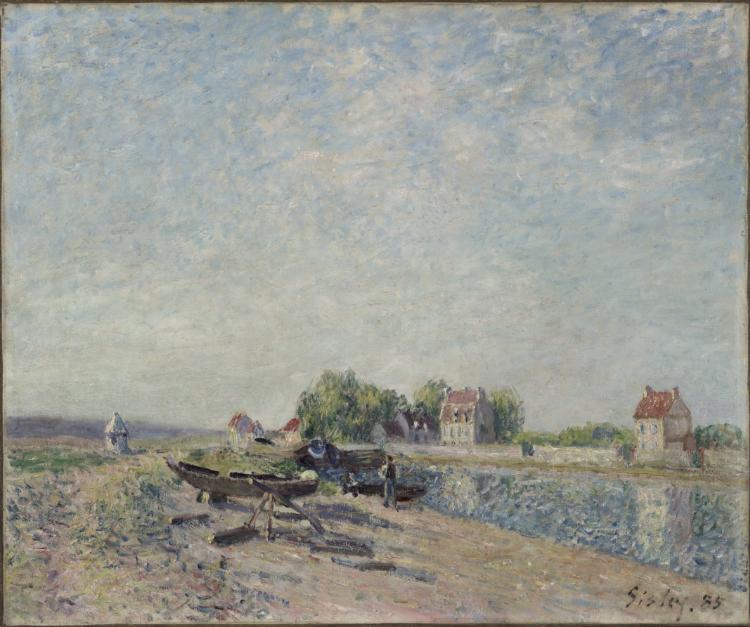
Alfred Sisley · The Cleveland Museum of Art · Gift of Mr. and Mrs. Lewis B. Williams from The Blair Trust · CC0
- Name
- Alfred Sisley
- Born
- 30 October 1839
- Birthplace
- Paris, France
- Died
- 29 January 1899
- Place of death
- Moret-sur-Loing, France
- Field
- Painting
- Training
- Marc-Charles-Gabriel Gleyre
- Movement
- Impressionism
- Nationality
- United Kingdom of Great Britain and Ireland and France.
- Fields
- visual arts and Impressionism.
- Movements
- Impressionism.
- Education
- Beaux-Arts de Paris.
VALÉORINE Encyclopedia
VALÉORINE documentary reading
Documentary summary
Alfred Sisley (30 October 1839 – 29 January 1899) was an Impressionist landscape painter, born in Paris to British expatriate parents. Considered the most consistent of the Impressionists in his dedication to painting en plein air (outdoors), Sisley's oeuvre comprises almost entirely landscapes, with his most important works including series of paintings around Hampton Court on the River Thames, the floods at Marly-le-Roi in 1875, and the Gothic church at Moret-sur-Loing. He also produced notable paintings portraying riverside scenes on the Seine in the suburbs west of Paris throughout his career.
Admitted source layer · organised and presented by VALÉORINE
Reference Check
Propose documentary evidence for Alfred Sisley. A contribution is never written directly as fact: identity, source, rights and evidence gates still decide.
Sign in to contribute
World of VALÉORINE
Documentary connections
Only confirmed graph relationships appear here. Images are shown only when their identity and reuse rights both pass the documentary gate.
Documentary evidence
Documentary basis
Authority files
gnd · 5072379-0 · wikidata · Q175130 · wikipedia · Alfred Sisley
In this article
Biography
Biography
Sisley received little critical recognition or financial reward for his work during his lifetime, spending most of his career in reduced circumstances, dependent on the support of patrons and art dealers. Sisley's work has since received posthumous critical and market re-appraisal, recognising Sisley's important contribution to Impressionism and French landscape painting.
Alfred Sisley studied at Beaux-Arts de Paris. Training under Charles Gleyre is recorded. Paul Vogler, Camille Varlet and Rudolf Quittner are recorded as having studied under Alfred Sisley. The recorded working language is French and English. The field of work recorded is visual arts and Impressionism. Subjects and genres recorded for the work are landscape and still life. John Constable, J. Turner and Gustave Courbet are recorded as an influence. Places of work recorded in the authority are France and Paris. Works named in the authority record are Flooding at Port-Marly, Le chemin de la Machine, Louveciennes and La Place du Chenil à Marly, effet de neige. Work by Alfred Sisley is recorded in the collections of Museum Boijmans Van Beuningen, Städel Museum, Minneapolis Institute of Art, Museo del Prado and The Nelson-Atkins Museum of Art.
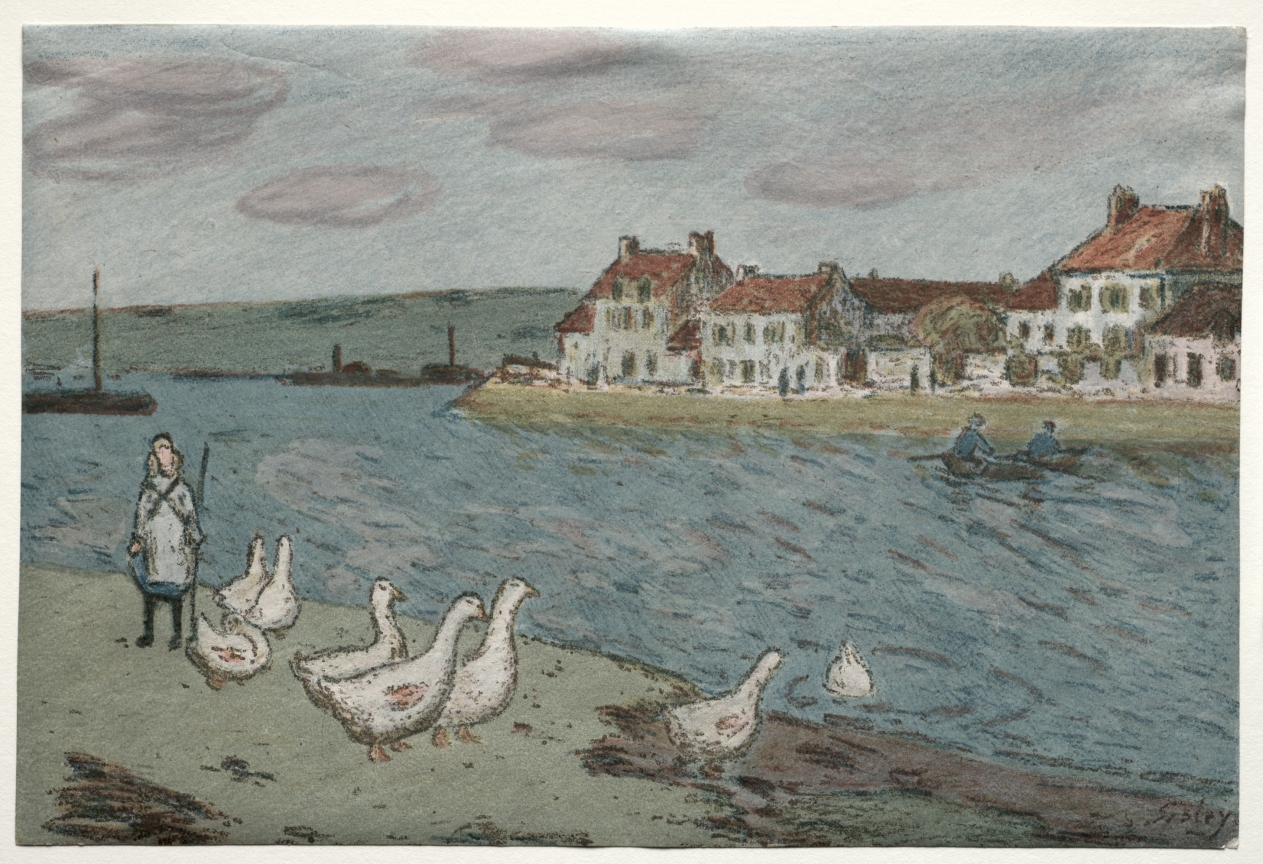
The River Bank or Geese, 1897, by Alfred Sisley
Alfred Sisley · The Cleveland Museum of Art · Mr. and Mrs. Lewis B. Williams Collection
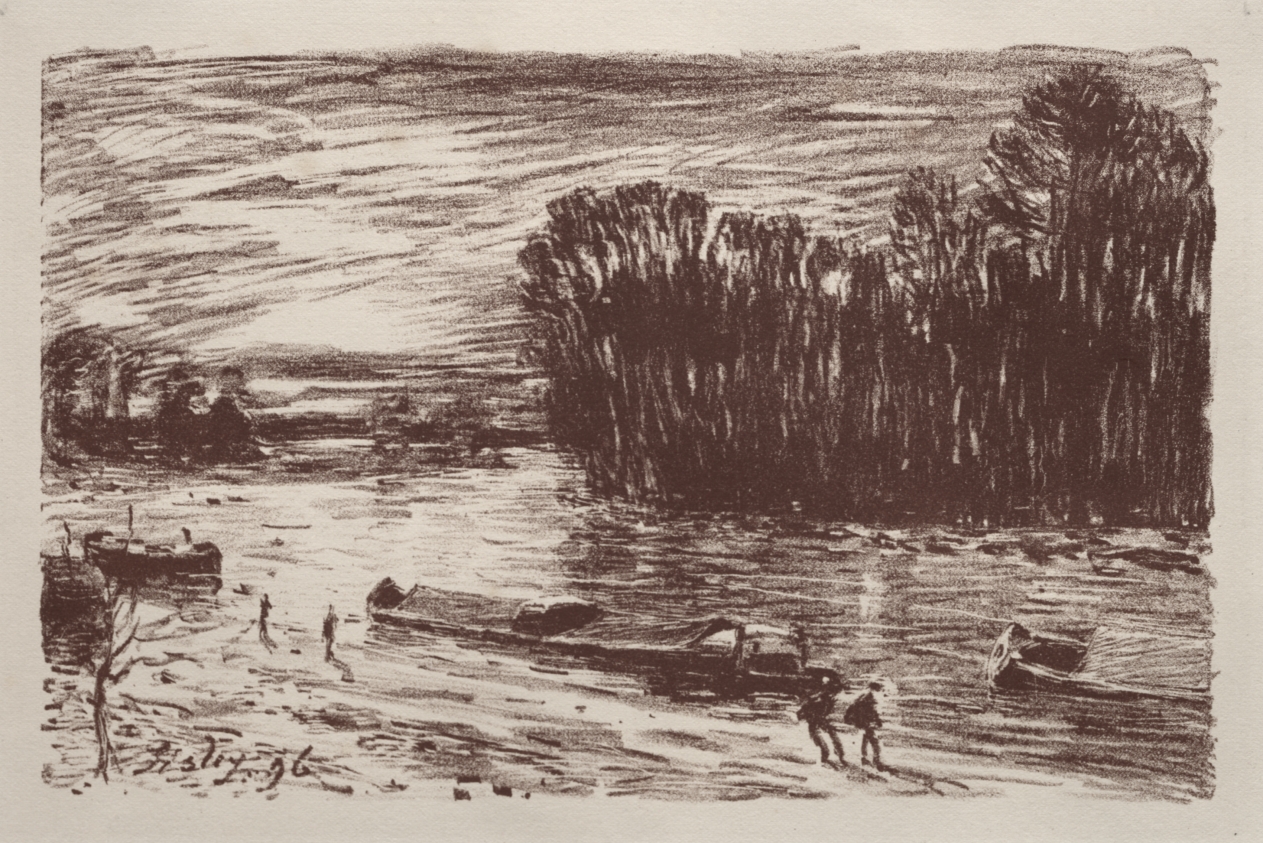
On the Banks of the Loing, 1896, by Alfred Sisley
Alfred Sisley · The Cleveland Museum of Art · Dudley P. Allen Fund
Key facts
Key facts
• Name — Alfred Sisley • Born — 30 October 1839 • Birthplace — Paris, France • Died — 29 January 1899 • Place of death — Moret-sur-Loing, France • Field — Painting • Training — Marc-Charles-Gabriel Gleyre • Movement — Impressionism • Patrons — Paul Durand-Ruel, Georges Petit, Jean-Baptiste Faure
Life
Life
Sisley was born in Paris on 30 October 1839, the youngest of four children of William Sisley, an affluent merchant of imported luxury goods, and Felicia Sell. Little is known of Sisley's childhood in Paris, other than his education was bilingual (French and English). At the age of 18 (in 1857) Sisley was sent to London to live and study with his English relatives for a career in the family import-export business. According to his confidante and biographer Gustave Geffroy, Sisley 'remained there for a few years, but above all learned painting from Turner and Constable, and literature from Shakespeare's plays.' Having shown no aptitude for business, Sisley returned to Paris in 1861. Later in 1861 Sisley began studying at the École des Beaux-Arts in Paris within the atelier of Swiss artist Marc-Charles-Gabriel Gleyre, where he befriended Frédéric Bazille, Claude Monet, and Pierre-Auguste Renoir. Frustrated with the bounds of the studio and strictures of the classicist Gleyre, the group (led by Monet) quickly began to make regular excursions to locales around Paris to paint en plein air landscapes (see Works). Unlike his friends Monet and Renoir, Sisley benefited from financial support from his family while studying. Renoir and Sisley became close friends and shared a studio, and Renoir became well known to Sisley's family: William commissioning his portrait from him (see picture). Sisley met his future wife Eugénie Lescouezec (1834–1898) in 1866, while she was working as an artists model and florist living in the Batignolles quarter of Paris. The couple's first child, Pierre, was born in Paris in June 1867 while Sisley was based in Honfleur, Normandy, a picturesque holiday resort popular with painters. Their daughter Jeanne-Adèle was born in January 1869; their second son, Jacques, born November 1871, died in infancy. In 1870-71 the financial security that Sisley had enjoyed via remittances from his family came to an abrupt end, due to the calamitous effect the outbreak of the Franco-Prussian War had on William Sisley's trading business, and ostracism and enstrangement on the grounds of Eugénie's humble and unmarried status. Sisley's financial position would remain precarious for the remainder of his life, dependent on the support of patrons, friends and the sale of his works (see Works). Sisley would visit Britain on three occasions. The first occurred in 1874 after the First Impressionist Exhibition, accompanying his patron the opera singer Jean-Baptiste Faure to London, producing twenty paintings of the non-tidal Thames at East Molesey around Hampton Court Bridge later described by art historian Kenneth Clark as "a perfect moment of Impressionism." A visit to the Isle of Wight in 1881 had to be abandoned when the canvases and materials Sisley had arranged to be shipped from France were never delivered. The third visit, in the summer of 1897, was undertaken by Alfred and Eugénie towards the end of their lives, with Eugénie in the early stages of throat cancer. Sponsored by his patron François Depeaux, who was visiting Cardiff on business, the couple settled in neighbouring Penarth, where Sisley began painting from the cliffs overlooking the town. Sisley made the acquaintance of the French consul in Cardiff Adolphe de Trobiaud, who on 3 August formally certified Eugénie the mother of Alfred's children; two days later Alfred and Eugénie were married at Cardiff Register Office, thereby legitimising their children and securing their inheritance. The couple honeymooned at the Osborne Hotel at Langland Bay on the Gower Peninsula, where Sisley painted in and around Langland Bay and Rotherslade (then called Lady's Cove). The couple returned to Moret in October 1897. In early 1898 Sisley applied for French citizenship, but was initially refused. A second application later that year was made and supported by a police report, but illness intervened. Alfred Sisley remained solely a British citizen his entire life. Eugénie Sisley died on 8 October 1898 and was buried in Moret cemetery the following day. Alfred was by then succumbing to the ravages of throat cancer and was unable to attend the funeral. Alfred Sisley died on 29 January 1899 at the age of 59. His funeral was held on 1 February and attended by his children Jeanne and Pierre joined by his friends Claude Monet, Auguste Renoir, Jean-Charles Cazin, Albert Lebourg, and Adolphe Tavernier, and dignitaries from Moret. In the days before his death, Sisley had spoken with his friend Monet and asked him to take care of his children, who were now left without resources other than the numerous unsold paintings in their father's studio. Monet arranged for a benefit auction to be held at Galerie Georges Petit held on 1 May 1899 for sale of 'Paintings, studies and pastels from his studio and those given to his children by other artists'. The former comprised 27 paintings and 6 pastels by Sisley, the latter numerous works donated at Monet's request by Sisley's friends and contacts across the Impressionist movement. The auction and sales raised 145,000 francs for Sisley's estate.
Works
Works
Sisley produced over 900 oil paintings, some 100 pastels and many other drawings.. Sisley's student works at the École des Beaux-Arts under Gleyre are lost, and his studio in Bougival was destroyed at the outbreak of the Franco-Prussian War. Sisley along with Monet, Renoir and Bazille would paint landscapes en plein air rather than in the studio in order to capture the transient effects of sunlight realistically. This approach, innovative at the time, resulted in paintings more colourful and more broadly painted than the public was accustomed to seeing. Consequently, Sisley and his friends initially had few opportunities to exhibit or sell their work. Their paintings were usually rejected by the jury of the most important art exhibition in France, the annual Salon.His first landscape paintings are sombre, coloured with dark browns, greens, and pale blues. They were often executed at Marly and Saint-Cloud. Little is known about Sisley's relationship with the paintings of J. M. W. Turner and John Constable, which he may have seen in London, but some have suggested that these artists may have influenced his development as an Impressionist painter, as may have Gustave Courbet and Jean-Baptiste-Camille Corot. He was inspired by the style and subject matter of previous modern painters Camille Pissarro and Édouard Manet. Among the Impressionists, Sisley has been overshadowed by Monet, whose work his resembles in style and subject matter, although Sisley's effects are more subdued. Described by art historian Robert Rosenblum as having "almost a generic character, an impersonal textbook idea of a perfect Impressionist painting", his work strongly invokes atmosphere, and his skies are always impressive. He concentrated on landscape more consistently than any other Impressionist painter. Among Sisley's best-known works are Street in Moret and Sand Heaps, both owned by the Art Institute of Chicago, and The Bridge at Moret-sur-Loing, shown at Musée d'Orsay, Paris. Allée des peupliers de Moret (The Lane of Poplars at Moret) has been stolen three times from the Musée des Beaux-Arts in Nice – once in 1978 when on loan in Marseilles (recovered a few days later in the city's sewers), again in 1998 (when the museum's curator was convicted of the theft and jailed for five years with two accomplices), and finally in August 2007 (on 4 June 2008 French police recovered it and three other stolen paintings from a van in Marseilles).
Exhibitions
Exhibitions
Significant retrospective exhibitions of Sisley's works include: • Alfred Sisley (1992-1993) - Royal Academy of Arts, London: 3 July to 18 October 1992; Musée d'Orsay, Paris: 28 October 1992 to 31 January 1993; Walters Art Museum, Baltimore: 14 March to 13 June 1993. • Alfred Sisley retrospective (2000) - Isetan Museum, Tokyo: 2 March to 17 April 2000; Takamatsu City Art Museum, Kagawa: 22 April to 21 May 2000; Hiroshima Museum of Art: 27 May to 2 July 2000; The Museum of Modern Art, Wakayama: 8 July to 10 September 2000. • Sisley: Poet of Impressionism (2002-2003) - “Alfred Sisley: Poeta dell'Impressionismo” - Palazzo dei Diamanti, Ferrara: 17 February to 19 May 2002; “Alfred Sisley: Poeta del Impresionismo” - Thyssen-Bornemisza National Museum, Madrid: 8 June to 15 September 2002; “Alfred Sisley: poète de l'impressionnisme” - Musée des Beaux-Arts de Lyon, Lyon: 10 October 2002 to 6 January 2003. • Sisley in England and Wales (2009) - National Gallery, London: 12 November 2008 to 22 February 2009; Amgueddfa Cymru / National Museum of Wales, Cardiff: 7 March to 14 June 2009. • Alfred Sisley: the true Impressionist (2011-12) - "Alfred Sisley: der wahre Impressionist" Von der Heydt-Museum, Wuppertal: 13 September 2011 to 29 January 2012. • Alfred Sisley: Impressionist Master / Sisley l’impressionsite (2017) - “Alfred Sisley: Impressionist Master” - Bruce Museum, Greenwich, Connecticut: 21 January to 21 May 2017.; “Sisley l’impressionsite” - Centre d’Art Aix-en-Provence, Caumont, Aix-en-Provence: 10 June to 15 October 2017.
Selected works
Selected works
• Avenue of Chestnut Trees near La Celle-Saint-Cloud (1865) • View of Montmartre from Cité des Fleurs to Les Batignolles (1869) • The Bridge at Villeneuve-la-Garenne (1872) • Ferry to the Ile-de-la-Loge – Flood (1872) • La Grande-Rue, Argenteuil (c. 1872) • Square in Argenteuil (Rue de la Chaussee) (1872) • Footbridge at Argenteuil (1872) • Chemin de la Machine, Louveciennes (1873) • Louveciennes. Sentier de la Mi-côte (1873) • Hampton Court Bridge (painting) (1874) • Molesey Weir – Morning (1874) • Regatta at Molesey (1874) • Under Hampton Court Bridge (1874) • The Terrace at Saint-Germain, Spring (1875) • The Small Meadows in Spring, By (c. 1881)
Gallery
Gallery
• Illustration — St. Martin Canal, 1870, Musée d'Orsay, Paris • Illustration — The Seine at Argenteuil, 1872, Faure Museum, Aix-les-Bains • Illustration — The Bridge at Villeneuve-la-Garenne, 1872, Metropolitan Museum of Art, New York City • Illustration — Grain fields on the hills of Argenteuil, 1873, Hamburger Kunsthalle, Hamburg • Illustration — Chemin de la Machine, Louveciennes, 1873, Musée d'Orsay, Paris • Illustration — Fog, Voisins, 1874, Musée d'Orsay, Paris • Illustration — La Petite Place - La Rue du Village, 1874, Aberdeen Art Gallery • Illustration — Under the Bridge at Hampton Court, 1874, Kunstmuseum Winterthur, Switzerland • Illustration — The Terrace at Saint-Germain, Spring, 1875, The Walters Art Museum, Baltimore • Illustration — The Meadow, 1875, National Gallery of Art, Washington, D.C. • Illustration — The Seine at Bougival, 1876, Metropolitan Museum of Art, New York City • Illustration — La Seine au point du jour, 1877, Musée Malraux, Le Havre • Illustration — Resting by a Stream at the Edge of the Wood, 1878, Musée d'Orsay, Paris • Illustration — La Seine à Suresnes, 1880, Rehs Galleries, Inc., New York City • Illustration — Le Givre à Veneux, 1880, University of Michigan Museum of Art, Ann Arbor • Illustration — A path at Les Sablons, 1883, National Gallery of Australia, Canberra • Illustration — The Edge of Fontainebleau Forest, 1885, Pushkin Museum, Moscow • Illustration — Women Going to the Woods, 1886, Artizon Museum, Tokyo • Illustration — Le Pont de Moret, effet d'orage, 1887, Musée Malraux, Le Havre • Illustration — Seaside, Langland, 1887, Museum of Fine Arts Bern • Illustration — A Bend in the Loing, 1892, Museu Nacional d'Art de Catalunya, Barcelona • Illustration — The Church at Moret in the Morning Sun, 1893, Musée des Beaux-Arts de Rouen • Illustration — A Forest Clearing, 1895, Thyssen-Bornemisza Museum, Madrid
Identity and overview
Identity and overview
The following is established of the heading itself.
Origins and background
Origins and background
The following is established of origins and background. Sisley died in 1899 at cemetery of Moret-sur-Loing. Institutional cataloguing adds that alfred Sisley was born in 1839 at former 4th arrondissement of Paris.
Places
Named by the record
Places
Only places the record itself states, plotted where the house gazetteer settles their coordinates. Nothing is inferred from a name or a nationality.
former 4th arrondissement of Paris.
Birth place
cemetery of Moret-sur-Loing.
Death place
Stolen and looted paintings
During the Nazi period (1933–1945) a number of Sisley works were taken from Jewish art collectors by Nazis or their agents (such as the E.R.R.) as part of the widespread looting of property owned by Jews which preceded the Holocaust. Several of these stolen paintings have been the subject of restitution efforts and litigation. • In 2004 Sisley's Soleil de printemps, le Loing (1892) was restored to the family of Louis Hirsch, in a ceremony in Paris. • In 2008 Bateaux en Réparation à Saint Mammès (1885) was recognised as having been looted by the Nazis, and was the subject of a settlement with the heirs of Benno and Frances Bernstein (who had owned it before Nazi occupation). • In 2016 a dispute erupted between Alain Dreyfus, an art dealer in Switzerland, and the auction house Christie's, over Sisley's Premier jour de printemps à Moret (1889). Dreyfus, who had purchased the painting at auction in 2008, was subject to a claim by Daniel Lindon family that the painting had been looted from his grandfather Abner Lindenbaum. Dreyfus alleged that Christie's had not sufficiently examined the work's provenance before putting it up for sale, and not disputing the Lindon family's claim, sought reimbursement of the purchase price plus interest from Christie's. Numerous Sisleys looted by the Nazis have still have not been found. The German Lost Art Foundation has 24 listings for Sisley.
Primary material
Documents and archives
reference work
- “Alfred Sisley”, English Wikipedia, consulted as further reading
Reputable secondary · Wikipedia
authority file
- Gemeinsame Normdatei 5072379-0, Exhibition Alfred Sisley (1992-1993 : London u.a.).
General reference · Deutsche Nationalbibliothek
authority record
- Wikidata, structured authority record Q175130: Alfred Sisley
General reference · Wikidata
Notes from the source article
Cited by Wikipedia
Notes from the source article
These works are cited by the source article, in its own numbering. They are recorded as its citations, not as sources VALÉORINE has verified.
- 1.Plaque at 19 rue des Trois-Bornes, Paris. Wikicommons.
- 2.Renoir, Jean. Renoir, my father. Little Brown. 120. 1962.
- 3.Clark, Kenneth. Landscape into Art. Beacon Press. 90. 1949.
- 4.14 January 2016. From Alfred Sisley to Paul Vogler: A forged signature and its history.
- 5.Paul Vogler (*Paris 1852 - † Verneuil-sur-Seine (Yvelines) 1904), Maler Baumallee bei einem Städtchen, 4. Viertel 19. Jahrhundert. Kunsthalle Bremen.
- 6.Haine, Scott. The History of France. Greenwood Press. 112. 2000. 0-313-30328-2.
- 7.Bomford et al. 1990, p. 203.
- 8.Earth Times. French National Pleads Guilty to International Stolen Art Conspiracy. 10 July 2008.
- 9.Restitution d'un tableau d'Alfred Sisley. Le Monde. 2004-06-19.
- 10.Darmon, Adrian. Un Sisley volé par les Nazis refait surface. artcult.fr.
- 11.Meaux, Lorraine de. Une grande famille russe. Les Gunzburg. Place des éditeurs. 2018-03-22. 978-2-262-07616-0.
- 12.Impressionist and Modern Art (Evening Sale), Lot 37, Soleil de printemps - Le Loing. Christie's. 3 November 2004.
- 13.Impressionist and Modern Art Day Sale, Lot 315, Bateaux en Réparation à Saint Mammès. Sothebys. 6 February 2008.
- 14.Impressionist and Modern Art Day Sale, Lot 200, 'Premier jour de printemps à Moret'. Christie's. 6 November 2008.
- 15.Moynihan, Colin. Did Christie's Do Its Homework? Buyer of Nazi-Tainted Work Says No. The New York Times. 3 June 2018.
- 16.Herzberg, Nathaniel. Un Sisley vole par les nazis embarrasse Christie's. Le Monde. 28 May 2018.
- 17.lootedart.com. Alfred Sisley – Results.
- 18.lostart.de. Lost Art Internet Database – Einfache Suche – Sisley.
- 19.Sisley. Musée d'Orsay.
- 20.Alfred Sisley: Poeta dell'Impressionismo. Palazzo dei Diamanti.
- 21.Sisley. Poet of Impressionism. Thyssen-Bornemisza National Museum.
- 22.Sisley in England and Wales. National Gallery.
- 23.Exhibitions - review. Von der Heydt Museum.
- 24.Sisley: The Impressionist. Caumont, Centre d'Art.
- 25.Bruce Museum. Alfred Sisley (1839-1899): Impressionist Master. 2 January 2017.
References
Citations
References
Each reference names the institution holding it, so a reader may go to the document itself.
reference work
Secondary witnessauthority file
Gemeinsame Normdatei 5072379-0, Exhibition Alfred Sisley (1992-1993 : London u.a.).Deutsche Nationalbibliothek
Secondary witnessauthority record
General reference
Further particulars
Held on the record
Further particulars
Open the remaining particulars
This entry is compiled from 15 catalogued sources across 10 independent registers. The registers consulted are Crossref registry, Internet Archive, The Metropolitan Museum of Art, The Art Institute of Chicago, The Cleveland Museum of Art, DOAJ, Deutsche Nationalbibliothek, Wellcome Collection, Wikidata and Wikipedia. Every statement above is held against the register that stated it; where the registers are silent, the entry is silent.
The Encyclopedia exists whether or not anything is for sale. Corrections are recorded rather than overwritten, and every version of this record is kept. Published 17 August 2026.
Elsewhere in Paintings
19,261 published records in this field, each with its sources named.
- Alfred Robert QuintonArtist
- Alfred RoloffArtist
- Alfred SchouppéArtist
- Alfred SimonsenArtist
- Alfred Sohn-RethelArtist
- Alfred StevensArtist
- Alfred SullyArtist
- Alfred Thomas AgateArtist
Best supported in this field
For owners
Own a work by Alfred Sisley?
A specialist will read what you send and tell you what the house can establish, what it cannot, and whether the object is suited to sale. There is no charge and no obligation. The object stays with you throughout; nothing is shipped to us unless it is arranged in writing beforehand.