
Yehuda Bacon
Illustration — Yehuda Bacon, 2008 Yehuda Bacon (born July 28, 1929) is an Israeli artist and Holocaust survivor.
Yehuda Bacon
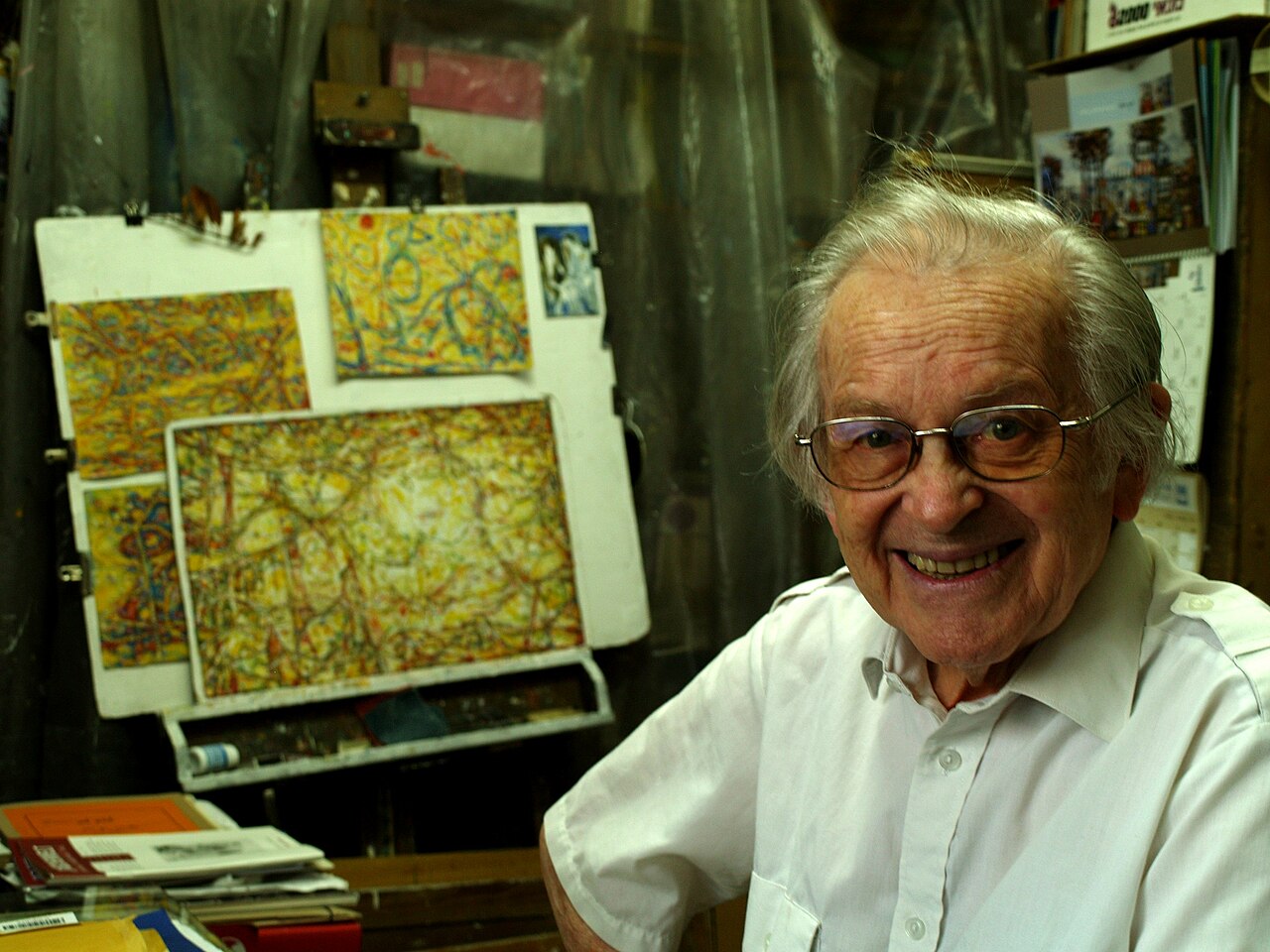
Lukas Welz · Welz · CC BY-SA 3.0
- Born
- 1929 · Moravská Ostrava.
- Nationality
- Israel
- Occupation
- painter · university teacher · illustrator · printmaker · artist
- Fields
- visual arts · painting · graphics
- Education
- New Bezalel School of Arts and Crafts · Central School of Art and Design · Beaux-Arts de Paris · Pratt Institute
- Honours
- Cross of the Order of Merit of the Federal Republic of Germany · Mordecai Ish Shalom Lifetime Achievement Award
VALÉORINE Encyclopedia
VALÉORINE documentary reading
Documentary summary
Illustration — Yehuda Bacon, 2008 Yehuda Bacon (born July 28, 1929) is an Israeli artist and Holocaust survivor.
Admitted source layer · organised and presented by VALÉORINE
Reference Check
Propose documentary evidence for Yehuda Bacon. A contribution is never written directly as fact: identity, source, rights and evidence gates still decide.
Sign in to contribute
World of VALÉORINE
Documentary connections
Only confirmed graph relationships appear here. Images are shown only when their identity and reuse rights both pass the documentary gate.
Documentary evidence
Documentary basis
Authority files
wikidata · Q799798 · wikipedia · Yehuda Bacon
In this article
Biography
Biography
Yehuda Bacon studied at New Bezalel School of Arts and Crafts, Central School of Art and Design and Beaux-Arts de Paris. The field of work recorded is visual arts, painting and graphics. Residence is recorded at Moravská Ostrava. Employment is recorded with University of Haifa and Bezalel Academy of Art and Design. Distinctions recorded are Cross of the Order of Merit of the Federal Republic of Germany and Mordecai Ish Shalom Lifetime Achievement Award.
Yehuda Bacon was born into a Hasidic (Orthodox Jewish) family in Ostrava, then part of Czechoslovakia. In the fall of 1942, at the age of 13, Bacon was deported with his family from Ostrava to the Ghetto Theresienstadt, where he shared a room with George Brady. In Theresienstadt he played in the children's opera Brundibár. In December 1943, he was deported to the concentration and extermination camp Auschwitz-Birkenau, where he and other imprisoned children were used to bedazzle the International Committee of the Red Cross in the so-called "family camp". In fact, the "Birkenau Boys" were used for transport work in the entire complex of Auschwitz II-Birkenau. In June 1944, Bacon saw his father murdered in the gas chambers. At this time, his mother and his sister Hanna were deported to the Stutthof concentration camp, where they died a few weeks before its liberation. On January 18, 1945, Bacon was sent on the camp's death march, which lasted three days and led him through the Mauthausen-Gusen concentration camp to its subcamp Gunskirchen. In March, Bacon was sent on another death march to a subcamp of Mauthausen, Gunskirchen, in the woods. As he reports, there was no food, water or clothing. On May 5, 1945, Bacon was liberated by the US Army. Before the SS guards left the camp, they poisoned the rest of the food. After fleeing to a village, many inmates died from eating too much too suddenly, in amounts their bodies could no longer handle. Bacon and his friend Wolfie Adler (who later became an Israeli rabbi and published a book about his experiences) left the camp. US soldiers brought them to a hospital in the Austrian town Steyr. After his recovery, Bacon returned to Prague hoping to reunite with his mother and sisters. He lived in an orphanage not far from Prague in Štiřín, which was established by the Czech educator and humanist Přemysl Pitter. The writer H.G. Adler was also a teacher there. Through Pitter and Adler, he found a way to live after the liberation. In 1946, Bacon immigrated to Israel with the help of Youth Aliyah. There he studied at Bezalel Academy of Arts and Design. In 1959, he became a professor of graphic art and drawing at Bezalel. Yehuda Bacon lives with his wife Leah Bacon in Katamon neighborhood of Jerusalem. He has two sons and a daughter by a former marriage to Josephine Bacon.
Art career
Art career
• Illustration — Reproduction of Bacon painting, Yad Vashem, Jerusalem After liberation, Bacon decided to become an artist to process his experiences and try to describe what he lived through. As a survivor he feels a responsibility to tell his story and to make future generations aware of their responsibility in the present and future. He was among the first survivors of the Shoah to set foot again on German soil. Bacon's drawings show details and sequences of what he saw in the concentration camps and scenes he drew as a teenager shortly after the liberation. His drawings served as evidence in trials against Nazi criminals (including the Eichmann trial in Jerusalem and the Frankfurt Auschwitz Trials) and were used in the litigation against Holocaust denier David Irving, who challenges the existence of gas chambers in Auschwitz. His art is a kind of asynergistic interaction: on the one hand, Bacon processes the experiences of his childhood and youth in the concentration camps, on the other he is searching for a way of understanding through his art. Bacon was early part of interfaith dialogues and Israeli-Palestinian dialogue in the 1950s. His art is shown in several museums and collections around the world, among the Israel Museum and Yad Vashem in Jerusalem, the United States Congress in Washington, D.C., in the homes of Theodore Roosevelt, John D. Rockefeller, Martin Buber and Chaim Weizmann as well as in London.
Solo exhibitions
Solo exhibitions
• Nora Gallery, Jerusalem (1954) • Whippmann Gallery, Johannesburg (1955) • Princeton University, Princeton (1973) • Lutheran Education Center, Munich (1978) • Portland City Hall, Portland, Oregon (1988) • SOCA Gallery, Auckland (1995) • Studio Visuri Osmo, Helsinki (1999) • Spectrum Gallery, Frankfurt (2004) • Museum am Dom, Würzburg (2008) • Czech Centre, Prague (2011)
Group exhibitions
Group exhibitions
• Henny Handler, London (1987) starring Naomi Blake • St. Paul's Church, Frankfurt (1999) with Dan Richter-Levin • Art Museum, Tel Aviv (1952) with Isidor Aschheim, Naftali Bezem, Nahum Gutman, Aviva Uri, et al. • 45e Exposition de la Maison des intellectuels, Paris (1962) • National Museum of Modern Art, Tokyo (1962) • Pratt Graphic Art Center, New York (1966) • Art Gallery, São Paulo, (1967) by Mordechai Ardon, Moshe Castel, Jacob Pins, Anna Ticho, Yigael Tumarkin, et al. • Gallery of Modern Art Rijeka, Ljublijana (1968) • Musée d'Art Moderne, Paris (1981) • Imperial War Museum, London (2001) • The Brooklyn Museum of Art, New York (2003) • Los Angeles Museum, California 2004 • Ben Uri Gallery, London (2008) - Israel and Art - 60 years through the eyes of Teddy Kolek
Life and career
Dated record
Life and career
The full dated record · 1 entries
1929
Yehuda Bacon was born on 28 July 1929.
Collections
Collections
• Yad Vashem, Jerusalem • Ghetto Fighters' House Museum, Western Galilee • Victoria and Albert Museum, London • British Museum, London • Imperial War Museum, London • Magnes Museum, Berkeley • Museum am Dom, Würzburg
Documents and archives
Primary material
Documents and archives
authority record
- Wikidata, structured authority record Q799798: Yehuda Bacon
General reference · Wikidata
reference work
- “Yehuda Bacon”, English Wikipedia, consulted as further reading
Reputable secondary · Wikipedia
Citations
References
Each reference names the institution holding it, so a reader may go to the document itself.
authority record
Secondary witnessreference work
Secondary witness
The Encyclopedia exists whether or not anything is for sale. Corrections are recorded rather than overwritten, and every version of this record is kept. Published 16 August 2026.
Elsewhere in Prints
4,138 published records in this field, each with its sources named.
- Yannis MoralisEngraver
- Yaroslav OmelianEngraver
- Yasuhide KobashiEngraver
- Yasuo KuniyoshiEngraver
- Yi EungroEngraver
- Yolanda GonzalezEngraver
- Yolanda LópezEngraver
- Yoshio FujimakiEngraver
Best supported in this field
For owners
Own a work by Yehuda Bacon?
A specialist will read what you send and tell you what the house can establish, what it cannot, and whether the object is suited to sale. There is no charge and no obligation. The object stays with you throughout; nothing is shipped to us unless it is arranged in writing beforehand.