
Yannis Ritsos
Yiannis Ritsos (ˈritsos; 1 May 1909 – 11 November 1990) was a Greek poet and communist and an active member of the Greek Resistance during World War II. While he disliked being regarded as a political poet, he has been called "the great poet of the Greek left".
Also recorded as Yiannis Ritsos · Giannis Ritsos
Yannis Ritsos

Dzole at English Wikipedia · Public domain
- Name
- Yiannis Ritsos
- Born
- 1 May 1909
- Birthplace
- Monemvasia, Greece
- Died
- 11 November 1990
- Place of death
- Athens, Greece
- Occupation
- Poet
- Movement
- Modernism Generation of the '30s
- Full name
- Ιωάννης Ρίτσος.
- Nationality
- Greece.
- Fields
- poetry, literature, theatre and translation.
- Movements
- realism, surrealism and Thirties Generation.
- Honours
- Order of Friendship of Peoples, Lenin Peace Prize, Golden Wreath and honorary doctor of the University of Strasbourg-II.
VALÉORINE Encyclopedia
VALÉORINE documentary reading
Documentary summary
Yiannis Ritsos (ˈritsos; 1 May 1909 – 11 November 1990) was a Greek poet and communist and an active member of the Greek Resistance during World War II. While he disliked being regarded as a political poet, he has been called "the great poet of the Greek left".
Admitted source layer · organised and presented by VALÉORINE
Note VALÉORINE
No house-authored Note is published until its assertions and sources pass the VALÉORINE evidence contract. The documentary article remains available in full while that enrichment is being consolidated.
Documentary enrichment in progress · no unsupported statement published
Reference Check
Propose documentary evidence for Yannis Ritsos. A contribution is never written directly as fact: identity, source, rights and evidence gates still decide.
Sign in to contribute
Documentary evidence
Evidence Panel
not yet certified
- Identity
- resolved
- Independent source families
- 0
- Admitted assertions
- 0
- Open conflicts
- 0
Authority files
wikidata · Q297409
In this article
Key facts
Key facts
• Name — Yiannis Ritsos • Native Name — Γιάννης Ρίτσος • Born — 1 May 1909 • Birthplace — Monemvasia, Greece • Died — 11 November 1990 • Place of death — Athens, Greece • Occupation — Poet • Movement — Modernism Generation of the '30s
Early life
Early life
Ritsos was born on 1 May 1909 to a well-to-do landowning family in Monemvasia. He suffered great losses as a child: his mother and eldest brother died early from tuberculosis, his father struggled with mental illness, and his famly was economically ruined. This marked Ritsos and affected his poetry. Ritsos himself was confined in a sanatorium for tuberculosis from 1927 to 1931.
Literary start
Literary start
In 1934, Ritsos joined the Communist Party of Greece (KKE). He maintained a working-class circle of friends and published Tractor in 1934. Kostis Palamas, the well known and respected poet, impressed by his talent, praised him publicly. In 1935, he published Pyramids; these two works sought to achieve a fragile balance between faith in the future, founded on the Communist ideal, and personal despair. Tractors and Pyramids initially were not well received by leftist critics, who found the language "too embellished" and Ritsos overly focused on form. He was inspired for his landmark poem "Epitaphios" by a photo of a dead protester during a massive tobacco-workers demonstration in Thessaloniki in May 1936. Published the same year, it broke with the shape of the Greek traditional popular poetry and expressed in clear and simple language a message of the unity of all people.
Political upheaval and the poet
Political upheaval and the poet
In August 1936, the right-wing dictatorship of Ioannis Metaxas came to power and Epitaphios was burned publicly at the foot of the Acropolis in Athens. Ritsos responded by taking his work in a different direction. He began to explore the conquests of surrealism through the domain of dreams, surprising associations, explosions of images and symbols, a lyricism illustrative of the anguish of the poet, and both tender and bitter souvenirs. During this period Ritsos published The Song of my Sister (1937) and Symphony of the Spring (1938).
Axis occupation, Civil War and the Junta
Axis occupation, Civil War and the Junta
During the Axis occupation of Greece (1941–1945) Ritsos became a member of the EAM (National Liberation Front) and authored several poems for the Greek Resistance. These include a booklet of poems dedicated to the resistance leader Aris Velouchiotis, written immediately upon the latter's death on 16 June 1945. Ritsos also supported the Left in the subsequent Civil War (1946–1949); in 1948 he was arrested and spent four years in prison camps. In the 1950s Epitaphios, set to music by Mikis Theodorakis, became the anthem of the Greek Left. In 1967 he was arrested by the Papadopoulos dictatorship and sent to a prison camp in Gyaros, later to Samos and finally Lemnos.
Translations
Translations
• Subterranean Horses, tr. Minas Savvas, illustrations by the author (1980) • Chronicle of Exile, tr. M. Savvas (1977) [select poems] • Eighteen Short Songs of the Bitter Motherland, tr. A. Mims, illus. Y. Ritsos (1974) [Greek and English] • Exile and Return, tr. E. Keeley (1985; repr. 1987, 1989) [select poems] • Gestures and other poems, 1968-1970, tr. N. Stangos, illus. by the poet (1971) • Repetitions, Testimonies, Parentheses, tr. E. Keeley (1990) • Selected Poems 1938-1988, tr. K. Friar, K. Myrsiades & others (1989) • Selected Poems, tr. N. Stangos (1974) • The Fourth Dimension, tr. P. Green, B. Bardsley (1993) • Late Into the Night: The Last Poems of Yannis Ritsos, trans. Martin McKinsey (Oberlin College Press, 1995). • Diaries of Exile, Archipelago Books, (2012) • Petrified Time: Poems from Makrónissos, trans. Martin McKinsey and Scott King (Red Dragonfly Press, 2014).. • Twelve Poems About Cavafy, tr. Paul Merchant (Tavern Books, 2010) • Monochords, tr. Paul Merchant (Tavern Books, 2017)
Identity and origins
Identity and origins
One child is recorded: Eri Ritsos. Other recorded relations include Despina Glezou.
Identity
Identity
Yannis Ritsos is recorded with the occupation playwright. Recorded as poet, playwright, translator, writer and actor. Recorded at birth as Ιωάννης Ρίτσος.
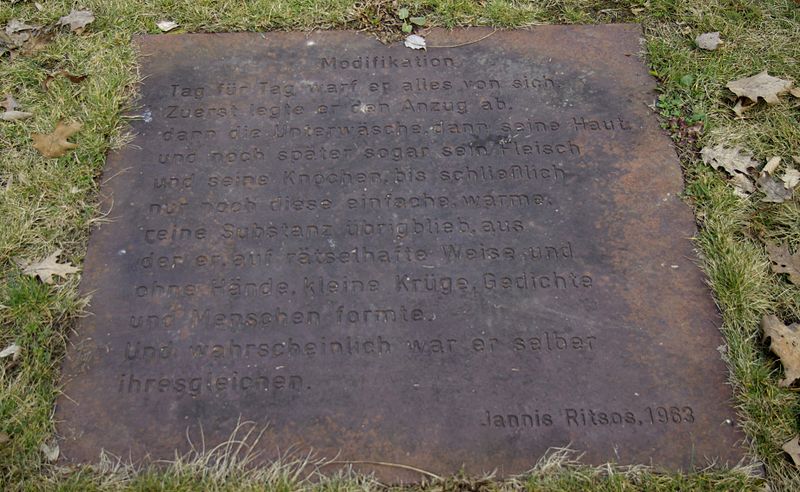
Skulptur Gefangene Steine 1 (1974) von Hans-Jürgen Breuste in Erlangen
Janericloebe
![A photo allegedly from front page of the Greek newspaper Rizospastis, May 10, 1936. The real photo can be seen here: [1].](https://upload.wikimedia.org/wikipedia/commons/thumb/d/d4/A_mother_who_cries_%28Thessaloniki_1936%29.jpg/800px-A_mother_who_cries_%28Thessaloniki_1936%29.jpg)
A photo allegedly from front page of the Greek newspaper Rizospastis, May 10, 1936. The real photo can be seen here: [1].
Rizospastis.gr
Life and career
Dated record
Life and career
The full dated record · 2 entries
1909
Yannis Ritsos born at Monemvasia.
1990
Yannis Ritsos died on 11 November 1990.
Places
Named by the record
Places
Only places the record itself states, plotted where the house gazetteer settles their coordinates. Nothing is inferred from a name or a nationality.
Monemvasia.
Birth place
Athens.
Death place
Legacy
• Illustration — Sculpture "Prisoner Stones 1" (1974) by Hans-Jürgen Breuste in Erlangen. Featuring a Yannis Ritsos poem. Today, Ritsos is considered one of the great Greek poets of the twentieth century, alongside Konstantinos Kavafis, Kostas Kariotakis, Angelos Sikelianos, Giorgos Seferis, and Odysseas Elytis. The French poet Louis Aragon once said that Ritsos was "the greatest poet of our age." Pablo Neruda declared him to be more deserving of the Nobel Prize for Literature than himself. Ritsos was proposed several times for it, and was shortlisted as one of the final candidates at least once, in 1973. When he won the Lenin Peace Prize in 1975, he declared "this prize is more important for me than the Nobel." His poetry was banned at times in Greece due to his left wing beliefs. Notable works by Ritsos include Pyramids (1935), Epitaphios (1936; second edition, 1956), Vigil (1941–1953), Romiosini (1954) and 18 short songs of the bitter Motherland (18 λιανοτράγουδα της πικρής πατρίδας/18 Lianotragouda Tis Pikris Patridas) (1973). Stratis Haviaras also praised two poems (the one about Jesus and the one about Karl Marx) in his first collection Tractor (1934). Robert Shannan Peckham described him as "perhaps Greece's greatest contemporary poet." Epitaphios became an anthem of the Greek left in the 1950s, and his best-known work. Ritsos won the first Greek state poetry award for Moonlight Sonata: Some offer more measured praise. In a review of Selected Poems: 1938-1988, James Erdman argued, To my ear, many of these selections are simply short prose works, lacking the concentration of the best poetry. The pieces of ancient history and mythology from Repetitions such as "The Graves of Our Ancestors," "Alcmene," "Philometa," and "Achilles After Death" seem among the better efforts. [...] he often uses dream imagery, which can be effective in small doses but soon grows monotonous: not all concepts can be expressed in images. [...] But Ritsos is also capable of writing with great power. His best poem is "Romiosini," a lengthy paean to the spirit of the Greek Resistance. Ted Sampson stated that Louis Aragon's declaration about Ritsos was "hyperbolic", but wrote that the poet still "excelled in brief epigrammatic utterances as well as in extended lyrics, sequences, and verse dramas of astonishing imagistic and thematic originality—to say nothing of their latent emotional intensity". Ritsos is also a Golden Wreath Laureate of the Struga Poetry Evenings for 1985. His daughter, Eri, was a candidate for the European Parliament with KKE in the elections of 25 May 2014.
Primary material
Context
The circumstances in which Yannis Ritsos stands. Recorded as having received Order of Friendship of Peoples, Lenin Peace Prize and Golden Wreath.
Notes from the source article
Cited by Wikipedia
Notes from the source article
These works are cited by the source article, in its own numbering. They are recorded as its citations, not as sources VALÉORINE has verified.
- 1.Antonis Liakos, "Hellenism and the Making of Modern Greece" in: Hellenisms: Culture, Identity, and Ethnicity from Antiquity to Modernity, Ashgate Publishing, Ltd., 2008, p. 216.
- 2.Ritsos, Giannēs, 1909-1990. Library of Congress. 4 August 2025.
- 3.Wagner, Guy. Ritsos. 2003.
- 4.Glanville, Jo. Beyond Bars. SAGE Publications Ltd. 9781446241479.
- 5.Capri-Karka, C. Editorial. The Charioteer. 29/30. 7–18. 1987–88. 0-933824-20-3.
- 6.The poems are dated July 1945. Το Υστερόγραφο της δόξας ('Postscript to glory'), 10th ed., Athens: Kedros, 1991.
- 7.Brahic, Beverley Bie. In Secret: Versions of Yannis Ritsos translated by David Harsent – review. The Guardian. 2013-02-22.
- 8.Papadopoulos, Stephanos. Hurt Into Poetry: On Poetry and Greece. Los Angeles Review of Books. 2013-05-10.
- 9.Chrysopoulos, Philip. November 11, 1990: World of Poetry Mourns Passing of Yiannis Ritsos. Greek Reporter. 2018-11-11.
- 10.nobelprize.org. Nomination archive: Yannis Ritsos.
- 11.Svenska Akademien. Ur nobelarkivet för år 1973.
- 12.Haviaras, Stratis. Review of Selected Poems, 1938-1988. Harvard Book Review. 19/20. 18. 1991. 1080-6067.
- 13.Nilan, Vivienne. Two books highlight work of Ritsos eKathimerini.com. Kathimerini. 2002-03-14.
- 14.Yannis Ritsos -- Britannica Academic. academic-eb-com.eres.qnl.qa.
- 15.Peckham, Robert Shannan. Yannis Ritsos (1909-1990). Mediterraneans. 2–3. 327–331. 1992.
- 16.Yannis Ritsos, 81; Prolific Greek Poet. Los Angeles Times. 1990-11-13.
- 17.Erdman, James. Review of Selected Poems: 1938-1988. Harvard Book Review. 17/18. 37–38. 1990. 1080-6067.
- 18.Sampson, Ted. Review of Selected Poems, 1938-1988. World Literature Today. 64. 3. 507–508. 1990. 0196-3570.
References
Citations
References
Each reference names the institution holding it, so a reader may go to the document itself.
reference work
Wikidata, structured authority record Q297409: Yannis RitsosWikimedia Foundation
Partially resolved
Further particulars
Held on the record
Further particulars
Open the remaining particulars
Yannis Ritsos worked in poetry, literature, theatre and translation. His work is associated with realism, surrealism and Thirties Generation. He belonged to National Liberation Front. Ritsos received Order of Friendship of Peoples, Lenin Peace Prize, Golden Wreath and honorary doctor of the University of Strasbourg-II.
Career and activity
Recognition and collections
The Encyclopedia exists whether or not anything is for sale. Corrections are recorded rather than overwritten, and every version of this record is kept. Published 14 August 2026.
Elsewhere in Books
38,960 published records in this field, each with its sources named.
- Yann-Fañch KemenerAuthor
- Yannick HaenelAuthor
- Yannis KondosAuthor
- Yannis PatilisAuthor
- Yannis SkarimpasAuthor
- Yannis VarverisAuthor
- Yannis VlachoyannisAuthor
- Yannis YfantisAuthor
Best supported in this field
For owners
Own a work by Yannis Ritsos?
A specialist will read what you send and tell you what the house can establish, what it cannot, and whether the object is suited to sale. There is no charge and no obligation. The object stays with you throughout; nothing is shipped to us unless it is arranged in writing beforehand.