
Bulat Okudzhava
Bulat Shalvovich Okudzhava (Russian: Була́т Ша́лвович Окуджа́ва; Georgian: ბულატ ოკუჯავა; Armenian: Բուլատ Օկուջավա; May 9, 1924 – June 12, 1997) was a Soviet and Russian poet, writer, musician, novelist, and singer-songwriter of Georgian-Armenian ancestry. He was one of the founders of the Soviet genre called "author song" (авторская песня, avtorskaya pesnya), or "guitar song", and the author of about 200 songs, set to his own poetry. His songs are a mixture of Russian poetic and folk song traditions and the French chansonnier style represented by such contemporaries of Okudzhava as Georges Brassens.
Also recorded as Bulat Shalvovich Okudzhava · Bulat Okujava
Bulat Okudzhava
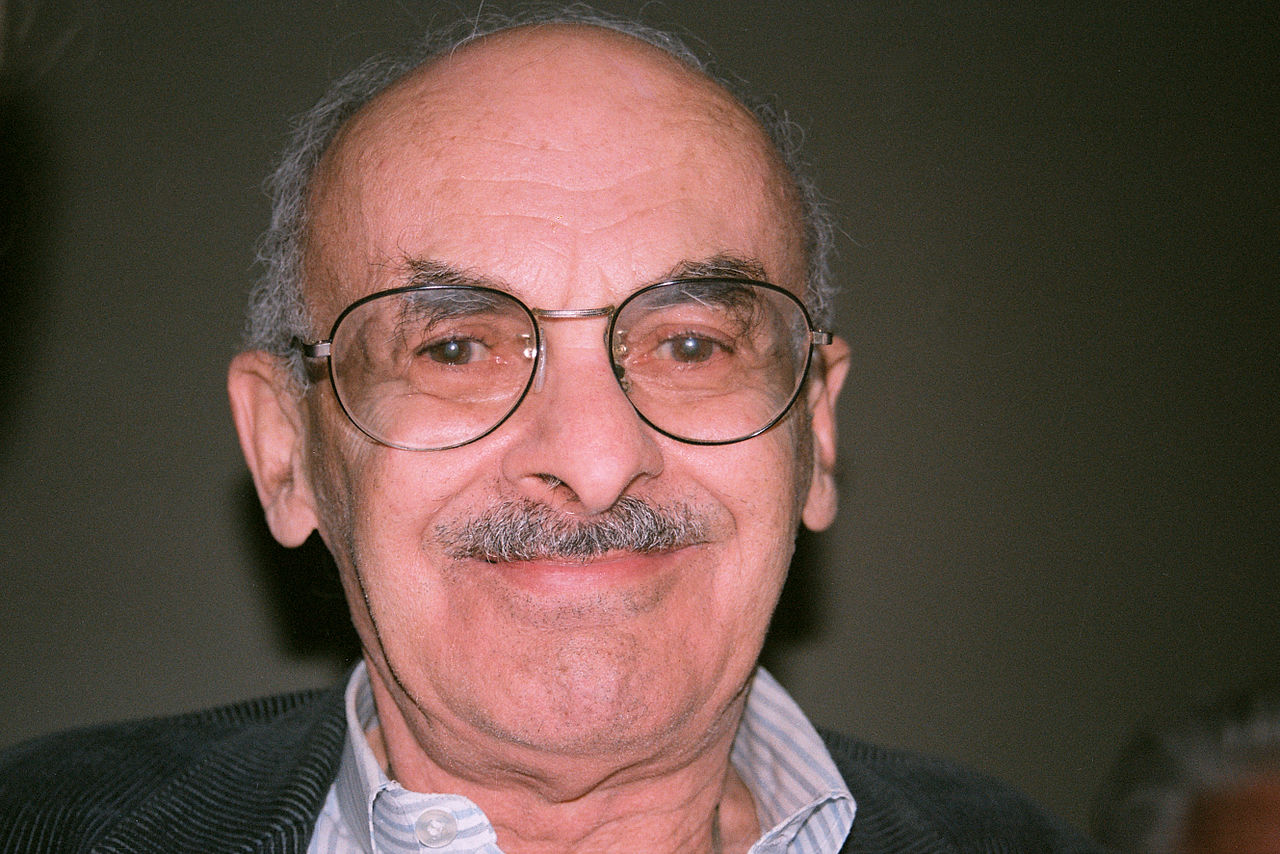
Anastasiya Fedorenko · has been sent by email from author · CC BY-SA 3.0
- Born
- 1924. · Moscow.
- Died
- 1997. · Clamart.
- Nationality
- Soviet Union and Russia.
- Occupation
- screenwriter, poet, actor, singer, writer, composer, novelist and guitarist.
- Fields
- bard song, poetry, prose and sketch story.
- Education
- Faculty of Philology and Tbilisi University.
- Honours
- USSR State Prize, Order of the Patriotic War, 1st class, Order of Friendship of Peoples, Medal For the Defence of the Caucasus, Medal For the Victory over Germany in the Great Patriotic War 1941–1945 and Jubilee Medal 50 Years of Victory in the Great Patriotic War 1941–1945.
- Languages
- Russian.
VALÉORINE Encyclopedia
VALÉORINE documentary reading
Documentary summary
Bulat Shalvovich Okudzhava (Russian: Була́т Ша́лвович Окуджа́ва; Georgian: ბულატ ოკუჯავა; Armenian: Բուլատ Օկուջավա; May 9, 1924 – June 12, 1997) was a Soviet and Russian poet, writer, musician, novelist, and singer-songwriter of Georgian-Armenian ancestry. He was one of the founders of the Soviet genre called "author song" (авторская песня, avtorskaya pesnya), or "guitar song", and the author of about 200 songs, set to his own poetry. His songs are a mixture of Russian poetic and folk song traditions and the French chansonnier style represented by such contemporaries of Okudzhava as Georges Brassens.
Admitted source layer · organised and presented by VALÉORINE
Note VALÉORINE
Bulat Okudzhava (1924–1997) was an actor, composer and guitarist, among other activities, of Russian and Soviet nationality. The actor was born in Moscow and died in Clamart. Bulat Okudzhava was educated at Faculty of Philology, Tbilisi University.
The work spans bard song, poetry and prose, among others. Languages used include Russian. Honours include Order of Friendship of Peoples, Order of the Patriotic War, 1st class and USSR State Prize.
Composed from admitted, traceable facts · 27 September 2026
VALÉORINE
Reference Check
Propose documentary evidence for Bulat Okudzhava. A contribution is never written directly as fact: identity, source, rights and evidence gates still decide.
Sign in to contribute
Documentary evidence
Evidence Panel
not yet certified
- Identity
- resolved
- Independent source families
- 0
- Admitted assertions
- 0
- Open conflicts
- 0
Authority files
wikidata · Q239652 · wikipedia · Bulat Okudzhava
In this article
Life
Life
Though his songs were never overtly political, the freshness and independence of Okudzhava's artistic voice presented a subtle challenge to Soviet cultural authorities, who were thus hesitant for many years to give him official recognition.
Bulat Okudzhava studied at Faculty of Philology, Tbilisi University. The recorded working language is Russian. Subjects and genres recorded for the work are bard song, poetry, prose and sketch story. Distinctions recorded are USSR State Prize, Order of the Patriotic War, 1st class, Order of Friendship of Peoples and Medal "For the Defence of the Caucasus".
Bulat Okudzhava was born in Moscow on May 9, 1924, into a family of communists who had come from Tbilisi, the capital of Georgia, to study and to work for the Communist Party. The son of a Georgian father, Shalva Okudzhava, and an Armenian mother, Ashkhen Nalbandyan, Bulat Okudzhava spoke and wrote only in Russian. Okudzhava's mother was the niece of a well-known Armenian poet, Vahan Terian. His father served as a political commissar during the Civil War and as a high-ranking Communist Party member thereafter, under the protection of Sergo Ordzhonikidze (1886-1937). His uncle Vladimir Okudzhava was an anarchist and terrorist who left the Russian Empire after a failed attempt to assassinate the Kutaisi governor. Vladimir was listed among the passengers of the infamous sealed train that delivered Vladimir Lenin, Grigory Zinoviev and other revolutionary leaders from Switzerland to Russia in 1917.
Terror and war
Terror and war
Shalva, Okudzhava's father, was arrested in February 1937 during the Great Purge, accused of Trotskyism and wrecking. He was shot on 4 August, along with his two brothers. His wife was arrested in 1939 "for anti-Soviet deeds" and sent to the Gulag. Bulat returned to Tbilisi to live with his relatives. His mother was released in 1946, but arrested for the second time in 1949, spending another 5 years in labor camps. She was fully released in 1954 and rehabilitated in 1956, along with her husband. In 1942, at the age of 17, 9th-grader Bulat Okudzhava volunteered for the Red Army infantry, and from 1942 he participated in the war against Nazi Germany. After his discharge from the service in 1944, he returned to Tbilisi where he passed his high school graduation exams and enrolled at Tbilisi State University, graduating in 1950. After graduating, he worked as a teacher, first in a rural school in the village of Shamordino in the Kaluga Region, and later in the city of Kaluga itself.
Return to Moscow
Return to Moscow
In 1956, three years after the death of Joseph Stalin, Okudzhava returned to Moscow. Following his parents' rehabilitation and the 20th Party Congress at which Khrushchev denounced Stalin, Bulat Okudzhava was able to join the Communist Party, of which he remained a member until 1990. In the Soviet capital he worked first as an editor in the publishing house Molodaya Gvardiya (Young Guard), and later as the head of the poetry division at the most prominent national literary weekly in the former USSR, Literaturnaya Gazeta ("Literary Newspaper"). It was then, in the middle of the 1950s, that he began to compose songs and to perform them, accompanying himself on a Russian guitar. Soon he was giving concerts. He only employed a few chords and had no formal training in music, but he possessed an exceptional melodic gift, and the intelligent lyrics of his songs blended perfectly with his music and his voice. His songs were praised by his friends, and amateur recordings were made. These unofficial recordings were widely copied as magnitizdat, and spread across the USSR and Poland, where other young people picked up guitars and started singing the songs for themselves. In 1970, his lyrics appeared in the classic Soviet film White Sun of the Desert.
Music
Music
Okudzhava, like most bards, did not come from a musical background. He learned basic guitar skills with the help of some friends. He also knew how to play basic chords on a piano. Okudzhava tuned his Russian guitar to the "Russian tuning" of D'-G'-C-D-g-b-d' (thickest to thinnest string), and often lowered it by one or two tones to better accommodate his voice. He played in a classical manner, usually finger picking the strings in an ascending/descending arpeggio or waltz pattern, with an alternating bass line picked by the thumb. Initially Okudzhava was taught three basic chords, and towards the end of his life he claimed to know a total of seven. Many of Okudzhava's songs are in the key of C minor (with downtuning B flat or A minor), centering on the C minor chord (X00X011, thickest to thinnest string), then progressing to a G 7 (00X0433), then either an E-flat minor (X55X566) or C major (55X5555). In addition to the aforementioned chords, the E-flat major chord (X55X567) was often featured in songs in a major key, usually C major (with downtuning B-flat or A major). By the nineties, Okudzhava adopted the increasingly popular six string guitar but retained the Russian tuning, subtracting the fourth string, which was convenient to his style of playing.
Fiction in English translation
Fiction in English translation
"The Art of Needles and Sins", (story), from The New Soviet Fiction, Abbeville Press, NY, 1989. "Good-bye, Schoolboy!" and "Promoxys", (stories), from Fifty Years of Russian Prose, Volume 2, M.I.T Press, MA, 1971. The Extraordinary Adventures of Secret Agent Shipov in Pursuit of Count Leo Tolstoy, in the year 1862, (novel), Abelard-Schuman, UK, 1973, translated by Heather Maisner. Nocturne: From the Notes of Lt. Amiran Amilakhvari, Retired, (novel), Harper and Row, NY, 1978. A Taste of Liberty, (novel), Ardis Publishers, 1986. "Girl of My Dreams", (story), from 50 Writers: An Anthology of 20th Century Russian Short Stories, Academic Studies Press, 2011.
Life and career
Dated record
Life and career
Explore 1924–1997
The full dated record · 8 entries
1924
Bulat Okudzhava was born in 1924 at Moscow.
1924
Bulat Okudzhava (b. 1924) — Songs (lyrics and music) (1976) is digitised and catalogued by Internet Archive.
1976
Bulat Okudzhava (b. 1924) — Songs (lyrics and music) digitised by Internet Archive.
1978
Songs from Motion Pictures with Lyrics by Bulat Okudzhava (1978) is digitised and catalogued by Internet Archive.
1978
Songs from Motion Pictures with Lyrics by Bulat Okudzhava digitised by Internet Archive.
1980
Bulat Okudzhava — Songs digitised by Internet Archive.
1987
Bulat Okudzhava — New Songs digitised by Internet Archive.
1997
Bulat Okudzhava died in 1997 at Clamart.
Places
Named by the record
Places
Only places the record itself states, plotted where the house gazetteer settles their coordinates. Nothing is inferred from a name or a nationality.
Moscow.
Birth place
Clamart.
Death place
Songwriter, poet and novelist
Though Okudzhava's songs were not published by any official media organization until the late 1970s, they quickly achieved enormous popularity, especially among the intelligentsia – mainly in the USSR at first, but soon among Russian-speakers in other countries as well. Vladimir Nabokov, for example, cited his Sentimental March in the novel Ada or Ardor. Okudzhava, however, regarded himself primarily as a poet and claimed that his musical recordings were insignificant. During the 1980s, he also published a great deal of prose (his novel The Show is Over won him the Russian Booker Prize in 1994). By the 1980s, recordings of Okudzhava performing his songs finally began to be officially released in the Soviet Union, and many volumes of his poetry were also published. In 1991, he was awarded the USSR State Prize. He supported the reform movement in the USSR and in October 1993, signed the Letter of Forty-Two. Okudzhava died in Paris on June 12, 1997, and is buried in the Vagankovo Cemetery in Moscow. A monument marks the building at 43 Arbat Street where he lived. His dacha in Peredelkino is now a museum that is open to the public. A minor planet, 3149 Okudzhava, discovered by Czech astronomer Zdeňka Vávrová in 1981 is named after him. His songs remain very popular and frequently performed.
Selected discography
Wonderful waltz, 1969 While the Earth is still turning, 1994 And when the first love comes... (А как первая любовь), 1997 Piosenki (Songs), Polish edition, 2000 Green lantern, On Smolensk road, Main song, Record on stone, and Your Honor – records made during last years of his life
Primary material
Documents and archives
scholarly publication
- Bulat Okudzhava--His Circle and His Times : A Discussion, Russian Studies in Literature, 2004
Scholarly · Crossref registry · 2004
- Bulat Okudzhava, 50 Writers, 2011
Scholarly · Crossref registry · 2011
- Bulat Okudzhava. 65 pesen, Russian Review, 1981
Scholarly · Crossref registry · 1981
reference work
- Wikidata, structured authority record Q239652: Bulat Okudzhava
Reputable secondary · Wikimedia Foundation
- “Bulat Okudzhava”, English Wikipedia, consulted as further reading
Reputable secondary · Wikipedia
Notes from the source article
Cited by Wikipedia
Notes from the source article
These works are cited by the source article, in its own numbering. They are recorded as its citations, not as sources VALÉORINE has verified.
- 1.Smith, G. S. Okudzhava Marches On. Slavonic and East European Review. 66.4 (October 1). 553. 1988.
- 2.Bulat Okudzhava (2006). The Abolished Theater: A Family Chronicle. Moscow: Zebra E, 336 pages.
- 3.List of Passengers That Crossed Germany During the War published by Vladimir Burtsev on October, 1917 (in Russian)
- 4.Dmitry Bykov, Bulat Okudzhava. Moscow: Molodaya Gvardiya, 2009, 784 pages.
- 5.Новости, Р. И. А. Булат Окуджава. История поэта, не любившего говорить о себе. РИА Новости. 2009-05-08.
- 6.Izvestia. October 5, 1993.
- 7.Dictionary of Minor Planet Names – p.260
- 8.Sentries of Love, Bulat Okudzhava's songs by Tatiana and Sergei Nikitin
- 9.Songs of Bulat Okudzhava by Galina Khomchik
- 10.Songs of Bulat Okudzhava by Zhanna Bichevskaya
- 11.Blue balloon, song and music by Bulat Okudzhava, performed by Elena Frolova
References
Citations
References
Each reference names the institution holding it, so a reader may go to the document itself.
scholarly publication
Bulat Okudzhava--His Circle and His Times : A Discussion, Russian Studies in Literature, 2004Crossref registry
Verifiedscholarly publication
Bulat Okudzhava, 50 Writers, 2011Crossref registry
Verifiedscholarly publication
Bulat Okudzhava. 65 pesen, Russian Review, 1981Crossref registry
Verifiedreference work
Wikidata, structured authority record Q239652: Bulat OkudzhavaWikimedia Foundation
Partially resolvedreference work
Partially resolved
The Encyclopedia exists whether or not anything is for sale. Corrections are recorded rather than overwritten, and every version of this record is kept. Published 14 August 2026.
Elsewhere in Books
38,661 published records in this field, each with its sources named.
- BuhturiAuthor
- Buket UzunerAuthor
- Bukhar-zhirau KalmakanovAuthor
- Buland al-HaydariAuthor
- Bülent EcevitAuthor
- Bülent TekinAuthor
- Bulleh ShahAuthor
- Bulud QarachorluAuthor
Best supported in this field
For owners
Own a work by Bulat Okudzhava?
A specialist will read what you send and tell you what the house can establish, what it cannot, and whether the object is suited to sale. There is no charge and no obligation. The object stays with you throughout; nothing is shipped to us unless it is arranged in writing beforehand.