
William Dyce
Illustration — William Dyce RA, by Edgar George Papworth Senior, 1864 William Dyce (19 September 1806 in Aberdeen14 February 1864) was a Scottish painter, who played a part in the formation of public art education in the United Kingdom, and the South Kensington Schools system. Dyce was associated with the Pre-Raphaelite Brotherhood and played a part in their early popularity.
Also recorded as Dyce · W. Dyce
William Dyce
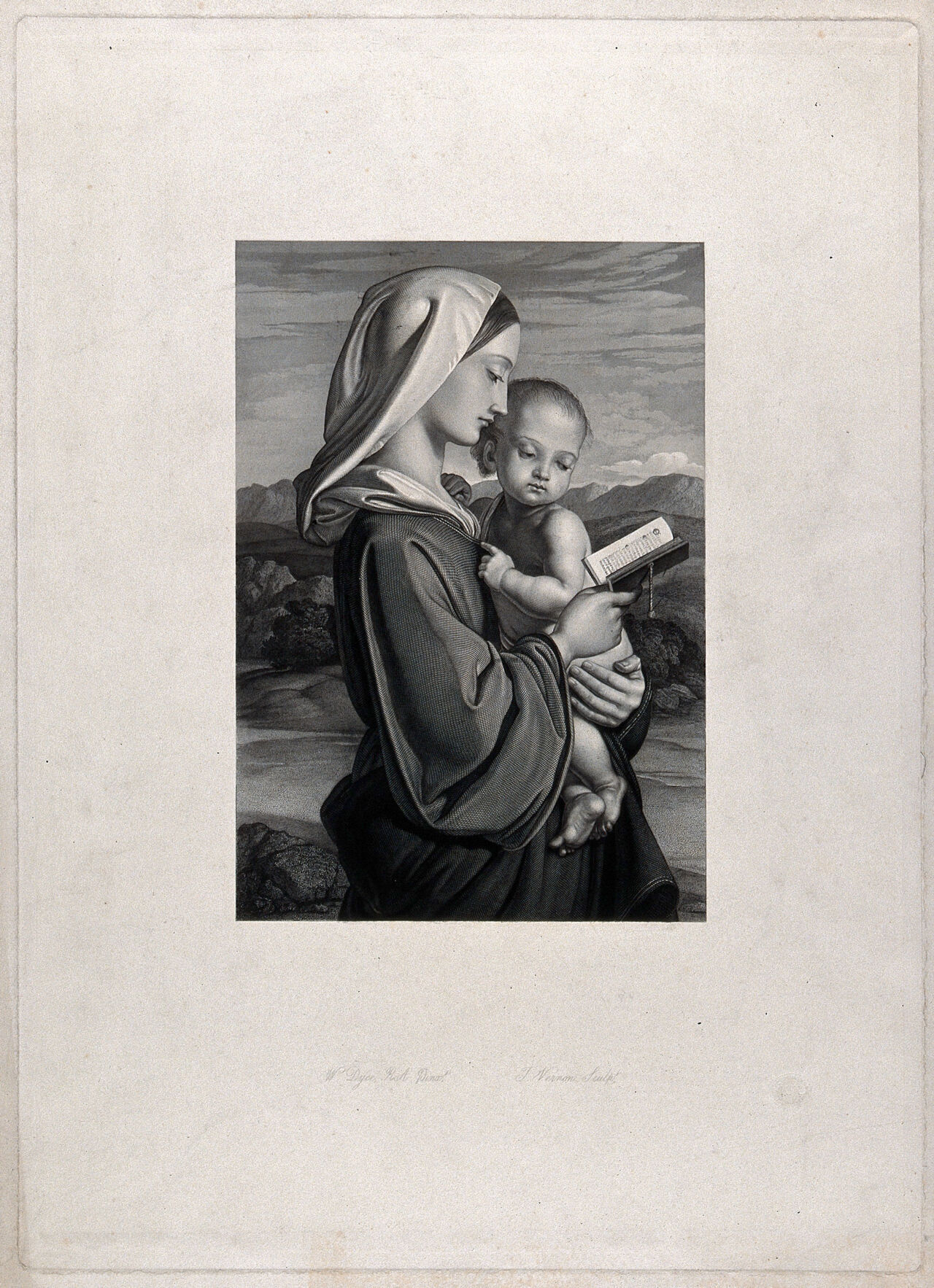
William Dyce · Wellcome Collection, London · Wellcome Collection · Public Domain Mark
- Born
- 1806. · Aberdeen.
- Died
- 1864. · Streatham.
- Nationality
- United Kingdom of Great Britain and Ireland.
- Occupation
- painter and university teacher.
- Fields
- painting.
- Movements
- Pre-Raphaelite Brotherhood.
- Honours
- Fellow of the Royal Society of Edinburgh.
- Languages
- English.
VALÉORINE Encyclopedia
VALÉORINE documentary reading
Documentary summary
Illustration — William Dyce RA, by Edgar George Papworth Senior, 1864 William Dyce (19 September 1806 in Aberdeen14 February 1864) was a Scottish painter, who played a part in the formation of public art education in the United Kingdom, and the South Kensington Schools system. Dyce was associated with the Pre-Raphaelite Brotherhood and played a part in their early popularity.
Admitted source layer · organised and presented by VALÉORINE
Note VALÉORINE
No house-authored Note is published until its assertions and sources pass the VALÉORINE evidence contract. The documentary article remains available in full while that enrichment is being consolidated.
Documentary enrichment in progress · no unsupported statement published
Reference Check
Propose documentary evidence for William Dyce. A contribution is never written directly as fact: identity, source, rights and evidence gates still decide.
Sign in to contribute
World of VALÉORINE
Documentary connections
Only confirmed graph relationships appear here. Images are shown only when their identity and reuse rights both pass the documentary gate.
Documentary evidence
Evidence Panel
not yet certified
- Identity
- resolved
- Independent source families
- 0
- Admitted assertions
- 0
- Open conflicts
- 0
Authority files
wikidata · Q2095630 · wikipedia · William Dyce
In this article
Life
Life
The recorded working language is English. The field of work recorded is painting. Employment is recorded with King's College London. Work by William Dyce is recorded in the collections of National Gallery of Victoria, Tate, National Galleries Scotland, National Gallery and Minneapolis Institute of Art. Distinctions recorded are Fellow of the Royal Society of Edinburgh.
• Illustration — King Lear and the Fool in the Storm, 1851 • Illustration — Pegwell Bay, Kent – a Recollection of October 5th 1858 • Illustration — Dyce grave, churchyard of the Kirk of St Nicholas, Aberdeen Dyce was born on 19 September 1806 at 48 Marischal Street in Aberdeen, the son of William Dyce of Fonthill and Cuttlehill FRSE and Margaret Chalmers of Westburn. His uncle was General Alexander Dyce FRSE. His older brother was Robert Dyce FRSE. After studying at Marischal College, Dyce showed an early aptitude for design and began his artistic career at the Royal Academy schools in Edinburgh and London. He travelled to Rome for the first time in 1825, and while there he studied the works of Titian and Poussin. He returned to Aberdeen after nine months, and painted several pictures, including Bacchus nursed by the Nymphs of Nysa, which was exhibited in 1827. He returned to Rome in 1827, this time staying for a year and a half, and during this period he appears to have made the acquaintance of the German Nazarene painter Friedrich Overbeck, who admired Dyce's Virgin and Child. After these travels, Dyce settled for several years in Edinburgh. He supported himself by painting portraits at first, but soon took to other subjects of art, especially the religious subjects he preferred. In 1837 Dyce was given charge of the School of Design in Edinburgh, and was then invited to London, where he was based thereafter, to head the newly established Government School of Design, later to become the Royal College of Art. Before taking up this post in 1838 he and a colleague were sent to visit France and Germany to enquire into design education there and prepare a report. He left the school in 1843, to be able to paint more, but remained a member of the Council of the school. The ideas that were developed in the following decade into the "South Kensington system" that dominated English art education for the rest of the century really have their origin in Dyce's work. In 1844, having been appointed professor of fine art in King's College London, he delivered a significant lecture, The Theory of the Fine Arts. In 1835 he had been elected an associate of the Royal Scottish Academy, an honour he relinquished upon settling in London, and he was then made an honorary member. In 1844 he became an associate, and in 1848 a full member, of the London Royal Academy of Arts; he also was elected a member of the Pennsylvania Academy of the Fine Arts in Philadelphia. Around this time, Dyce moved to Cheyne Walk in the artistic quarter of Chelsea, London. In 1849 when the new 'godless' florin coins were introduced by the Royal Mint, Dyce was responsible for the reverse design showing crowned cruciform shields bisected with emblems of the rose, thistle and shamrock in the angles. He also took on the similar design used on the reverse of the later Queen Victoria 'gothic head' florins which were issued from 1851 to 1887. Dyce is less known for, but nevertheless important as, the founder of the Motett Society (1840–1852), which sought to advance the restoration and liturgical use of long-neglected works of the English church. He was noted as an able organist, and is also reputed to have composed some musical works (unverified). Dyce died in Streatham in Surrey on 14 February 1864. There is a street in Streatham named for him – William Dyce Mews. A stained glass window in St Machar's Cathedral in Aberdeen is jointly dedicated to Dyce.
Pre-Raphaelites
Pre-Raphaelites
Dyce is the figure in Scottish art most associated with the Pre-Raphaelites. He befriended the young Pre-Raphaelites in London and introduced their work to the influential art critic John Ruskin. His later work was Pre-Raphaelite in its spirituality, as can be seen in his The Man of Sorrows and David in the Wilderness (both 1860), which contain a Pre-Raphaelite attention to detail.
Westminster frescoes
Westminster frescoes
• Illustration — The Return of King Arthur • Illustration — Knights of the Round Table Departing on the Quest for the Holy Grail Later in his career, Dyce turned to fresco-painting, and was selected to execute a series of murals at the newly completed the Palace of Westminster. In preparation for work at Westminster, he returned to Italy in 1845–47, to observe the fresco techniques employed there. He was particularly impressed by Pinturicchio's frescoes in the Piccolomini Library in Siena, and by the works of Perugino. After completing The Baptism of Ethelbert (1846) in the House of Lords Chamber, Dyce was commissioned to decorate the Queen's Robing Room in the Palace. He chose as his subject the Arthurian legends, He had some difficulty adapting the Courtly love of Malory's tales to Victorian mores. The Arthurian legend became popular later in the Victorian period, but when Dyce received the commission to decorate the room in 1847, it was still an obscure subject. The legend soon became a major problem for Dyce, as it turns on the unfaithfulness of a queen, which causes the fall of a kingdom. After initially experimenting with a narrative sequence in which the tale would unfold in the room's panels, Dyce abandoned this in favour of an allegorical approach. In their finished form, Dyce's frescoes depict scenes from the Arthurian legend that are intended to exemplify the virtues inscribed beneath them. The actions of the figures in his frescoes appear to the modern viewer to convey qualities whose status as virtues is uncertain, and the connection between the episodes from the Arthurian legend and the virtues they represent is sometimes difficult to discern. The virtues depicted are Mercy, Hospitality, Generosity, Religion, and Courtesy. Two projected frescoes, Courage and Fidelity, were never executed. Dyce was working on the frescoes in Westminster when he collapsed, and later died at his home in Streatham on 14 February 1864. He was buried at St Leonard's Church, Streatham. A nearby drinking fountain, designed in the neo-Gothic style by Dyce, was subsequently dedicated to him by the parishioners.
Family
Family
In 1850 Dyce married Jane Bickerton Brand (died 1885). Dyce's nephew (his sister's son) was the engineer William Dyce Cay, and his niece was the social activist Meredith Jemima Brown.
Gallery of works
Gallery of works
• Illustration — Lamentation over the Dead Christ, 1835, Aberdeen Art Gallery • Illustration — Joash Shooting the Arrow of Deliverance, 1844, Hamburger Kunsthalle • Illustration — St Joseph, 1847, Windsor Castle • Illustration — Neptune Resigning to Britannia the Empire of the Sea, 1847, Osborne House • Illustration — Omnia Vanitas, 1848 • Illustration — The Highland Ferryman, 1857, Aberdeen Art Gallery • Illustration — Titian Preparing To Make His First Essay in Colouring, 1856–1857, Aberdeen Art Gallery • Illustration — Beatrice, 1859, Aberdeen Art Gallery • Illustration — Henry VI at Towton, 1860 • Illustration — George Herbert at Bemerton 1860
Life and career
Dated record
Life and career
The full dated record · 2 entries
1806
William Dyce born at Aberdeen.
1864
William Dyce died at Streatham.
Places
Named by the record
Places
Only places the record itself states, plotted where the house gazetteer settles their coordinates. Nothing is inferred from a name or a nationality.
Aberdeen.
Birth place
Streatham.
Death place
Collections
Collections
Dyce's most highly thought of painting today is his exceptionally detailed seaside landscape of Pegwell Bay in Kent, now in the Tate Gallery. A rather atypical work, it is fully titled Pegwell Bay, Kent – a Recollection of October 5th 1858, and was exhibited at the Royal Academy summer exhibition in 1860. The largest collection of Dyce's work is held at Aberdeen Art Gallery, Scotland. A lengthy assessment of his art and influence was written by William Michael Rossetti in the Encyclopædia Britannica Eleventh Edition.
Documents and archives
Primary material
Documents and archives
reference work
- Wikidata, structured authority record Q2095630: William Dyce
Reputable secondary · Wikimedia Foundation
- “William Dyce”, English Wikipedia, consulted as further reading
Reputable secondary · Wikipedia
scholarly publication
- Dyce, William (1806–1864), Oxford Dictionary of National Biography, 2017
Scholarly · Crossref registry · 2017
Citations
References
Each reference names the institution holding it, so a reader may go to the document itself.
scholarly publication
Verifiedreference work
Wikidata, structured authority record Q2095630: William DyceWikimedia Foundation
Partially resolvedreference work
Partially resolved
The Encyclopedia exists whether or not anything is for sale. Corrections are recorded rather than overwritten, and every version of this record is kept. Published 14 August 2026.
Elsewhere in Paintings
18,623 published records in this field, each with its sources named.
- William DringArtist
- William DuesburyArtist
- William DukeArtist
- William DunlapArtist
- William Edward Lewis BunnArtist
- William Edwin AtkinsonArtist
- William EttyArtist
- William Ewart LockhartArtist
Best supported in this field
For owners
Own a work by William Dyce?
A specialist will read what you send and tell you what the house can establish, what it cannot, and whether the object is suited to sale. There is no charge and no obligation. The object stays with you throughout; nothing is shipped to us unless it is arranged in writing beforehand.