
William Beechey
Sir William Beechey (12 December 175328 January 1839) was a British portraitist during the golden age of British painting.
Also recorded as Sir Beechey · Sir William Beechy · Sir Wm. Beechey · William Beechey (Sir)
William Beechey
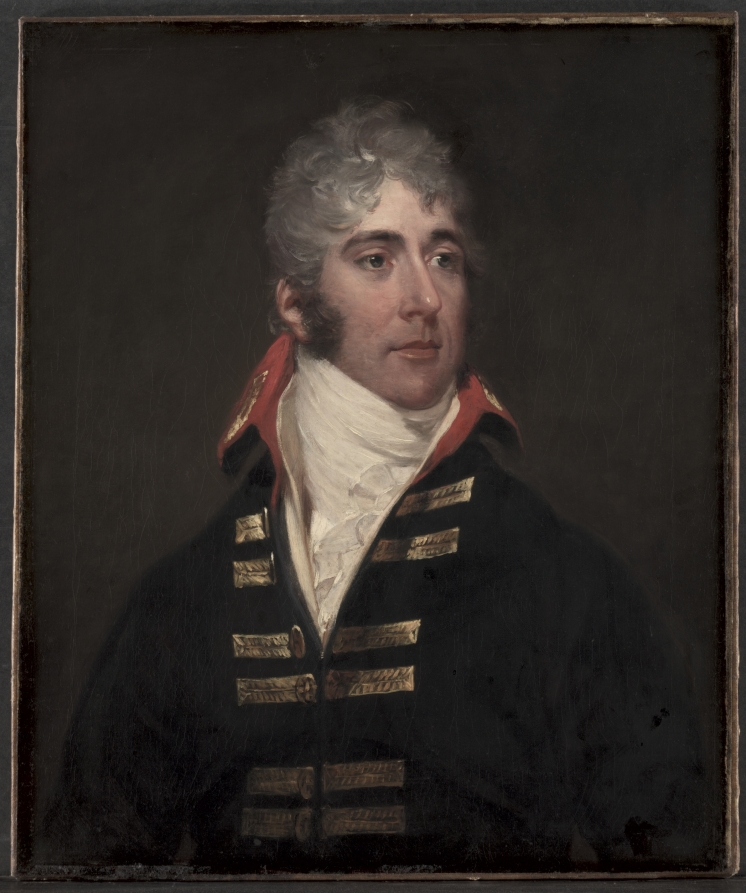
William Beechey · The Cleveland Museum of Art · Anonymous Gift · CC0
- Name
- Sir William Beechey
- Born
- 12 December 1753
- Birthplace
- Burford, Oxfordshire, England
- Died
- 28 January 1839
- Place of death
- London, England
- Spouse
- * Mary Ann Jones
- Known for
- Painting
- Nationality
- Kingdom of Great Britain · United Kingdom of Great Britain and Ireland · United Kingdom
- Occupation
- painter
- Fields
- portrait painting
VALÉORINE Encyclopedia
VALÉORINE documentary reading
Documentary summary
Sir William Beechey (12 December 175328 January 1839) was a British portraitist during the golden age of British painting.
Admitted source layer · organised and presented by VALÉORINE
Note VALÉORINE
William Beechey (1753–1839) was a painter, of British and British nationality. The painter was born in Burford and died in London. William Beechey was a member of Royal Academy of Arts and worked in England.
The work spans portrait painting. Languages used include English.
Composed from admitted, traceable facts · 27 September 2026
VALÉORINE
Reference Check
Propose documentary evidence for William Beechey. A contribution is never written directly as fact: identity, source, rights and evidence gates still decide.
Sign in to contribute
Documentary evidence
Evidence Panel
not yet certified
- Identity
- resolved
- Independent source families
- 0
- Admitted assertions
- 0
- Open conflicts
- 0
Authority files
wikidata · Q48566 · wikipedia · William Beechey
In this article
Key facts
Key facts
• Name — Sir William Beechey • Born — 12 December 1753 • Birthplace — Burford, Oxfordshire, England • Died — 28 January 1839 • Place of death — London, England • Spouse — * Mary Ann Jones • Anne Phyllis Jessop • Children — * Henry • Frederick • George • St. Vincent • Richard • Known for — Painting
Early life
Early life
Beechey was born at Burford, Oxfordshire, on 12 December 1753, the son of William Beechey, a solicitor, and his wife Hannah Read. Both parents died when he was still quite young in the early 1760s, and he and his siblings were brought up by his uncle Samuel, a solicitor who lived in nearby Chipping Norton. The uncle was determined that the young Beechey should likewise follow a career in the law, and at an appropriate age he was entered as a clerk with a conveyancer near Stow-on-the-Wold. But as The Monthly Mirror later recorded in July 1798, he was: "Early foredoomed his [uncle's] soul to cross/ And paint a picture where he should engross".
Career
Career
• Illustration — Prince Ernest, later King of Hanover (1771–1851), by William Beechey, c. 1797–1802 Beechey was admitted to the Royal Academy Schools in 1772, where he is thought to have studied under Johan Zoffany. He first exhibited at the Academy in 1776. His earliest surviving portraits are small-scale full-length and conversation pieces which are reminiscent of Zoffany. In 1782, he moved to Norwich, where he gained several commissions, including a portrait of John Wodehouse and a series of civic portraits for St. Andrew's Hall, Norwich. By 1787, he had returned to London, and in 1789, he exhibited a celebrated portrait of John Douglas, Bishop of Carlisle (now in Lambeth Palace). Beechey's career during this period is marked by a succession of adept and restrained portraits in the tradition of Joshua Reynolds. • Illustration — King George III, by William Beechey, 1799–1800 Beechey's style perfectly suited the conventional taste of the royal family, and in 1793, he was commissioned to paint a full-length portrait of Queen Charlotte and subsequently named as her official portrait painter. That same year, he was elected as an associate member of the Royal Academy. Following his royal appointment, the number of royal commissions he undertook increased markedly, and in 1797 he exhibited six royal portraits. In 1798, he was elected a full member of the Royal Academy and painted George III and the Prince of Wales Reviewing Troops for that year's academy's exhibition. This enormous composition depicts King George III, the Prince of Wales and staff officers on horseback at an imagined cavalry review in Hyde Park. The King was reported to be delighted with the painting and rewarded Beechey with a knighthood. Joseph Farington's Diaries give many accounts of Beechey's relations with the royal family during this period, including his temporary fall from favour in 1804, which Farington attributes to the vagaries of George III's mental condition. Beechey's portraits of the turn of the century are considered to be his most colourful and lively. They are closer to the flamboyant and free techniques employed by his younger rivals, John Hoppner and Sir Thomas Lawrence. Royal patronage resumed in around 1813, when Beechey was appointed portrait painter to Prince William Frederick, Duke of Gloucester and Edinburgh, and culminated with his appointment in 1830 as principal portrait painter to William IV. In 1830, he stood for election as President of the Royal Academy following the death of Thomas Lawrence, finishing second to Martin Archer Shee. In 1836, Beechey retired to Hampstead and on 9–11 June that year, the contents of his studio along with his collection were sold at Christie's. Although capable of impetuousness and irascibility, Beechey was known for his generosity to students. In particular, he took a close interest in the career of the young John Constable.
Subjects
Subjects
• Illustration — Beechey's Victoria, Duchess of Kent with Princess Victoria at Kensington Palace, 1821 During a prolific career spanning half a century, Beechey painted many of the leading figures of his day. His sitters included: • Royalty and Prime Ministers — Political figures — Others • *George III *George IV *William IV *Princess, later Queen Victoria *Prince Ernest, later King of Hanover *Queen Charlotte *Prince Adolphus, Duke of Cambridge *Prince William Henry, Duke of Gloucester and Edinburgh *Prince Edward, Duke of Kent *Prince William Frederick, Duke of Gloucester and Edinburgh *Princess Mary, Duchess of Gloucester and Edinburgh *Henry Addington, 1st Viscount Sidmouth, prime minister *Spencer Perceval, prime pinister *Arthur Wellesley, 1st Duke of Wellington, prime minister — *Henry Phipps, 1st Earl of Mulgrave, foreign secretary *Warren Hastings, governor-general of India *James Cecil, 1st Marquess of Salisbury, statesman *Henry Paget, 1st Marquess of Anglesey, field marshal *Horatio Nelson, 1st Viscount Nelson, admiral *John Jervis, 1st Earl of St Vincent, admiral *Charles Cornwallis, 1st Marquess Cornwallis, general *George Montagu, 1st Duke of Montagu *George Douglas, 16th Earl of Morton *John Wodehouse, 1st Baron Wodehouse — *Sarah Siddons, actress *John Philip Kemble, actor *Sir David Wilkie, artist *Paul Sandby, artist *John Carr, architect *Edward Hodges Baily, sculptor *Joseph Nollekens, sculptor *James Watt, inventor *Sir Everard Home, Bt, surgeon *Sir James Earle, surgeon *Thomas Coutts, banker *Philip Meadows Martineau, surgeon and Lord of the manor of Carrow *Edward Maltby, Bishop of Durham *John Douglas, Bishop of Salisbury In his 1978 novel Desolation Island, Patrick O'Brian wrote that Capt. Jack Aubrey had been painted by Beechey. The portrait, which showed Aubrey in Royal Navy uniform wearing the insignia of the Order of the Bath, hung in his home, Ashgrove Cottage.
Family
Family
William Beechey's first marriage was to Mary Ann Jones (c. 1760–1793) in 1772 (other sources say 1778). Their children included British painter and Egyptologist Henry William Beechey (1788–1862). Following his first wife's death, Beechey married the successful miniature painter Anne Phyllis Jessop (1764–1833) in 1793. They had many children together, including: Royal Navy captain, geographer, and politician Frederick William Beechey (1796–1856); painter George Duncan Beechey (1798–1852); clergyman St. Vincent Beechey (1806–1899); and painter and admiral in the British navy Richard Brydges Beechey (1808–1895). • Illustration — Miss Harriet Beechey, by William Beechey, c. 1800 • Illustration — Anne Jessop, Lady Beechey, by William Beechey, c. 1800
Prices at auction
Prices at auction
Beechey's Portrait of James Watt sold for £153,440 at Sotheby's on 20 March 2003. His Portrait of Mirza Abu'l Hassan Khan, Envoy Extraordinary and Minister Plenipotentiary to the Court of King George III sold for £181,600 at Christie's on 8 June 2006. His Portrait of George Douglas, 16th Earl of Morton in the dress of the Royal Company of Archers sold for £481,250 at Christie's on 5 July 2011. His portrait of The Dashwood Children sold at auction for $821,000 including premium at Christie's on 29 January 2014.
Gallery
Gallery
Beechey's works are represented in many of the world's leading collections, including the Louvre, the Smithsonian Institution, the Royal Collection, the Royal Academy of Arts, the National Portrait Gallery, London, the Tate and the Metropolitan Museum of Art. • Illustration — Portrait of Edward Miles, 1785 • Illustration — Sir John Wodehouse, 1785 • Illustration — Dorothea Jordan as Rosalind, 1787 • Illustration — Admiral Jervis, 1787 • Illustration — The Dashwood Children, c. 1789 • Illustration — Paul Sandby, c. 1789 • Illustration — George Douglas, 16th Earl of Morton (1761–1827), c. 1790 • Illustration — John Carr, 1791 • Illustration — Sarah Siddons with the Emblems of Tragedy, 1793 • Illustration — Sir Francis Ford's Children Giving a Coin to a Beggar Boy, 1793 • Illustration — King George III Reviewing the Prince of Wales' Regiment of Light Dragoons, Attended by the Prince of Wales, the Duke of York and Other General Officers (c.1794), Oil on canvas, 46 5/16 x 56 3/16 in. (117.6 x 142.7 cm), Clark Art Institute • Illustration — Thomas Law Hodges, 1795 • Illustration — Master James Hatch, 1796 • Illustration — Portrait of Queen Charlotte, 1796 • Illustration — Princess Amelia, 1797 • Illustration — Frederica, Duchess of York, 1797 • Illustration — Portrait of George, Prince of Wales, c. 1798 • Illustration — George III and the Prince of Wales Reviewing Troops, 1798 • Illustration — Portrait of Thomas Hope, 1798 • Illustration — Pasquale Paoli, 1798 • Illustration — Portrait of John Philip Kemble, 1799 • Illustration — Sketch for portrait of Horatio, 1800 • Illustration — Portrait of George III, 1800 • Illustration — Elizabeth Eden, Lady Godolphin (1780–1847), c. 1800 • Illustration — Portrait of John Boydell, 1801 • Illustration — Portrait of Horatio Nelson, 1801 • Illustration — James Watt (1736–1819), c. 1802 • Illustration — Princess Augusta Sophia, c. 1802 • Illustration — George Rose, 1802 • Illustration — Portrait of Henry Addington, 1803 • Illustration — Mrs Symonds and Her Children, 1803 • Illustration — Princess Sophia of Gloucester, c.1803 • Illustration — Lord Mulgrave, 1807 • Illustration — Adolphus, Duke of Cambridge, 1808 • Illustration — Henry Halford, 1809 • Illustration — John Duckworth, 1809 • Illustration — David Wilkie, c.1809 • Illustration — Mirza Abu'l Hassan Khan, 1809–10 • Illustration — Portrait of Francis Bourgeois, 1810 • Illustration — Portrait of Joseph Nollekens, 1812 • Illustration — Portrait of Harriet Mellon, 1815 • Illustration — Portrait of Lord Beresford, c. 1815 • Illustration — Portrait of Thomas Picton, c. 1815 • Illustration — Lord Exmouth During the Bombardment of Algiers, 1817 • Illustration — Portrait of Augusta, Duchess of Cambridge, 1818 • Illustration — Edward, Duke of Kent, 1818 • Illustration — The Misses Plowden, 1819 • Illustration — Portrait of George Cockburn, 1820 • Illustration — Robert Grant, 1823 • Illustration — Joseph Stannard, 1824 • Illustration — Portrait of Thomas Lowndes, 1824 • Illustration — Miss Windham, 1828 • Illustration — Portrait of William IV, c.1830 • Illustration — Queen Adelaide, c. 1831
Coat of arms
Coat of arms
Beechey was granted arms on 16 February 1829.
Key facts
Key facts
• Escutcheon — Per fess Azure and Ermine a pale counterchanged on a chevron Gules between three eagles displayed Or a knights helmet proper between two chaplets gold. • Crest — An eagle displayed Azure charged on the breast and wings with an ermine spot Or each claw resting on a chaplet as in the Arms. • Motto — Persta Atque Obdura
Identity and origins
Identity and origins
The authorities additionally record the headings Sir Beechey, Sir William Beechy, Sir Wm. Beechey, William Beechey (Sir) and Beechy. His recorded language was English. He married Anne Beechey.
Identity
Identity
William Beechey is recorded as Kingdom of Great Britain, United Kingdom of Great Britain and Ireland and United Kingdom.
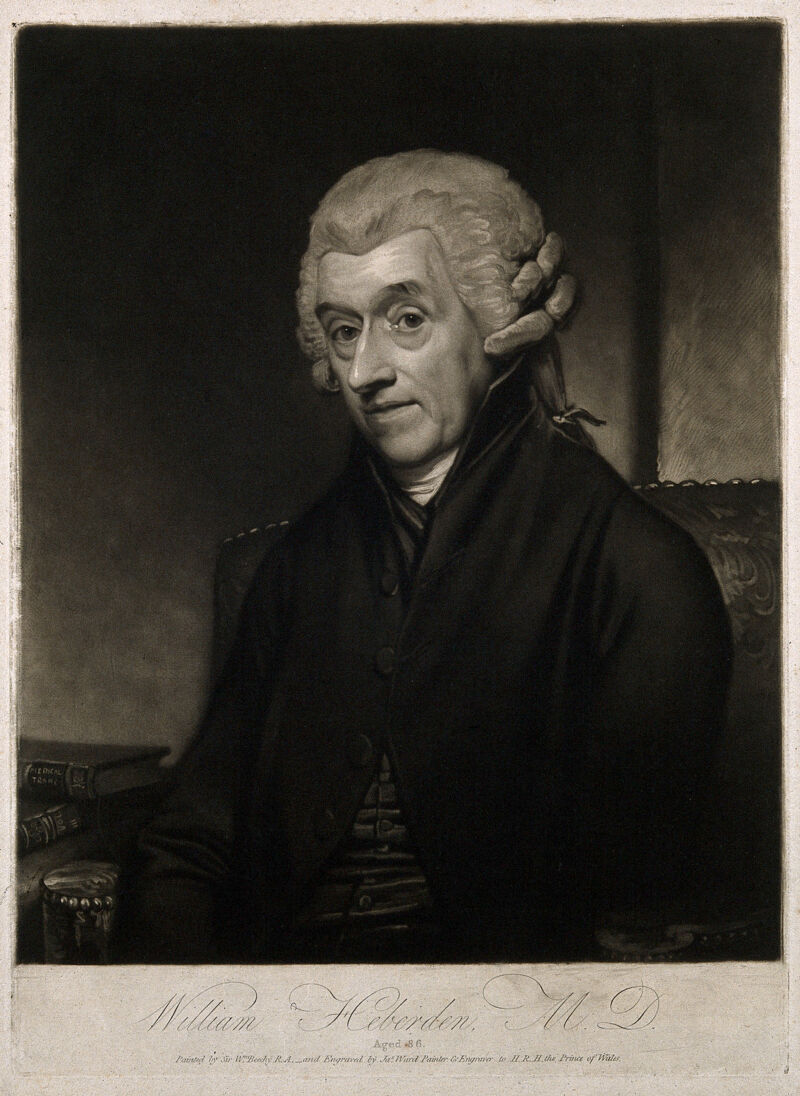
William Heberden. Mezzotint by J. Ward after Sir W. Beechey., by William Beechey
William Beechey · Wellcome Collection, London · Wellcome Collection
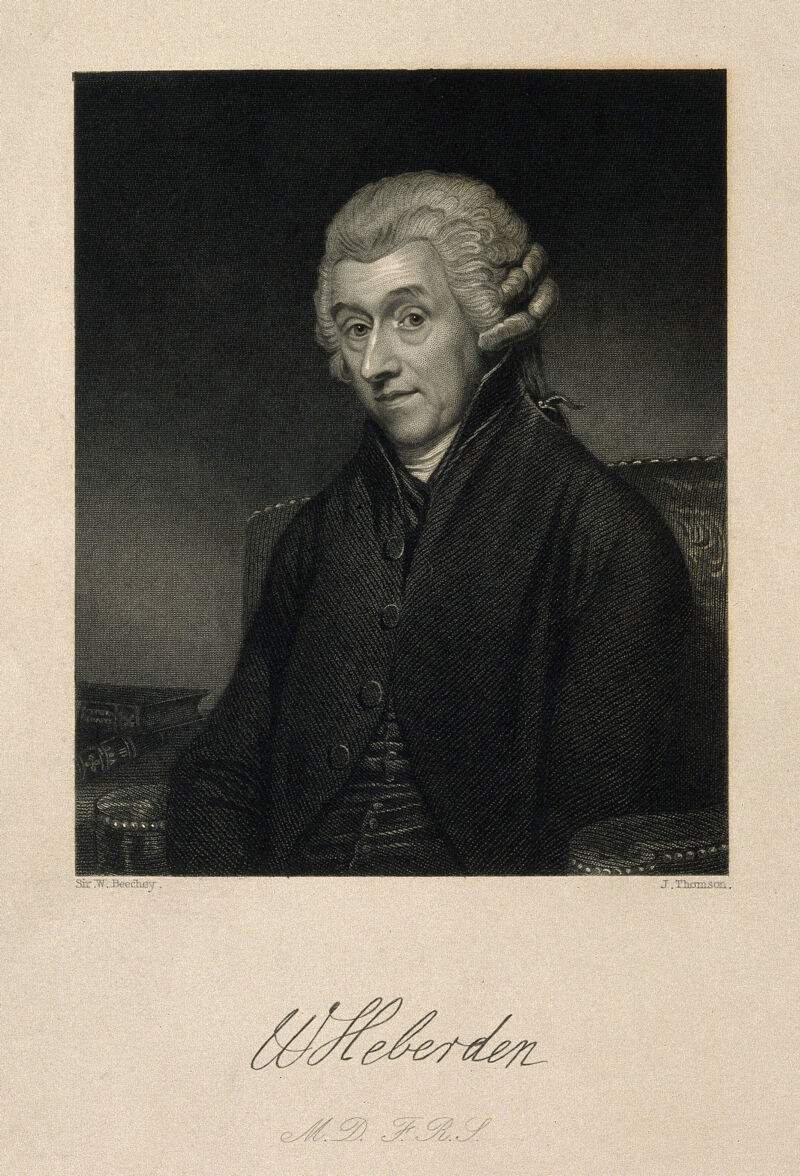
William Heberden. Stipple engraving by J. Thomson after Sir W. Beechey., by William Beechey
William Beechey · Wellcome Collection, London · Wellcome Collection
Life and career
Dated record
Life and career
The full dated record · 2 entries
1753
William Beechey was born in 1753.
1839
William Beechey died at London.
Notes from the source article
Cited by Wikipedia
Notes from the source article
These works are cited by the source article, in its own numbering. They are recorded as its citations, not as sources VALÉORINE has verified.
- 1.https://www.louvre.fr/en/expositions/gainsborough-turnerthe-golden-age-english-portraiture-and-landscape-collections-louvre , Le Louvre, Retrieved 25 September 2018
- 2.Philip Mould. Sir William Beechey RA (1753–1839). HistoricalPortraits.com.
- 3.Hermann p.30
- 4.John Wilson, "Beechey, Sir William (1753–1839)", Oxford Dictionary of National Biography, Oxford University Press, 2004; online edn, Oct 2006 Retrieved 2 May 2017
- 5.http://www.sothebys.com/en/auctions/ecatalogue/2003/the-james-watt-sale-l03500/lot.43.html?locale=en, Christie's, Retrieved 25 September 2018
- 6.https://www.christies.com/en/lot/lot-4718893, Christie's, Retrieved 25 September 2018
- 7.https://www.christies.com/en/lot/lot-5460655, Christie's, Retrieved 25 September 2018
- 8.https://www.christies.com/en/lot/lot-5765897, Christie's, Retrieved 25 September 2018
- 9.Heraldry Online. Grant of Arms: Sir William Beechey 1829. 15 September 2018.
Bibliography printed in the source article · 5
- Hermann, Like. Nineteenth Century British Painting. Charles de la Mare, 2000.
- Redgrave, Richard. A Century of Painters of the English School. Sampson Low, Marston. 1947.
- Roberts, W. Sir William Beechey, R.A. Duckworth & Co. 1907.
- 3. 640.
- Laughton, John Knox. 4.
References
Citations
References
Each reference names the institution holding it, so a reader may go to the document itself.
reference work
Wikidata, structured authority record Q48566: William BeecheyWikimedia Foundation
Partially resolvedreference work
Partially resolved
The Encyclopedia exists whether or not anything is for sale. Corrections are recorded rather than overwritten, and every version of this record is kept. Published 14 August 2026.
Elsewhere in Paintings
18,717 published records in this field, each with its sources named.
- William Barnes WollenArtist
- William BartholomewArtist
- William BaziotesArtist
- William Beckwith McInnesArtist
- William BehnesArtist
- William Bell ScottArtist
- William BellersArtist
- William Benjamin Sarsfield TaylorArtist
Best supported in this field
For owners
Own a work by William Beechey?
A specialist will read what you send and tell you what the house can establish, what it cannot, and whether the object is suited to sale. There is no charge and no obligation. The object stays with you throughout; nothing is shipped to us unless it is arranged in writing beforehand.