
William Alexander
William Alexander • Illustration — Self-portrait, 1793 William Alexander (10 April 1767 – 23 July 1816) was an English painter, illustrator and engraver. The hallmarks of his work, usually executed in watercolours, were clearness and harmony of colour, simplicity and taste in composition, grace of outline, and delicacy of execution. He accompanied the Macartney Embassy to China in 1792.
Also recorded as Mr. Alexander · W. Alexander
William Alexander
William Alexander · Wellcome Collection, London · Wellcome Collection · Public Domain Mark
- Born
- 1767. · Maidstone.
- Died
- 1816. · Maidstone.
- Nationality
- United Kingdom of Great Britain and Ireland.
- Occupation
- painter, drafter, illustrator, draftsperson and conservator.
- Education
- Maidstone Grammar School and Royal Academy of Arts.
- Languages
- English.
VALÉORINE Encyclopedia
VALÉORINE documentary reading
Documentary summary
William Alexander • Illustration — Self-portrait, 1793 William Alexander (10 April 1767 – 23 July 1816) was an English painter, illustrator and engraver. The hallmarks of his work, usually executed in watercolours, were clearness and harmony of colour, simplicity and taste in composition, grace of outline, and delicacy of execution. He accompanied the Macartney Embassy to China in 1792.
Admitted source layer · organised and presented by VALÉORINE
Note VALÉORINE
William Alexander (1767–1816) was a conservator, drafter and draftsperson, among other activities, of British nationality. The conservator was born and died in Maidstone.
William Alexander was educated at Maidstone Grammar School and Royal Academy of Arts. The conservator worked for British Museum.
Languages used include English. Works are held at National Library of Wales, National Museum of World Cultures and Pinacoteca de São Paulo, among others.
Composed from admitted, traceable facts · 26 September 2026
VALÉORINE
Reference Check
Propose documentary evidence for William Alexander. A contribution is never written directly as fact: identity, source, rights and evidence gates still decide.
Sign in to contribute
Documentary evidence
Documentary basis
Authority files
getty · 500784787 · gnd · 1157622216 · wikidata · Q961465
In this article
Life and works
Life and works
Prints of his work were reproduced from engravings. One of his works was used to illustrate Cadell & Davies' Britannia depicta.
William Alexander studied at Maidstone Grammar School and Royal Academy of Arts. The recorded working language is English. Employment is recorded with British Museum. Work by William Alexander is recorded in the collections of Tate, National Museum of World Cultures, National Library of Wales, Yale Center for British Art and Pinacoteca de São Paulo.
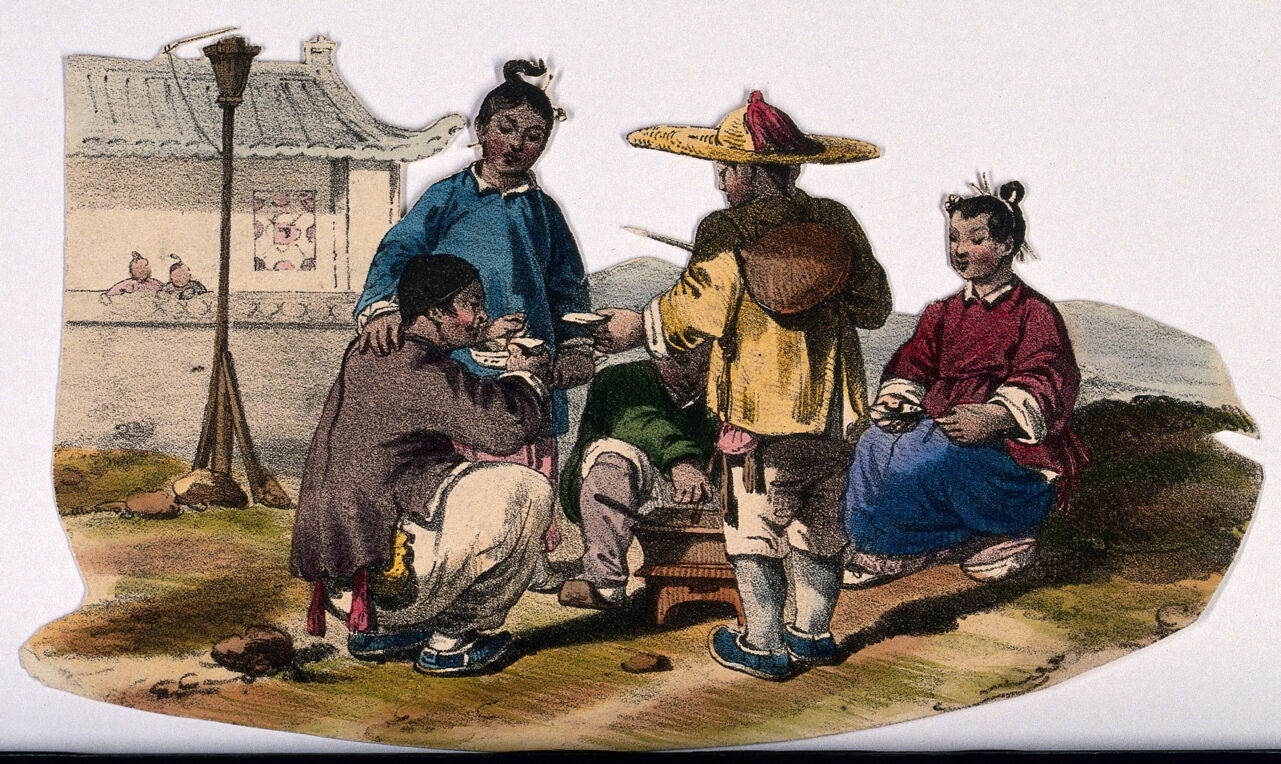
• Illustration — A soldier of the Tây Sơn dynasty in 1793 Alexander was born in Maidstone, Kent, the son of Harry Alexander, a coachmaker. He was educated at Maidstone Grammar School, but in 1782, at the age of 15, moved to London to study art - first under William Pars, and subsequently Julius Caesar Ibbetson. In February 1784, he was admitted to the Royal Academy Schools. He assiduously applied himself to the mastery of his profession, obtaining the notice and approbation of Sir Joshua Reynolds. In 1792, he was appointed as one of the draughtsmen to the Macartney Embassy to China. He accompanied the Earl of Macartney to Peking where he made drawings for the plates which accompanied Sir George Staunton's account of the embassy (published in 1797). In 1794 he returned to England and married Jane Wogan the following year. She died soon afterwards. His other principal works were: "Views of Headlands, Islands, etc. taken during the Voyage to China" (1798); drawings based on Daniells' sketches, for Vancouver's Voyage to the North Pacific Ocean (1798); and the descriptive plates to Sir John Barrow's Travels in China (1804), and Voyage to Cochin China (1806). In 1805 he published "The Costume of China", illustrated by 48 coloured engravings. The work was so well-received that in 1814 he published another book titled Picturesque Representations of the Dress and Manners of the Chinese, illustrated in fifty colored engravings, with descriptions. Besides his works as a draughtsman, he made several engravings - the principal one of which is a representation of the Festival given by the Earl of Romney to the Kentish Volunteers, on 1 August 1799, from his own drawing. • Illustration — View of the Suburbs of a Chinese City (1795) In 1802, Alexander was appointed professor of drawing at the Military College at Great Marlow, resigning in May 1808 to take up the post of assistant keeper of antiquities in the British Museum. In the years 1810, 1812, and 1815, he made drawings of the terra cottas and marbles in the Museum which were engraved and published in three volumes - the accompanying text being provided by Taylor Combe (keeper of the Department of Antiquities). Alexander had completed drawings for a fourth volume before his death. He died at the house of his uncle in Maidstone in July 1816, and was buried in Boxley churchyard. He was described in one of his obituaries as "a man of mild and unassuming manners, rich in the knowledge of art, and of unsullied integrity." In honour of his artistic accomplishments, an exhibition titled "William Alexander: An English Painter in Imperial China" was held at the Royal Pavilion Art Gallery and Museum, Brighton from 8 September to 25 October, 1981 and at the Nottingham Art Gallery from 23 November to 17 December 1981.
Works and production
Works and production
The following works and productions are recorded by name or by count. Recorded with the occupation painter. Institutional cataloguing adds that william Alexander is recorded with the occupation drafter. Recorded with the occupation illustrator. Institutional cataloguing adds that william Alexander is recorded with the occupation draftsperson. Recorded with the occupation conservator. Recorded as a citizen of United Kingdom of Great Britain and Ireland. Institutional cataloguing adds that william Alexander is recorded with the gender male. The record continues: william Alexander was born on 10 April 1767.
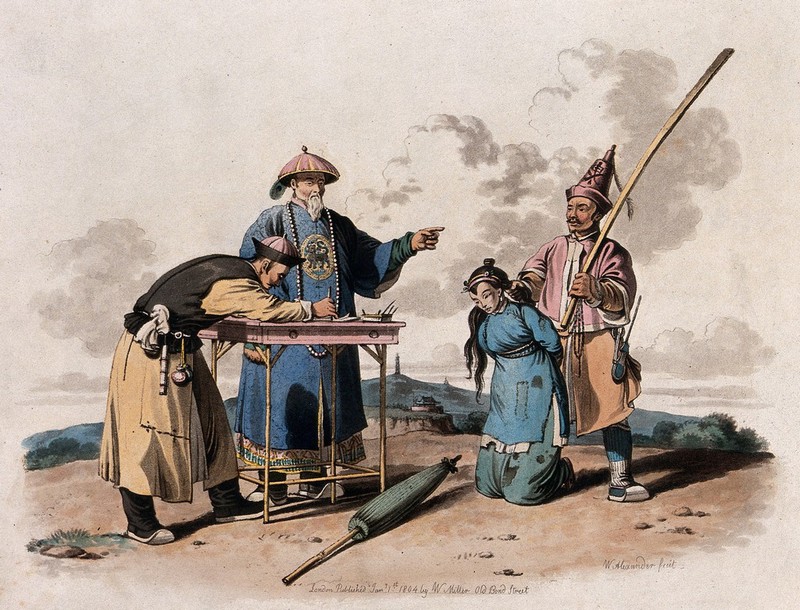
A Chinese woman about to be beaten with a wooden rod as a judicial punishment. Coloured aquatint by W. Alexander, 1804., 1st Jany. 1804, by William Alexander
William Alexander · Wellcome Collection, London · Wellcome Collection
Where the work is held
Collections and holdings
Institutional holdings are recorded as follows. It is also recorded that the Papers of William Alexander Graham.
Notes from the source article
Cited by Wikipedia
Notes from the source article
These works are cited by the source article, in its own numbering. They are recorded as its citations, not as sources VALÉORINE has verified.
- 1.William Alexander. The Costume of China. W. Miller. 1805.
- 2.Alexander, William. Picturesque Representations of the Dress and Manners of the Chinese, illustrated in fifty coloured engravings, with descriptions. Murray. 1814.
- 3.Combe, Taylor. A Description of the Collection of Ancient Terracottas in the British Museum. British Museum; and G. & W. Nicol. 1810.
- 4.Combe, Taylor. A Description of the Collection of Ancient Marbles in the British Museum. British Museum; G. & W. Nicol; W. Miller; Longman and company. 1812.
References
Citations
References
Each reference names the institution holding it, so a reader may go to the document itself.
Institutional database
Wikidata, structured authority record Q961465: William AlexanderWikimedia Foundation
Institutional witness
The Encyclopedia exists whether or not anything is for sale. Corrections are recorded rather than overwritten, and every version of this record is kept. Published 17 August 2026.
Elsewhere in Illustration
5,224 published records in this field, each with its sources named.
- Willi BaumeisterIllustrator
- Willi GeigerIllustrator
- Willi GlasauerIllustrator
- William Adolphus KnellIllustrator
- William AscroftIllustrator
- William AustinIllustrator
- William Balfour KerIllustrator
- William BoissevainIllustrator
Best supported in this field
For owners
Own a work by William Alexander?
A specialist will read what you send and tell you what the house can establish, what it cannot, and whether the object is suited to sale. There is no charge and no obligation. The object stays with you throughout; nothing is shipped to us unless it is arranged in writing beforehand.