
Walter MacEwen
Illustration — Self-portrait Walter MacEwen (13 February 1860 - 20 March 1943) was an American painter. From 1884 to 1914, he often lived and worked in the Netherlands. He is considered to have been a member of the Egmondse School, named after the mostly American artists' colony near Egmond aan Zee.
Also recorded as Walter Mcewen · Walter Macewen · McEwen w. · McEwen
Walter MacEwen
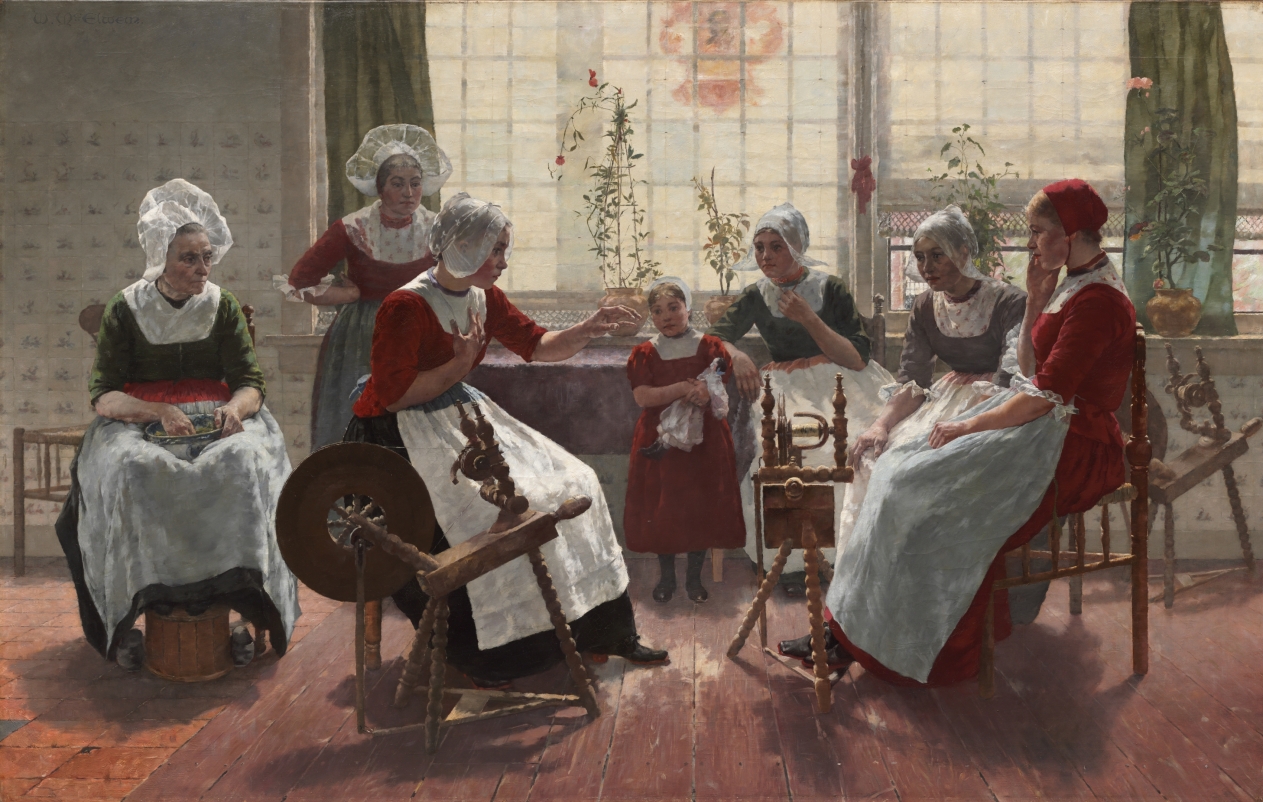
Walter MacEwen · The Cleveland Museum of Art · Gift of Mrs. Edward S. Harkness · CC0
- Born
- 1860 · Chicago.
- Died
- 1943 · New York City.
- Nationality
- United States
- Occupation
- painter
- Education
- Académie Julian
Enciclopedia VALÉORINE
Il dossier documentario
Ogni enunciato è letto negli archivi di autorità delle istituzioni nominate. Scegliete «Prova» accanto a un enunciato per vedere la scheda da cui è tratto, il punto esatto e la data di lettura.
Walter MacEwen, pittore, nacque nel 1860 a Chicago, Illinois, Stati Uniti e morì nel 1943.
Vita
Entrambi gli eventi sono registrati dalla Bibliothèque nationale de France e dalla Deutsche Nationalbibliothek.
Istituzioni citate
Bibliothèque nationale de France · Deutsche Nationalbibliothek
Catena di lettura completa (JSON)Reference Check
Propose documentary evidence for Walter MacEwen. A contribution is never written directly as fact: identity, source, rights and evidence gates still decide.
Sign in to contribute
World of VALÉORINE
Documentary connections
Only confirmed graph relationships appear here. Images are shown only when their identity and reuse rights both pass the documentary gate.
Documentary evidence
Documentary basis
Authority files
wikidata · Q18563057 · wikipedia · Walter MacEwen
In this article
Biography
Biography
Walter MacEwen studied at Académie Julian. Work by Walter MacEwen is recorded in the collections of Art Institute of Chicago, Museum of Fine Arts Ghent (MSK), Musée d'Orsay, Pennsylvania Academy of the Fine Arts and Virginia Museum of Fine Arts.
MacEven was born and raised in Chicago. He was the son of a merchant and entrepreneur of Scottish origin. He began by studying business, but decided that he would rather be a painter. In pursuit of that goal, he went to Europe in 1877 and enrolled at the Academy of Fine Arts, Munich. In 1881, he continued his studies in Paris at the Académie Julian. There, he met George Hitchcock and Gari Melchers, who would become his lifelong friend. Both had already made plans to work in the Netherlands. He followed them there in 1884 and settled in Egmond aan Zee, where he would live for three years and many times thereafter, until the beginning of World War I, although he still visited Paris during the war. At various times, he also worked in Hattem, where he briefly had his own studio, Volendam and Haarlem. He focused on simple, rural themes and was very fond of the works of Jan Vermeer, although he also displays some influence from the Hague School. During his life, he was internationally known. He held several exhibitions at the Paris Salon and was awarded a medal at the Exposition Internationale at Antwerp in 1894. He also had showings at the World's Columbian Exposition in his hometown of Chicago and at the Exposition Universelle (1900). After World War I, he settled in Paris. While there, he continued to paint the same general type of subject matter, but also took commissions for portraits. In 1940, the outbreak of World War II forced him to leave again. He returned to the United States and took up residence in New York, where he died three years later. In the United States, his works may be seen at the Virginia Museum of Fine Art, Dallas Museum of Art, Art Institute of Chicago, the Telfair Museum of Art in Savannah and at the National Academy of Design in New York.
Places
Named by the record
Places
Only places the record itself states, plotted where the house gazetteer settles their coordinates. Nothing is inferred from a name or a nationality.
Chicago.
Birth place
New York City.
Death place
Selected paintings
• Illustration — The Notary • Illustration — Returning from Work • Illustration — Telling a Ghost Story • Illustration — The Letter (inspired by Vermeer) • Illustration — The Scribe's Office
Text attribution
Licensing
Text attribution
Part of the biographical narrative on this page reuses licensed material. Its origin, revision and licence are recorded here.
The biographical narrative on this page is based on the Wikipedia article Walter MacEwen, revision 1374051915 (EN edition), by its contributors. VALÉORINE has edited that text and built its own documentary record around it. The reused material is available under CC BY-SA 4.0, and this page's reuse of it is offered under the same licence. Everything else on this page — the chronology, the holdings, the evidence, the plates and the connections — is VALÉORINE's own record. Sources and licences.
References
Citations
References
Each reference names the institution holding it, so a reader may go to the document itself.
reference work
Secondary witnessreference work
Secondary witness
The Encyclopedia exists whether or not anything is for sale. Corrections are recorded rather than overwritten, and every version of this record is kept. Published 24 August 2026.
Elsewhere in Paintings
19,456 published records in this field, each with its sources named.
- Walter Leighton ClarkArtist
- Walter LinsenmaierArtist
- Walter Lofthouse DeanArtist
- Walter LoosliArtist
- Walter MafliArtist
- Walter MorasArtist
- Walter OsborneArtist
- Walter PachArtist
Best supported in this field
For owners
Own a work by Walter MacEwen?
A specialist will read what you send and tell you what the house can establish, what it cannot, and whether the object is suited to sale. There is no charge and no obligation. The object stays with you throughout; nothing is shipped to us unless it is arranged in writing beforehand.