
Vladimir Winkler
Vladimir Winkler (born František Winkler; Влади́мир Фра́нцевич Ви́нклер; 1 June 1885 – 1956) was a Czech sculptor. He is best known for early 20th century buildings' facades in Russian Siberia.
Vladimir Winkler

Дмитрий Лебедев · Wikimedia Commons · CC BY-SA 3.0
- Name
- Vladimir Winkler
- Birth Name
- František Winkler
- Born
- 1 June 1885
- Birthplace
- Přerov, Moravia, Austria-Hungary
- Died
- 1956
- Place of death
- Harbin, China
- Field
- Sculpture, architecture
- Movement
- Baroque
- Nationality
- Hungary · Russian Empire · Soviet Union
- Occupation
- sculptor
- Movements
- Baroque sculpture
- Education
- Academy of Arts and Architecture and Design in Prague
VALÉORINE Encyclopedia
VALÉORINE documentary reading
Documentary summary
Vladimir Winkler (born František Winkler; Влади́мир Фра́нцевич Ви́нклер; 1 June 1885 – 1956) was a Czech sculptor. He is best known for early 20th century buildings' facades in Russian Siberia.
Admitted source layer · organised and presented by VALÉORINE
Reference Check
Propose documentary evidence for Vladimir Winkler. A contribution is never written directly as fact: identity, source, rights and evidence gates still decide.
Sign in to contribute
World of VALÉORINE
Documentary connections
Only confirmed graph relationships appear here. Images are shown only when their identity and reuse rights both pass the documentary gate.
Documentary evidence
Documentary basis
Authority files
wikidata · Q4111551 · wikipedia · Vladimir Winkler
In this article
Key facts
Key facts
• Name — Vladimir Winkler • Birth Name — František Winkler • Born — 1 June 1885 • Birthplace — Přerov, Moravia, Austria-Hungary • Died — 1956 • Place of death — Harbin, China • Field — Sculpture, architecture • Movement — Baroque • Works — Omsk Drama Theater
Biography
Biography
František Winkler was born on 1 June 1885 in Přerov, Moravia, Austria-Hungary (today the Czech Republic). Since his childhood he was interested in art, and his father sent him to an Industrial Arts school in Prague, after graduating from which, František entered the Prague School of Applied Arts, where he studied in the class of Professor Stanislav Sucharda. Winkler graduated from the school in 1908 and engaged in arts. World War I, that started in 1914, changed his life. He was a photographer at the Russian-German front and was taken captive. As a prisoner of war, he was sent to Omsk. At that time, Omsk was passing through the phase of cultural and economic upturn. The city was growing rapidly and had resources to elect monumental administrative buildings, cultural and educational facilities. Omsk needed Winkler's talent to decorate the facades and interiors. In the beginning, he was the only academic sculptor in the region. František Winkler adopted the name Vladimir when living in Russia. • Illustration — Omsk Drama Theater Winger genius by Vladimir Winkler • Illustration — A Russian stamp depicting the statue of a winged genius by Vladimir Winkler Winkler's works include the buildings of New Town Theater (now Omsk Drama Theater), which pediment is topped by his sculpture of a winged genius, Omsk Railway Administration, Commercial School, Chrystal Palace cinema, Court of Justice, Russian Asiatic Society. In early 1918, Winkler went with Czechoslovak Legion to Vladivostok, where he continued his work through the Civil War and several political system changes. New Theater's sculptural decoration, created in 1924, and the monumental composition "The proletarian, breaking the chains around the Earth" on the Palace of Labour mark his Soviet period. In 1928, he left the Soviet Russia and went to Harbin, China, where many White Russians lived at that time, and again lived through wars and different political regimes, first creating works dedicated to Nicholas II, then to Stalin and Mao Zedong. Winkler died in Harbin in 1956.
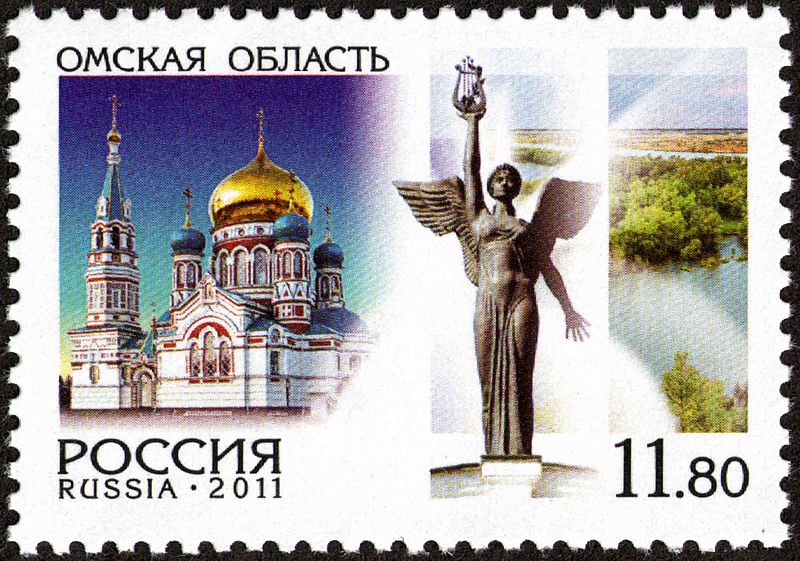
Russia. Regions. Omsk Oblast. Assumption Cathedral in Omsk; the sculpture Winged Genius (by Vladimir Winkler), mounted on the pediment of Omsk Academic Theatre of Drama; Irtysh River. The stamp of Russia, 11.80 Rubles, 12 December 2011, PTC Marka Catalogue No 1554, Michel No 1786. Coated paper. Offset printing.
Russian Post, Publishing and Trade Centre "Marka" (ИТЦ «Марка»). The design of the stamp by V. Beltyukov.
Places
Named by the record
Places
Only places the record itself states, plotted where the house gazetteer settles their coordinates. Nothing is inferred from a name or a nationality.
Přerov.
Birth place
Harbin.
Death place
Primary material
Documents and archives
reference work
- “Vladimir Winkler”, English Wikipedia, consulted as further reading
Reputable secondary · Wikipedia
authority record
- Wikidata, structured authority record Q4111551: Vladimir Winkler
General reference · Wikidata
Notes from the source article
Cited by Wikipedia
Notes from the source article
These works are cited by the source article, in its own numbering. They are recorded as its citations, not as sources VALÉORINE has verified.
- 1.Československá obec legionářská. Vladimír Wnkler.
- 2.Kasyanov, Victor. Odyssey of a Czech sculptor: František Winkler's story. Russian diaspora in the Czech Republic website.
- 3.Theaters and Concert Halls. The Official Site of the City of Omsk.
- 4.Kasyanov, Victor. Omskaya Gazeta. 2 July 2007.
- 5.Regnum Information Agency. 6 October 2006.
References
Citations
References
Each reference names the institution holding it, so a reader may go to the document itself.
reference work
Secondary witnessauthority record
General reference
The Encyclopedia exists whether or not anything is for sale. Corrections are recorded rather than overwritten, and every version of this record is kept. Published 17 August 2026.
Elsewhere in Sculpture
6,174 published records in this field, each with its sources named.
- Vladimir KushArtist
- Vladimir Osipovich SherwoodArtist
- Vladimír PreclíkArtist
- Vladimir VeličkovićArtist
- Vladimir Yefimovich TsigalArtist
- Vlasta PrachatickáArtist
- Vlasta ZorkoArtist
- Vojin BakićArtist
Best supported in this field
For owners
Own a work by Vladimir Winkler?
A specialist will read what you send and tell you what the house can establish, what it cannot, and whether the object is suited to sale. There is no charge and no obligation. The object stays with you throughout; nothing is shipped to us unless it is arranged in writing beforehand.