
Gideon Klein
Illustration — Gideon Klein Gideon Klein (6 December 1919 – c. January 1945) was a Czech pianist, classical music composer, educator and organizer of cultural life at Theresienstadt concentration camp. Klein was murdered in the Holocaust.
Gideon Klein

Francisco Peralta Torrejón · CC BY-SA 4.0
- Born
- 1919 · Přerov.
- Died
- 1945 · Fürstengrube.
- Nationality
- Czechoslovakia
- Occupation
- composer · pianist · musician
- Fields
- classical music
- Teachers
- Vilém Kurz
- Languages
- Czech
VALÉORINE Encyclopedia
VALÉORINE documentary reading
Documentary summary
Illustration — Gideon Klein Gideon Klein (6 December 1919 – c. January 1945) was a Czech pianist, classical music composer, educator and organizer of cultural life at Theresienstadt concentration camp. Klein was murdered in the Holocaust.
Admitted source layer · organised and presented by VALÉORINE
Note VALÉORINE
Gideon Klein (1919–1945) was a composer, musician and pianist, of Czechoslovak nationality. The composer was born in Přerov and died in Fürstengrube. Gideon Klein lived in Praha II.
The work spans classical music. Languages used include Czech.
Composed from admitted, traceable facts · 26 September 2026
VALÉORINE
Reference Check
Propose documentary evidence for Gideon Klein. A contribution is never written directly as fact: identity, source, rights and evidence gates still decide.
Sign in to contribute
World of VALÉORINE
Documentary connections
Only confirmed graph relationships appear here. Images are shown only when their identity and reuse rights both pass the documentary gate.
Documentary evidence
Documentary basis
Authority files
wikidata · Q653614 · wikipedia · Gideon Klein
In this article
Life
Life
Klein was born into a Moravian Jewish family in Přerov and, showing musical talent early, studied piano with Růžena Kurzová and Vilém Kurz, and composition with Alois Hába (in 1939–1940). He was forced to abort his university studies in 1940 when the Nazis closed all institutions of higher learning following their occupation of Czechoslovakia in March 1939. Since compositions and performances by Jewish musicians were banned, his own works could not be performed, though he managed to perform as a concert pianist under several aliases for a time, e.g., under the pseudonym Karel Vránek. Despite those harsh circumstances Klein managed to continue composing. In 1940 he was offered a scholarship at the Royal Academy of Music in London, but by that time anti-Jewish legislation prevented his emigration. In December 1941 he was deported by the Nazis to Theresienstadt Ghetto concentration camp, where along with Leoš Janáček's pupil Pavel Haas, Hans Krása, and Schoenberg's pupil Viktor Ullmann he became one of the major composers at that camp. He gave concerts in secret, but the camp became one of the few in which artistic activity was eventually permitted by Nazis on any scale, if only to deceive the broader public as to their real intentions. His works from these years include music for string quartet (similar in tone to Berg's opus 3 work), a string trio, and a piano sonata, among others. Moreover, Klein performed as solo pianist at approximately 15 recitals, and also participated in chamber music performances (as part of a piano trioand a piano quartet). In October 1944, Klein was deported to Auschwitz and then to Fürstengrube, a coal-mining labour camp less than two weeks after completing his string trio. Klein was murdered under unclear circumstances at age 25 on January 25, 1945, during the liquidation of Fürstengrube, a subcamp of Auschwitz. He had confided his manuscripts to Irma Semecká, his Theresienstadt girlfriend, before leaving, and they were turned over to his sister Eliška at the war's end. His work was influenced by Alois Hába, Arnold Schoenberg, Alban Berg, and particularly Leoš Janáček. He used melody from Janáček's The Diary of One Who Disappeared as a theme in his Divertimento (1940). Recordings on Northeastern and on Koch International Classics, for example, have allowed modern listeners to listen to his compositions of the 1940s.
Selected works
Selected works
• Four Movements for String Quartet (1936–1938), CHF • Topol (The Poplar Tree), melodrama for narrator and piano (1938) • Duo for Violin and Viola in the Quarter-Tone System (1940) • Preludium for Solo Viola (1940) • Divertimento for Eight Wind Instruments (1940) • Three Songs for High Voice and Piano, Op. 1 (1940) • I. The Fountain (Johann Klaj) • II. In the Midst of Life (Friedrich Hölderlin) • III. Darkness Descending (Johann Wolfgang Goethe), Czech translations by Erich A. Saudek • String Quartet, Op. 2 (1941) • Duo for Violin and Cello (1941; unfinished) • Male Choruses, arrangements of Czech and Russian folk-songs (1942) • Bachuri Le'an Tisa (Young Man, Where are you Going?), setting of Hebrew text for 3-part female choir (1942) • Madrigal for Two Sopranos, Alto, Tenor and Bass to words by François Villon, Czech translation by Otokar Fischer (1942) • The First Sin, for male voice choir on a Czech folk poem (1942) • Fantasy and Fugue for String Quartet (1942–1943) • Wiegenlied, arrangement of a Jewish lullaby, set in Hebrew (1943) • Piano Sonata (1943), PA 9' • Madrigal for Two Sopranos, Alto, Tenor and Bass to words by Franz Holderlin, Czech translation by Erich A Saudek (1943) • Spruch (A Saying) for mixed choir (1944) • Trio for Violin, Viola and Cello (1944) • Partita (Trio for Violin, Viola and Cello in arrangement for chamber orchestra by Vojtěch Saudek)
Remembrance
Remembrance
• Illustration — Stolpersteine in Prague-Nové Mӗsto In Prague, German artist Gunter Demnig collocated two Stolpersteine für Gideon Klein and Ilona Kleinová. There is a Klein Trio, playing his music.

Stolpersteine für Gideon Klein und Ilona Kleinová
Francisco Peralta Torrejón
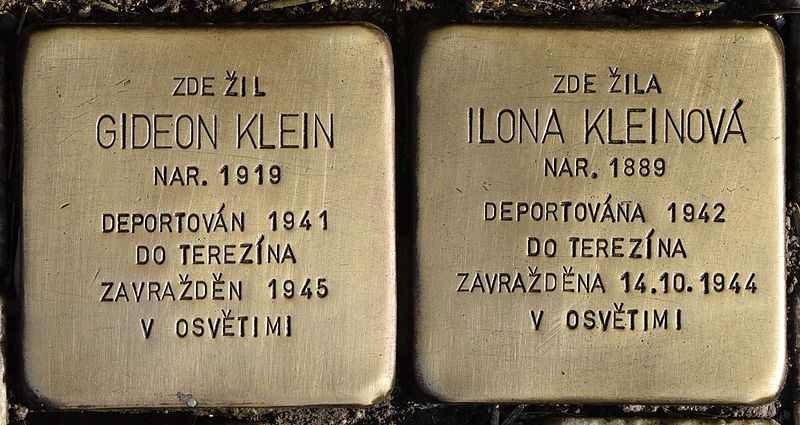
Stolpersteine für Gideon Klein und Ilona Kleinova 2
Francisco Peralta Torrejón
Places
Named by the record
Places
Only places the record itself states, plotted where the house gazetteer settles their coordinates. Nothing is inferred from a name or a nationality.
Praha II
Residences
Přerov.
Birth place
Fürstengrube.
Death place
Primary material
Documents and archives
reference work
- “Gideon Klein”, English Wikipedia, consulted as further reading
Reputable secondary · Wikipedia
authority record
- Wikidata, structured authority record Q653614: Gideon Klein
General reference · Wikidata
Notes from the source article
Cited by Wikipedia
Notes from the source article
These works are cited by the source article, in its own numbering. They are recorded as its citations, not as sources VALÉORINE has verified.
- 1.Joseph Way. Fuguemasters.com. 1997.
- 2.David Bloch. Music and the holocaust.
- 3.Rodney Winther, An Annotated Guide to Wind Chamber Music, Alfred Music 2004 p.141
- 4.Lucy Miller Murray, Chamber Music: An Extensive Guide for Listeners, Rowman & Littlefield 2015 p.237.
- 5.Kuna, p. 117
- 6.Brown, Kellie D. The sound of hope: Music as solace, resistance and salvation during the holocaust and world war II. McFarland. 92. 2020. 978-1-4766-7056-0.
Bibliography printed in the source article · 9
- Slavický, Milan: Gideon Klein. A Fragment of Life and Work. Praha: Helvetica Tempora 1995. (Czech version of the book )
- Kuna, Milan: Hudba vzdoru a naděje. Terezín 1941–1945. Praha: Editio Bärenreiter 2000. H 7822
- Vysloužil, Jiří: Hudební slovník pro každého II. Vizovice: Lípa, 1998
- Gertsenzon, Galit: Gideon Klein's Songs Op. 1 for High Voice and Piano http://holocaustmusic.ort.org/places/theresienstadt/klein-gideon/gideon-kleins-songs-op-1-for-high-voice-and-piano/
- Fligg, David: Dopis od Gideona. Praha: Nakladatelství P3K 2019.
- Fligg, David: (Re)Visiting the (Jewish) Archive of Gideon Klein - Terezin, 1941-1944, in Erik Levi and David Fanning (eds.) 'The Routledge Handbook to Music under German Occupation, 1938-1945.' Oxon: Routledge 2020.
- Fligg, David: Gideon Klein at 100: A festival and a new biography. Prague: Czech Music Quarterly 2020.
- Fligg, David. Don't forget about me: The Short Life of Gideon Klein, Composer and Pianist. Boydell & Brewer (2022).
- Dümling, Albrecht, ed., Torso eines Lebens Der Komponist und Pianist Gideon Klein (1919-1945), von Bockel Verlag, Neumünster, 2021
References
Citations
References
Each reference names the institution holding it, so a reader may go to the document itself.
reference work
Secondary witnessauthority record
General reference
The Encyclopedia exists whether or not anything is for sale. Corrections are recorded rather than overwritten, and every version of this record is kept. Published 18 August 2026.
Elsewhere in Music memorabilia
42,438 published records in this field, each with its sources named.
- Giant MusicOrganisation
- Giant RecordsOrganisation
- Giant StepOrganisation
- Gică PetrescuPerson
- Gideon NxumaloPerson
- Gideon WahlbergPerson
- Gidon KremerPerson
- Gidon SaksPerson
Best supported in this field
For owners
Own a work by Gideon Klein?
A specialist will read what you send and tell you what the house can establish, what it cannot, and whether the object is suited to sale. There is no charge and no obligation. The object stays with you throughout; nothing is shipped to us unless it is arranged in writing beforehand.