
Vincent Esch
Vincent Jerome Esch, FRIBA (20 July 1876 – 9 December 1950) was a British architect who worked in India. He is regarded as a pioneer of the Indo-Saracenic architectural style, which developed during the British rule in the Indian subcontinent. Vincent Esch was born in London, he moved to India in 1898, and was appointed assistant engineer on the Bengal Nagpur Railway before setting himself up as an architect in Calcutta.
Also recorded as Vincent J. Esch · Vincent Jerome Esch
Vincent Esch

fraboof · ST831503 · CC BY-SA 2.0
- Name
- Vincent Jerome Esch
- Born
- 10 July 1876
- Birthplace
- Blackheath, London, England
- Died
- 9 December 1950
- Place of death
- Surrey, England
- Awards
- CVO
- Occupation
- architect
- Education
- Mount St Mary's College
- Languages
- English
VALÉORINE Encyclopedia
VALÉORINE documentary reading
Documentary summary
Vincent Jerome Esch, FRIBA (20 July 1876 – 9 December 1950) was a British architect who worked in India. He is regarded as a pioneer of the Indo-Saracenic architectural style, which developed during the British rule in the Indian subcontinent. Vincent Esch was born in London, he moved to India in 1898, and was appointed assistant engineer on the Bengal Nagpur Railway before setting himself up as an architect in Calcutta.
Admitted source layer · organised and presented by VALÉORINE
Reference Check
Propose documentary evidence for Vincent Esch. A contribution is never written directly as fact: identity, source, rights and evidence gates still decide.
Sign in to contribute
World of VALÉORINE
Documentary connections
Only confirmed graph relationships appear here. Images are shown only when their identity and reuse rights both pass the documentary gate.
Documentary evidence
Documentary basis
Authority files
wikidata · Q18530950 · wikipedia · Vincent Esch
In this article
Biography
Biography
In 1914, he was invited to Hyderabad by the Nizam, to design some major public buildings. He designed the Kacheguda railway station, the High Court, the City College, and the Osmania General Hospital in Hyderabad. He was in Hyderabad until 1921, then returned to Calcutta. He later returned to England, and died in 1950.
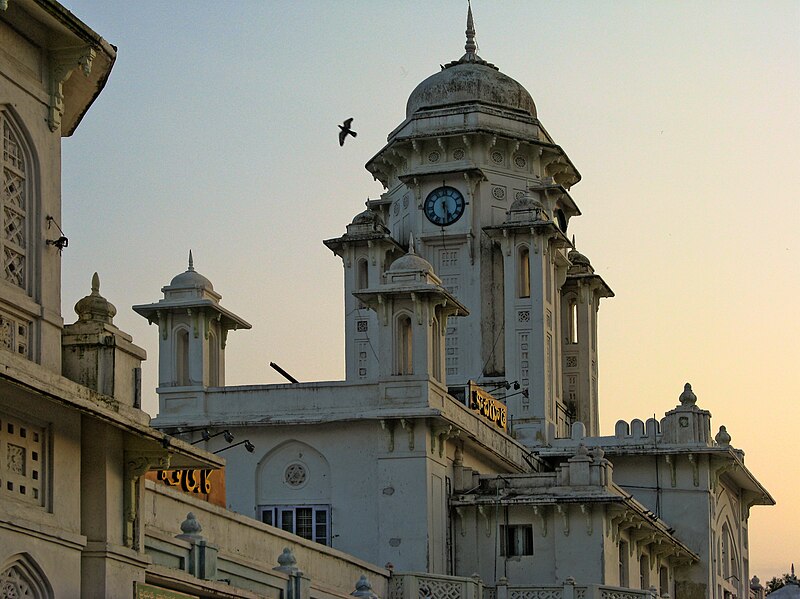
Kachiguda Railway Station
B.jehle

Bengal Nagpur Railway (BNR) or South Eastern Railway (SER) Office, Garden Reach
Rangan Datta Wiki
Key facts
Key facts
• Name — Vincent Jerome Esch • Born — 10 July 1876 • Birthplace — Blackheath, London, England • Died — 9 December 1950 • Place of death — Surrey, England • Awards — CVO
Early life and background
Early life and background
He was born the son of C.A. Bernard Esch, a merchant banker of Blackheath, London and educated at Mount St Mary's College. He then trained as an architect in London.
Career
Career
• Illustration — Bengal-Nagpur Railway Headquarters
Early career
Early career
• Illustration — Osmania General Hospital, Hyderabad • Illustration — Kacheguda Railway Station Esch moved to India in 1898 and was appointed assistant engineer on the Bengal Nagpur Railway and also established a private practise in Calcutta (now Kolkata). During this period he designed some of the important building in the city such as the Allahabad Bank, the Temple ChamberVis, the Royal Calcutta Turf Club and Bengal Club. After designing the temporary exhibition building for the Delhi Durbar of 1903, he was employed as an assistant architect to Sir William Emerson, who had been chosen to design the monumental Victoria Memorial Hall in Calcutta. Esch was given the role of Superintending Architect and made major contributions to the design of the building. He had also won a competition to design the Bengal-Nagpur Railway head office building at Garden Reach. Buildings designed by Esch in Calcutta respected the inherent architectural vocabulary of Calcutta and followed an architectural style of restrained classicism, he preferred the use of iconic order. However, while designing of Bengal-Nagpur Railway head office he included regional architectural elements like bengal roofs and jharokha. Similar concept is applied to Victoria Memorial Kolkata by Esch by introducing small domes (Chhatris) in the four corners and around the central dome. Esch describes this addition in his paper in the following words: "The style of design is purist classic with a refined suggestion of Indian character in the beautiful carved brackets to maintain cornice, some of the floral decoration and the shape of the smaller dome" Another important contribution of Esch to widely use concrete in the buildings for structural purposes. In Victoria Memorial he replaced the intended deep foundation with concrete and in Allahabad precast concrete is used for superstructure as well.
Career in Hyderabad - Vincent Esch and Indo-Saracenic Movement
Career in Hyderabad - Vincent Esch and Indo-Saracenic Movement
After the Great Musi Floods of 1908 in Hyderabad a city improvement board was set up for the development and beautification of Hyderabad. By this time Esch was a well established architect in calcutta with prominent works under his name, further he was employed by Nizam Mir Osman Ali Khan in Hyderabad as an architect on the board. Most prominent works of Esch are from Hyderabad and here he took forward the concept of Indo-Saracenic architecture in Hyderabad which was already popular in other cities of the country like Baroda and Allahabad • Illustration — Facade of Kacheguda Railway Station showing chatri chajja (eaves) and jali (lattice screen) Four prominent works of Esch in Hyderabad are the Kachiguda railway station (1914), the High Court (1916), the City College (1917–20), and the large Osmania General Hospital (1918–21). The latter is now threatened with demolition.
Kacheguda Railway Station
Kacheguda Railway Station
Kachiguda Railway Station was Esch's first project in Hyderabad. He continued his approach to explore modern technology like concrete and the station is entirely built of concrete. In terms of design unlike Calcutta, Esch uses several Indian architectural element, Chajja (eaves) Jalis (lattice screen) domes with lotus top, finials and brackets, which is very evident in the facade of the building. The amalgamation of modern technology with traditional Indian or Islamic elements is termed as "mogul Saracenic" by Esch and his contemporaries.
Later career
Later career
Esch enjoyed 25 years of success as an architect in Calcutta, where he became a proponent of the Indo-Saracenic style, a fusion of classical and Islamic styles. In 1922 he was made CVO.
Return to England and death
Return to England and death
He later returned to England and died in Surrey in late 1950.
Personal life
Personal life
He had married Olive Edward in 1923 and had one son and one daughter.
Places
Named by the record
Places
Only places the record itself states, plotted where the house gazetteer settles their coordinates. Nothing is inferred from a name or a nationality.
Blackheath.
Birth place
Surrey.
Death place
Primary material
Documents and archives
reference work
- “Vincent Esch”, English Wikipedia, consulted as further reading
Reputable secondary · Wikipedia
authority record
- Wikidata, structured authority record Q18530950: Vincent Esch
General reference · Wikidata
Notes from the source article
Cited by Wikipedia
Notes from the source article
These works are cited by the source article, in its own numbering. They are recorded as its citations, not as sources VALÉORINE has verified.
- 1.Tillotson, G. H. R. Vincent J. Esch and the Architecture of Hyderabad, 1914–36. South Asian Studies. 9. 1. 29–46. January 1993. 0266-6030.
- 2.Tillotson, G. H. R. Vincent J. Esch and the Architecture of Hyderabad, 1914–36. South Asian Studies. 9. 1. 29–46. 1993. 0266-6030.
- 3.Bonhams. Vincent Jerome Esch C.V.O., F.R.I.B.A (1876-1950).
- 4.Catalani, Anna. Cities' Identity Through Architecture and Arts: Proceedings of the International Conference on Cities' Identity through Architecture and Arts (CITAA 2017), May 11-13, 2017, Cairo, Egypt. Routledge. 2018-05-01. 978-1-351-68033-2.
- 5.Khalidi, Omar. A Guide to Architecture in Hyderabad, Deccan, India. 221, 244, 245, 273. 2009.
- 6.32716. 4317–4325. 2 June 1922.
References
Citations
References
Each reference names the institution holding it, so a reader may go to the document itself.
reference work
Secondary witnessauthority record
General reference
The Encyclopedia exists whether or not anything is for sale. Corrections are recorded rather than overwritten, and every version of this record is kept. Published 18 August 2026.
Elsewhere in Design
11,558 published records in this field, each with its sources named.
- Villem TomisteDesigner
- Vilmos FreundDesigner
- Vince ProbyDesigner
- Vincent CallebautDesigner
- Vincent HarrisDesigner
- Vincent Richards LeeDesigner
- Vincenz StatzDesigner
- Vincenzo BaldoniDesigner
Best supported in this field
For owners
Own a work by Vincent Esch?
A specialist will read what you send and tell you what the house can establish, what it cannot, and whether the object is suited to sale. There is no charge and no obligation. The object stays with you throughout; nothing is shipped to us unless it is arranged in writing beforehand.