
Torii Kiyonaga
Torii • Illustration — Bathhouse Women Torii Kiyonaga (1752 – June 28, 1815) was a Japanese ukiyo-e artist of the Torii school. Originally Sekiguchi Shinsuke, the son of an Edo bookseller, from Motozaimokuchō Itchōme in Edo, he took on Torii Kiyonaga as an art name. The master Kiyomitsu died in 1785; since his son died young, and Kiyotsune, Kiyonaga's senior, was a less promising artist, Kiyonaga was the obvious choice to succeed Kiyomitsu to leadership of the Torii school.
Also recorded as Shinsuke · Kiyonaga Seki · Kiyonaga · Shirakoya Ichibei
Torii Kiyonaga
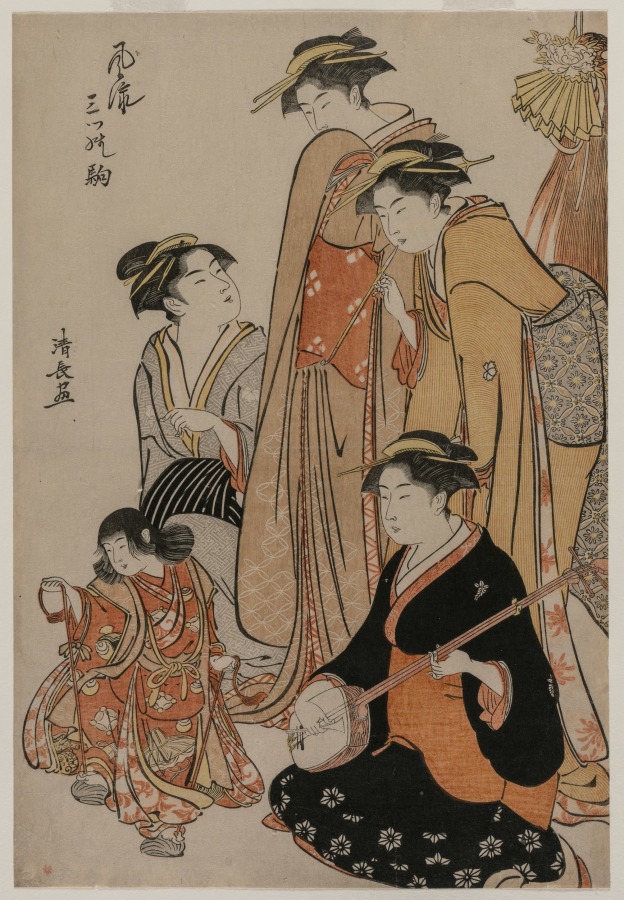
Torii Kiyonaga · The Cleveland Museum of Art · The Kelvin Smith Collection, given by Mrs. Kelvin Smith · CC0
- Born
- 1752. · Edo.
- Nationality
- Japan.
- Occupation
- xylographer, artist, painter, property manager and draftsperson.
- Fields
- yakusha-e and bijin-ga.
- Movements
- Torii school.
- Teachers
- Torii Kiyomitsu.
- Languages
- Japanese.
VALÉORINE Encyclopedia
VALÉORINE documentary reading
Documentary summary
Torii • Illustration — Bathhouse Women Torii Kiyonaga (1752 – June 28, 1815) was a Japanese ukiyo-e artist of the Torii school. Originally Sekiguchi Shinsuke, the son of an Edo bookseller, from Motozaimokuchō Itchōme in Edo, he took on Torii Kiyonaga as an art name. The master Kiyomitsu died in 1785; since his son died young, and Kiyotsune, Kiyonaga's senior, was a less promising artist, Kiyonaga was the obvious choice to succeed Kiyomitsu to leadership of the Torii school.
Admitted source layer · organised and presented by VALÉORINE
Note VALÉORINE
No house-authored Note is published until its assertions and sources pass the VALÉORINE evidence contract. The documentary article remains available in full while that enrichment is being consolidated.
Documentary enrichment in progress · no unsupported statement published
Reference Check
Propose documentary evidence for Torii Kiyonaga. A contribution is never written directly as fact: identity, source, rights and evidence gates still decide.
Sign in to contribute
Documentary evidence
Evidence Panel
not yet certified
- Identity
- resolved
- Independent source families
- 0
- Admitted assertions
- 0
- Open conflicts
- 0
Authority files
getty · 500058786 · gnd · 133261468 · wikidata · Q427642 · wikipedia · Torii Kiyonaga
In this article
Artistic career
Artistic career
However, he delayed this for two years, likely devoting time to his bijin-ga and realizing the immense responsibility that would fall on his shoulders once he took over the school. Thus, in 1787, he began organizing the production of kabuki signboards and the like, which the school held a near monopoly on. He also began to train Kiyomitsu's grandson, Torii Kiyomine, who was to succeed him.
Training under Torii Kiyomitsu is recorded. Torii Kiyomoto II is recorded as having studied under Torii Kiyonaga. The recorded working language is Japanese. The field of work recorded is visual arts and wood engraving technique. Subjects and genres recorded for the work are yakusha-e and bijin-ga. Places of work recorded in the authority are Japan. Work by Torii Kiyonaga is recorded in the collections of Minneapolis Institute of Art, Art Institute of Chicago, The Nelson-Atkins Museum of Art, Auckland Art Gallery and Finnish National Gallery.
• Illustration — Eleventh month (Jūichi gatsu), from the series 'Twelve months of the southern quarter' (Minami jūni ko), c. 1783. Chester Beatty Library Torii Kiyonaga began his training under Torii Kiyomitsu in 1765 at the age of 14 years old. It is suspected that prior to entering the Torii school he may have trained under Isoda Koryūsai, Suzuki Harunobu, and Kitao Shigemasa, as much of Kiyonaga's work shows influence from these other ukiyo-e masters. The strength of his brushwork, evident in both his prints and paintings, has also been taken as evidence that he may have trained at the Kanō school. Many of his early works were billboards and depictions of actors based on his visits to nearby kabuki theatres. The highlight of his career is when he began to produce pieces of beautiful women. In addition Torii Kiyonaga created illustrations for books and picture programs called banzuke. Kiyonaga is considered one of the great masters of the full-color nishiki-e print and of bijin-ga, images of courtesans and other beautiful women. Like most ukiyo-e artists, however, he also produced a number of prints and paintings depicting Kabuki actors and related subjects, many of them promotional materials for the theaters. He also produced a number of shunga, or erotic images, including two adaptations of Harunobo's Zashiki Hakkei. In the field of bijin-ga, only the works of Harunobu and a handful of others are generally regarded comparable with those of Kiyonaga. Kiyonaga produced a great many bijin-ga prints in the 1780s, and this is generally regarded as his high point; this is particularly true because he nearly stopped doing art entirely in the early 1790s. Some scholars point out the beauty of his paintings as being particularly exceptional given his commoner heritage and upbringing. Adopted into the Torii family, Kiyonaga's biological father was the owner of a number of tenements near a fish market; though his family may not have been particularly poor, he was certainly not brought up in an environment of high culture. Meanwhile, contemporary artists of the samurai class, who would be expected to have a better innate sense of the aesthetics and details of aristocratic culture, produced images quite arguably inferior to those of Kiyonaga. The women in Kiyonaga's prints are often described as exceptionally tall, seeming fuller, and more mature than those of his predecessor Harunobu, whose prints often depict women who seem younger and thinner. Though a difference of personal styles accounts for this primarily, it also comes in part from Kiyonaga's use of larger sheets of paper (ōban, rather than chūban or hosoban). Kiyonaga's works broke the mold of many previous artists. A great proportion of Kiyonaga's work is in diptych or triptych form, making the work seem larger and more impressive overall. Due to the large size of his prints many of his works with beautiful women also feature a scenic background illustrated with the Western concept of perspective. His prints are also well known for the variance and richness in colors. Just as Kiyonaga can be said to have replaced the earlier Harunobu as the most popular bijinga artist of his time, so Kiyonaga can be said to have been replaced by Utamaro, whose women are even fuller and more mature than those of the former. Kiyonaga's kabuki prints, depicting scenes on stage and the like, show a great attention to detail, and seek to depict real Kabuki scenes, rather than idealized versions. There is something very plain about much of his depictions, showing that those depicted are in fact actors and not the true idealized characters they represent; however, he did not make the leap to portraying the individual features and personalities of the actors as some other artists (including the Katsukawa school) did. Some scholars label his style as an important intermediary step leading to the bombastic, yet realistic, style of Sharaku. In 1794, when Utamaro became the lead bijin-ga artist, Torii Kiyonaga shifted his artistic focus to surimono, illustrations, and paintings. His last known print dates from 1813, two years before he died.
In Philately
In Philately
Kiyonaga’s works have been featured several times in commemorative postage stamps issued by the Japanese post office: • 1958 Philatelic Week • 1982 Philatelic Week (se-tenant pair) • 2003 Commemorative issue of the 250th anniversary of Kiyonaga’s birth
Life and career
Dated record
Life and career
The full dated record · 2 entries
1752
Torii Kiyonaga born at Edo.
1815
Torii Kiyonaga died at Edo.
Collections
Collections
His work is held in the permanent collections of many museums, including the Fine Arts Museum of San Francisco, the Brooklyn Museum, the Princeton University Art Museum, the Fairfield University Museum, the Smart Museum of Art, the Metropolitan Museum of Art, the Philadelphia Museum of Art, the Walters Art Museum, the Harvard Art Museums, the Portland Art Museum, the British Museum, the University of Michigan Museum of Art, and the Nelson-Atkins Museum of Art. • Illustration — Sixth month, from the series 'Twelve months of the southern quarter', c. 1784. • Illustration — Ninth month, from the series 'Twelve months of the southern quarter', c. 1784. Chiba City Museum of Art • Illustration — Snowball Fight, from the series Children at Play in Twelve Months, 1787, Honolulu Museum of Art • Illustration — Cooling on Riverside
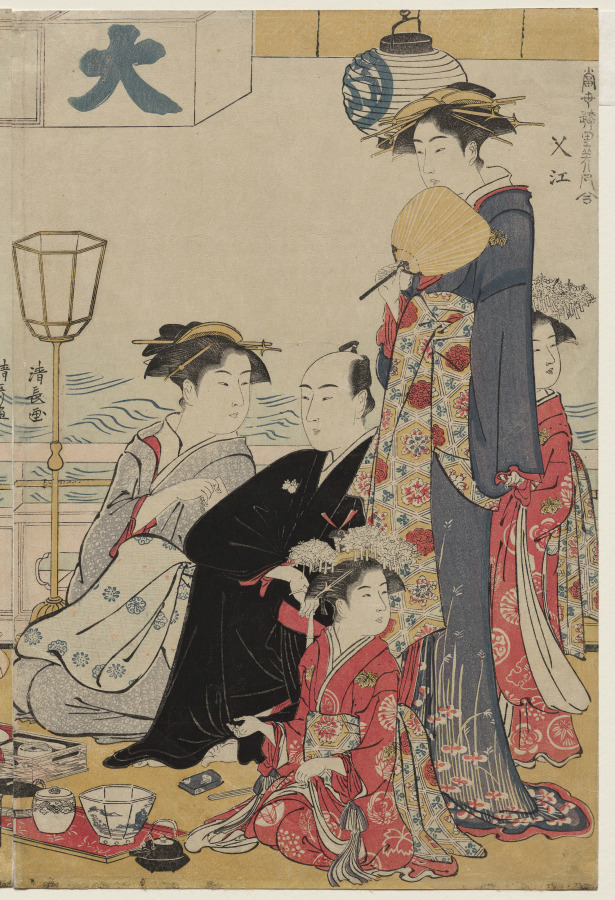
Entertainment on a Balcony by the Water at Nakasu, from the series, A Collection of Beautiful Modern Women of the Pleasure Quarters, 1783, by Torii Kiyonaga
Torii Kiyonaga · The Cleveland Museum of Art · Bequest of Edward L. Whittemore
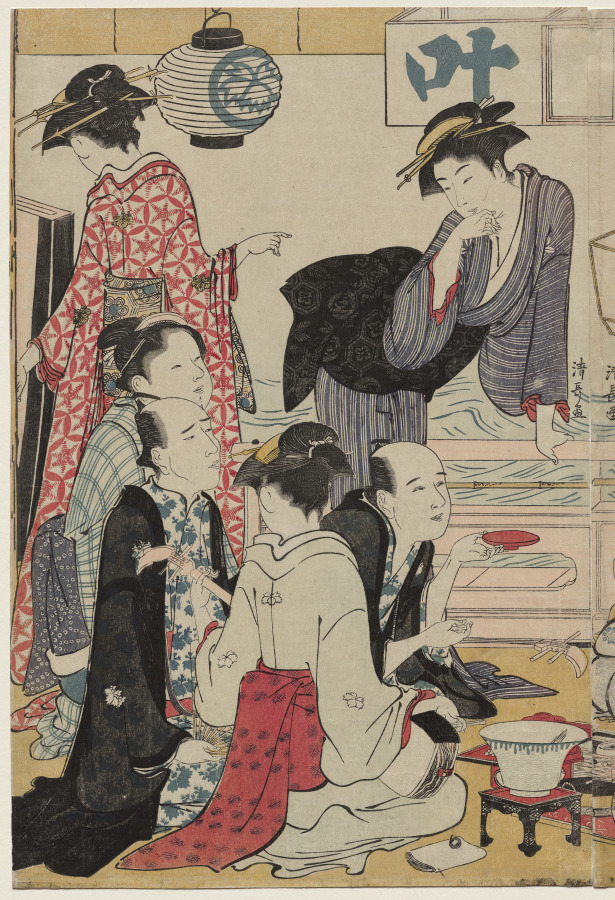
Entertainment on a Balcony by the Water at Nakasu, from the series, A Collection of Beautiful Modern Women of the Pleasure Quarters, 1783, by Torii Kiyonaga
Torii Kiyonaga · The Cleveland Museum of Art · Bequest of Edward L. Whittemore
Documents and archives
Primary material
Documents and archives
authority file
- Gemeinsame Normdatei 133261468, Torii, Kiyonaga.
Unverified · Deutsche Nationalbibliothek
- Getty Union List of Artist Names 500058786, Torii, Kiyonaga.
Unverified · The Getty Research Institute
reference work
- Wikidata, structured authority record Q427642: Torii Kiyonaga
Reputable secondary · Wikimedia Foundation
- “Torii Kiyonaga”, English Wikipedia, consulted as further reading
Reputable secondary · Wikipedia
References
Citations
References
Each reference names the institution holding it, so a reader may go to the document itself.
authority file
Gemeinsame Normdatei 133261468, Torii, Kiyonaga.Deutsche Nationalbibliothek
Partially resolvedauthority file
Getty Union List of Artist Names 500058786, Torii, Kiyonaga.The Getty Research Institute
Partially resolvedreference work
Wikidata, structured authority record Q427642: Torii KiyonagaWikimedia Foundation
Partially resolvedreference work
Partially resolved
Further particulars
Held on the record
Further particulars
Open the remaining particulars
The authorities additionally record the headings Shinsuke, Kiyonaga Seki, Kiyonaga, Shirakoya Ichibei and Kiyonaga Torii. Kiyonaga worked in visual arts and wood engraving technique. Recorded as xylographer, artist, painter, property manager and draftsperson.
Work by Torii Kiyonaga is
Minneapolis Institute of Art, Art Institute of Chicago, The Nelson-Atkins Museum of Art and Auckland Art Gallery
The Encyclopedia exists whether or not anything is for sale. Corrections are recorded rather than overwritten, and every version of this record is kept. Published 14 August 2026.
Elsewhere in Paintings
18,623 published records in this field, each with its sources named.
- Tōrei EnjiArtist
- Torii KiyomasuArtist
- Torii Kiyomasu IIArtist
- Torii KiyomitsuArtist
- Torii KiyonobuArtist
- Torii KiyotsuneArtist
- Torsten AnderssonArtist
- Torsten WasastjernaArtist
Best supported in this field
For owners
Own a work by Torii Kiyonaga?
A specialist will read what you send and tell you what the house can establish, what it cannot, and whether the object is suited to sale. There is no charge and no obligation. The object stays with you throughout; nothing is shipped to us unless it is arranged in writing beforehand.