
Torii Kiyomitsu
Illustration — Woddblock print by Torii-Kiyomitsu I, the actor Arashi Sankatsu I. as Kaga no Okiku, 1763 • Illustration — Woodblock print by Torii Kiyomitsu showing kabuki actor Bandō Hikosaburō II as Shita no Kotaro in Katakiuchi Mogami no Inabune • Illustration — Signature of Torii Kiyomitsu reading “Torii Kiyomitsu ga” (鳥居 清満 画) Torii Torii Kiyomitsu was a painter and printmaker of the Torii school of Japanese ukiyo-e art; the son of Torii Kiyonobu II or Torii Kiyomasu II, he was the third head of the school, and was originally called Kamejirō before taking the gō Kiyomitsu. Dividing his work between actor prints and bijinga (pictures of beautiful women), he primarily used the benizuri-e technique prolific at the time, which involved using one or two colors of ink on the woodblocks rather than hand-coloring; full-color prints would be introduced later in Kiyomitsu's career, in 1765. Though scholars generally note his kabuki prints as lacking originality, they see a grace, beauty, and "dream-like quality" in his prints of young men and women which, at times, rivals that of the work of Suzuki Harunobu, who was just beginning his career at this time.
Also recorded as Torii Kiyomitsu I · Kiyomutso · Kamejurō · Kiyomitsu Torii
Torii Kiyomitsu
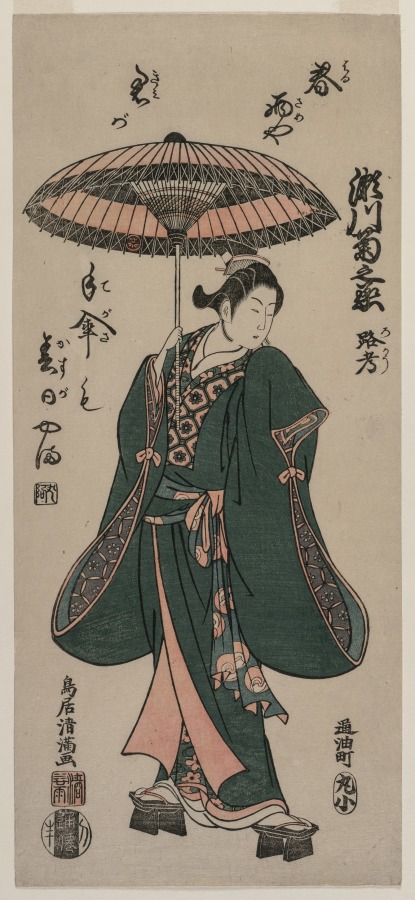
Torii Kiyomitsu · The Cleveland Museum of Art · Bequest of Edward L. Whittemore · CC0
- Born
- 1735. · Tokyo.
- Died
- 1785.
- Nationality
- Japan.
- Occupation
- painter and artist.
VALÉORINE Encyclopedia
VALÉORINE documentary reading
Documentary summary
Illustration — Woddblock print by Torii-Kiyomitsu I, the actor Arashi Sankatsu I. as Kaga no Okiku, 1763 • Illustration — Woodblock print by Torii Kiyomitsu showing kabuki actor Bandō Hikosaburō II as Shita no Kotaro in Katakiuchi Mogami no Inabune • Illustration — Signature of Torii Kiyomitsu reading “Torii Kiyomitsu ga” (鳥居 清満 画) Torii Torii Kiyomitsu was a painter and printmaker of the Torii school of Japanese ukiyo-e art; the son of Torii Kiyonobu II or Torii Kiyomasu II, he was the third head of the school, and was originally called Kamejirō before taking the gō Kiyomitsu. Dividing his work between actor prints and bijinga (pictures of beautiful women), he primarily used the benizuri-e technique prolific at the time, which involved using one or two colors of ink on the woodblocks rather than hand-coloring; full-color prints would be introduced later in Kiyomitsu's career, in 1765. Though scholars generally note his kabuki prints as lacking originality, they see a grace, beauty, and "dream-like quality" in his prints of young men and women which, at times, rivals that of the work of Suzuki Harunobu, who was just beginning his career at this time.
Admitted source layer · organised and presented by VALÉORINE
Note VALÉORINE
No house-authored Note is published until its assertions and sources pass the VALÉORINE evidence contract. The documentary article remains available in full while that enrichment is being consolidated.
Documentary enrichment in progress · no unsupported statement published
Reference Check
Propose documentary evidence for Torii Kiyomitsu. A contribution is never written directly as fact: identity, source, rights and evidence gates still decide.
Sign in to contribute
Documentary evidence
Evidence Panel
not yet certified
- Identity
- resolved
- Independent source families
- 0
- Admitted assertions
- 0
- Open conflicts
- 0
Authority files
getty · 500057317 · gnd · 141950684 · wikidata · Q3136173 · wikipedia · Torii Kiyomitsu
In this article
Identity
Identity
Kiyomitsu continued to produce the billboards and other kabuki-related materials which were the domain of the Torii school, and in those works he was quite traditional and retrospective in his style. However, he was more or less the first Torii artist to experiment outside that field, and to truly emerge into the wider mainstream of ukiyo-e styles, adapting to the use of new techniques and popular subjects. Overall, it is said that the workshop flourished under his direction, but the core "Torii style" was not truly changed or advanced. Two of his greatest pupils were Torii Kiyotsune, who faithfully continued the Torii traditions, and Torii Kiyonaga, who went on to be a master and innovator in his own right.
Places of work recorded in the authority are Japan. Work by Torii Kiyomitsu is recorded in the collections of Minneapolis Institute of Art, The Nelson-Atkins Museum of Art, Auckland Art Gallery, National Museum of World Cultures and Vanderbilt Museum of Art.
Torii Kiyomitsu is recorded as painter and artist.
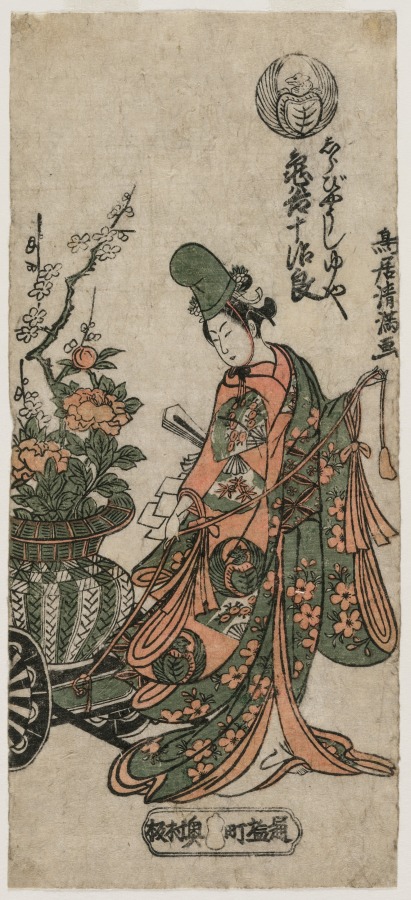
Kametani Jujiro as the Shirabyoshi Dancer Yuya, c. early 1760s, by Torii Kiyomitsu
Torii Kiyomitsu · The Cleveland Museum of Art · The Kelvin Smith Collection, given by Mrs. Kelvin Smith
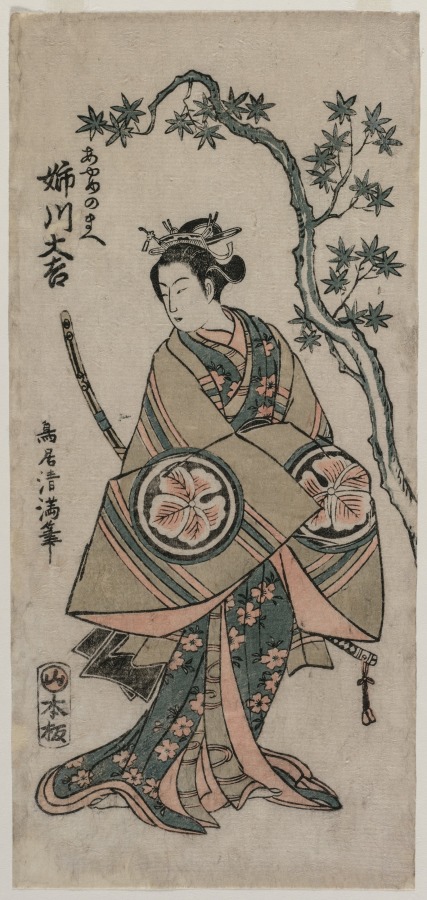
Anekawa Daisuke as Ayame-no-mae, 1760, by Torii Kiyomitsu
Torii Kiyomitsu · The Cleveland Museum of Art · The Kelvin Smith Collection, given by Mrs. Kelvin Smith
Life and career
Dated record
Life and career
The full dated record · 2 entries
1735
Torii Kiyomitsu born at Tokyo.
1785
Torii Kiyomitsu died.
Primary material
Documents and archives
Institutional database
- Wikidata, structured authority record Q3136173: Torii Kiyomitsu
Scholarly · Wikimedia Foundation
authority file
- Gemeinsame Normdatei 141950684, Torii, Kiyomitsu.
Unverified · Deutsche Nationalbibliothek
reference work
- “Torii Kiyomitsu”, English Wikipedia, consulted as further reading
Reputable secondary · Wikipedia
Literature
Literature
Torii Kiyomitsu I, Oxford Art Online, 2003
Torii Kiyomitsu I, Primitive Ukiyo-E, 1980
Torii Kiyomitsu II (Kiyomine), Primitive Ukiyo-E, 1980
References
Citations
References
Each reference names the institution holding it, so a reader may go to the document itself.
Institutional database
Wikidata, structured authority record Q3136173: Torii KiyomitsuWikimedia Foundation
Verifiedauthority file
Gemeinsame Normdatei 141950684, Torii, Kiyomitsu.Deutsche Nationalbibliothek
Partially resolvedreference work
Partially resolved
A further 1 witness is held back from this article because the person or object named in it is not yet resolved to this record. They are kept, not discarded, and return once the identity is established.
Further particulars
Held on the record
Further particulars
Open the remaining particulars
Those registers additionally record the forms Torii, Kamejirō, Torii Kiyomitsu, Kamejurō, Kiyomitsu I, Kiyomitsu and Torii Kamejirō.
The Encyclopedia exists whether or not anything is for sale. Corrections are recorded rather than overwritten, and every version of this record is kept. Published 14 August 2026.
Elsewhere in Paintings
18,705 published records in this field, each with its sources named.
- Tore HamsunArtist
- Tōrei EnjiArtist
- Torii KiyomasuArtist
- Torii Kiyomasu IIArtist
- Torii KiyonagaArtist
- Torii KiyonobuArtist
- Torii KiyotsuneArtist
- Torsten AnderssonArtist
Best supported in this field
For owners
Own a work by Torii Kiyomitsu?
A specialist will read what you send and tell you what the house can establish, what it cannot, and whether the object is suited to sale. There is no charge and no obligation. The object stays with you throughout; nothing is shipped to us unless it is arranged in writing beforehand.