
Thomas Moran
Thomas Moran (February 12, 1837 – August 25, 1926) was an American painter and printmaker of the Hudson River School in New York whose work often featured the Rocky Mountains. Moran and his family, wife Mary Nimmo Moran and daughter Ruth, took residence in New York where he obtained work as an artist. He was a younger brother of the noted marine artist Edward Moran, with whom he shared a studio.
Also recorded as thos. moran · Thomas Yellostone Moran · Moran
Thomas Moran
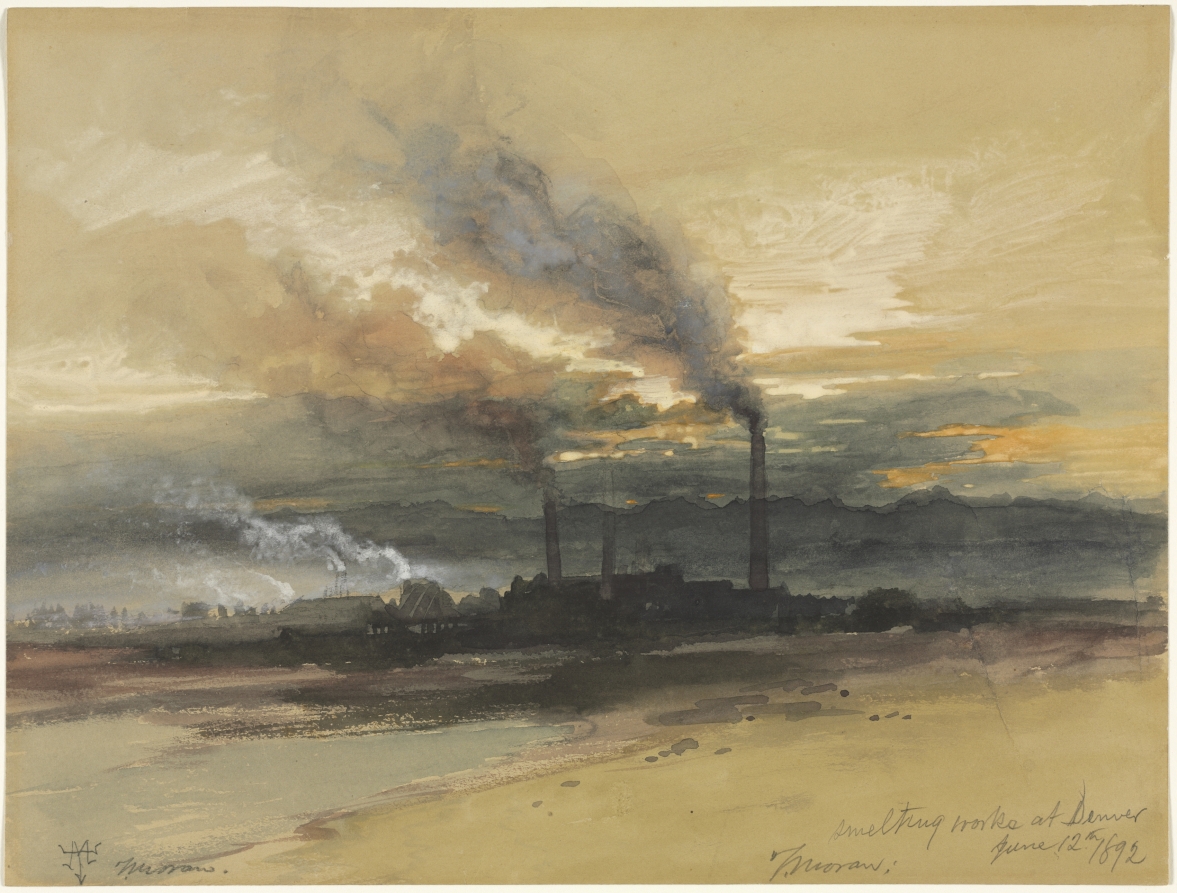
Thomas Moran · The Cleveland Museum of Art · Bequest of Mrs. Henry A. Everett for the Dorothy Burnham Everett Memorial Collection · CC0
- Name
- Thomas Moran
- Born
- 12 February 1837
- Birthplace
- Bolton, Lancashire, England
- Died
- 25 August 1926
- Place of death
- Santa Barbara, California, United States
- Spouse
- Mary Nimmo Moran
- Known for
- Landscape painting
- Movement
- Hudson River School, Rocky Mountain School
- Nationality
- United States.
- Fields
- landscape painting, painting and graphics.
- Movements
- Hudson River school.
- Languages
- English.
VALÉORINE Encyclopedia
VALÉORINE documentary reading
Documentary summary
Thomas Moran (February 12, 1837 – August 25, 1926) was an American painter and printmaker of the Hudson River School in New York whose work often featured the Rocky Mountains. Moran and his family, wife Mary Nimmo Moran and daughter Ruth, took residence in New York where he obtained work as an artist. He was a younger brother of the noted marine artist Edward Moran, with whom he shared a studio.
Admitted source layer · organised and presented by VALÉORINE
Reference Check
Propose documentary evidence for Thomas Moran. A contribution is never written directly as fact: identity, source, rights and evidence gates still decide.
Sign in to contribute
World of VALÉORINE
Documentary connections
Only confirmed graph relationships appear here. Images are shown only when their identity and reuse rights both pass the documentary gate.
Documentary evidence
Documentary basis
Authority files
wikidata · Q983441 · wikipedia · Thomas Moran
In this article
Biography
Biography
A talented illustrator and exquisite colorist, Thomas Moran was hired as an illustrator at Scribner's Monthly. During the late 1860s, he was appointed the chief illustrator for the magazine, a position that helped him launch his career as one of the premier painters of the American landscape, in particular, the American West. Moran along with Albert Bierstadt, Thomas Hill, and William Keith are sometimes referred to as belonging to the Rocky Mountain School of landscape painters because of all of the Western landscapes made by this group.
Deborah Griscom Passmore is recorded as having studied under Thomas Moran. The recorded working language is English. The field of work recorded is landscape painting, painting and graphics. Subjects and genres recorded for the work are landscape. Places of work recorded in the authority are United States and Lake Como. Works named in the authority record are Childe Roland to the Dark Tower Came. Work by Thomas Moran is recorded in the collections of Minneapolis Institute of Art, Art Institute of Chicago, The Nelson-Atkins Museum of Art, Metropolitan Museum of Art and Buffalo Bill Center of the West.
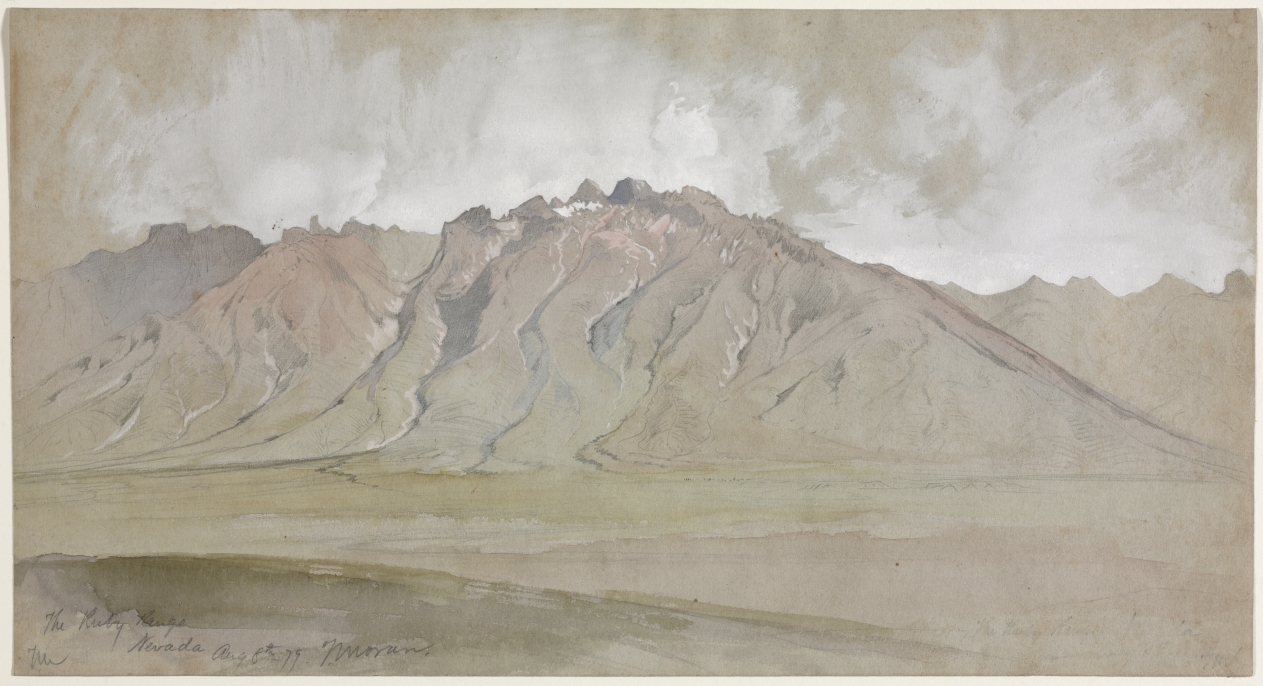
The Ruby Range, Nevada, 1879, by Thomas Moran
Thomas Moran · The Cleveland Museum of Art · Bequest of Mrs. Henry A. Everett for the Dorothy Burnham Everett Memorial Collection
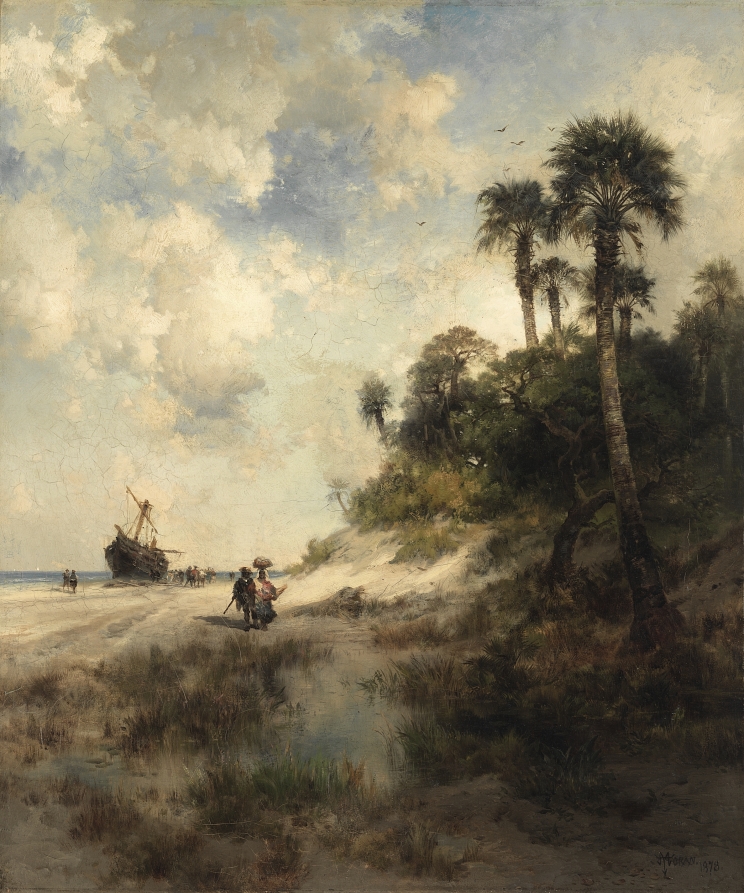
Fort George Island, Florida, 1878, by Thomas Moran
Thomas Moran · The Cleveland Museum of Art · Hinman B. Hurlbut Collection
Key facts
Key facts
• Name — Thomas Moran • Born — 12 February 1837 • Birthplace — Bolton, Lancashire, England • Died — 25 August 1926 • Place of death — Santa Barbara, California, United States • Spouse — Mary Nimmo Moran • Known for — Landscape painting • Movement — Hudson River School, Rocky Mountain School
Biography
Biography
• Illustration — Thomas Moran standing on a balcony, smoking a cigar, 1912 Moran was born in Bolton, Lancashire, in England, to Mary (née Higson) and Thomas Moran Sr., one of seven children His father belonged to a family of handloom weavers. He wanted a better future for his family, so they moved to the United States in 1844, when young Thomas was 7 years old. The trip had a life-long impression on Moran, who later created sketches and paintings of the sea. His family first settled in Baltimore, moving afterwards to Kensington, a suburb of Philadelphia. Moran began his artistic career as a teenage apprentice to the Philadelphia wood-engraving firm Scattergood & Telfer. Moran found the engraving process "tedious" and spent his free time working on his own watercolors. By the mid-1850s, he was drawing the firm's illustrations for publication rather than carving them. It was then that he encountered illustrated books that included examples of the work of British artist J. M. W. Turner, who was to be a lasting influence on Moran's work. He also began studying with local painter James Hamilton. Moran traveled to England in 1862 to see Turner's work. From that point on, he emulated Turner's use of color, his choice of landscapes, and was inspired by his explorations in watercolor, a medium for which Turner was particularly well-known. During the 1870s and 1880s, Moran's designs for wood-engraved illustrations appeared in major magazines and gift oriented publications. Although he mastered multiple printing media including wood-engraving, etching, and lithography, which he learned from his brothers, he received renown for his paintings in oil and in watercolor. The height of his career coincided with the popularity of chromolithography, which Moran used to make color prints of his works, so that they could be widely distributed. He was also one of the leaders of the etching revival in the United States and Great Britain. • Illustration — Grand Canyon of the Colorado River (1892–1908) Moran was married to Scottish born Mary Nimmo Moran (1842–1899), an etcher and landscape painter. The couple had two daughters and a son. His brothers Edward (1829–1901), John (1831–1902) and Peter (1841–1914), as well as his nephews Edward Percy Moran (1862–1935) and Jean Leon Gerome Ferris (1863–1930) were also active as artists. His brother John was also a pioneer in artistic photography. The two often worked side by side, John photographing the same scene that Thomas was painting. He died in Santa Barbara, California on August 25, 1926.
Yellowstone images
Yellowstone images
• Illustration — The Grand Canyon of the Yellowstone (1893–1901), Smithsonian American Art Museum Thomas Moran's vision of the Western landscape was critical to the creation of Yellowstone National Park. In 1871, Ferdinand Vandeever Hayden, director of the United States Geological Survey, invited Moran, at the request of American financier Jay Cooke, to join Hayden and his expedition team into the unknown Yellowstone region. Hayden was just about to embark on his arduous journey when he received a letter from Cooke presenting Moran as "an artist of Philadelphia of rare genius". Funded by Cooke (the director of the Northern Pacific Railroad), and Scribner's Monthly, a new illustrated magazine, Moran agreed to join the survey team of the Hayden Geological Survey of 1871 in their exploration of the Yellowstone region. During forty days in the wilderness area, Moran visually documented over 30 different sites and produced a diary of the expedition's progress and daily activities. His sketches, along with photographs produced by survey member William Henry Jackson, captured the nation's attention and helped inspire Congress to establish the Yellowstone region as the first national park in 1872. Moran's paintings along with Jackson's photographs revealed the scale and splendor of the beautiful Yellowstone region where written or oral descriptions failed, persuading President Grant and the US Congress that Yellowstone was to be preserved. Moran's impact on Yellowstone was great, but Yellowstone had a significant influence on the artist, too. His first national recognition as an artist, as well as his first large financial success, resulted from his connection with Yellowstone. He even adopted a new signature: T-Y-M, Thomas "Yellowstone" Moran. Just one year after his introduction to the area, Moran captured the imagination of the American public with his first enormous painting of a far-western natural wonder, The Grand Canyon of the Yellowstone, which the government purchased in 1872 for $10,000. For the next two decades, he published his work in various periodicals and created hundreds of large paintings. Among these, The Grand Canyon of the Yellowstone (1872) and Chasm of the Colorado (1873–74) are exhibited at the Department of the Interior Museum. Over the next forty years Moran traveled extensively. He went back to Yellowstone with Jackson in 1892. They were invited by Elwood Mead, the state engineer of Wyoming, in preparation for a "Wyoming Exhibition" at the World's Columbian Exposition. Thousands of tourists were now able to visit the park, arriving by the Northern Pacific Railway, and Moran and Jackson were able to take advantage of the tourist facilities, such as a hotel at Mammoth Hot Springs. Moran wrote "After a day at Norris we left for the Grand Canyon where we stayed two days and made a great many photos. I saw so much to sketch that I have determined to return there myself after I have been to the Geyser Basins and the lake and spend a week at work there. It is as glorious in color as ever and I was completely carried away by its magnificence. I think I can paint a better picture of it than the old one after I have made my sketches." Moran sketched many more images of the Canyon on this trip than he had in 1871, including views from the viewpoint named for him on the 1871 trip, "Moran Point". The Grand Canyon of the Yellowstone (1893–1901) is on view at the Smithsonian American Art Museum. Moran was an honorary artist member of the Salmagundi Club New York beginning in 1888, and served as its 4th president, from 1893 to 1896. He was elected to the membership of the National Academy of Design in 1884 and produced numerous works of art in his senior years.
Painting in the White House
Painting in the White House
• Illustration — The Three Tetons, 1895, by Thomas Moran (right), in the Oval Office during Barack Obama's term Thomas Moran has a painting exhibited as part of the White House collection. In the photograph depicting President Barack Obama and Israeli President Shimon Peres in the Oval Office it is seen on the wall: the portrait of George Washington is between City of Washington from Beyond the Navy Yard (1833) by George Cooke (on the left) and The Three Tetons (1895) by Thomas Moran (on the right). Official White House photo by Pete Souza.
Selected works
Selected works
• Nearing Camp, Evening on the Upper Colorado River, Wyoming, 1882. Bolton Museum, UK • Illustration — Under the Trees, 1865 • Illustration — Yellowstone Canyon, 1872 • Illustration — Colburn's Butte, South Utah, 1873, Metropolitan Museum of Art. • Illustration — Mosquito Trail, 1874 • Illustration — The Golden Hour, 1875 • Illustration — Shoshone Falls, Idaho, ca. 1875 • Illustration — Green River, Wyoming (1878), Crystal Bridges Museum of American Art. • Illustration — Mist in Kanab Canyon, Utah, 1892 • Illustration — Venice: The Lagoon Looking toward Santa Maria della Salute, 1894, Princeton University Art Museum • Illustration — Shoshone Falls on the Snake River (1900), Gilcrease Museum, Tulsa, OK. • Illustration — Thomas Moran, Cliffs of Green River, 1874, Amon Carter Museum of American Art • Illustration — Grand Canyon of Yellow Stone (1904), Honolulu Museum of Art. • Illustration — Sunset at Sea, ca. 1906 • Illustration — An angry sea (1887), Philbrook Museum, Tulsa OK • Illustration — Green River, Wyoming (1907), Tacoma Art Museum • Illustration — Valley of Babbling Waters, Southern Utah, (c) 1876; from the Louis Prang & Company Collection of the Boston Public Library • Illustration — Great falls of Snake River, Idaho Territory, (c) 1876; from the Louis Prang & Company Collection of the Boston Public Library • Illustration — The Castle Geyser, Upper Geyser Park, (c) 1874; from the Louis Prang & Company Collection of the Boston Public Library • Illustration — Salvator Rosa Sketching the Banditi, 1860, Chrysler Museum of Art
Places
Named by the record
Places
Only places the record itself states, plotted where the house gazetteer settles their coordinates. Nothing is inferred from a name or a nationality.
Bolton.
Birth place
Santa Barbara.
Death place
Legacy
The Thomas Moran House in East Hampton, New York is a National Historic Landmark. Mount Moran in the Grand Teton National Park is named for Moran. His work is held in the collection of the Gilcrease Museum in Tulsa, Oklahoma, Cooper-Hewitt, National Design Museum, the Amon Carter Museum of American Art, R. W. Norton Art Gallery, and the Berkshire Museum in Pittsfield, Massachusetts.
Citations
References
Each reference names the institution holding it, so a reader may go to the document itself.
reference work
Secondary witnessreference work
Secondary witness
The Encyclopedia exists whether or not anything is for sale. Corrections are recorded rather than overwritten, and every version of this record is kept. Published 14 August 2026.
Elsewhere in Paintings
19,261 published records in this field, each with its sources named.
- Thomas Leeson Scrase RowbothamArtist
- Thomas LunyArtist
- Thomas McKnightArtist
- Thomas MonroArtist
- Thomas MulvanyArtist
- Thomas MurrayArtist
- Thomas Musgrave JoyArtist
- Thomas P. BarnettArtist
Best supported in this field
For owners
Own a work by Thomas Moran?
A specialist will read what you send and tell you what the house can establish, what it cannot, and whether the object is suited to sale. There is no charge and no obligation. The object stays with you throughout; nothing is shipped to us unless it is arranged in writing beforehand.