
Thomas Cole
Thomas Cole (February 1, 1801 – February 11, 1848) was an Anglo-American artist who founded the Hudson River School art movement. He painted romantic landscapes and history paintings. Influenced by European painters, but with a strong American sensibility, he was prolific throughout his career and worked primarily with oil on canvas.
Also recorded as T. Cole · Cole
Thomas Cole
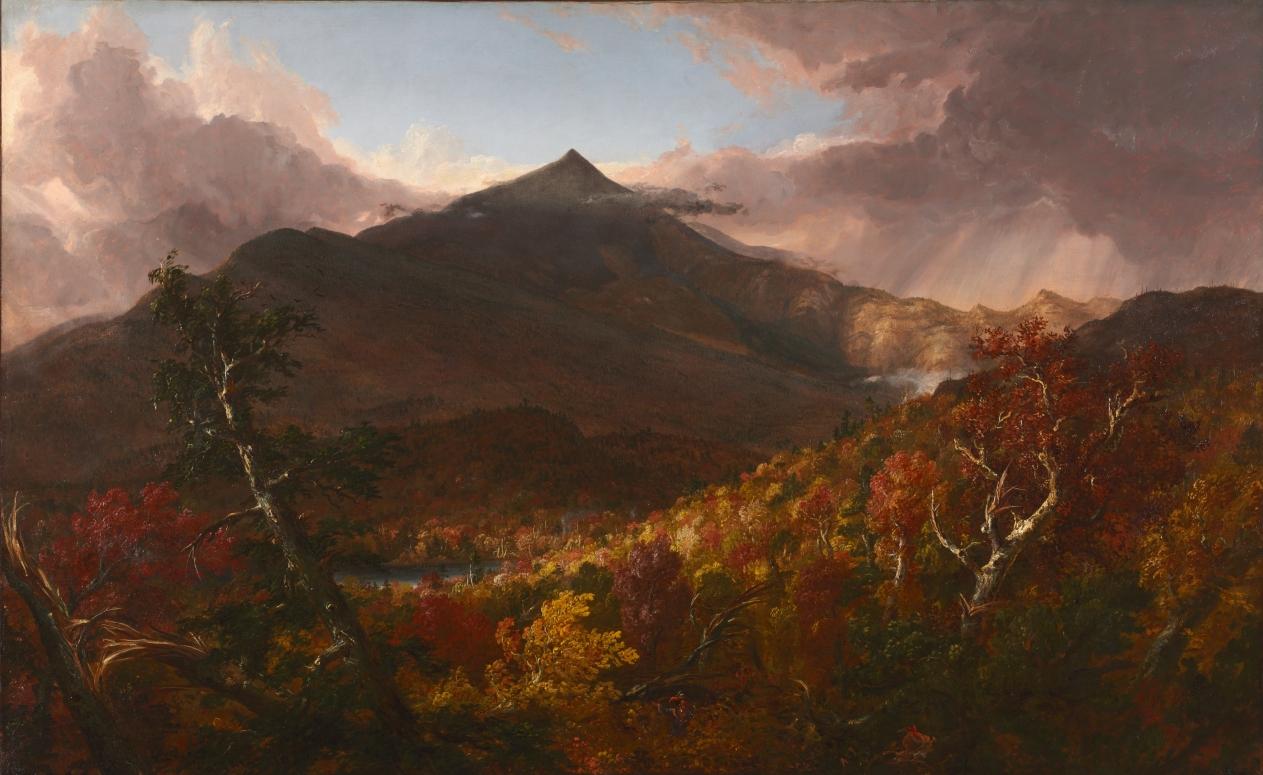
Thomas Cole · The Cleveland Museum of Art · Hinman B. Hurlbut Collection · CC0
- Name
- Thomas Cole
- Born
- 1 February 1801
- Birthplace
- Bolton le Moors, Lancashire, England
- Died
- 11 February 1848
- Place of death
- Catskill, New York, U.S
- Movement
- Hudson River School
- Known for
- Painting, oil on canvas
- Nationality
- United States and United Kingdom of Great Britain and Ireland.
- Occupation
- painter, printmaker and illustrator.
- Fields
- landscape painting.
- Movements
- Hudson River school.
VALÉORINE Encyclopedia
VALÉORINE documentary reading
Documentary summary
Thomas Cole (February 1, 1801 – February 11, 1848) was an Anglo-American artist who founded the Hudson River School art movement. He painted romantic landscapes and history paintings. Influenced by European painters, but with a strong American sensibility, he was prolific throughout his career and worked primarily with oil on canvas.
Admitted source layer · organised and presented by VALÉORINE
Reference Check
Propose documentary evidence for Thomas Cole. A contribution is never written directly as fact: identity, source, rights and evidence gates still decide.
Sign in to contribute
Documentary evidence
Documentary basis
Authority files
wikidata · Q334001 · wikipedia · Thomas Cole
In this article
Biography
Biography
His paintings are typically allegoric and often depict small figures or structures set against moody and evocative natural landscapes. They are usually escapist, framing the New World as a natural eden contrasting with the smog-filled cityscapes of Industrial Revolution-era Britain, in which he grew up. His works, often seen as conservative, criticize the contemporary trends of industrialism, urbanism, and westward expansion.
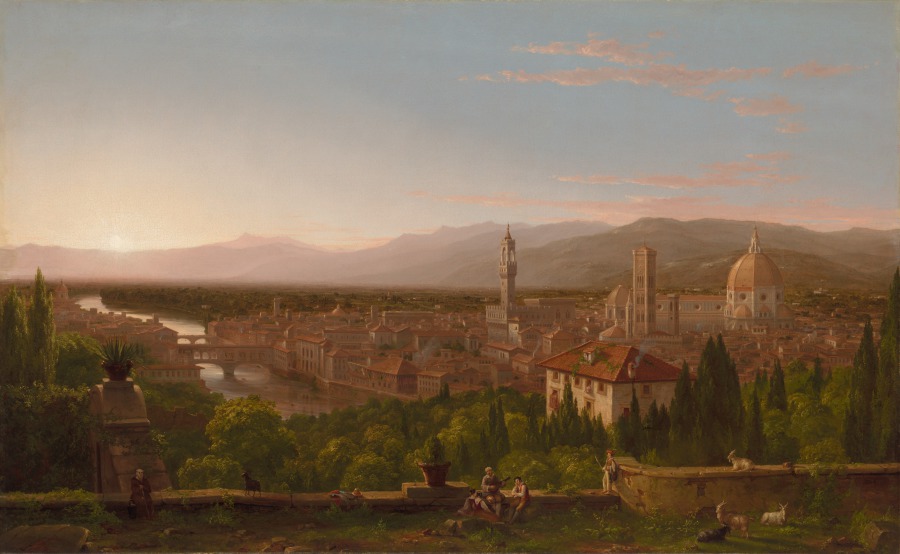
View of Florence, 1837, by Thomas Cole
Thomas Cole · The Cleveland Museum of Art · Mr. and Mrs. William H. Marlatt Fund
Key facts
Key facts
• Name — Thomas Cole • Born — 1 February 1801 • Birthplace — Bolton le Moors, Lancashire, England • Died — 11 February 1848 • Place of death — Catskill, New York, U.S • Movement — Hudson River School • Known for — Painting, oil on canvas • Notable Works — The Titan's Goblet The Course of Empire The Oxbow The Voyage of Life among others... • Illustration — The Oxbow (The Connecticut River near Northampton) (1836) • Illustration — The Course of Empire (1833–1836). This animated image shows all five paintings in the series as separate frames.
Early life and education
Early life and education
Born in Bolton le Moors in Lancashire on February 1, 1801, Thomas Cole immigrated with his family to the United States in 1818, settling in Steubenville, Ohio. At the age of twenty-two, he moved to Philadelphia and later, in 1825, to Catskill, New York, where he lived with his children and wife until his death in 1848. Cole found work early on as an engraver. He was largely self-taught as a painter, relying on books and by studying the work of other artists. In 1822, he started working as a portrait painter and later on, gradually shifted his focus to landscape.
Painting
Painting
• Illustration — The Titan's Goblet (1833), oil on canvas; 49 × 41 cm. The Metropolitan Museum of Art, New York In New York, Cole sold three paintings to George W. Bruen, who subsequently financed a summer trip to the Hudson Valley where the artist produced landscapes featuring the Catskill Mountain House, the famous Kaaterskill Falls, the ruins of Fort Putnam, and two views of Cold Spring. Returning to New York, he displayed five landscapes in the window of William Colman's bookstore; according to the New York Evening Post the two views of Cold Spring were purchased by A. Seton, who lent them to the American Academy of the Fine Arts annual exhibition in 1826. This garnered Cole the attention of John Trumbull, Asher Brown Durand, and William Dunlap. Among the paintings was a landscape called View of Fort Ticonderoga from Gelyna. Trumbull was especially impressed with the work of the young artist and sought him out, bought one of his paintings, and put him into contact with a number of his wealthy friends including Robert Gilmor Jr. of Baltimore and Daniel Wadsworth of Hartford, Connecticut, who became important patrons of the artist. Eighty-nine of Cole's paintings were exhibited at the National Academy of Design between its founding in 1825 and Cole's death in 1848. Five of his works were engraved and published in The Token and Atlantic Souvenir annual gift book between 1826 and 1842. The historian David S. Lovejoy considers the best to be The Whirlwind (1837), which Lovejoy said "is unique in its boldness" compared to the predominantly serene landscapes of the period. Published in the 1830 volume, contemporary critic John Neal called Chocurua's Curse "beautifully contrived". Cole was primarily a painter of landscapes, but he also painted allegorical works. The most famous of these are the five-part series, The Course of Empire, which depict the same landscape over generations—from a near state of nature to consummation of empire, and then decline and desolation—now in the collection of the New-York Historical Society and the four-part The Voyage of Life. There are two versions of the latter, the 1840 original at the Munson-Williams-Proctor Arts Institute in Utica, New York and the 1842 replicas with minor alterations at the National Gallery in Washington, D.C. Among Cole's other famous works are The Oxbow (1836), The Notch of the White Mountains, Daniel Boone at his cabin at the Great Osage Lake, and Lake with Dead Trees (1825) which is at the Allen Memorial Art Museum. He also painted The Garden of Eden (1828), with lavish detail of Adam and Eve living amid waterfalls, vivid plants, and deer. In 2014, friezes painted by Cole on the walls of his home, which had been decorated over, were discovered. Cole influenced his peers in the art movement later termed the Hudson River School, especially Durand and Frederic Edwin Church. Church studied with Cole from 1844 to 1846, where he learned Cole's technique of sketching from nature and later developing an idealized, finished composition; Cole's influence is particularly notable in Church's early paintings. Cole spent the years 1829 to 1832 and 1841 to 1842 abroad, mainly in England and Italy.
Other work
Other work
Cole is best known for his work as an American landscape artist. In an 1836 article on "American Scenery", he described his complex relationship with the American landscape in esthetic, emotional, and spiritual terms. He also produced thousands of sketches of varying subject matter. Over 2,500 of these sketches can be seen at The Detroit Institute of Arts. In 1842, Cole embarked on the Grand Tour in an effort to study in the style of the Old Masters and to paint its scenery. Most striking to Cole was the tallest active volcano in Europe, Mount Etna. Cole was so moved by the volcano's beauty that he produced several sketches and at least six paintings of it. The most famous of these works is A View of Mount Etna from Taormina which is a 78 by oil on canvas. Cole also produced a highly detailed sketch View of Mount Etna which shows a panoramic view of the volcano with the crumbling walls of the ancient Greek theater of Taormina on the far right. Cole was also a poet and dabbled in architecture, a not uncommon practice at the time when the profession was not so codified. Cole was an entrant in the design competition held in 1838 to create the Ohio Statehouse in Columbus, Ohio. His entry won third place, and many contend that the finished building, a composite of the first, second, and third-place entries, bears a great similarity to Cole's entry.
Personal life
Personal life
• Illustration — Thomas Cole House, "Cedar Grove" After 1827 Cole maintained a studio at the farm called Cedar Grove, in the town of Catskill, New York. He painted a significant portion of his work in this studio. In 1836, he married Maria Bartow of Catskill, a niece of the owners, and became a year-round resident. Thomas and Maria had five children. His daughter Emily Cole (1843–1913) was a botanical artist who worked in watercolor and painted porcelain. Cole's sister, Sarah Cole, was also a landscape painter. Additionally, Cole held many friendships with important figures in the art world including Daniel Wadsworth, with whom he shared a close friendship. Proof of this friendship can be seen in the letters that were unearthed in the 1980s by the Trinity College Watkinson Library. Cole emotionally wrote Wadsworth in July 1832: "Years have passed away since I saw you & time & the world have undoubtedly wrought many changes in both of us; but the recollection of your friendship... [has] never faded in my mind & I look at those pleasures as 'flowers that never will in other garden grow-'" Thomas Cole died at Catskill on February 11, 1848, of pleurisy. The fourth-highest peak in the Catskills is named Thomas Cole Mountain in his honor. Cedar Grove, also known as the Thomas Cole House, was declared a National Historic Site in 1999 and is now open to the public.
Selected works
Selected works
• Illustration — Imaginary scene from The Last of the Mohicans (1827), Wadsworth Atheneum • Illustration — Expulsion from the Garden of Eden (1828), Museum of Fine Arts, Boston • Illustration — Romantic Landscape with Ruined Tower (1832–36), Albany Institute of History & Art • Illustration — The Course of Empire: Consummation (1835–1836), New-York Historical Society • Illustration — The Architect's Dream (1840), Toledo Museum of Art • Illustration — The Voyage of Life: Youth (1842), National Gallery of Art • Illustration — Temple of Segesta (1843), Museum of Fine Arts, Boston • Illustration — A View of the Two Lakes and Mountain House, Catskill Mountains, Morning (c. 1844), Brooklyn Museum • Illustration — Home in the Woods (1847), Reynolda House Museum of American Art • Illustration — Prometheus Bound (1847), Fine Arts Museums of San Francisco
Life and career
Dated record
Life and career
Explore 1801–1848
The full dated record · 3 entries
1801
Thomas Cole was born in 1801.
1832
Interior of the Colosseum, Rome is dated 1832.
1848
Thomas Cole died at New York City.
Other sources
Other sources
*
Notes from the source article
Cited by Wikipedia
Notes from the source article
These works are cited by the source article, in its own numbering. They are recorded as its citations, not as sources VALÉORINE has verified.
- 1.Thomas Cole. National Gallery of Art.
- 2.Lovejoy, David S. American Painting in Early Nineteenth-Century Gift Books. American Quarterly. 7. 4. 355. Winter 1955. 10.2307/2710429.
- 3.Genocchio, Benjamin. In an Untamed Wilderness, Finding the Serene. The New York Times. June 18, 2006.
- 4.Cotter, Holland. Thomas Cole, American Moralist. The New York Times. March 15, 2018.
- 5.Kornhauser, Elizabeth. Re-examining Thomas Cole. The Magazine Antiques. January 8, 2018.
- 6.Parry III, Ellwood C. Thomas Cole's "The Hunter's Return". The American Art Journal. 17. 3. 2–17. Summer 1985. 10.2307/1594431.
- 7.Truettner, William H. Thomas Cole Landscape into History. Yale University Press. 8. 1994.
- 8.Truettner, William H. Thomas Cole: Landscape into History. Yale University Press. 25–26. 1994.
- 9.Noble, Louis Legrand. The life and works of Thomas Cole. Sheldon, Blakeman. 56. 1856.
- 10.Effmann, Elise. Thomas Cole's View of Fort Putnam. The Magazine Antiques. 154–159. November 2004.
- 11.COLE T25FP. Hamilton Auction Galleries.
- 12.Lovejoy, David S. American Painting in Early Nineteenth-Century Gift Books. American Quarterly. 7. 4. 355. Winter 1955. 10.2307/2710429.
- 13.Brophy, Alfred L. Property and Progress: Antebellum Landscape Art and Property Law. McGeorge Law Review. 40. 605–59. 2009.
- 14.Exhibit at the Amon Carter Museum in Fort Worth, Texas
- 15.Schweber, Nate. Unknown Thomas Cole Paintings Found at His Home. The New York Times. July 1, 2015.
- 16.Howat, John K. Frederic Church. Yale University Press. 9–12. 2005. 978-0300109887.
- 17.American Scenery--Thomas Cole vs NASA.
- 18.Cole, Thomas. American Scenery. The American Monthly Magazine. 1. 1–12. January 1836.
- 19."Studies on Thomas Cole" Baltimore Museum of Art, Annual II. pp. 123. Baltimore, Maryland 1967.
- 20.Weidman, Jeffrey. Artists in Ohio, 1787–1900: A Biographical Dictionary. Kent State University Press. 174. 2000. 978-0-87338-616-6.
- 21.The Art of Emily Cole. Thomas Cole National Historic Site. February 19, 2019.
- 22.Cascone, Sarah. Emily Cole, Daughter of Hudson River School Icon, Shines in Overdue Museum Show. Artnet News. 2025-04-16.
- 23.Cole, T., & Wadsworth, D. (1983). The correspondence of Thomas Cole and Daniel Wadsworth: Letters in the Watkinson Library, Trinity College, Hartford, and in the New York State Library, Albany, New York. Hartford, Conn.: Connecticut Historical Society.
- 24.Biography of Thomas Cole. Thomas Cole National Historic Site. March 18, 2016.
- 25.Thomascole.org. Cedar Grove History.
- 26.The Thomas Cole National Historic Site. History of Cedar Grove.
References
Citations
References
Each reference names the institution holding it, so a reader may go to the document itself.
reference work
Wikidata, structured authority record Q334001: Thomas ColeWikimedia Foundation
Secondary witnessreference work
Secondary witness
Further particulars
Held on the record
Further particulars
Open the remaining particulars
Formation and teaching. Each of those relationships is stated by the authority record rather than inferred from style. Cole worked in painting. His work is associated with Hudson River school. He worked at Steubenville, New York City, Philadelphia and Pittsburgh. Work and production. Works recorded as notable number 4: The Oxbow, The Voyage of Life, The Subsiding of the Waters of the Deluge and The Course of Empire. His recorded genre is landscape. Recorded as United States and United Kingdom of Great Britain and Ireland.
Career and activity
Recognition and collections
Work by Thomas Cole is
Minneapolis Institute of Art, The Nelson-Atkins Museum of Art, Thyssen-Bornemisza Museum and National Gallery of Canada
Interior of the Colosseum, Rome
1832
The Encyclopedia exists whether or not anything is for sale. Corrections are recorded rather than overwritten, and every version of this record is kept. Published 14 August 2026.
Elsewhere in Illustration
5,224 published records in this field, each with its sources named.
- Thomas Bangs ThorpeIllustrator
- Thomas Bolton Gilchrist Septimus DalzielIllustrator
- Thomas Cantrell DugdaleIllustrator
- Thomas CantyIllustrator
- Thomas Cooper GotchIllustrator
- Thomas CraneIllustrator
- Thomas DerrickIllustrator
- Thomas Edward GordonIllustrator
Best supported in this field
For owners
Own a work by Thomas Cole?
A specialist will read what you send and tell you what the house can establish, what it cannot, and whether the object is suited to sale. There is no charge and no obligation. The object stays with you throughout; nothing is shipped to us unless it is arranged in writing beforehand.