
Théodore Rousseau
Étienne Pierre Théodore Rousseau (15 April 181222 December 1867) was a French painter of the Barbizon School. • Illustration — Les chênes d'Apremont (Oak Grove, Apremont), 1850–1852
Also recorded as Pierre Étienne Théodore Rousseau · Pierre-Étienne-Théodore Rousseau · Pierre Etienne Théodore Rousseau · Theodore Rousseau
Théodore Rousseau
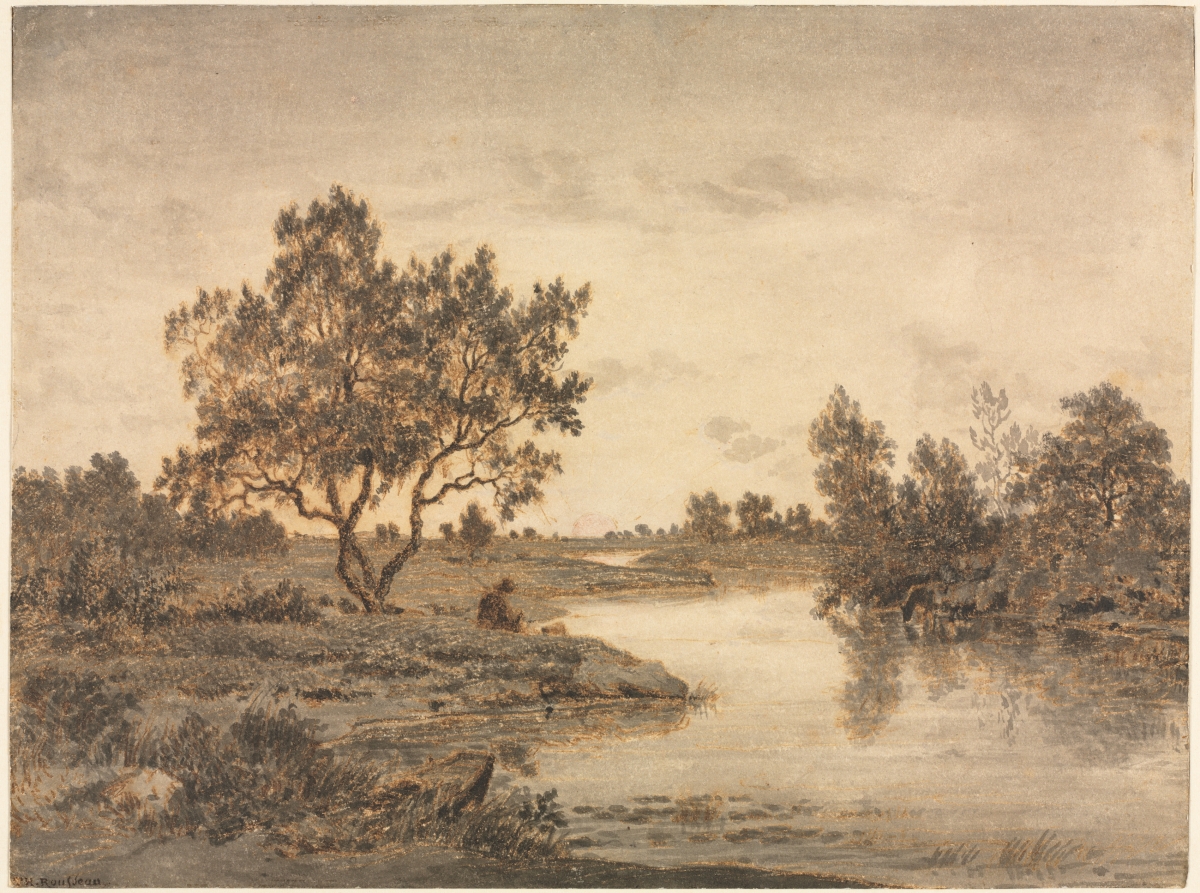
Théodore Rousseau · The Cleveland Museum of Art · John L. Severance Fund · CC0
- Name
- Théodore Rousseau
- Birth Name
- Étienne Pierre Théodore Rousseau
- Born
- 15 April 1812
- Birthplace
- Paris, France
- Died
- 22 December 1867
- Place of death
- Barbizon, France
- Nationality
- France.
- Occupation
- painter, photographer, draftsperson, printmaker, visual artist and graphic artist.
- Movements
- Barbizon school.
- Known for
- Les Chênes d'Apremont, Le Printemps and La Gorge aux Loups.
VALÉORINE Encyclopedia
VALÉORINE documentary reading
Documentary summary
Étienne Pierre Théodore Rousseau (15 April 181222 December 1867) was a French painter of the Barbizon School. • Illustration — Les chênes d'Apremont (Oak Grove, Apremont), 1850–1852
Admitted source layer · organised and presented by VALÉORINE
Note VALÉORINE
Théodore Rousseau (1812–1867) was a draftsperson, graphic artist and painter, among other activities, of French nationality. The draftsperson was associated with Barbizon school. Among the works are La Gorge aux Loups, Le Printemps and Les Chênes d'Apremont.
Composed from admitted, traceable facts · 27 September 2026
VALÉORINE
Reference Check
Propose documentary evidence for Théodore Rousseau. A contribution is never written directly as fact: identity, source, rights and evidence gates still decide.
Sign in to contribute
World of VALÉORINE
Documentary connections
Only confirmed graph relationships appear here. Images are shown only when their identity and reuse rights both pass the documentary gate.


Documentary evidence
Evidence Panel
not yet certified
- Identity
- resolved
- Independent source families
- 0
- Admitted assertions
- 0
- Open conflicts
- 0
Authority files
gnd · 1068044527 · wikidata · Q310025 · wikipedia · Théodore Rousseau
In this article
Key facts
Key facts
• Name — Théodore Rousseau • Birth Name — Étienne Pierre Théodore Rousseau • Born — 15 April 1812 • Birthplace — Paris, France • Died — 22 December 1867 • Place of death — Barbizon, France • Patrons — Jean-Charles-Joseph Rémond
Youth
Youth
He was born in Paris, France in a bourgeois family. At first he received a basic level of training, but soon displayed aptitude for painting. Although his father regretted the decision at first, he became reconciled to his son forsaking business, and throughout the artist's career (for he survived his son) was a sympathizer with him in all his conflicts with the Paris Salon authorities. Théodore Rousseau shared the difficulties of the romantic painters of 1830, in securing for their pictures a place in the annual Paris exhibition. The influence of classically trained artists was against them, and not until 1848 was Rousseau presented adequately to the public. • Illustration — The Fisherman, 1848–49 • Illustration — The Charcoal Burner's Hut, c. 1850, Dallas Museum of Art He had exhibited six works in the Salons of 1831, 1833, 1834 and 1835, but in 1836 his great work Paysage du Jura [La descente des vaches] was rejected by the Salon jury. He sent a total of eight further works to the Salon between 1836 and 1841; and yet none of them were accepted. Thereafter, he ceased sending work to the Salon until 1849, when all three of his submissions were accepted. He was not without champions in the press, and with the title of "le grand refusé" he became known through the writings of his friend Théophile Thoré, the critic who afterwards resided in England and wrote using the name Burger. During these years of artistic exile Rousseau produced some of his best pictures: The Chestnut Avenue, The Marsh in the Landes (now in the Louvre), Hoar-Frost (now in America); and in 1851, after the reorganization of the Salon of 1848, he exhibited his masterpiece, The Edge of the Forest (also in the Louvre), a picture similar in treatment to, but slightly varied in subject from, the composition called A Glade in the Forest of Fontainebleau, in the Wallace Collection at Hertford House, London.
Barbizon and maturity
Barbizon and maturity
Until this period Rousseau had lived only occasionally at Barbizon, but in 1848 he took up his residence in the forest village, and spent most of his remaining days in the vicinity. He was now able to obtain fair sums for his pictures (but only about one-tenth of their value thirty years after his death), and the number of his admirers increased. He was still ignored by the authorities, even while his mentee Narcisse Virgilio Diaz was made Chevalier of the Legion of Honour in 1851. Rousseau was left undecorated, but was nominated and awarded the Cross soon afterwards. He would eventually become an Officer of the Legion of Honor. At the Exposition Universelle of 1855, where all Rousseau's rejected pictures of the previous twenty years were gathered together, his works were acknowledged to form one of the best of the many groups there exhibited. But, after an unsuccessful sale of his works by auction in 1861, he contemplated leaving Paris for Amsterdam or London, or even New York. • Illustration — Hoarfrost, 1845this painting by Rousseau shows the effects of frost on the sloping terrain. The Walters Art Museum.
Later years
Later years
• Illustration — Barbizon landscape, c. 1850 Rousseau then suffered a series of misfortunes. His wife's mental health had worsened; his aged father became dependent on him for pecuniary assistance; his patrons were few. Moreover, while he was temporarily absent with his ill wife, a youth living in his home (a friend of his family) committed suicide in his Barbizon cottage. When he visited the Alps in 1863, making sketches of Mont Blanc, he became dangerously ill with inflammation of the lungs; and when he returned to Barbizon he suffered from insomnia and became gradually weakened. He was elected president of the fine-art jury for the 1867 Exposition; however, his disappointment at being denied the better awards may have affected his health, for in August he became paralyzed. He recovered slightly, but was again attacked several times during the autumn. In November his condition worsened, and he died in the presence of his lifelong friend, Jean-François Millet, on 22 December 1867. Millet, the peasant painter, for whom Rousseau had the greatest regard, had been much with him during the last years of his life, and at his death Millet assumed charge of Rousseau's ill wife. Rousseau's other friend and neighbor, Jules Dupré, himself an eminent landscape painter of Barbizon, relates the difficulty Rousseau experienced in knowing when his picture was finished, and how he, Dupré, would sometimes take away from the studio some canvas on which Rousseau was laboring too long. Rousseau was a good friend to Diaz, teaching him how to paint trees, for until a certain point in his career Diaz considered he could only paint figures.
Work
Work
Rousseau's pictures are always grave in character, with an air of exquisite melancholy. They are well finished when they profess to be completed pictures, but Rousseau spent so much time developing his subjects that his absolutely completed works are comparatively few. He left many canvases with parts of the picture realized in detail and with the remainder somewhat vague; and also a good number of sketches and water-color drawings. His pen work in monochrome on paper is rare. There are a number of good pictures by him in the Louvre, and the Wallace collection contains one of his most important Barbizon pictures. There is also an example in the Ionides collection at the Victoria and Albert Museum in London.
Identity and origins
Identity and origins
He also worked under the name Rousseau, Theodore. His recorded language was French.
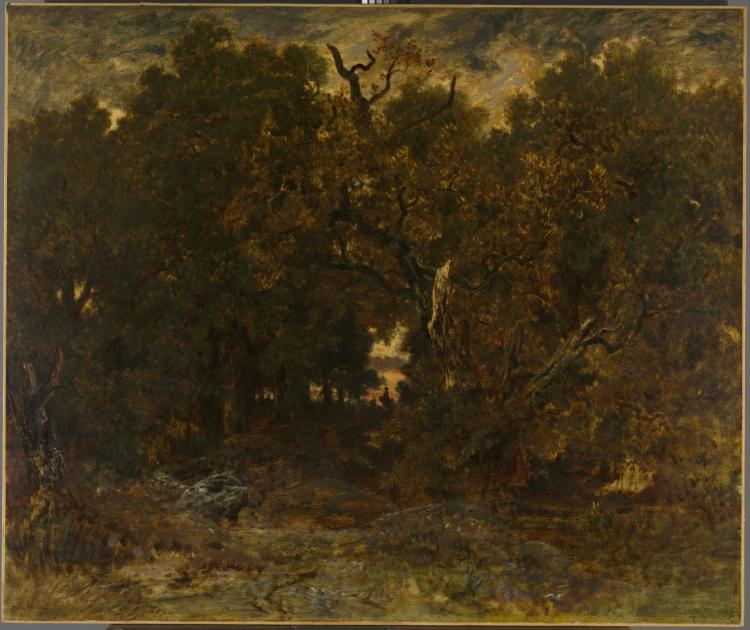
Leaving the Forest,
Théodore Rousseau · The Cleveland Museum of Art · John L. Severance Fund
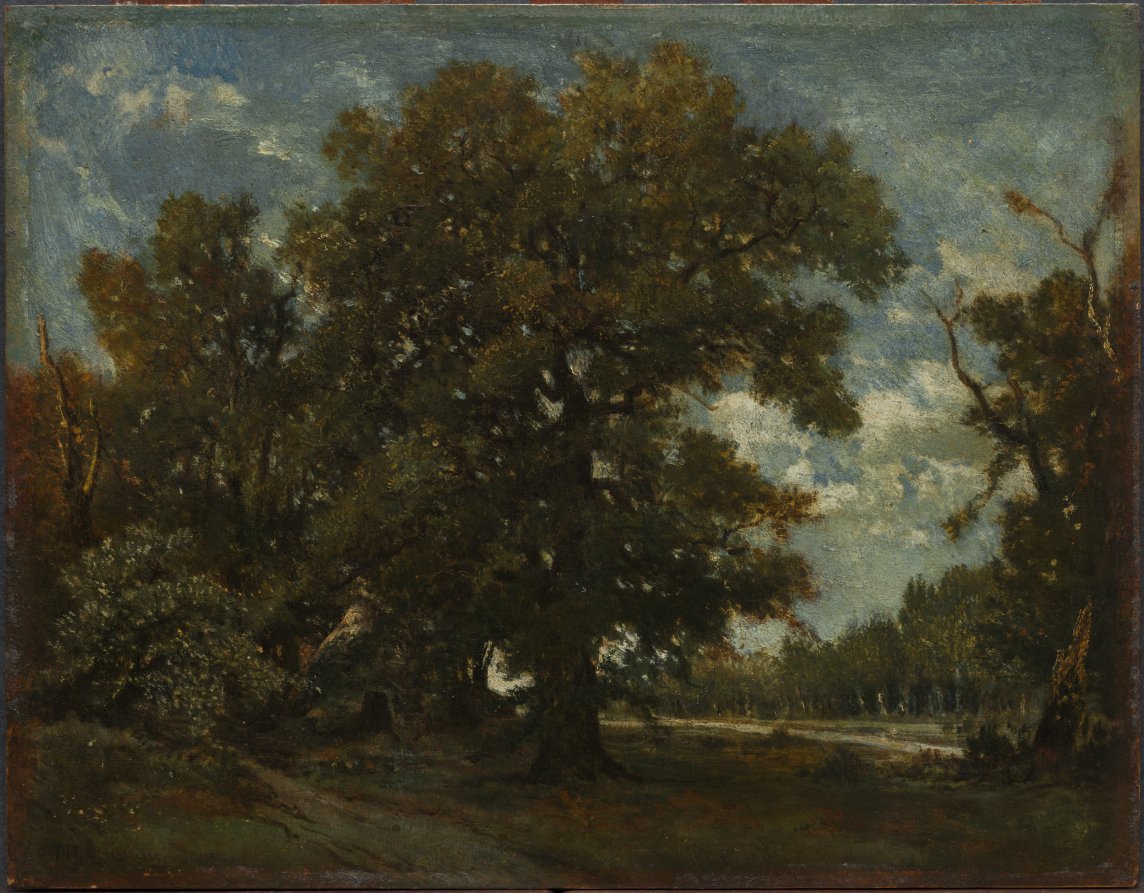
The Oak Tree, 19th century, by Théodore Rousseau
Théodore Rousseau · The Cleveland Museum of Art · Gift of Mr. and Mrs. J. H. Wade
Life and career
Dated record
Life and career
The full dated record · 2 entries
1812
Théodore Rousseau was born in 1812.
1867
Théodore Rousseau died at Barbizon.
Paintings
• Illustration — Fishing Village, 1831, oil on canvas • Illustration — Study of tree-trunks, 1833; oil on canvas, Musée des Beaux-Arts de Strasbourg • Illustration — Thunderstorm over Mont Blanc, 1834; oil-painting • Illustration — A Swamp in Les Landes, 1844, oil on panel, Walters Art Museum • Illustration — A Meadow Bordered by Trees, c. 1845; oil on panel, Metropolitan Museum of Art • Illustration — Thunderstorms mood in the level of Montmartre, 1845-1848, color on panel, Musée d'Orsay • Illustration — View of the Plain of Montmartre, c. 1848, oil on panel, Thyssen-Bornemisza Museum • Illustration — The Forest of Fontainebleau: Morning, c 1850, oil on canvas, Wallace Collection, London • Illustration — Charcoal hut in the forest of Fontainebleau, c. 1855, oil on canvas, Thyssen-Bornemisza Museum • Illustration — Study of an Oak Tree, c. 1857-1867, drawing in black and white chalk on paper, Museum of Fine Arts, Houston • Illustration — The Great Oaks of Old Bas-Bréau, 1864, oil on canvas, Museum of Fine Arts, Houston
Recognition and collections
Where the work is held
Recognition and collections
Théodore Rousseau received Knight of the Legion of Honour and Officer of the Legion of Honour.
Documents and archives
Primary material
Documents and archives
authority file
- Gemeinsame Normdatei 1068044527, Exhibition The Untamed Landscape. Théodore Rousseau and the Path to Barbizon (2014-2015 : New York, NY).
Unverified · Deutsche Nationalbibliothek
authority record
- Wikidata, structured authority record Q310025: Théodore Rousseau
Unverified · Wikidata
reference work
- “Théodore Rousseau”, English Wikipedia, consulted as further reading
Reputable secondary · Wikipedia
Literature
Literature
19701, 1850-03-02, ROUSSEAU (Théodore), Art Sales Catalogues Online.
Rousseau, Théodore or Étienne Pierre Théodore, Benezit Dictionary of Artists, 2011
Rousseau, Théodore Auguste, Benezit Dictionary of Artists, 2011
Théodore Rousseau: La Voix de la forêt (Théodore Rousseau: The Voice of the Forest), Nineteenth-Century Art Worldwide, 2024
La forêt comme « tremplin pour s’élever plus haut »: composition et représentation de la forêt de Fontainebleau entre réel et imaginaire chez Théodore Rousseau et Gustave Flaubert, Voix Plurielles, 2019
Notes from the source article
Cited by Wikipedia
Notes from the source article
These works are cited by the source article, in its own numbering. They are recorded as its citations, not as sources VALÉORINE has verified.
Bibliography printed in the source article · 1
References
Citations
References
Each reference names the institution holding it, so a reader may go to the document itself.
authority file
Gemeinsame Normdatei 1068044527, Exhibition The Untamed Landscape. Théodore Rousseau and the Path to Barbizon (2014-2015 : New York, NY).Deutsche Nationalbibliothek
Partially resolvedauthority record
Partially resolvedreference work
Partially resolved
People, houses and institutions
Knowledge graph
People, houses and institutions
Teachers, collaborators, publishers and institutions recorded against this person, each on a stated basis.
Born at
1- ParisPlace
Established from a fact already recorded on a verified source.
Further particulars
Held on the record
Further particulars
Open the remaining particulars
He trained under Jean-Charles-Joseph Rémond and Alexandre Pau de Saint-Martin. His recorded influences include John Constable, Richard Parkes Bonington and Caspar David Friedrich. Each of those relationships is stated by the authority record rather than inferred from style.
The Encyclopedia exists whether or not anything is for sale. Corrections are recorded rather than overwritten, and every version of this record is kept. Published 14 August 2026.
Elsewhere in Prints
4,138 published records in this field, each with its sources named.
- Théodore FourmoisEngraver
- Theodore Henry Adolphus FieldingEngraver
- Théodore Octave GirardetEngraver
- Théodore RichommeEngraver
- Théodore VerstraeteEngraver
- Théophile PoilpotEngraver
- Theresa ChromatiEngraver
- Theresa Maria CoriolanoEngraver
Best supported in this field
For owners
Own a work by Théodore Rousseau?
A specialist will read what you send and tell you what the house can establish, what it cannot, and whether the object is suited to sale. There is no charge and no obligation. The object stays with you throughout; nothing is shipped to us unless it is arranged in writing beforehand.