
Stefano della Bella
Stefano della Bella (18 May 1610 – 12 July 1664) was an Italian draughtsman and printmaker known for etchings of a great variety of subjects, including military and court scenes, landscapes, and lively genre scenes. He left 1052 prints, and several thousand drawings, but only one known painting. He was born and later died in Florence, Italy.
Also recorded as Etienne Della Bella · Steffani de la Bella · Stefano Della. Bella · Stephan della Bella
Stefano della Bella

Carlo Dolci · Public domain
- Name
- Stefano Della Bella
- Born
- 18 May 1610
- Birthplace
- Florence, Grand Duchy of Tuscany
- Died
- 12 July 1664 (aged 54)
- Known for
- Engraver
- Movement
- Baroque
- Nationality
- Grand Duchy of Tuscany.
- Occupation
- printmaker, painter, artist, draftsperson, etcher and copper engraver.
- Movements
- Baroque.
- Languages
- Italian.
VALÉORINE Encyclopedia
VALÉORINE documentary reading
Documentary summary
Stefano della Bella (18 May 1610 – 12 July 1664) was an Italian draughtsman and printmaker known for etchings of a great variety of subjects, including military and court scenes, landscapes, and lively genre scenes. He left 1052 prints, and several thousand drawings, but only one known painting. He was born and later died in Florence, Italy.
Admitted source layer · organised and presented by VALÉORINE
Note VALÉORINE
Stefano della Bella (1610–1664) was an artist, copper engraver and draftsperson, among other activities, a national of the Grand Duchy of Tuscany. The artist was born and died in Florence.
Stefano della Bella was a member of Accademia delle Arti del Disegno. Activity centred on engraving process, graphics and visual arts. Stefano della Bella was associated with Baroque.
Among the works are Cards of the Kings of France, Carroussel in Modena and Jeu de la géographie. Languages used include Italian. Works are held at Art Institute of Chicago, Art Museum of Estonia and Auckland Art Gallery, among others.
Composed from admitted, traceable facts · 01 October 2026
VALÉORINE
Reference Check
Propose documentary evidence for Stefano della Bella. A contribution is never written directly as fact: identity, source, rights and evidence gates still decide.
Sign in to contribute
World of VALÉORINE
Documentary connections
Only confirmed graph relationships appear here. Images are shown only when their identity and reuse rights both pass the documentary gate.
Documentary evidence
Documentary basis
Authority files
gnd · 10107166-8 · wikidata · Q921242 · wikipedia · Stefano della Bella
In this article
Biography
Biography
Livio Mehus is recorded as having studied under Stefano della Bella. The recorded working language is Italian. The field of work recorded is engraving process, visual arts and graphics. Works named in the authority record are Carroussel in Modena, Cards of the Kings of France and Jeu de la géographie. Work by Stefano della Bella is recorded in the collections of Städel Museum, Museo del Prado, Art Museum of Estonia, Art Institute of Chicago and The Nelson-Atkins Museum of Art.
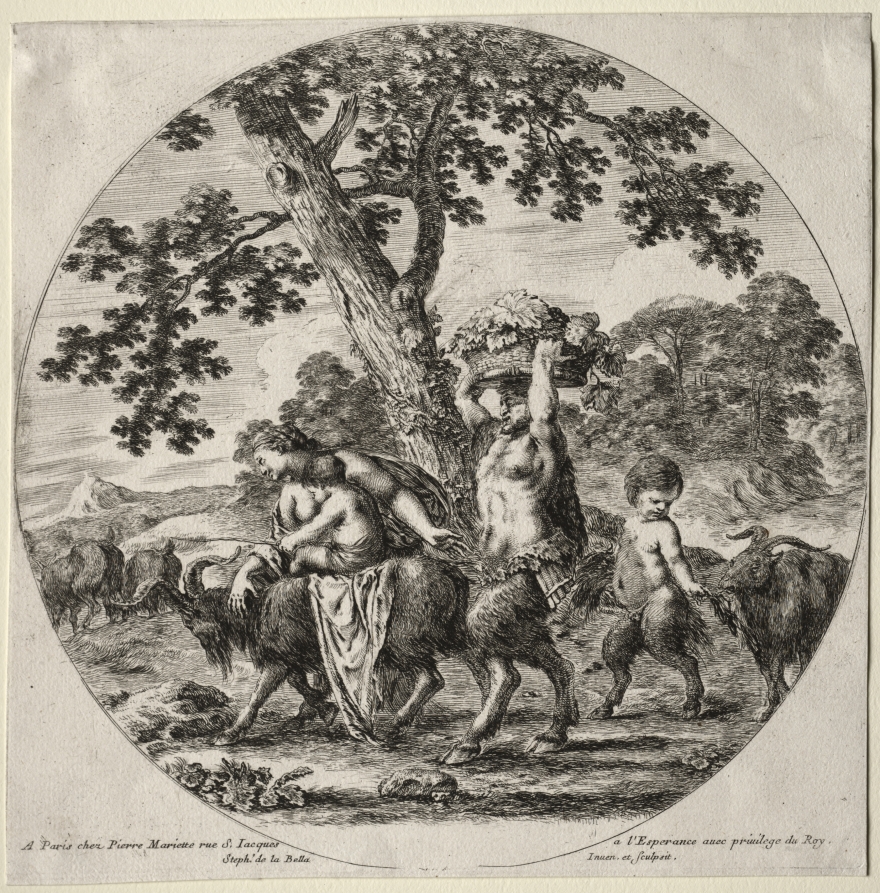
A Satyr Family Traveling, c. 1657, by Stefano della Bella
Stefano Della Bella · The Cleveland Museum of Art · Gift of George P. Bickford
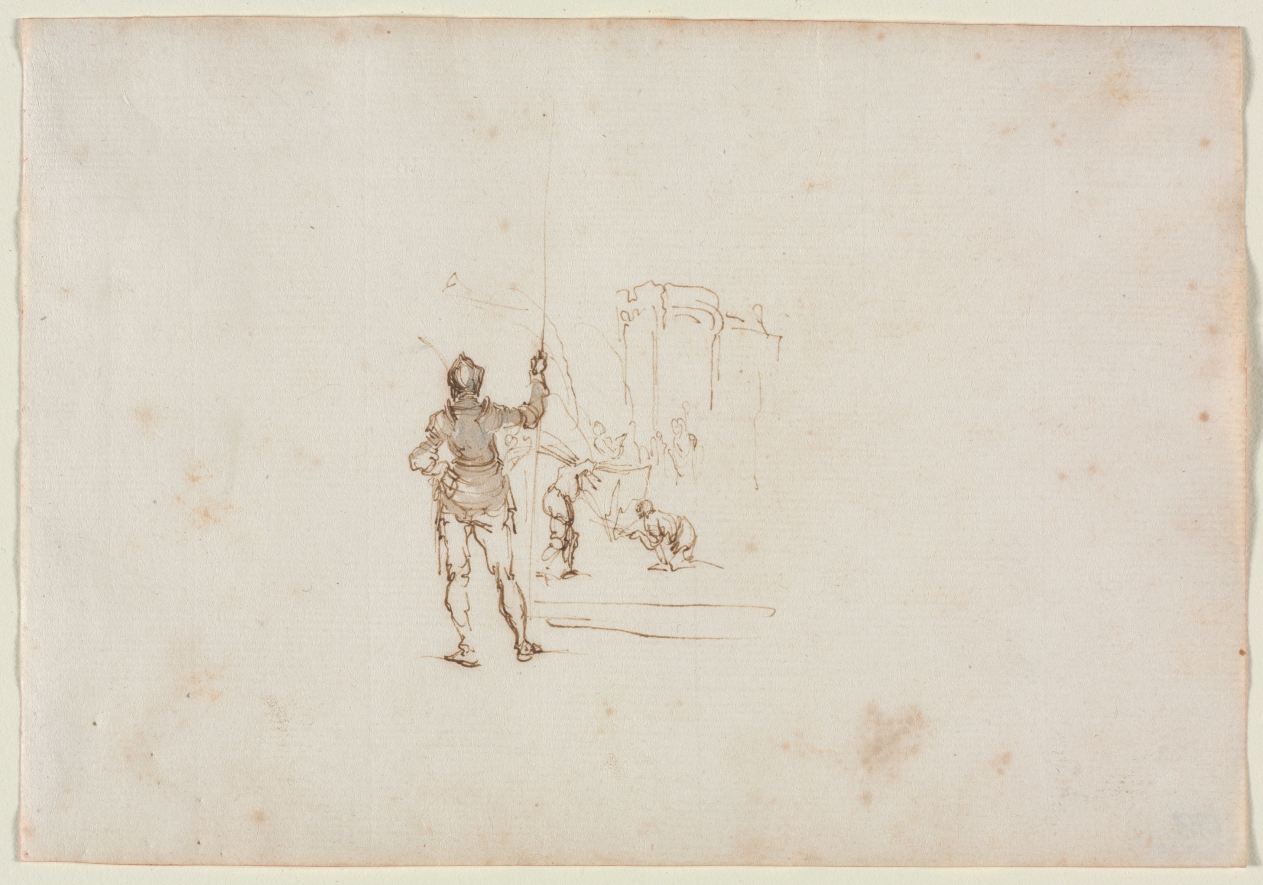
Detail of Martyrdom of Saint John the Evangelist, after Callot, after 1634?, by Stefano della Bella
Stefano Della Bella · The Cleveland Museum of Art · James Parmelee Fund
Key facts
Key facts
• Name — Stefano Della Bella • Born — 18 May 1610 • Birthplace — Florence, Grand Duchy of Tuscany • Died — 12 July 1664 (aged 54) • Place of death — Florence, Grand Duchy of Tuscany • Known for — Engraver • Movement — Baroque
Early life in Florence
Early life in Florence
Della Bella was born at Florence to a family of artists, and was apprenticed to a goldsmith, but became an engraver working briefly under Orazio Vanni and then Cesare Dandini. He studied etching under Remigio Cantagallina, who had also been the instructor of Jacques Callot. Della Bella's early prints are very similar to those of Callot. When he was seventeen years of age, he presented an etching depicting a banquet in the Palazzo Pitti to the young Giancarlo de' Medici following which della Bella would receive official commissions by the Medici family. In 1630, at the age of twenty, he produced a manuscript copy from one of the many manuscript versions of Leonardo da Vinci's Trattato della Pittura. He illustrated his copy with about 50 sketches. Della Bella's copy was published in 1792 with "accurate engravings of all of his sketches." By 1632 or 1633 he was the recipient of direct patronage from Lorenzo de' Medici (brother to Cosimo II and uncle to Giancarlo de' Medici). At this time Della Bella requested from his patron permission to go to Rome "to perfect himself as an artist."
Work in Rome
Work in Rome
Having arrived in Rome in 1633, della Bella lived and studied there for six years. He resided in the Medici Palace, producing vedute and drawings of antiquities as well as crowded images of public occasions in a series of sketchbooks. Many of these images were later turned into prints. He also recorded and assisted the court festivities of the Medici. In this period della Bella's style developed from Mannerist to Baroque. Della Bella created a series of six prints forming a long, 2.5-meter panel, showing the Polish Ambassador’s Ceremonial Entry into Rome in 1633. He also created a number of prints of views of Rome. While living in Rome, he often returned to Florence working on commissions for his clients there. • Illustration — Entry of the Polish Ambassador to Rome, 1633 • Illustration — Polish horseman etching
Paris and the return to Florence
Paris and the return to Florence
In 1639, della Bella went to Paris and lived there until 1650. He adapted his style to French tastes, and was influenced by Rembrandt and other Dutch print makers. Della Bella made trips to Holland and North Africa. The majority of della Bella's prints date from the years in Paris; he had arrived four years after the death of Callot, and was already known to important French publishers. In 1641 Cardinal Richelieu sent him to Arras to make drawings for prints of the siege and taking of that town by the royal army, and in 1644 Cardinal Mazarin commissioned four sets of educational playing cards for the young Louis XIV. His ornament prints were very innovative, seeming to look forward to the Rococo. Della Bella also engraved views of Paris, including a very large print of the Pont Neuf, looking south from the entrance of the Place Dauphine, with topographically accurate depictions of the buildings south of the bridge on the banks of the Seine, such as the Church of Saint-Germain l'Auxerrois, the Petit Bourbon and the Louvre Palace on the right bank and the Hôtel de Nevers, the Tour de Nesle, and in the distance, the Abbey of Saint-Germain-des-Prés, on the left. The road over the bridge and in front of the central platform with the statue of Henri IV is crowded with carriages, wagons, people, and animals. Among the 451 distinct figures are beggars, gypsies, hurdy-gurdy players, children and tooth-pullers, with horses, donkeys, dogs, and even a lamb. • Illustration — View of the Pont Neuf, 1646 • Illustration — Detail with figures French anti-Italian feeling during the Fronde, and the death of Mazarin probably forced della Bella's return to Florence, where he obtained a pension from the grand duke, whose son, Cosimo III de' Medici, he instructed in drawing. He continued to send plates to Paris publishers. Della Bella is known to have illustrated some discoveries for Galileo, and depicted Hansken the famous elephant, when dead. In his final years he produced a number of prints experimenting with tonal effects, though these were little known at the time; he had long made much use of wash in his drawings, and was now attempting with considerable success to achieve similar effects in etching, though only a few good impressions could be taken from the plate. In 1661 he appears to have suffered a stroke, after which he produced little work. Antonio Francesco Lucini was one of his pupils in Florence.
Life and career
Dated record
Life and career
The full dated record · 2 entries
1610
Stefano della Bella born at Florence.
1664
Stefano della Bella died at Florence.
Primary material
Documents and archives
reference work
- Wikidata, structured authority record Q921242: Stefano della Bella
Reputable secondary · Wikimedia Foundation
- “Stefano della Bella”, English Wikipedia, consulted as further reading
Reputable secondary · Wikipedia
authority file
- Gemeinsame Normdatei 10107166-8, Ausstellung Stefano della Bella. Ein Meister der Barockradierung (2005 : Karlsruhe).
General reference · Deutsche Nationalbibliothek
Notes from the source article
Cited by Wikipedia
Notes from the source article
These works are cited by the source article, in its own numbering. They are recorded as its citations, not as sources VALÉORINE has verified.
- 1.RKD; Massar 1996; De Vesme 1906, p. 68, states he was baptised on 18 March and born the same day.
- 2.Reed 1989, 234; Massar 1996.
- 3.Chishholm 1911.
- 4.Massar 1996.
- 5.Massar 1968, p. 160.
- 6.Massar 1971, p. 4.
- 7.Massar 1971, p. 5.
- 8.Massar 1996; Reed 1989, pp. 234–236.
- 9.Reed 1989, p. 234.
- 10.Reed 1989, p. 242; Massar 1996.
Bibliography printed in the source article · 6
- 7. 965.
- De Vesme, Alexandre (1906). "Étienne Della Bella", pp. 66–79 and "Oeuvre d'Étienne Della Bella", pp. 79–332", in Le Peintre-Graveur italien (at Internet Archive). Milan: Ulrico Hoepli.
- Massar, Phyllis Dearborn (1968). "Presenting Stefano della Bella." The Metropolitan Museum of Art Bulletin, vol. 27 (New Series), no. 3 (November, 1968), pp. 159–176. . .
- Massar, Phyllis D. (1971). Stefano Della Bella, Catalogue Raisonné. Alexandre De Vesme with Introduction and Additions by Phyllis Dearborn Massar. New York: Collectors Editions.
- Massar, Phyllis D. (1996). "Bella, Stefano della", vol. 3, pp. 631–634, in The Dictionary of Art (34 vols.), edited by Jane Turner. New York: Grove. . Also at Oxford Art Online, subscription required (accessed 22 November 2010).
- Reed, Sue Welsh & Wallace, Richard, editors (1989). Italian Etchers of the Renaissance and Baroque, Museum of Fine Arts, Boston. or 304-4 (pb)
References
Citations
References
Each reference names the institution holding it, so a reader may go to the document itself.
authority file
Gemeinsame Normdatei 10107166-8, Ausstellung Stefano della Bella. Ein Meister der Barockradierung (2005 : Karlsruhe).Deutsche Nationalbibliothek
Secondary witnessreference work
Wikidata, structured authority record Q921242: Stefano della BellaWikimedia Foundation
Secondary witnessreference work
Secondary witness
Further particulars
Held on the record
Further particulars
Open the remaining particulars
The authorities additionally record the headings Etienne Della Bella, Steffani de la Bella, Stefano Della. His recorded language was Italian. Formation and teaching. Each of those relationships is stated by the authority record rather than inferred from style. Bella worked in engraving process, visual arts and graphics. His work is associated with Baroque. He belonged to Accademia delle Arti del Disegno. Recorded as printmaker, painter, artist, draftsperson and etcher.
Identity and origins
Bella, Stephan della Bella and Etienne De La Belle Della
Career and activity
Recognition and collections
Work by Stefano della Bella is
Städel Museum, Museo del Prado, Art Museum of Estonia and Art Institute of Chicago
The Encyclopedia exists whether or not anything is for sale. Corrections are recorded rather than overwritten, and every version of this record is kept. Published 14 August 2026.
Elsewhere in Paintings
19,261 published records in this field, each with its sources named.
- Stefano CernottoArtist
- Stefano d'Antonio di VanniArtist
- Stefano da VeronaArtist
- Stefano Dall' ArzereArtist
- Stefano di FrancescoArtist
- Stefano ErardiArtist
- Stefano FiorentinoArtist
- Stefano FolchettiArtist
Best supported in this field
For owners
Own a work by Stefano della Bella?
A specialist will read what you send and tell you what the house can establish, what it cannot, and whether the object is suited to sale. There is no charge and no obligation. The object stays with you throughout; nothing is shipped to us unless it is arranged in writing beforehand.