
Spanish Forger
Illustration — Forgery attributed to the Spanish Forger: Visitation scene, Metropolitan Museum of Art, New York • Illustration — Boating party setting forth from a castle, 1890-1910, miniature attributed to the 'Spanish Forger' • Illustration — Miniature attributed to the Spanish Forger The Spanish Forger (Le Faussaire espagnol) is the name given to an unidentified individual who, in the late 19th and early 20th centuries, created a large number of forgeries of medieval miniatures.
Spanish Forger
Derived from original commons upload at which is now in the history version: 01:39, 13. 8. 2005 Colour-graded to reveal more detail using GIMP software "curves" tool · Public domain
- Occupation
- illuminator · art forger · painter · illustrator
VALÉORINE Encyclopedia
VALÉORINE documentary reading
Documentary summary
Illustration — Forgery attributed to the Spanish Forger: Visitation scene, Metropolitan Museum of Art, New York • Illustration — Boating party setting forth from a castle, 1890-1910, miniature attributed to the 'Spanish Forger' • Illustration — Miniature attributed to the Spanish Forger The Spanish Forger (Le Faussaire espagnol) is the name given to an unidentified individual who, in the late 19th and early 20th centuries, created a large number of forgeries of medieval miniatures.
Admitted source layer · organised and presented by VALÉORINE
Note VALÉORINE
Spanish Forger was an art forger, illuminator and illustrator, among other activities. The art forger worked in France. Works by Spanish Forger are held at Metropolitan Museum of Art.
Composed from admitted, traceable facts · 28 September 2026
VALÉORINE
Reference Check
Propose documentary evidence for Spanish Forger. A contribution is never written directly as fact: identity, source, rights and evidence gates still decide.
Sign in to contribute
Documentary evidence
Documentary basis
Authority files
wikidata · Q3222703 · wikipedia · Spanish Forger
In this article
Nationality
Nationality
As recently as 1930, the Forger was believed to be of Spanish origin. This is because one of their first identified forgeries was attributed as a genuine work by Jorge Inglés, a Spanish artist who was active during the 15th century. However, when one considers the provenance of the Forger's pieces along with many of the medieval collectible miniatures of the period, Paris was the center of purchasing, selling, and forging. A number of their forged miniatures have been identified as copied, with modifications, from those published in several French books dating to the 1870s−1880s.
Identification
Identification
The work of the Spanish Forger was first identified by Belle da Costa Greene who worked at the Pierpont Morgan Library. She was also the one who dubbed the artist 'the Spanish Forger'. Their works were very deceptive when created, but over time it has been recognized that the faces of individuals in their pictures have "sugary expressions" inconsistent with genuine medieval illuminations. Some of their miniatures have also been identified as forgeries because they are of secular scenes that would not have appeared in genuine medieval religious texts. Additionally, many of the individuals in the Spanish Forger's miniatures have a tilt to their heads that would not be present in authentic medieval works. In the "Knights of the Crusade" miniature, the bearded knight at the gate and the maiden in the bottom embellishment exhibit the classic head tilt. The facial expressions on most of the subjects in their miniatures are sweet and cloying, not pious and pensive as with true works. In legitimate medieval works, gold leaf was added first so that the paints would not be obscured by it. However, the Spanish Forger used gold leaf as a final touch, obscuring their paints and giving a lustrous appearance to their forgeries. Up to a certain point, most of the Spanish Forger's miniatures had been identified by their unique stylistic characteristics. In 2009, Lucia Burgio, Robin Clark, and Richard Hark performed spectroscopic investigation, i.e. comprehensive analysis of pigments by Raman spectroscopy and X-ray fluorescence, upon five of the Spanish Forger's miniatures in order to determine with scientific certainty that the forgeries were exactly that. Use of the pigments ultramarine blue (first synthesized after 1828) and Scheele's green (synthesized after 1775) was discovered, providing solid evidence that the Forger's imitations were fabricated in post-medieval times.
Technique and materials
The Spanish Forger's works were painted on vellum or parchment leaves of genuine medieval books, using either blank margins or scraping off the original writing. They also "completed" unfinished miniatures or added missing miniatures in medieval choir books. Their works fooled many experts and collectors at the time and appear today in the collections of many museums and libraries. More than 200 forgeries have been identified.
Exhibitions and collections
Exhibitions and collections
The Spanish Forger's works were the subject of an exhibition at the Morgan Library in New York City in 1978, for which an extensive catalog was published. Their works are now themselves collected as forgeries, selling for several thousand dollars each. They created more than 194 imitations that have been identified, which were purchased by multiple collectors of medieval art around the end of the 19th century and the beginning of the 20th century. In January 2009, it was announced that the Victoria and Albert Museum purposely acquired five examples of the Spanish Forger's work for their collection "for what it tells us about late 19th-century perceptions". The museum took the works in lieu of £20,000 ($US 30,000) of inheritance tax, equivalent to a value per work of about $6,000. Another of the artist's paintings appeared on an episode of the US TV series Antiques Roadshow in 2014, being valued at around $4,000.

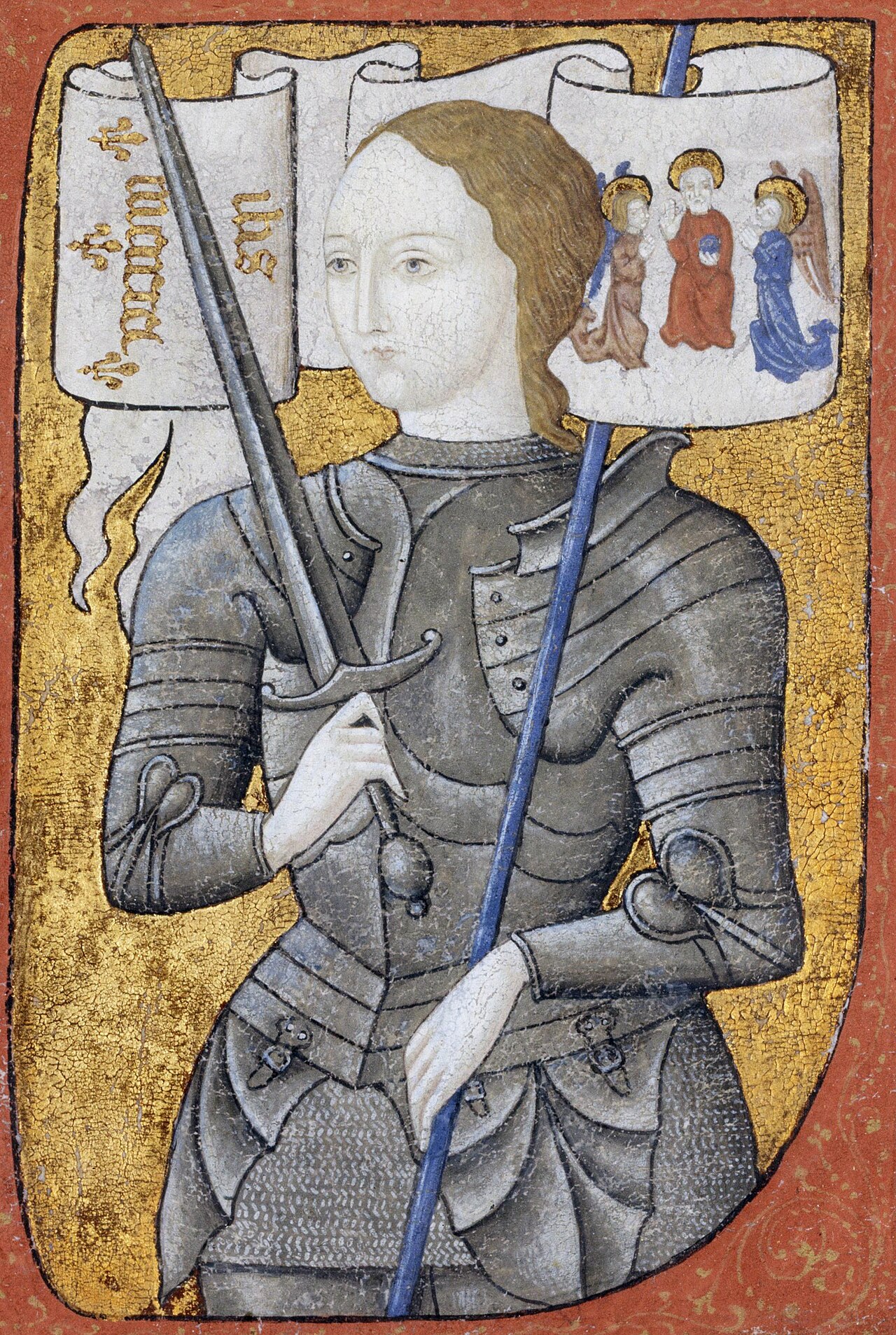
Spanish Forger, Joan of Arc miniature (cropped)
http: nevsepic.com.ua/uploads/posts/2012-04/thumbs/1335688016-1872170-1429-1431-jeanne-darc-en-armure-tenant-son-gtendard-miniature-du-xvgyo.jpg

Joan of Arc depicted in an historiated initial. Miniature probably produced in the late 19th century by an anonymous artist, possibly the painter and collector Georges Spetz or the "Spanish Forger" - French National Archives, AE-II-2490.
This file was provided to Wikimedia Commons by the Archives Nationales as part of a cooperation project with Wikimédia France.
Documents and archives
Primary material
Documents and archives
reference work
- “Spanish Forger”, English Wikipedia, consulted as further reading
Reputable secondary · Wikipedia
authority record
- Wikidata, structured authority record Q3222703: Spanish Forger
General reference · Wikidata
Notes from the source article
Cited by Wikipedia
Notes from the source article
These works are cited by the source article, in its own numbering. They are recorded as its citations, not as sources VALÉORINE has verified.
- 1.William Voelkle, assisted by Roger S. Wieck, The Spanish Forger, New York, Pierpont Morgan Library, 1978 (containing a catalog of known forgeries, with many images).
- 2.Brbl-net.library.yale.edu. Spanish Forger miniatures in book at Yale.
- 3.Auction results: 227 forgeries have been found.
- 4.Wieck, William Voelkle; assisted by Roger S. The Spanish forger. Pierpont Morgan Library. 1978. 978-0875980652.
- 5.Manuscript Studies: Bibliography (Forgeries / bibliographic fraud).
- 6.Backhouse, Janet. The 'Spanish Forger'. British Museum Quarterly. 33. 1/2. 68-->. Autumn 1968. 10.2307/4423017.
- 7.Kurz, Otto. Fakes, New York, 1948, p. 90.
- 8.Library.upenn.edu. Penn Special Collections-Schoenberg Exhibit Arts of the Page. 2012-08-02.
- 9.Burgio, Lucia. Spectroscopic investigation of modern pigments on purportedly medieval miniatures by the 'Spanish Forger'. Journal of Raman Spectroscopy. 40. 12. 2031–2036. July 17, 2009. 10.1002/jrs.2364.
- 10.Willam Voelkle, supra.
- 11.Sale 103 results. 2006-02-08.
- 12.US. August 2021.
- 13.PBS. Spanish Forger Painting | Antiques Roadshow. 2001-08-18.
Bibliography printed in the source article · 1
- "The Spanish Forger: Master of Manuscript Chicanery" in Thomas Coomans & Jan De Maeyer, eds., The Revival of Medieval Illumination: Nineteenth-Century Belgium Manuscripts and Illuminations from a European Perspective (Leuven, 2007), pp. 207–227. Catalog raisonné of works of the Spanish Forger.
References
Citations
References
Each reference names the institution holding it, so a reader may go to the document itself.
reference work
Secondary witnessauthority record
General reference
The Encyclopedia exists whether or not anything is for sale. Corrections are recorded rather than overwritten, and every version of this record is kept. Published 17 August 2026.
Elsewhere in Illustration
5,224 published records in this field, each with its sources named.
- Sophie BlackallIllustrator
- Sophie JodoinIllustrator
- Sophie Taeuber-ArpIllustrator
- Soraya SagaIllustrator
- Staffan UllströmIllustrator
- Standing BearIllustrator
- Stanislas-André SteemanIllustrator
- Stanislav HolýIllustrator
Best supported in this field
For owners
Own a work by Spanish Forger?
A specialist will read what you send and tell you what the house can establish, what it cannot, and whether the object is suited to sale. There is no charge and no obligation. The object stays with you throughout; nothing is shipped to us unless it is arranged in writing beforehand.