
Sofia University
Also recorded as University of Sofia · BFUS · St. Kliment Ohridski · Sofiyski universitet
Sofia University
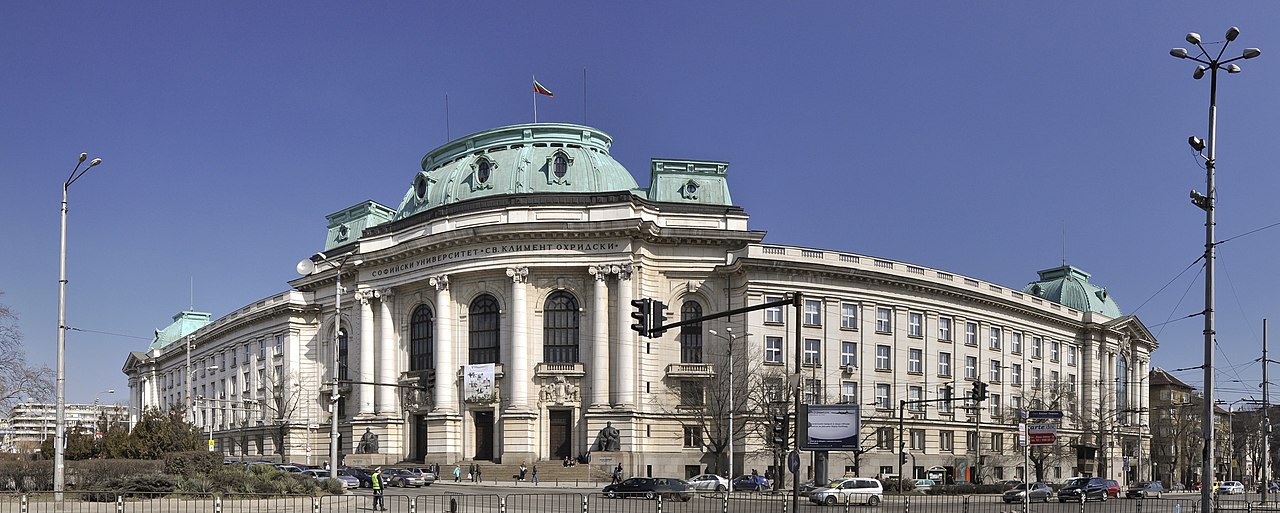
MrPanyGoff · Plamen Agov • studiolemontree.com · CC BY-SA 3.0
- Name
- Sofia University
- Founded
- 1888
- Founder
- 1st Grand National Assembly of Bulgaria
- Headquarters
- Sofia
Reference Check
Propose documentary evidence for Sofia University. A contribution is never written directly as fact: identity, source, rights and evidence gates still decide.
Sign in to contribute
World of VALÉORINE
Documentary connections
Only confirmed graph relationships appear here. Images are shown only when their identity and reuse rights both pass the documentary gate.
Educated At · incoming
Aleksandar Vutimski
Author

Educated At · incoming
Assen Razcvetnikov
Author
This file was provided to Wikimedia Commons by the Bulgarian Archives State Agency as part of a cooperation project . The Bulgarian Archives State Agency provides images, which are public domain . For
Educated At · incoming
Blaga Dimitrova
Author

Educated At · incoming
Blaže Koneski
Author
Own work

Educated At · incoming
Borislav Slavov
Person
Own work
Located In · outgoing
Bulgaria
Place

Educated At · incoming
Dimcho Debelyanov
Author
Book "180 years from the birth of Georgi Mashev"

Educated At · incoming
Dora Gabe
Author
Own work

Educated At · incoming
Edvin Sugarev
Author
Own work
Educated At · incoming
Emel Emin
Author

Educated At · incoming
Georgi Gospodinov
Author
Own work

Educated At · incoming
Georgi Karaslavov
Author
This file was provided to Wikimedia Commons by the Bulgarian Archives State Agency as part of a cooperation project . The Bulgarian Archives State Agency provides images, which are public domain . For

Educated At · incoming
Georgi Stamatov
Author
личен архив
Educated At · incoming
Gergina Dvoretzka
Author

Educated At · incoming
Iana Boukova
Author
Own work

Educated At · incoming
Ilian Djevelekov
Person
email
Documentary evidence
Documentary basis
Authority files
wikidata · Q841581 · wikipedia · Sofia University
In this article
Overview
Overview
Recorded constituent parts are Faculty of History of the Sofia University, Faculty of Chemistry and Pharmacy, Sofia University, Faculty of Classic and Modern Philologies, Sofia University and Faculty of Mathematics and Informatics, Sofia University. It is associated with Bulgaria. The record gives 1888 as its date of establishment or first appearance. Its recorded founders are 1st Grand National Assembly of Bulgaria. Its recorded seat is Sofia.
Key facts
Key facts
• Name — Sofia University • Native Name — Софийски университет • Former Names — Higher Pedagogical Course • Motto — Ipsa scientia potestas est • Motto Lang — la • Motto Eng — Knowledge itself is power • Type — Public • Established — 1888 10 01 • Affiliations — EUA • Endowment — $125 million • Rector — Georgi Valchev • Academic Staff — 1,700 • Students — 21,000 (2023) • Address — 15 Tsar Osvoboditel Boulevard • City — Sofia • Country — Bulgaria • Campus Type — Urban • Language — Bulgarian • Colors — Purple • Website — uni-sofia.bg
Key facts
Key facts
• The W — > 800 • The W Year — 2020 • Qs Eeca — 44 • Qs Eeca Year — 2022 • Qs W — 731-740 • Qs W Year — 2026 Sofia University "St. Kliment Ohridski" is a public research university in Sofia, Bulgaria. It is the oldest institution of higher education in Bulgaria. Founded on 1 October 1888, the edifice of the university was constructed between 1924 and 1934 with the financial support of the brothers Evlogi Georgiev and Hristo Georgiev (whose sculptures are now featured on its façade) and has an area of 18,624 m 2 and a total of 324 premises. The university has 16 faculties and three departments, where over 21,000 students receive their education. The current rector is Georgi Valchev.
History
History
• Illustration — University students in the 1930s The university was founded on 1 October 1888—ten years after the liberation of Bulgaria—to serve as Bulgaria's primary institution of higher education. The university's first iteration was as a year-long "Higher Pedagogical Course" extending the curriculum of an already existing secondary school in Sofia. The course's founders "consciously built the foundations of an institution of higher learning" within their curriculum, drawing upon the subject matter of Austrian and German Universities from which four of them had received their doctorates. Subsisting of seven initial lecturers and forty-three students, the Higher Pedagogical Course aimed to educate elementary school teachers at the Gymnasium to fill national gaps among civil servants in "education and scholarship." With aid from provisional statutes provided by founder Ivan Shishmanov in January 1889, the initial Higher Pedagogical Course was legally extended into a multi-departmental "Higher School" with three-year study tracks before the end of its first year. As the demand for educators was met, Sofia's Higher School and its staff continued to organize, expand, and refine their efforts across disciplines. And though it would take 15 years for its fully-actualized "vision" to come to fruition, according to historian Marin Pundeff (Bulgarian: Марин Пундев), by the mid 1890's the Higher School was a respected national hub for scholarship with all "the functions and earmarks of a university." Shishmanov became Minister of Education in 1903, and by 1904 he passed a law through the National Assembly which expanded the Higher School's now four-year magistrate program into an officially instituted university. Sofia University's first rector was Bulgarian linguist Aleksandar Teodorov-Balan. During its first years, Sofia University had three faculties, namely a Faculty of History and Philology (since 1888), a Faculty of Mathematics and Physics (since 1889) and a Faculty of Law (since 1892). History, geography, Slavic philology, philosophy and pedagogics, mathematics and physics, chemistry, natural sciences and law were also taught. The first women (16 in number) were welcomed to the university in 1901 and 25 November (8 December N.S.), the day of St. Kliment of Ohrid, became the university's official holiday the following year. As Prince Ferdinand opened the National Theatre in 1907, he was booed by Sofia University students, for which the university was closed for six months and all lecturers were fired. Not until a new government with Aleksandar Malinov at the head came into power in January 1908 was the crisis resolved. At the beginning of the Balkan Wars, 1,379 students (725 men and 654 women) were recorded to attend the university. A fourth faculty was established in 1917, the Faculty of Medicine, the fifth, the Faculty of Agronomy following in 1921, the Faculty of Veterinary Medicine and the Faculty of Theology being founded in 1923. In 1922–1923, Sofia University had 111 chairs, 205 lecturers and assistants and 2,388 students, of which 1,702 men and 686 women. The foundation stone of Sofia University's new edifice was laid on 30 June 1924. Funds were secured by the brothers Evlogi Georgiev and Hristo Georgiev. The rectorate was built according to the initial plans of the French architect Henri Bréançon, who had won a competition for the purpose in 1907. The plans were developed by Nikola Lazarov and revised by Yordan Milanov, who also directed the construction, but died before the official opening on 16 December 1934. On 27 October 1929, the first doctoral thesis in natural science of the university was defended by geologist Vassil Tzankov. The second one in chemistry followed on 1 July 1930 and the title doctor was granted to Aleksandar Spasov. In 1930–1931, the university had four more doctors. After the political changes of 9 September 1944 and the emergence of the People's Republic of Bulgaria, radical alterations were made in the university system of the country. At that time in 1944–1945, 13,627 students attended the university, taught by 182 professors and readers and 286 assistants. Communist professors were introduced to the higher ranks of university authority, with others that did not share these views being removed. Specific party-related chairs were established and the university was restricted after the Soviet model. Three new faculties were founded in 1947, one of forestry, one of zootechnics and one of economics and major changes occurred, with many departments seceding in later years to form separate institutions. In 2001, the Sofia University was the first Bulgarian Athenaeum to open a Theological Faculty ruled by the national Orthodox Church after the fall of communism. Sofia University Mountains on Alexander Island, Antarctica were named for the university in commemoration of its centennial celebrated in 1988 and in appreciation of the university's contribution to the Antarctic exploration.
Astronomy Observatory
Astronomy Observatory
• Illustration — Astronomical Observatory of Sofia University Astronomical Observatory of Sofia University "St. Kliment Ohridski" is the first astronomical observatory in Bulgaria and one of the first on the Balkan Peninsula. The Observatory is also the first building constructed for the needs of Sofia University. It was established in 1897 at the initiative of Prof. Marin Bachevarov. It is located in Borisova Gradina, near the "Maria Luisa" swimming pool. The primary purpose of the astronomical observatory is educational, serving the Department of Astronomy of the Faculty of Physics of Sofia University.
Faculties
Faculties
• Illustration — Sofia University's main building • Illustration — Aula of Sofia University in the Rectorate, the university main building • Illustration — Faculty of Biology • Illustration — Faculty of Chemistry and Pharmacy Sofia University offers a wide range of degrees in 16 faculties: • Faculty of Biology • Faculty of Chemistry and Pharmacy • Faculty of Classical and Modern Philology • Faculty of Economics and Business Administration • Faculty of Education • Faculty of Geology and Geography • Faculty of History • Faculty of Journalism and Mass Communication • Faculty of Law • Faculty of Mathematics and Informatics • Faculty of Philosophy • Faculty of Physics • Faculty of Pre-school and Primary School Education • Faculty of Slavic Studies • Faculty of Theology • Faculty of Medicine
Departments
Departments
• Department of Language Learning • Department for Information and In-service Training of Teachers • Sports Department
Affiliated bodies
Affiliated bodies
• Balkan Universities Network • National Centre of Polar Research
Notable alumni
Notable alumni
• Bulgaria Elisaveta Bagryana, poet • United Kingdom Anthony Bailey, businessman • Bulgaria Pepka Boyadjieva, sociologist • Bulgaria Kiril Bratanov, scientist • Colombia Iván Cepeda, politician and senator of Colombia • Bulgaria Ljubomir Chakaloff, mathematician • Bulgaria/Italia Boris Christoff, opera singer • Belgium Raymond Detrez, historian • Bulgaria Philip Dimitrov, politician and lawyer, former Prime Minister of Bulgaria and member of the Constitutional Court of Bulgaria • Bulgaria Todor Georgiev, scientist and inventor • Bulgaria Khristo Ivanov, scientist • Bulgaria Rostislaw Kaischew, scientist • Bulgaria Mimoza Konteva, geographer • Bulgaria Ivan Kostov, politician and economist, former Prime Minister of Bulgaria • Bulgaria/France Julia Kristeva, philosopher and writer • Bulgaria Maxim, cleric and head of the Bulgarian Orthodox Church • Bulgaria Georgi Nadjakov, physicist • Bulgaria Ivan Kostov Nikolov, geologist and mineralogist • Israel Ya'akov Nitzani, politician, Knesset member • Bulgaria Georgi Parvanov, former President of Bulgaria • Bulgaria/United States Ivan Georgiev Petrov, physicist • Bulgaria Assen Razcvetnikov, poet, writer and translator • Bulgaria Dimitar Sasselov, astronomer • Bulgaria Lachezara Stoeva, diplomat • Bulgaria Petar Stoyanov, former president of Bulgaria • Bulgaria/Germany Ivan Stranski, physical chemist • Bulgaria/France Tzvetan Todorov, philosopher • Bulgaria Orlin D. Velev, professor and scientist • Syria Mikhail Wehbe, diplomat • Iraq Rashid Yassin, journalist and poet • Bulgaria Zhelyu Zhelev, former President of Bulgaria • Bulgaria Maria Zheleva, filmmaker and former First Lady of Bulgaria • Bulgaria Lyudmila Zhivkova, politician • Bulgaria Iliana Iotova, current President of Bulgaria
Europe
Europe
Humboldt-Universität Berlin, Technische Universität Dresden, Université de Genève, Université libre de Bruxelles and others.
Institutional history
Dated record
Institutional history
The full dated record · 2 entries
1888
Sofia University established.
1888
Sofia University is recorded from 1888.
Knowledge graph
People and holdings
Those recorded as working within this institution, and the records it holds or is connected with.
Studied at
8- Blaga DimitrovaAuthor
Established from a fact already recorded on a verified source.
- Blaže KoneskiAuthor
Established from a fact already recorded on a verified source.
- Dimcho DebelyanovAuthor
Established from a fact already recorded on a verified source.
- Dora GabeAuthor
Established from a fact already recorded on a verified source.
- Georgi KaraslavovAuthor
Established from a fact already recorded on a verified source.
- Iana BoukovaAuthor
Established from a fact already recorded on a verified source.
Notes from the source article
Cited by Wikipedia
Notes from the source article
These works are cited by the source article, in its own numbering. They are recorded as its citations, not as sources VALÉORINE has verified.
- 1.THE Education Ltd. World University Rankings 2020.
- 2.QS World University Rankings-Emerging Europe & Central Asia.
- 3.QS World University Rankings.
- 4.Pundeff, Marin. he University of Sofia at Eighty. Slavic Review. 27. 3. 438-446. September 1968. 10.2307/2493343.
- 5.Bourchier, James David. 779: Education.
- 6.Merdjanova, Ina. Uneasy Tolerance: Interreligious Relations in Bulgaria after the Fall of Communism. Occasional Papers on Religion in Eastern Europe. 3. December 1, 2006. 1069-4781.
- 7.Kadiyska, Tanya. Encyclopedia Sofia. Trud Publishing House. 94. 2017. 978-954-8104-36-4.
- 8.Sofia University. The Observatory of Sofia University "St. Kliment Ohridski" is one of the first in the Balkans. 17 September 2013.
- 9.Sofia University. Astronomical Observatory.
References
Citations
References
Each reference names the institution holding it, so a reader may go to the document itself.
reference work
Secondary witnessreference work
Secondary witness
Further particulars
Held on the record
Further particulars
Open the remaining particulars
It is classified as public university and open-access publisher. It comprises Faculty of History of the Sofia University, Faculty of Chemistry and Pharmacy, Sofia University, Faculty of Classic and Modern Philologies, Sofia University, Faculty of Mathematics and Informatics, Sofia University, Faculty of Slavic Studies of Sofia University and Faculty of Law of Sofia University.
Sofia University is connected to 34 other published records in the VALÉORINE Encyclopedia.
The Encyclopedia exists whether or not anything is for sale. Corrections are recorded rather than overwritten, and every version of this record is kept. Published 16 August 2026.
Elsewhere in Publishers and printers
5,459 published records in this field, each with its sources named.
- Söderströms Förlags AbOrganisation
- Södertörn UniversityOrganisation
- SoedescoOrganisation
- Soegijapranata Catholic UniversityOrganisation
- Soft Skull PressOrganisation
- SoftdiskOrganisation
- Soho PressOrganisation
- Sōka UniversityOrganisation
Best supported in this field
For owners
Own an object connected with Sofia University?
A specialist will read what you send and tell you what the house can establish, what it cannot, and whether the object is suited to sale. There is no charge and no obligation. The object stays with you throughout; nothing is shipped to us unless it is arranged in writing beforehand.