
Simón Díaz
Narciso Díaz Márquez (August 8, 1928 – February 19, 2014), also known as tío Simón, was a Venezuelan singer, actor, TV host, comedian, and Grammy Award-winning composer of Venezuelan music. Some of his most popular songs include Caballo viejo, Tonada de luna llena and La vaca Mariposa. Díaz endeavored to recover the folklore and musical traditions of the Venezuelan Llanos (plains).
Also recorded as Simón Narciso Díaz Márquez · Simón Díaz Márquez
Simón Díaz
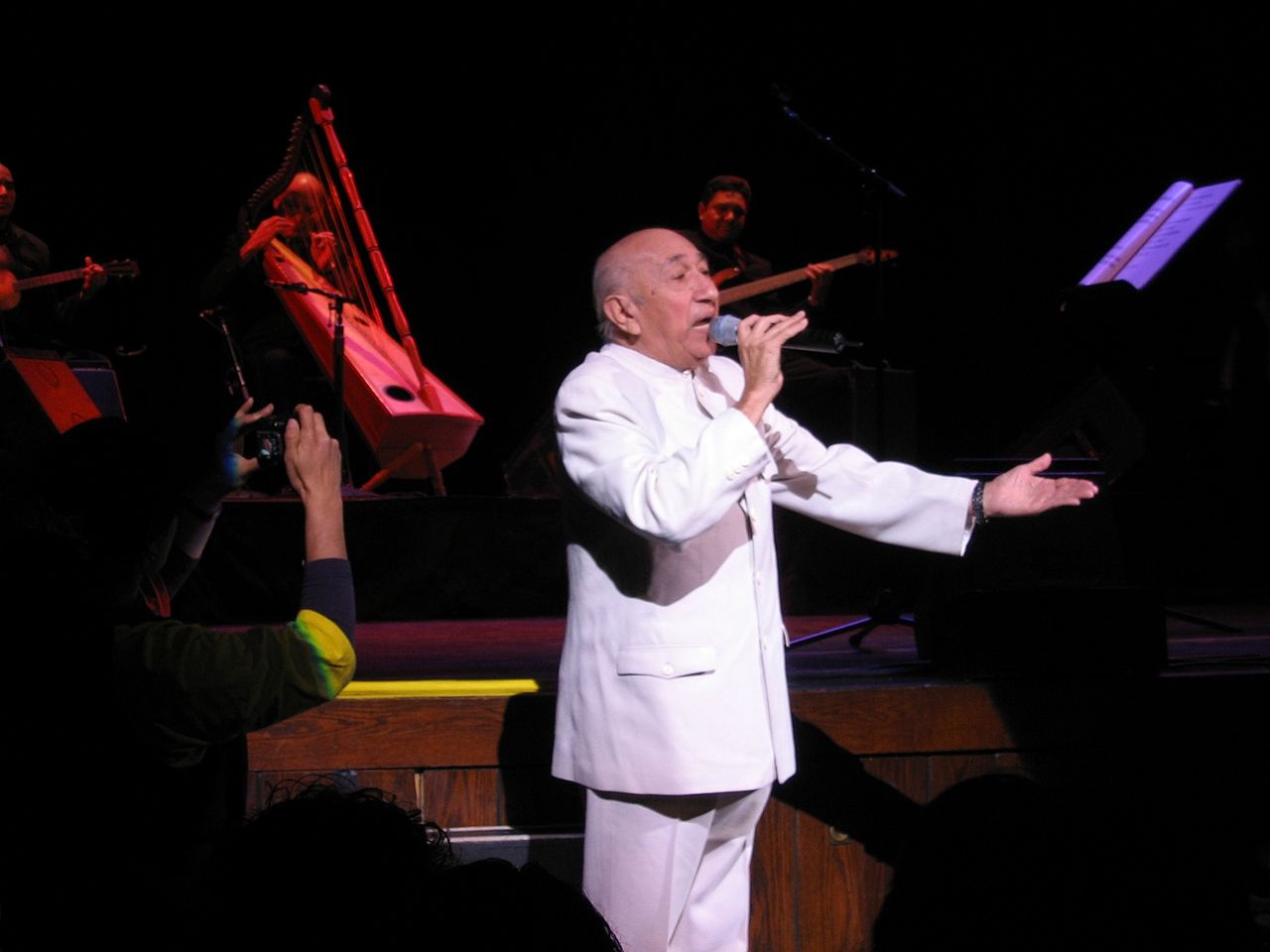
Wladimir Labeikovsky · Flickr: Simón Díaz en Boston · CC BY-SA 2.0
- Name
- Simón Díaz
- Occupation
- Musician, singer, composer
- Birth Name
- Simón Narciso Díaz Márquez
- Born
- 8 August 1928
- Birthplace
- Barbacoas, Aragua, Venezuela
- Died
- 19 February 2014
- Place of death
- Caracas, Venezuela
- Full name
- Simón Narciso Díaz Márquez.
- Nationality
- Venezuela
- Fields
- joropo
- Known for
- Caballo Viejo
- Honours
- Latin Grammy Trustees Award · Order of the Liberator · National Music Prize of Venezuela
VALÉORINE Encyclopedia
VALÉORINE documentary reading
Documentary summary
Narciso Díaz Márquez (August 8, 1928 – February 19, 2014), also known as tío Simón, was a Venezuelan singer, actor, TV host, comedian, and Grammy Award-winning composer of Venezuelan music. Some of his most popular songs include Caballo viejo, Tonada de luna llena and La vaca Mariposa. Díaz endeavored to recover the folklore and musical traditions of the Venezuelan Llanos (plains).
Admitted source layer · organised and presented by VALÉORINE
Reference Check
Propose documentary evidence for Simón Díaz. A contribution is never written directly as fact: identity, source, rights and evidence gates still decide.
Sign in to contribute
World of VALÉORINE
Documentary connections
Only confirmed graph relationships appear here. Images are shown only when their identity and reuse rights both pass the documentary gate.
Documentary evidence
Documentary basis
Authority files
wikidata · Q2519623 · wikipedia · Simón Díaz
In this article
Biography
Biography
This style of music has since been performed by artists such as Argentina's Mercedes Sosa, Brazil's Caetano Veloso, Spain's Joan Manuel Serrat, Peru's Susana Baca, Puerto Rico's Danny Rivera, and Venezuelans Franco De Vita, Soledad Bravo, Juan Carlos Salazar, Carlos Baute and José Luis Rodríguez, among others. Many of Díaz's works have been adapted by symphonies and choral ensembles throughout Venezuela, as well as being incorporated into the orchestral and choral arrangements of conductors and composers of academic music. Artists from other disciplines have also utilized Díaz's work. For example, German choreographer Pina Bausch included some of Díaz's songs in her work Nur Du. Film director Pedro Almodóvar included Díaz's song "Tonada de luna llena" as part of the soundtrack for his film The Flower of My Secret, sung by the Brazilian artist Caetano Veloso.
The recorded working language is Spanish. Subjects and genres recorded for the work are joropo. Works named in the authority record are Caballo Viejo. Distinctions recorded are Latin Grammy Trustees Award, Order of the Liberator and National Music Prize of Venezuela.

Simón Díaz in the 1980s
Ana Victoria Flamerich · Own work (Personal Work)
Key facts
Key facts
• Name — Simón Díaz • Landscape — yes • Genre — Venezuelan folk music • Occupation — Musician, singer, composer • Birth Name — Simón Narciso Díaz Márquez • Alias — Tío Simón • Born — 8 August 1928 • Birthplace — Barbacoas, Aragua, Venezuela • Died — 19 February 2014 • Place of death — Caracas, Venezuela • Years Active — 1948–2007 • Website — http: www.simondiaz.com Simón Narciso Díaz Márquez (August 8, 1928 – February 19, 2014), also known as tío Simón, was a Venezuelan singer, actor, TV host, comedian, and Grammy Award-winning composer of Venezuelan music. Some of his most popular songs include Caballo viejo, Tonada de luna llena and La vaca Mariposa. Díaz endeavored to recover the folklore and musical traditions of the Venezuelan Llanos (plains). This style of music has since been performed by artists such as Argentina's Mercedes Sosa, Brazil's Caetano Veloso, Spain's Joan Manuel Serrat, Peru's Susana Baca, Puerto Rico's Danny Rivera, and Venezuelans Franco De Vita, Soledad Bravo, Juan Carlos Salazar, Carlos Baute and José Luis Rodríguez, among others. Many of Díaz's works have been adapted by symphonies and choral ensembles throughout Venezuela, as well as being incorporated into the orchestral and choral arrangements of conductors and composers of academic music. Artists from other disciplines have also utilized Díaz's work. For example, German choreographer Pina Bausch included some of Díaz's songs in her work Nur Du. Film director Pedro Almodóvar included Díaz's song "Tonada de luna llena" as part of the soundtrack for his film The Flower of My Secret, sung by the Brazilian artist Caetano Veloso.
Early life
Early life
He was born in Barbacoas, Guárico state (nowadays in the state of Aragua), Venezuela, to Juan Díaz and María Márquez de Díaz. He had 7 siblings, one of whom is the now deceased, actor and comedian Joselo Díaz. His father was a musician and played the cornet in a local band, and he encouraged him to play the Venezuelan cuatro as well as taught him some of the basics in music. After his father's death in 1940, his family relocated to San Juan de los Morros, where he finished primary school and started receiving music lessons from Ramón Ziegler. In an interview, he described that in that moment, as the eldest brother, he became the “man of the house” and helped his mother raise the rest of his siblings. When he turned 15, he started working as an assistant of the local Siboney Orchestra and soon after performed as comedian under the pseudonym «el Chato».
Career
Career
• Illustration — Simón Díaz's driver's license (1951) In 1949 he started working in Caracas as a collector for the Banco Venezolano de Crédito and started receiving music lessons at the Escuela Superior de Música de Caracas. In the 1950s he gained attention as the host of El llanero, a radio show where he mixed folk music and comedy. Later on, he hosted another radio show in 70s with his brother Joselo, titled Media hora con Joselo y Simón. In 1963 he participated as a collaborator in the album Parranda criolla, produced by Hugo Blanco. His first album as a solo artist Ya llegó Simón was released in that same year. Throughout his career he recorded over 70 records and CDs, and made innumerable performances. Díaz composed and authored the music & lyrics of "Caballo viejo", first released in 1980 (Venezuela) under the album titled "Golpe y Pasaje", Label Palacio de la Música. To date, the song has more than 300 covers from around the world. In 1987 it was recorded by the Gipsy Kings as the hit song "Bamboléo". Simón Díaz's compositions have been performed by artists such as "Roberto Torres", Plácido Domingo, Ray Conniff, Julio Iglesias, Celia Cruz, Rubén Blades, Gilberto Santa Rosa, Gipsy Kings, Ivan Lins, Joyce, Cheo Feliciano, Juan Gabriel, María Dolores Pradera, Tania Libertad, Ry Cooder and Devendra Banhart Díaz also performed in theater, motion pictures and television. In the 1960s he became a comedian in Venezuela. He had the leading role in three plays, and participated in films such as Cuentos para mayores (1963), Isla de sal (1964), El reportero (1968), La bomba (1975), Fiebre (1976), La invasión (1977) y La empresa perdona un momento de locura (1978). He produced and hosted 12 different TV shows, all of them devised to promote Venezuelan music. One of these shows, Contesta por tío Simón, aired on Venezolana de Television for over 10 years and was devoted to teaching popular culture to children. It was during this time that Díaz's viewers began calling him "tío Simón" (uncle Simón). • Illustration — Simón Díaz
Death
Death
After battling Alzheimer's disease for many years, his daughter, Bettsimar Díaz García, announced that he died at his home in Caracas on 19 February 2014. Following his death, the Venezuelan Government announced three days of national mourning, and a concert to celebrate his life on 23 February 2014. He was buried on 21 February 2014 at the Cementerio General del Este in Caracas.
Life and career
Dated record
Life and career
The full dated record · 2 entries
1928
Simón Díaz born at Aragua.
2014
Simón Díaz died at Caracas.
Places
Named by the record
Places
Only places the record itself states, plotted where the house gazetteer settles their coordinates. Nothing is inferred from a name or a nationality.
Aragua.
Birth place
Caracas.
Death place
Discography
• Serie — Title — Label — Year • LP 6124 — Parranda Criolla — Palacio — 1963 • LP 6128 — Lila + Hugo + Simón: Música de la Película "Isla de Sal" — Palacio — 1963 • LP 6136 — ¡Ya Llegó Simón! — Palacio — 1963 • LP 6146 — De Parranda con Simón — Palacio — 1964 • LP 6154 — Criollo y Sabroso — Palacio — 1965 • LP 6181 — Caracha Negro — Palacio — 1966 • LP 6194 — Gaitas y Parrandas con Simón — Palacio — 1967 • LP 6221 — Simón En Salsa... En Gaita — Palacio — 1968 • LP 6253 — Simón' 69 — Palacio — 1969 • LP 6273 — Artistas Venezolanos Solamente — Palacio • LP 6275 — Gaita 70 — Palacio — 1970 • LP 6297 — Simon 71 — Palacio — 1971 • LPS 66299 — Tonadas — Palacio — 1974 • L.P.S. 109 — Navidad Criolla con el Quinto Criollo — Palacio/Guarura — 1979 • LPS 66333 — La Gaita de las Cuñas: El Candidato Chévere ¡Vota por Él! — Palacio/H.B — 1973 • LPS 66345 — Las Gaitas de Simón: Enemigo Público N°1 — Palacio/H.B — 1974 • LPS 66363 — Las Gaitas de Simón: Culpable? — Palacio/H.B — 1975 • LPS 66384 — Tonadas Vol.2 — Palacio — 1976 • LPS 66383 — Las Gaitas de Simón: Cuñas, Locas, Borrachitos — Palacio/H.B • LPS 66406 — Las Gaitas de Simón — Palacio/H.B — 1977 • LPS 66407 — Canciones Criollas Vol.3 — Palacio — 1978 • LPS 66430 — Canciones y Tonadas Vol.4 — Palacio — 1978 • LPS 66479 — Golpe y Pasaje: Caballo Viejo — Palacio — 1980 • LPS 66483 — Música Folklórica y Popular de Venezuela en Contrapunto — Palacio • LPS 66508 — Tonadas Favoritas — Palacio • LPS 66591 — Sus Grandes Éxitos — Palacio • LPS 2058 — Amor Enguayabao — Palacio/Rodven — 1993 • LPS 2067 — Cuenta y Canta Vol.1 — Palacio • LPS 2068 — Cuenta y Canta Vol.2 — Palacio
Awards and recognition
Simón Díaz was awarded the highest recognition conferred by the Venezuelan state, "The Great Ribbon of the Liberator's Order". He was given honorary doctorate degrees by two major Venezuelan universities, Simón Rodríguez University and Zulia's Universidad Católica Cecilio Acosta. The Latin American TV channel A&E MUNDO produced a documentary dedicated to Díaz under its “Biography” program, honoring his many contributions to Venezuelan culture, the program began airing in September 2004. On September 30, 2008, the Latin Grammy Awards announced that they would honor Díaz with a Lifetime Achievement Award, (El Premio del Consejo Directivo). Díaz was awarded the 2008 Latin Recording Academy Trustees Award, presented by Venezuelan salsa singer Oscar D'León. In 2012, he received the National Prize of Culture (Premio Nacional de la Cultura), in the category of music, by the Venezuelan Ministry of Culture for his work in Venezuelan llanos music, particularly the tonada and traditional milking songs.
Notes from the source article
Cited by Wikipedia
Notes from the source article
These works are cited by the source article, in its own numbering. They are recorded as its citations, not as sources VALÉORINE has verified.
- 1.Murió Simón Díaz, el autor de "Caballo viejo". BBC Mundo. 19 February 2014.
- 2.País, El. Falleció el cantautor venezolano Simón Díaz, el autor de 'Caballo Viejo'. Noticias de Cali, Valle y Colombia - Periodico: Diario El País. 2014-02-19.
- 3.Murió Simón Díaz, el autor de "Caballo Viejo". BBC News Mundo. 2014-02-19.
- 4.Diaz, Simón. Simón Díaz.
- 5.Internet Movie Database. Soundtracks for La flor de mi secreto (1995).
- 6.Graci, Carl. GWU Press Release. George Washington University. GWU Division of External Relations. 2005-09-12.
- 7.Un día como hoy 19 de febrero muere el Tío Simón. DiarioRepublica.com.
- 8.Notizulia. Hoy se conmemoran 94 años del natalicio del maestro, "Simón Díaz". 2022-08-08.
- 9.Marcano, Rodrigo. La entrevista a Simón Díaz [1928-2014]. Prodavinci. 2020-02-19.
- 10.Fuentes de Arias, Cleotilde Victoria. El joropo venezolano expresión de identidad nacional en la cultura popular. Arjé revista de posgrado FACE-UC. 7. 13. 165. 23 September 2013.
- 11.Ballesta, Juan Carlos. Simón Díaz: un venezolano universal. Revista Ladosis. 2021-02-19.
- 12.Rohter, Larry. Simón Díaz, Venezuelan Folk Musician Heard Worldwide, Dies at 85. The New York Times. 2014-02-25. 0362-4331.
- 13.The Australian Broadcasting Corporation. Simon Diaz. The Daily Planet. 18 August 1998.
- 14.Sincopa. Simón Díaz. The Guide to Venezuelan Music.
- 15.Caballo Viejo recorded by Conniff in his album, Fantástico! 1983 Brazilian release CBS-138578
- 16.Sony Bmg/Columbia. Julio Iglesias Latinamente - Bamboleo. 1989.
- 17.AllMusic.com. Ivan Lins - Simon Diaz.
- 18.Latin World. Simón Díaz. Gracias Simón. 2002.
- 19.Steward, Sue. Simn Diaz - Gracias. World Music journalist. Passion Music.
- 20.1986 SERDISCO. María Dolores Pradera / Habaneras de Cadiz / El becerrito.
- 21.T.H. Rodven. Amar Amando. Tania Libertad.
- 22.globalrhythm.net. Simon Diaz. Global Rhythm.
- 23.Last.fm. Simón Díaz.
- 24.Internet Movie Database. Isla de sal (1964).
- 25.Internet Movie Database. El reportero (1968).
- 26.Udenrigsministeriet Dead link. Honorary Latin Grammy Award for Simón Díaz. October 2010.
- 27.Finol, David. Doctorado Honoris Causa en Música al maestro Simón Díaz. El Nacional. 2009-07-29.
- 28.NationalGeographic.com. Simon Diaz. National Geographic Music.
- 29.Latin Grammy.com. Artists to Receive the 2008 Latin Recording Academy Lifetime Achievement Award. Latin Grammy.
- 30.ztgroupcorp. ▷ Simón Díaz recibe Premio Nacional de Cultura. El Impulso. 2012-08-01.
References
Citations
References
Each reference names the institution holding it, so a reader may go to the document itself.
reference work
Wikidata, structured authority record Q2519623: Simón DíazWikimedia Foundation
Secondary witnessreference work
Secondary witness
Further particulars
Held on the record
Further particulars
Open the remaining particulars
Simón Díaz was recorded at birth as Simón Narciso Díaz Márquez. His recorded language was Spanish. Díaz received Latin Grammy Trustees Award, Order of the Liberator and National Music Prize of Venezuela.
Identity and origins
Recognition and collections
The Encyclopedia exists whether or not anything is for sale. Corrections are recorded rather than overwritten, and every version of this record is kept. Published 15 August 2026.
Elsewhere in Music memorabilia
42,307 published records in this field, each with its sources named.
- Simon ClimiePerson
- Simon CollinsPerson
- Simon CowellPerson
- Simon CritchleyPerson
- Simon DominicPerson
- Simon EmmersonPerson
- Simon EstesPerson
- Simon FinnPerson
Best supported in this field
For owners
Own a work by Simón Díaz?
A specialist will read what you send and tell you what the house can establish, what it cannot, and whether the object is suited to sale. There is no charge and no obligation. The object stays with you throughout; nothing is shipped to us unless it is arranged in writing beforehand.