
Sebastiano Ricci
Sebastiano Ricci (1 August 165915 May 1734) was an Italian Baroque painter of the late Baroque period in Venetian painting. About the same age as Piazzetta, and an elder contemporary of Tiepolo, he represents a late version of the vigorous and luminous Cortonesque style of grand manner fresco painting. He was the uncle of Marco Ricci (1676 – 1730), who trained with him, and became an innovator in landscape painting.
Also recorded as B. Ricci · Sabastian Rici · Seb. Ricci · Seb Ricci
Sebastiano Ricci
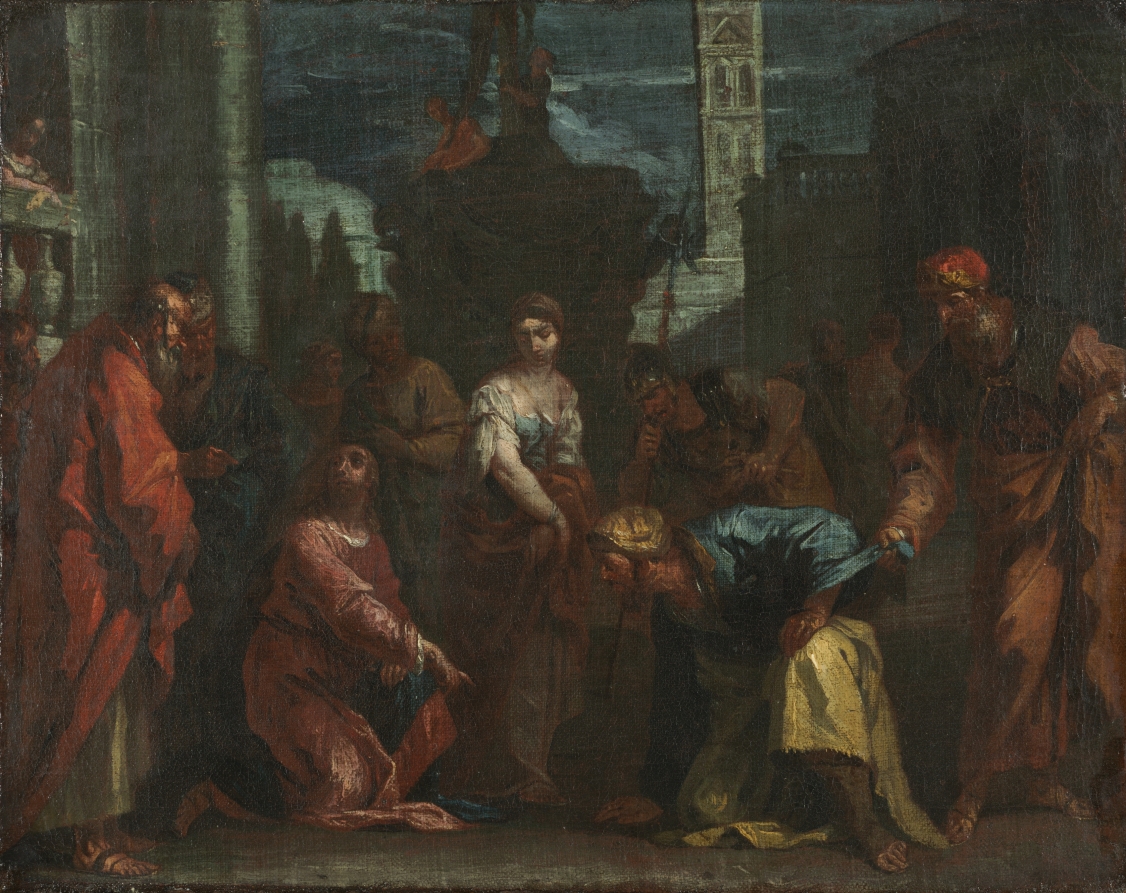
Sebastiano Ricci · The Cleveland Museum of Art · Holden Collection · CC0
- Name
- Sebastiano Ricci
- Born
- 1 August 1659
- Birthplace
- Belluno, Veneto, Republic of Venice
- Died
- 15 May 1734
- Place of death
- Venice, Republic of Venice
- Occupation
- Painter
- Spouse
- Unidentified wife (m. 1691)
- Nationality
- Republic of Venice
- Movements
- Baroque painting
- Known for
- Abraham and three angels · Hagar and Ishmael Saved by the Angel · Venus Surrounded by Nymphs Observing a Dance of Cupids · Allegory of the noon · Allegory of the Battle of Lepanto · Birth of Saint John the Baptist · Punishment of Cupid · St. Gregory the Great
- Languages
- Italian
VALÉORINE Encyclopedia
VALÉORINE documentary reading
Documentary summary
Sebastiano Ricci (1 August 165915 May 1734) was an Italian Baroque painter of the late Baroque period in Venetian painting. About the same age as Piazzetta, and an elder contemporary of Tiepolo, he represents a late version of the vigorous and luminous Cortonesque style of grand manner fresco painting. He was the uncle of Marco Ricci (1676 – 1730), who trained with him, and became an innovator in landscape painting.
Admitted source layer · organised and presented by VALÉORINE
Note VALÉORINE
No house-authored Note is published until its assertions and sources pass the VALÉORINE evidence contract. The documentary article remains available in full while that enrichment is being consolidated.
Documentary enrichment in progress · no unsupported statement published
Reference Check
Propose documentary evidence for Sebastiano Ricci. A contribution is never written directly as fact: identity, source, rights and evidence gates still decide.
Sign in to contribute
World of VALÉORINE
Documentary connections
Only confirmed graph relationships appear here. Images are shown only when their identity and reuse rights both pass the documentary gate.
Documentary evidence
Evidence Panel
not yet certified
- Identity
- resolved
- Independent source families
- 0
- Admitted assertions
- 0
- Open conflicts
- 0
Authority files
gnd · 1091348022 · wikidata · Q506483 · wikipedia · Sebastiano Ricci
In this article
Biography
Biography
The recorded working language is Italian. The authority associates the name with Baroque painting. Works named in the authority record are Abraham and three angels, Hagar and Ishmael Saved by the Angel, Venus Surrounded by Nymphs Observing a Dance of Cupids, Allegory of the noon, Allegory of the Battle of Lepanto and Birth of Saint John the Baptist. Work by Sebastiano Ricci is recorded in the collections of Städel Museum, Museo del Prado, The Nelson-Atkins Museum of Art, Auckland Art Gallery and Thyssen-Bornemisza Museum.
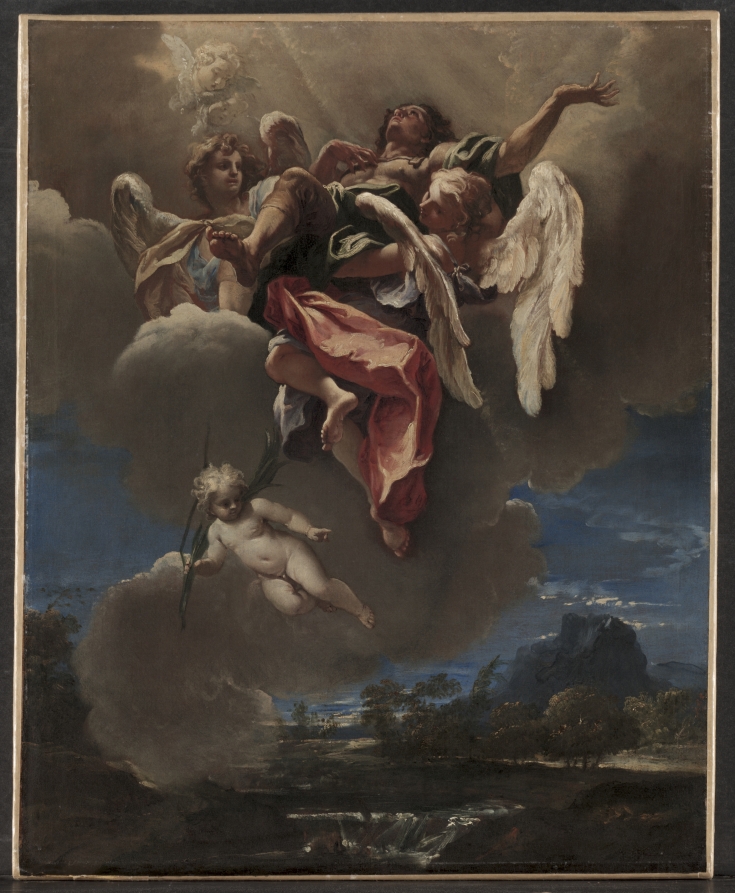
Study for "An Apotheosis of a Saint" (for San Bernardino dei Morti, Milan), c. 1695, by Sebastiano Ricci
Sebastiano Ricci · The Cleveland Museum of Art · Mr. and Mrs. William H. Marlatt Fund
Key facts
Key facts
• Name — Sebastiano Ricci • Born — 1 August 1659 • Birthplace — Belluno, Veneto, Republic of Venice • Died — 15 May 1734 • Place of death — Venice, Republic of Venice • Occupation — Painter • Spouse — Unidentified wife (m. 1691) • Children — 1 • Family — Marco Ricci (nephew)
Early years
Early years
He was born in Belluno, the son of Andreana and Livio Ricci. In 1671, he was apprenticed to Federico Cervelli of Venice. Others claim Ricci's first master was Sebastiano Mazzoni. Indiscretion at a young age in 1678 resulted in an unintended pregnancy and, later, a bigger scandal when Ricci was charged with trying to poison the young woman in question to avoid marriage. He was imprisoned, and released only after the intervention of a nobleman, probably a Pisani family member. He eventually married the mother of his child in 1691, although this was a stormy union. Following his release he moved to Bologna, where he lived near the Parish of San Michele del Mercato. His painting style there was apparently influenced by Giovanni Gioseffo dal Sole. On 28 September 1682 he was contracted by the "Fraternity of Saint John of Florence" to paint a Decapitation of John the Baptist for their oratory. On 9 December 1685, the Count of San Secondo near Parma commissioned the decoration of the Oratorio della Beata Vergine del Serraglio, which Ricci completed in collaboration of Ferdinando Galli-Bibiena by October 1687, receiving a payment of 4,482 Lira. In 1686, the Duke Ranuccio II Farnese of Parma commissioned a Pietà for a new Capuchin convent. In 1687-8 Ricci decorated the apartments of the Parmense Duchess in Piacenza with canvases recounting the life of the Farnese pope, Paul III.
Turin and return to Venice
Turin and return to Venice
• Illustration — Venus and Adonis Apparently in 1688, Ricci abandoned his wife and daughter, and fled from Bologna to Turin with Magdalen, the daughter of the painter Giovanni Peruzzini. He was again imprisoned, and nearly executed, but was eventually freed by the intercession of the Duke of Parma. The duke employed him and assigned him a monthly salary of 25 crowns and lodging in the Farnese palace in Rome. In 1692, he was commissioned to copy the Coronation of Charlemagne by Raphael in Vatican City, on behalf of Louis XIV, a task he finished only by 1694. The death of the Duke Ranuccio in December, 1694, who was also his protector, forced Ricci to abandon Rome for Milan, where by November 1695 he completed frescoes in the Ossuary Chapel of the Church of San Bernardino dei Morti. On 22 June 1697, the Count Giacomo Durini hired him to paint in the Cathedral of Monza. In 1698, he returned to the Venetian republic for a decade. By 24 August 1700, he had frescoed the chapel of the Santissimo Sacramento in the church of Santa Giustina of Padua. In 1701, the Venetian geographer Vincenzo Coronelli commissioned a canvas of the Ascension that was inserted into the ceiling of sacristy of the Basilica of the Santi Apostoli in Rome. In 1702, he frescoed the ceiling of the Blue Hall in the Schönbrunn Palace, with the Allegory of the Princely Virtues and Love of Virtue, which illustrated the education and dedication of future emperor Joseph I. In Vienna, Frederick August II, the elector Saxony, requested an Ascension canvas, in part to convince others of the sincerity of his conversion to Catholicism, which allowed him to become the King of Poland. In Venice in 1704 he executed a canvas of San Procolo (Saint Proculus) for the Dome of Bergamo and a Crucifixion for the Florentine church of San Francisco de Macci.
Florentine frescoes
Florentine frescoes
In the summer of 1706, he traveled to Florence, where he completed a work that is by many considered his masterpieces. During his Florentine stay he first completed a large fresco series on allegorical and mythological themes for the now-called Marucelli-Fenzi or Palazzo Fenzi (now housing departments of University of Florence). After this work, Ricci, along with the quadraturista Giuseppe Tonelli, was commissioned by the Grand Duke Ferdinando de' Medici to decorate rooms in the Pitti Palace, where his Venus takes Leave from Adonis contains heavenly depictions that are airier and brighter than prior Florentine fresco series. These works gained him fame and requests from foreign lands and showed the rising influence of Venetian painting into other regions of Italy. He was to influence the Florentine Rococo fresco painter Giovanni Domenico Ferretti. In 1708 he returned to Venice, completing a Madonna with the Child for San Giorgio Maggiore. In 1711, now painting alongside his nephew, Marco Ricci, he painted two canvases: Esther to Assuero and Moses saved from the Nile, for the Taverna Palace. • Illustration — Battle of the Lapiths and Centaurs, circa 1705. (High Museum of Art)
London and Paris
London and Paris
• Illustration — The apse of the chapel, Royal Hospital Chelsea, showing Ricci's painting of the Resurrection c. 1710–15 • Illustration — Diana and Her Dog He ultimately accepted foreign patronage in London, when he was provided a £770 commission by Lord Burlington for eight canvases, to be completed by him and his nephew Marco, depicting mythological frolics: Cupid and Jove, Bacchus meets Ariadne, Diana and Nymphs, Bacchus and Ariadne, Venus and Cupid, Diane and Endymion, and a Cupid and Flora. • Illustration — Bacchus and Ariadne He decorated the chapel at Bulstrode House near Gerrards Cross for Henry Bentinck, 1st Duke of Portland with a cycle of wall-paintings depicting scenes from the life of Christ. George Vertue described the scheme as "a Noble free invention. great force of lights and shade, with variety & freedom, in the composition of the parts". The chapel was demolished in the 19th century, but oil modelli still exist. Ricci also designed stained glass for the Duke of Chandos' chapel at Cannons. In c. 1710–15 Ricci painted the apse in the chapel at the Royal Hospital Chelsea of the resurrection. By the end of 1716, with his nephew, he left England for Paris, where he met Watteau, and submitted his Triumph of the Wisdom over Ignorance in order to gain admission to the Royal French Academy of Painting and Sculpture, which was granted on 18 May 1718. He returned to Venice in 1718 a wealthy man, and bought comfortable lodgings in the Old Procuratory of St. Mark. That same year, the Riccis decorated the villa of Giovanni Francesco Bembo in Belvedere, near Belluno. In 1722 he was one of twelve artists commissioned to contribute a painting on canvas of one of the apostles as part of a decorative scheme at the church of St Stae in Venice. The other artists involved included Tiepolo, Piazetti, and Pellegrini. • Illustration — Vision der Hl. Therese von Avila Kunsthistorisches Museum
Last years
Last years
From 1724 to 1729, Ricci worked intensely for the Royal House of Savoy in Turin. In 1724 he painted the Rejection of Agar and the Silenus adores the Idols, in 1725, the Madonna in Gloria, in Turin in 1726, he completed Susanna presented to Daniel and Moses causes water to gush from the rock. In October 1727 he was admitted to the Clementine Academy of Venice. Ricci's style developed a following among other Venetian artists, influencing Francesco Polazzo, Gaspare Diziani, Francesco Migliori, Gaetano Zompini, and Francesco Fontebasso (1709–1769). He died in Venice on 15 May 1734.
Veronese copies
Veronese copies
• Illustration — Fake portrait of Palladio attributed to Veronese, frontispiece to The Architecture of A. Palladio, 1715, engraved by Bernard Picart after Ricci Ricci made many copies from the works of Paolo Veronese, both of individual heads and of whole compositions. Some of these copies of heads were bought by George III. The king also bought a painting of the Finding of Moses which his agent, Joseph Smith, claimed was a Veronese, although this too had been painted by Ricci, either as a pastiche of Veronese's style, or a copy of a work now lost. Ricci painted a supposed portrait of Andrea Palladio, attributed to Veronese and engraved by Bernard Picart for the frontispiece of the first English edition (1715) of Palladio's Four Books of Architecture. According to Rudolf Wittkower, it does not depict Palladio, but rather is entirely the invention of Ricci.
Critical assessments
Critical assessments
"Ricci, leaning at first on the example of splendid art of the Veronese, made a new ideal prevail, one of clear and rich coloristic beauty: in this he paved the way for Tiepolo. The painting of figures of the Roccoco to Venice remains incomprehensible in its evolution without Ricci... Tiepolo germinated the work started by Ricci to such a richness and splendor that it leaves Ricci in the shadows... although Sebastiano is recognized in the combative role of forerunner "(Derschau). "He is the master of a resurrected-fifteenth century style, whose painterly features are enriched with nervous express and, typically 17th century" (Rudolf Wittkower). Wittkower in his Anthology, contrasts the facile luminous style of Ricci with the darker, more emotional intense painting of Piazzetta. Like Tiepolo, Ricci was an international artist; Piazzetta was local. "We perceive in him that synthesis of the baroque decorativeness and individualized and substantial painting, that we will see later again in Tiepolo. On one side the influence of Cortona, directed and indirect, and on the other the observant painting of the hermit Magnasco; more intense, substantial and freed academic impulses, the airy, shining influences become, to the open air, magical coves, as well as gloomy corners. A new synthesis that opened wide new painting horizons, even if the scene is not that of a ballet, it is felt like bing in the wonders of the color, in more vibrating, acute, agile accents "(Moschini). "At the start of the Baroque..Venetians remained isolated from the outside…from the great ideas of the baroque painting… The Ricci are the first traveling Venetian painters... and succeed to inaugurate the so-called roccoco rooms of Pitti and Marucelli palaces."(Roberto Longhi). Ricci "brought back in the Venetian tradition a wealth of chromatic expression resolved in a new vibrating brilliance brightness…by means of the intelligent interpretation of the Veronese chromatics and of the brushstrokes of a Magnasco-like touch, from the 16th century impediments, he takes unfashionable positions against "tenebrous styles", is against the new Piazzetta – Federico Bencovich. He supplied a valid painterly idiom for... Tiepolo to use after his defection from the Piazzettism "(Pallucchini). "Venice, still more than Naples, collects the Ricci inheritance of the prodigioso trade of Luca Giordano... Sebastiano throws again it, widens he then, refines it for the school of Sebastiano Mazzoni "(Argan) • Illustration — Venus and Satyr • Illustration — (between 1659 and 1734) • Illustration — Allegory with Figures of Hope, Time, and Death (between 1659 and 1734)
Works/Gallery
Works/Gallery
• Portrait of a Bishop, Landesmuseum Ferdinandeum, Innsbruck • Mercy (1686), New Church of the Capuchins, Parma • Frescoes in collaboration with Bibiena, (1687) Sacristy of the Fallen in Church of Santo Segundo, Parma • History and Apotheosis of Paul III (1687–1688), Farnese Palace, now Pinacoteca Civica, Piacenza • Guardian Angel (1694), Chiesa del Carmine, Pavia • Frescoes (1695), Church of San Bernardino alle Ossa, Milan • Ecstasy of St Francis (circa 1695–1696), Tweed Museum of Art, Duluth, Minnesota • Last Supper (c. 1720), Museum of Fine Arts, Houston, Texas • Frescoes (1697), Duomo of Monza • Communion of St Maria Egiziaca (1698), Archconfraternity of the Duomo of the Santa Sindone, Milan • St Gregory the Great intercedes with Madonna (1700), Church of Santa Giustina, Padua • Frescoes (1700), Church of Santa Giustina, Padua • Ascension (1701), Santi Apostoli, Rome • Allegory of the princely virtues (1702), Schönbrunn Palace, Vienna • Assumption of Virgin (1702) Gemäldegalerie, Dresden • Crucifixion with Virgin, John the Evangelist and Carlo Borromeo (1704), Uffizi, Florence • Procolo, Peasant Detention (1704), Duomo, Bergamo) • Vision of St. Bruno (1705) • Frescoes (1706–1707), Palazzi Fenzi Marucelli and Pitti, Florence • Madonna with Child (1708), San Giorgio Maggiore, Venice) • Family of Darius before Alexander and Continence of Scipio (ca 1709), North Carolina Museum of Art, Raleigh • Liberation of Saint Peter (1710), Trescore Balneario, Bergamo, church of Saint Peter)(San Stae) • Christ giving the keys to St Peter and Call of St Peter (1710), San Pietro, Bergamo • Assumption (1710), Santa Maria Maggiore, Bergamo) • Esther before Ahasuerus (1711), Palazzo Taverna, Rome • Moses saved from the waters (1711) • Sacred Family with Elizabeth and John (1712), Royal Collections, London • Frescoes for Burlington House (1712–1714), London • Cupid before Jove; Encounter of Bacchus and Ariadne; and Triumph of Galatea • Frescoes for Chiswick House (1712–1714), London • Bacchus and Ariadne (c. 1713) (National Gallery) • Venus and Cupid, Diana and Endymion, Cupid and Flora and Diana and Nymphs • Selene & Endymion (1713), London • The Resurrection (1714), Royal Hospital Chelsea, London • Triumph of Wisdom over Ignorance (1718), Louvre, Paris • Head of Woman (1718), fresco fragment, Civic Museum, Belluno • Bathsheba at her Bath (1724), Szépművészeti Múzeum, Budapest • Sabauda Gallery, Turin • Repudiation of Agar and Solomon adores the Idols (1724) • Madonna in Glory with archangel Gabriel and Saints Eusebio, Sebastiano & Rocco (1725) • Susanna in front of Daniel and Moses make water gush from the rock (1726) • Magdalen applies ointment to Christ's feet (1728) • Apotheosis of Saint Sebastian (circa 1725), Musée des Beaux-Arts, Strasbourg • St Cajetan heals the Sick (1727), Brera Gallery, Milan • Ecstasy of St. Teresa (1727, Church of St Jerome (now St Mark), Vicenza) • Royal Palace, Turin • Hagar in the desert; Jacob blesses the sons of Joseph; Moses saved from waters; and Rebecca and Eliazer at the well (1727) • Christ and the Centurions and Wedding at Cannae (1729), Capodimonte Museum, Naples • Communion and Martyrdom of St Lucia (1730), Church of Santa Lucia, Parma • Immaculate Conception (1730), Church of San Vitale, Venice • Madonna in Glory with Child and Angel Guardian, (1730) Scuola of the Guardian Angel, Venice • Prayer in Garden (1730), Kunsthistorisches Museum, Vienna • Self-portrait (1731), Uffizi Gallery • Pope Gregory the Great intercedes with Virgin (1731), Sant'Alessandro della Croce, Bergamo • Pope Gregory the Great intercedes for souls in Purgatory (1733), Saint Gervais, Paris • Pope Pio V, Saints Thomas Acquinus, & Peter Martyr (1733), Gesuati, Venice • St Francis from resuscitates child Paola and St Helen discovers True Cross, San Rocco Church, Venice • Baldassarre and Ester before Ahasuerus (1733), Quirinal Palace, Rome • Assumption (1734) Karlskirche, Vienna
Identity and origins
Identity and origins
The authorities additionally record the headings B. Ricci, Sabastian Rici, Seb. Ricci, Seb Ricci and Sebastiano Ricchi. His recorded language was Italian.
Work and production
Work and production
Works recorded as notable number 8: Abraham and three angels, Hagar and Ishmael Saved by the Angel, Venus Surrounded by Nymphs Observing a Dance of Cupids, Allegory of the noon, Allegory of the Battle of Lepanto, Birth of Saint John the Baptist, Punishment of Cupid and St. Gregory the Great.
Life and career
Dated record
Life and career
Explore 1659–1734
The full dated record · 3 entries
1659
Sebastiano Ricci born at Belluno.
1725
Marco Ricci, And Sebastiano Ricci Landscape with Post Deluge Ruins and survivours (1725) is digitised and catalogued by Internet Archive.
1734
Sebastiano Ricci died at Venice.
Places
Named by the record
Places
Only places the record itself states, plotted where the house gazetteer settles their coordinates. Nothing is inferred from a name or a nationality.
Belluno.
Birth place
Venice.
Death place
Primary material
Documents and archives
reference work
- Wikidata, structured authority record Q506483: Sebastiano Ricci
Reputable secondary · Wikimedia Foundation
- “Sebastiano Ricci”, English Wikipedia, consulted as further reading
Reputable secondary · Wikipedia
scholarly publication
- Ricci, Sebastiano or Bastiano, Benezit Dictionary of Artists, 2011
Scholarly · Crossref registry · 2011
authority file
- Gemeinsame Normdatei 1091348022, Sebastiano Ricci (1989 : Udine).
Unverified · Deutsche Nationalbibliothek
Literature
Literature
Literature
Ricci, Sebastiano, Oxford Art Online, 2003
Ricci, Sebastiano or Bastiano, Benezit Dictionary of Artists, 2011
Ricci, Sebastiano (bap
Ricci, Sebastiano (1659–1734)
Sebastiano Ricci impresario in angustie a Venezia: i guai della stagione 1718-1719 al Sant’Angelo, Drammaturgia, 2016
The Painter at the Crossroads: Sebastiano Ricci in Florence and the Interplay between the Arts, Il Capitale Culturale: Studies on the Value of Cultural Heritage, 2018
Scholarly footprint
Literature
Scholarly footprint
A count of publications is evidence of attention, not of standing, and is given here only as a measure.
References
Citations
References
Each reference names the institution holding it, so a reader may go to the document itself.
scholarly publication
Ricci, Sebastiano or Bastiano, Benezit Dictionary of Artists, 2011Crossref registry
Verifiedauthority file
Gemeinsame Normdatei 1091348022, Sebastiano Ricci (1989 : Udine).Deutsche Nationalbibliothek
Partially resolvedreference work
Wikidata, structured authority record Q506483: Sebastiano RicciWikimedia Foundation
Partially resolvedreference work
Partially resolved
Further particulars
Held on the record
Further particulars
Open the remaining particulars
Those registers additionally record the forms Mostra su Sebastiano Ricci (1989: Udine) and Mostra dei Dipinti di Sebastiano Ricci (1989: Udine).
The Encyclopedia exists whether or not anything is for sale. Corrections are recorded rather than overwritten, and every version of this record is kept. Published 14 August 2026.
Elsewhere in Paintings
18,717 published records in this field, each with its sources named.
- Sebastiano del PiomboArtist
- Sebastiano FilippiArtist
- Sebastiano FlorigerioArtist
- Sebastiano FolliArtist
- Sébastien-Melchior CornuArtist
- Seda TatoyanArtist
- SedjemnetjeruArtist
- Seien ShimaArtist
Best supported in this field
For owners
Own a work by Sebastiano Ricci?
A specialist will read what you send and tell you what the house can establish, what it cannot, and whether the object is suited to sale. There is no charge and no obligation. The object stays with you throughout; nothing is shipped to us unless it is arranged in writing beforehand.