
Sean Scully
Sean Scully (born 30 June 1945) is an Irish-born American-based artist working as a painter, printmaker, sculptor and photographer. His work is held in museum collections worldwide and he has twice been named a Turner Prize nominee. Moving from London to New York in 1975, Scully helped lead the transition from Minimalism to Emotional abstraction in painting, abandoning the reduced vocabulary of Minimalism in favour of a return to metaphor and spirituality in art.
Also recorded as Sean Skully
Sean Scully
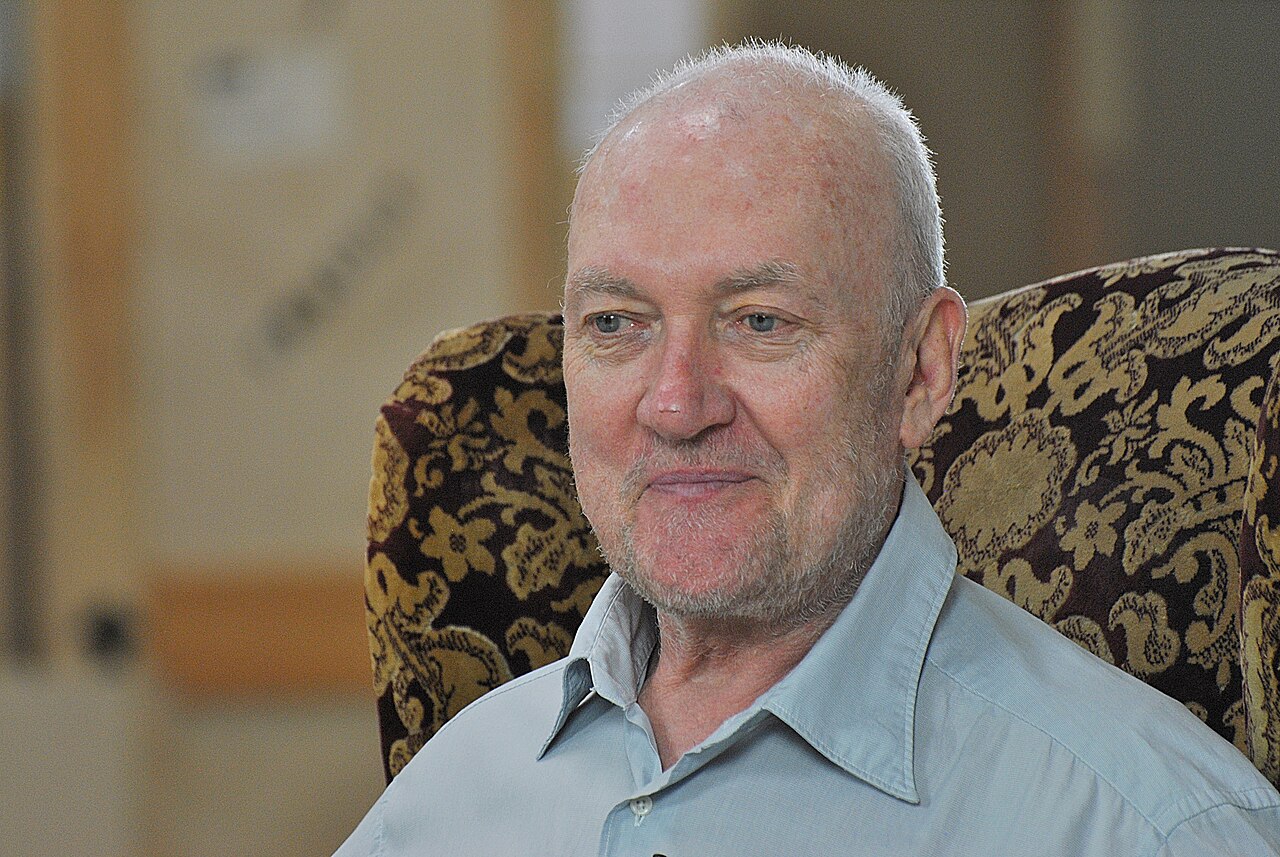
Raulmaigi · CC BY-SA 4.0
- Born
- 1945.
- Nationality
- United States and Ireland.
- Occupation
- painter, university teacher, illustrator, graphic artist and artist.
VALÉORINE Encyclopedia
VALÉORINE documentary reading
Documentary summary
Sean Scully (born 30 June 1945) is an Irish-born American-based artist working as a painter, printmaker, sculptor and photographer. His work is held in museum collections worldwide and he has twice been named a Turner Prize nominee. Moving from London to New York in 1975, Scully helped lead the transition from Minimalism to Emotional abstraction in painting, abandoning the reduced vocabulary of Minimalism in favour of a return to metaphor and spirituality in art.
Admitted source layer · organised and presented by VALÉORINE
Note VALÉORINE
Sean Scully (born 1945) is an artist, graphic artist and illustrator, among other activities, of Irish and American nationality. The artist was born in Dublin.
Sean Scully was educated at Harvard University and Newcastle University. The artist worked for Academy of Fine Arts, Munich and is a member of Aosdána and Royal Academy of Arts. Sean Scully worked in Barcelona, London and Munich, among others. Activity centred on painting.
Languages used include English. Honours include Guggenheim Fellowship.
Composed from admitted, traceable facts · 27 September 2026
VALÉORINE
Reference Check
Propose documentary evidence for Sean Scully. A contribution is never written directly as fact: identity, source, rights and evidence gates still decide.
Sign in to contribute
Documentary evidence
Documentary basis
Authority files
wikidata · Q535343 · wikipedia · Sean Scully
In this article
Early life
Early life
Scully has also been a lecturer and professor at a number of universities and his writing and teachings are collected in the 2016 book Inner: The Collected Writings and Selected Interviews of Sean Scully.
Sean Scully was born in Dublin, Ireland, on 30 June 1945. Four years later his family moved to London, where they lived in a working-class part of South London, moving from lodging to lodging for a number of years. By the age of 9, Scully knew he wanted to become an artist, and from the age of 15 until he was 17, Scully was apprenticed at a commercial printing shop in London as a typesetter, an experience that greatly influenced the art to come. From the age of 17 until he turned 20, despite working full-time in various jobs including graphic design, and messenger, Scully attended evening classes at the Central School of Art, focused on figurative painting. While working a stint as a plasterer's labourer on the Victoria Station Ballroom, Scully made daily visits to the Tate Milbank to visit Van Gogh's Chair (1888), which made an impression on him. In 1963, at the age of 18, Scully had a job loading trucks with flattened boxes at a cardboard factory. The idea of stacking central to much of his work came from this experience.
Education
Education
In September 1965 Sean Scully, age 20, began to study full-time at Croydon College of Art, London. As part of his course he attended Camberwell School of Art to study printmaking. He then moved on to Newcastle University in 1968. At Newcastle University, the University Theatre's production of Samuel Beckett’s Waiting for Godot made a lasting impact on him. Scully was also influenced by a trip to Morocco in 1969, where he became fascinated by the multi-colored stripes locals wove into wool tents and robes. Scully was awarded the Frank Knox Memorial Fellowship in 1972 to attend Harvard University. It was during this first stay in the US that Scully began to experiment with new techniques such as tape and spray paint.
Early career: 1970–1980
Early career: 1970–1980
Scully's first commercial show, at the Rowan Gallery in London, sold out. During this period Scully taught at the Chelsea College of Art and Design, and Goldsmith's, while continuing to paint in his Elephant Lane studio in Rotherhithe. In 1975, at the age of 30, Scully was awarded a two-year Harkness Fellowship with which he moved to New York. Once in New York, he began to develop important friendships with fellow artists such as Robert Ryman, and others in academic and artistic circles. Scully's response in the 1970s had been to bring the objectives of American Minimalism together with those of Op art, an important current in Europe, creating works using overlays and “supergrids” that bridged these two artistic movements in a new way. Once in New York, Minimalism had a strong influence on his work, and for a few years, Scully's palette was reduced to the grey monochrome ‘Black paintings’ series. Scully began working on the series known as The Catherine Paintings in 1979, while sharing his Duane Street studio with his third wife, the artist Catherine Lee. The idea behind the series was to choose the important painting Scully produced during each year together, that would then become part of a collection named after her. This was the beginning of Sean's own private collection of his work.
Departure from Minimalism: 1980–1982
Departure from Minimalism: 1980–1982
By 1980 Scully considered himself to be at war with the movement of Minimalism in New York and wanted to bring more human elements into his art. He made multiple trips to Morocco and Mexico during this time, as he considered these trips to have “a direct bearing on what I think art should be doing – which is concentrating on what’s interesting, engaging, perverse, and beautiful about human nature.” He later commented that “I had decided that what had been stripped out of painting—i.e., the ability to make relationships, to be metaphorical and referential, spiritual, poetic, all those things and aspects of human nature—had to be put back in if painting was to go forward.” In 1981 the first retrospective of Sean Scully's work was held at the Ikon Gallery in Birmingham. This was also the year that Scully's confidence to withdraw from adherence to Minimalism became apparent, with the return of color and space, and the freehand drawing of stripes and visible brushstrokes, rather than the hard lines of tape. Scully had a breakthrough with the seminal 1981 painting Backs and Fronts, which had a profound impact in the 1982 exhibition 'Critical Perspectives' at the PS1 Contemporary Art Center. This was a watershed painting which British conceptual artist Gillian Wearing has said “broke the logjam of American minimalist painting”.
Geometric Abstraction: 1982–present
Geometric Abstraction: 1982–present
In 1982 Scully began to work with the gallerist David McKee, an important relationship that lasted for a decade. During the summer of that year, Scully started producing small multi-panel works on found pieces of wood while staying in Montauk at the Edward Albee artist's colony. These works were titled Ridge, Plum, and Bear after the islands that surround Long Island. He also began applying a combination of rigid geometry and expressive texture and colour to larger paintings that year. A prime example of this was Heart of Darkness, inspired by the 1899 novella of the same name. Scully began collaborating with Mohammad O. Khalil in 1983, this was the first time he had collaborated with a printmaker and was the start of a career-long commitment to printmaking. That same year, Scully was awarded a Guggenheim Fellowship for Fine Arts. In 1984, the Museum of Modern Art included Scully in their International Survey of Recent Painting and Sculpture. The following year Scully's first American solo museum exhibition was held at the Museum of Art, Carnegie Institute in 1985, and traveled to the Museum of Fine Arts, Boston. Other major museums also began to acquire Scully's large-scale paintings, despite the dominant trend of the time tending towards Postmodernism. Scully's paintings from this period are heavy and physical in terms of both size and aesthetic, and make use of large-scale stretchers. By 1987, Scully's work became less complex, flatter and smaller in scale, and began to include lighter color palettes beginning with Pale Fire in 1988. The same year, while experimenting with watercolours on a beach in Mexico, Scully created the first image that would become an extended meditation on architecture and light with the Wall of Light series. In 1989 the Whitechapel Gallery in London held a solo exhibition for Scully, which then travelled to Palacio Velázquez in Madrid and to the Städtische Galerie im Lenbachhaus in Munich. These were Scully's first solo exhibitions in mainland Europe. The art critic Robert Hughes' 1989 piece for TIME magazine cemented Scully's increasing reputation. The painting Why and What (Yellow) in 1988 was the first to incorporate an inset element of steel. By 1991 Scully expanded the use of steel, setting oil on linen insets into large steel panels. He also began the regular use of a checkerboard motif at this time, first hinted at in his Taped and Hidden Drawing paintings of the mid-1970s. In 1992, while teaching at Harvard University, Sean Scully revisited Morocco to film the BBC documentary The Artist's Journey: Sean Scully on Henri Matisse, with Matisse having visited Morocco in 1912–1913. 1993 saw the first exhibition of The Catherine Paintings, at the Modern Art Museum of Fort Worth, Texas. In 1994 he opened a second studio in Barcelona, and he returned to Morocco in 1995, to spend more time in the country. Atlas Walls is a portfolio of Scully's photographic works taken during this trip. In 1995 Scully returned to New York, moving into a large new studio in Chelsea, Manhattan. Chelsea Wall was the first painting to be made there. Scully received a number of invitations to speak at academic institutions, and participated in the Joseph Beuys lectures on the state of contemporary art in Britain, Europe and the US, held by the Ruskin School at Oxford University, England. In 1997, Scully's photography was exhibited for the first time at the Sala de Exposiciones Rekalde in Bilbao, Spain. Scully participated in a colloquium in conjunction with the exhibition Richard Pousette-Dart at the Metropolitan Museum of Art in 1998. He visited Santo Domingo in 1999, resulting in the photography portfolio Santa Domingo for Nené. That year, Scully's prints were given a retrospective at the Graphische Sammlung Albertina, in Vienna, Austria, and the Musée du Dessin et de l’Estampe Originale in Gravelines. A catalogue raisonné of his prints from 1969 to 1999 was also published.
2001–2013
2001–2013
In 2001, the Modern Art Museum of Fort Worth acquired the complete Catherine series, eighteen paintings that each represent a year from the period 1979–1996, which was given a dedicated room for permanent exhibition in the new Museum building opened in 2002. In 2002 Scully was appointed Professor of Painting at the Academy of Fine Arts, Munich, a position he held through to 2007. A retrospective exhibition opened in 2004 at the Sara Hildén Art Museum in Tampere, Finland, which travelled to Klassik Stiftung Weimar, in Germany, and the National Gallery of Australia. While in Australia, Scully spent time travelling through the red desert interior. Between 2005 and 2006, Sean Scully's Wall of Light series was displayed at museums around the United States. This began with the exhibition Sean Scully: Wall of Light opened at The Phillips Collection, Washington D.C., and travelled to the Modern Art Museum of Fort Worth, the Cincinnati Art Museum, and finally the Metropolitan Museum of Fine Art to great acclaim. The same year Scully travelled with a group of students from the Art Academy in Munich, to Inisheer, an island off the Irish coast. It was here that the Aran portfolio of photographs were taken. In 2006 the Hugh Lane Gallery opened The Sean Scully Room, a dedicated, permanent installation of the artist's work, and the Bibliothèque nationale de France held an exhibition of his prints. Sean Scully: A Retrospective opened in 2007 at the Fundació Joan Miró, Barcelona, and travelled to the Musée d'art moderne (Saint-Étienne), and the Museo d’Arte Contemporanea Roma (MACRO) in Rome. The National Gallery of Art in Washington D.C. invited Scully to give the Elson Lecture in 2007. The retrospective exhibition Constantinople or the Sensual Concealed: The Imagery of Sean Scully opened in 2009 at the MKM Museum Küppersmühlefür Moderne Kunst, in Duisburg, Germany, and travelled to the Ulster Museum, Belfast. In 2010 a tour of important early works from the 1980s started at the Centre for Contemporary Arts, Carlow, Ireland, and then travelled to the Leeds Art Gallery, and the Wilhelm-Hack-Museum in Ludwigshafen am Rhein. In 2011 the Chazen Museum of Art opened their new expansion of the museum with a solo exhibition of Scully's eight-part Liliane paintings on aluminum, and other works. Scully opened nine more solo museum exhibitions in 2012, including Notations: Sean Scully at the Philadelphia Museum of Art, as well as exhibitions at museums like MIMA, Kunstmuseum Bern, the Lentos Kunstmuseum in Linz, and IVAM in Valencia, Spain.
2018
2018
2018 saw Scully have a total of fourteen public exhibitions around the world. This included the installation of the monumental sculpture Boxes of Air in the Cuadra San Cristóbal, in Mexico City, along with paintings installed in the horse stalls of the iconic pink stable block. Other museum shows included: Multimedia Art Museum, Moscow; Hatton and Laing Galleries, Newcastle, UK; De Pont Museum of Contemporary Art, Tilburg, Netherlands; Russian Museum, St Petersburg, Russia; Staatliche Kunsthalle Karlsruhe, Germany; Yorkshire Sculpture Park, UK, among many others.
2019
2019
In 2019, the exhibition Sean Scully: Sea Star opened at The National Gallery, London, showcasing Scully's work alongside works by J. M. W. Turner. On 6 April 2019, director Nick Willing's documentary film Unstoppable. Sean Scully & The Art of Everything aired nationally in the UK on BBC Two. For the 58th Venice Biennale, Scully presented Sean Scully: Human at the Basilica of San Giorgio Maggiore, an exhibition of recent paintings and a new sculpture titled Opulent Ascension under the dome of the late Renaissance church by Andrea Palladio.
2020s
2020s
From 11 May to 21 September 2025, the Parrish Art Museum exhibited “Sean Scully: The Albee Barn, Montauk,” a survey of Scully’s art created between 1981 and 2024, including the month he spent in Montauk in the summer of 1982. The catalog was published by Hatje Cantz (ISBN 978-3-775-75942-7). From 8 October 2025 to 14 December 2025, the Estorick Collection of Modern Italian Art exhibited Sean Scully: Mirroring "showcasing a body of his work alongside that of Italian master Giorgio Morandi." The exhibit displayed paintings, etchings and sculptures created between 1964 and the present.
Music
Music
Scully's mother Holly was a vaudeville singer, and Scully became heavily influenced by rhythm and blues in his adolescence. Scully owned and ran an R&B club as a teenager in South London, and was briefly in an R&B band with his brother and a friend. In 2016 the percussionist Billy Martin from the band Medeski Martin & Wood made a performative collaboration with Sean Scully's monumental corten steel sculpture Boxes of Air at Scully's Tappan studio. It culminated in ‘Boxing for Sean’, a 6 movement percussion composition performed live outdoors. In 2019 the duo Merzouga released a 46-minute sound composition, "The Language of Light - Music to the Work of Sean Scully" (YLE/DLF 2019) featuring the texts and the voice of Scully. Its premiere broadcast was on 3 December 2019 at 9pm local time on Finnish broadcaster Yleisradio. German nationwide broadcaster Deutschlandfunk co-produced the piece; the German broadcast was scheduled for February 2020.
Writing
Writing
Scully first began writing about art and his own work in the 1980s, although he only truly began to include writing as part of his practice from 1996 onwards. 2016 saw the publication of Inner: the collected writings and selected interviews of Sean Scully, by HatjeCantz.
Personal life
Personal life
Scully became a father at the age of 19, with the birth of his son Paul on 7 May 1965. Paul later died in a car accident in 1983 at the age of 18. While at Newcastle University, Scully met Rosemary Purnell, a fellow student in the Painting Department, they married in 1971 and later divorced. Scully married artist Catherine Lee in 1978, the two divorced in 1998. In 2006, he married artist Liliane Tomasko, his fourth wife. Their son Oisin Scully was born in 2009.
United States and South America
United States and South America
Ackland Art Museum, University of North Carolina – Chapel Hill, NC Albright–Knox Art Gallery – Buffalo, NY Art Institute of Chicago – Chicago, IL Art Gallery of Ontario – Ontario, Canada The Broad Art Foundation – Los Angeles, CA Carnegie Museum of Art – Pittsburgh, PA Iris & B. Gerald Cantor Center for Visual Arts, Stanford University – Stanford, CA Carpenter Center for the Visual Arts – Harvard University, Cambridge, MA Centro Cultural de Arte Contemporaneo – Mexico City, Mexico Chase Manhattan Bank – New York, NY Chemical Bank – New York, NY Cincinnati Art Museum – Cincinnati, OH Cleveland Museum of Art – Cleveland, OH Contemporary Museum – Honolulu, HI Corcoran Gallery of Art – Washington, D.C. Dallas Museum of Art – Dallas, TX David Winton Bell Gallery, List Art Center, Brown University, Providence, RI Denver Art Museum – Denver, CO Des Moines Art Center – Des Moines, IA De Young Museum – San Francisco, CA First Bank Minneapolis – Minneapolis, MN Fogg Art Museum, Harvard University – Cambridge, MA Ft. Lauderdale Museum of Art – Ft. Lauderdale, FL Glenstone – Potomac, MD Guggenheim Museum – New York, NY Hirshhorn Museum and Sculpture Garden – Washington, D.C. High Museum of Art – Atlanta, GA Hood Museum of Art – Hanover, NH Kemper Museum of Contemporary Art – Kansas City, MO Los Angeles County Museum of Art – Los Angeles, CA Modern Art Museum of Fort Worth – Fort Worth, TX Catherine Series BNY Mellon Center – Pittsburgh, PA Metropolitan Museum of Art – New York, NY Miami Art Museum – Miami, FL Mount Holyoke College Art Museum – South Hadley, MA Museo de Arte Contemporaneo – Caracas, Venezuela Museo de Arte Contemporaneo – Monterrey, Mexico Museo de Arte Moderno – Col. Bosques de Chapultepec, Mexico Museo de Arte Moderno – Mexico City, Mexico Museum of Fine Art, Boston – Boston MA Museum of Fine Arts, Houston – Houston, TX Museum of Modern Art – New York, NY National Gallery of Art – Washington, D.C. 8.10.89 (1989) Orlando Museum of Art – Orlando, FL Paine Webber Group, Inc. – New York, NY Philip Morris, Inc. – New York, NY The Phillips Collection - Washington, D.C. Princeton University Art Museum, Princeton, NJ Rose Art Museum, Brandeis University, Waltham, MA Santa Barbara Museum of Art – Santa Barbara, CA Seattle Museum of Art – Seattle, WA Sheldon Memorial Art Gallery and Sculpture Garden, University of Nebraska – Lincoln, NE Smith College Museum of Art – Northampton, MA Smithsonian American Art Museum – Washington, DC Works in the SAAM collection Raclin Murphy Museum of Art – Notre Dame, IN San Diego Museum of Art – San Diego, CA Saint Louis Art Museum – Saint Louis, MO Speed Art Museum — Louisville, KY Van Cliburn Foundation, Fort Worth, TX Walker Art Center – Minneapolis, MN Whitney Museum of Modern Art, New York, NY Yale University Art Gallery – New Haven, CT
Europe
Europe
Abbot Hall Art Gallery – Kendal, England Academy of Fine Arts, Munich – Munich, Germany Albertina – Vienna, Austria Arts Council of Great Britain – London, England AXA Belgique – Brussels, Belgium Banque Européenne d'Investissement – Luxembourg BAWAG – Vienna, Austria Bavarian State Painting Collections – Munich, Germany Bibliothèque nationale de France – Paris, France Birmingham Museum of Art – Birmingham, England British Council – London, England Centre national des arts plastiques – Paris, France Ceolfrith Art Center – Sunderland, England Château Lynch-Bages – Pauillac, France Museo Chillida-Leku, – Hernani, Spain Coleccion Conei, Barcelona, Spain Consejería de cultura – Santander, Spain Contemporary Arts Society – London, England Council of National Academic Awards – London, England Crawford Art Gallery – Cork, Ireland East Coast Light I (1973) Centre de la gravure et de l'image imprimee, La Louvière – Brussels, Belgium Daimler Art Collection – Stuttgart, Germany Deutsche Bank – London, UK DZ Bank AG Kunst sammlung / KMMM – Frankfurt, Germany Eastern Arts Association – Cambridge, England Ecole d’Arts Plastiques – Châtellerault, France Espace de l’Art Concret – Mouans-Sartoux, France EMMA, ESPOO, Museum of Modern Art – Helsinki, Finland Fitzwilliam Museum – Cambridge, England La Fondation Edelman – Lausanne, Switzerland Fondation Urvasco – Vittoria, Spain Foundation Stiftelsen Focus – Borås, Sweden CaixaForum Barcelona – Barcelona, Spain Fundació Allorda-Derksen – Barcelona, Spain Fundación Caixa Galicia - La Coruña, Spain Gallery of Modern Art László Vass Collection – Veszprém, Hungary Gertsev Collection – Moscow, Russia Hôtel des Arts - Toulon, France Hunterian Art Gallery – Glasgow, Scotland Hugh Lane Gallery – Dublin, Ireland Works in the Hugh Lane collection Institut Valencià d'Art Modern (IVAM) – Valencia, Spain Irish Museum of Modern Art (IMMA) – Dublin, Ireland Kunsthalle Bielefeld – Bielefeld, Germany Kunstmuseum Lentos Linz – Linz, Austria Kunstsammlung Nordrhein-Westfalen – Düsseldorf, Germany Kunsthaus Zürich – Zürich, Switzerland Kunst und Museumsverein Wuppertal – Wuppertal, Germany Laing Art Gallery – Newcastle, England László Vass Collection – Veszprém, Hungary Leicestershire Educational Authority – Leicester, England Louisiana Museum of Modern Art – Humlebaek, Denmark The Maramotti Collection – Reggio Emilia, Italy Manchester Art Gallery – Manchester, England Museum Folkwang – Essen, Germany Musée d'Art Contemporain du Val-de-Marne – Vitry-sur-Seine, France Musée d'art moderne (Saint-Étienne) – Saint-Étienne, France Musee du Dessin et de l'Estampe Originale – Gravelines, France Musée Jenisch – Vevey, Switzerland Musee National d´Art Moderne, Centre Georges Pompidou – Paris, France Musee de Roland-Garros – Paris, France Museo d'Arte Moderna di Bologna (MAMBO) – Bologna, Italy Museo Nacional Centro de Arte Reina Sofía – Madrid, Spain Barcelona Museum of Contemporary Art – Barcelona, Spain Mumok, Stiftung Ludwig – Vienna, Austria Museum Pfalzgalerie – Kaiserslautern, Germany National Museum Cardiff – Cardiff, Wales Northern Arts Association – Newcastle-Upon-Tyne, England Norwich Castle – Norwich, England Open Museum, Environmental & Heritage Resource Centre, Leicestershire, England Pier Arts Centre – Orkney, Scotland Ruhr University Bochum – Bochum, Germany Saastamoisen Saatio – Helsinki, Finland Sala Rekalde – Bilbao, Spain Sammlung Essl – Vienna, Austria Sara Hilden Art Museum – Tampere, Finland Staatsgalerie Stuttgart – Stuggart, Germany Staatliche Museen Kassel, Neue Galerie – Kassel, Germany Staatliche Graphische Sammlung München, Munich, Germany Lenbachhaus – Munich, Germany Tate Modern – London, England Works in the Tate collection The UBS Art Collection – Zürich/Basel, Switzerland Ulster Museum – Belfast, Northern Ireland Northumbria University – Newcastle, England Victoria and Albert Museum – London, England Von der Heydt Museum – Wuppertal, Germany Whitworth Art Gallery – Manchester, England Willy Michel Collection, Museum Franz Gertsch – Burgdorf, Switzerland ZKM Center for Art and Media Karlsruhe (ZKM) – Karlsruhe, Germany University of Limerick – Limmerick, Ireland
Australia
Australia
Art Gallery of New South Wales – Sydney, Australia National Gallery of Australia – Canberra, Australia National Gallery of Victoria – Felton Bequest – Melbourne, Australia Power Institute of Contemporary Art – Sydney, Australia
Japan
Japan
Bridgestone Museum of Art, Ishibashi Foundation – Tokyo Nagoya City Art Museum – Nagoya Tokyo International Forum – Tokyo
Quotes
Quotes
“Art, especially abstraction: has to be a moral act. If not it’s likely to fall into bed with decoration.” “Why stripes? Because they can be anything. And they can be anything because they are nothing. To make nothing into something is more interesting that making something into something else. The association with the devil notwithstanding” “Artistic culture, to me, is like a huge rug that is constantly folded and unfolded by us. Every time it’s turned over, turned out, unfolded: it shows something new or something overlooked that now seems new.”

Sean Scully at the presentation of "Opulent Ascension" at the LWL Museum of Art and Culture
Rainer Halama
Life and career
Dated record
Life and career
The full dated record · 1 entries
1945
Sean Scully was born in 1945.
Reception in China and new projects: 2014–2017
Reception in China and new projects: 2014–2017
In 2014, Scully opened a new studio space set on three acres in Tappan, New York, where he continued to extend the Landline series of paintings begun in 2000. That same year, Scully opened fourteen solo exhibitions around the world, including the first major retrospective by a western artist in China. The exhibition, entitled Follow the Heart: The Art of Sean Scully, opened in Beijing. The exhibition included China Piled-Up, a new monumental sculpture in corten-steel, and travelled from the Shanghai Himalayas Museum to the CAFA Art Museum in Beijing, to critical acclaim. Another outdoor sculpture Boxes Full of Air was commissioned at Chateau La Coste in France. Scully participated in the Venice Biennale for the first time, in 2015, with the solo exhibition Land Sea at the Palazzo Falier in Venice. The Museum Liaunig, in Neuhaus, Austria, opened its new building expansion with Sean Scully: Painting as an Imaginative World Appropriation. To honour his long-term friendship with art critic Arthur Danto who died in 2013, Scully published the book Danto on Scully, bringing together the series of five essays Danto had written on the artist over the previous 20 years. In 2015 Scully completed his restoration of the 10th Church of Santa Cecília de Montserrat in Spain, and opened it to the public. Commissioned by the Museum of Montserrat to make a holistic artistic intervention in the sacred space, Scully not only permanently installed paintings but worked on site-specific frescoes, and the design of the altar and cross. The chapel is now both a working church, and also the Espai d’Art Sean Scully. Scully was awarded the V Congreso Asociacion Protecturi for his contribution to Spanish religious heritage In 2016 Scully's second major exhibition in China, Sean Scully: Resistance and Persistence, opened at the Art Museum of the Nanjing University of the Arts, and travelled to the Guangdong Museum and the Hubei Museum in Wuhan. In the same year, as well as solo museum exhibitions in České Budějovice, Czech Republic, and Valencia, Spain, the artist put together two exhibitions of works from specific early periods in his private collection, one of works from the 1970s, in an off-site space in Ridgewood, Queens with Cheim & Read, and another of works from the 1980s with Mnuchin Gallery. Inspired by revisiting his earlier works, Scully began to reemploy techniques such as spray painting, which he first introduced in the late 1960s. Over the course of 2015–2017, Scully's work expanded in two particular directions: sculpture and figuration. During this period, Scully began working on sculptural projects, including the Tower series using various materials such as corten steel, marble, and stainless steel, and the Stack series in both raw and painted steel were introduced. A new series of Block paintings was begun, in which Scully self-referenced his sculpture in paint. This new direction was the focus of the solo exhibition Wall of Light Cubed at Cheim & Read, NY. Scully also revisited his early exploration in figuration from the late 1960s in a series of figurative paintings titled Eleuthera which was completed between 2015 and 2017. The series was inspired by Scully's son Oisin, and was named after the island of Eleuthera in the Bahamas and the feminine Greek adjective ἐλεύθερος (eleútheros), meaning "free".
Critical reception
Critical reception
Arthur Danto wrote that “Sean Scully’s name belongs on the shortest of short lists of the major painters of our time”, continuing that "Scully’s historical importance lies in the way he has brought the great achievement of Abstract Expressionist painting into the contemporary moment – and in a way overcome the terms of the paragon that sent painting into exile."
Primary material
Documents and archives
scholarly publication
- Scully, Sean, Benezit Dictionary of Artists, 2011
Scholarly · Crossref registry · 2011
Institutional database
- Wikidata, structured authority record Q535343: Sean Scully
Scholarly · Wikimedia Foundation
reference work
- “Sean Scully”, English Wikipedia, consulted as further reading
Reputable secondary · Wikipedia
Prizes and awards
Scully has been a member of Aosdána since 2001, and the Royal Academy of Arts since 2013. Scully received an Honorary Doctor of Fine Arts degree from both Massachusetts College of Art and the National University of Ireland in 2003, and a Doctor of Letters degree from Newcastle University. He received an Honorary Doctorate from Miguel Hernández University in 2006 and 2008.
Notes from the source article
Cited by Wikipedia
Notes from the source article
These works are cited by the source article, in its own numbering. They are recorded as its citations, not as sources VALÉORINE has verified.
- 1.João Ribas. Sean Scully. ARTINFO. October 20, 2005.
- 2.Hubbard, Sue. Scully, Sean: Wall of Light Desert Night (1999). The Independent. 2007-08-17.
- 3.William Cook. Building blocks: How Sean Scully conquered China. BBC Arts. 7 April 2016.
- 4.Making his mark on the art world. irishexaminer.com. 2013-04-12.
- 5.Biography -Sean Scully. Sean Scully Studio.
- 6.Sean Scully. Porto Venere.
- 7.Dunne, Aidan. Artist Sean Scully: 'It's about stacking, putting things in order'. The Irish Times.
- 8.Spence, Rachel. Sean Scully: 'England is a country that basically doesn't understand art'. Financial Times. September 21, 2018.
- 9.Sue Feay. Unstoppable: Sean Scully and the Art of Everything, BBC2 — a portrait of abstract art's great showman. Financial Times. 5 April 2019.
- 10.Sean Scully - Newcastle University. ncl.ac.uk.
- 11.Danto, Arthur Coleman. Unnatural Wonders: Essays from the Gap Between Art and Life. Columbia University Press. 2007. 978-0-231-14115-4.
- 12.Seeing Stripes: Sean Scully's "Catherine" Series Modern Art Museum of Fort Worth. themodern.org.
- 13.Sean Scully Artists Lisson Gallery. lissongallery.com.
- 14.Grovier, Kelly. Art Since 1989 (World of Art). Thames & Hudson. 2015-12-07. 978-0-500-77294-2.
- 15.Sean Scully - Bio. American Art - The Philips Collection.
- 16.Penn State Press. The Aesthete in the City: The Philosophy and Practice of American Abstract Painting in the 1980s. 250. 1994. 978-0-271-04297-8.
- 17.Pobric, Pac. Sean Scully: THE WANDERER. The Art Newspaper. May 2015.
- 18.Seeing Stripes: Sean Scully's "Catherine" Series Modern Art Museum of Fort Worth. themodern.org.
- 19.Scully, Sean. Inner : the collected writings and selected interviews of Sean Scully. Hatje Cantz. 290. 2016. 978-3-7757-4164-4.
- 20.BBC Two cbignore. Artists' Journeys. 14 June 1992.
- 21.Scully, Sean. Inner : the collected writings and selected interviews of Sean Scully. Hatje Cantz. 41. 2016. 978-3-7757-4164-4.
- 22.Sean Scully. Cristea Roberts Gallery.
- 23.Lewis, Jo Ann. SEAN SCULLY'S MANY-SIDED RECTANGLES. Washington Post. 1995-06-18. 0190-8286.
- 24.Penn State Press. The Aesthete in the City: The Philosophy and Practice of American Abstract Painting in the 1980s. 262. 1994. 978-0-271-04297-8.
- 25.DesignCurial. Gillian Wearing picks her top art, design and architecture events. designcurial.com.
- 26.San Scully - John Simon Guggenheim Memorial Foundation. www.gf.org.
- 27.Third Millennium Information Ltd. Modern Art Museum of Fort Worth. 157. 2002. 978-1-903942-14-7.
- 28.Marter, Joan M. The Grove Encyclopedia of American Art. Oxford University Press. 2011. 978-0-19-533579-8.
- 29.Hughes, Robert. Art: Earning His Stripes. Time. 1989-08-14. 0040-781X.
- 30.'Light from the South' an exhibition by Sean Scully, inspired by Alhambra and Morocco. Islamic Arts Magazine.
- 31.Philadelphia Museum of Art - Exhibitions - Notations: Sean Scully. philamuseum.org.
- 32.Glueck, Grace. Sean Scully: Wall of Light - Art - Review. The New York Times. 2006-09-29. 0362-4331.
- 33.Dunne, Aidan. Art in Focus: Landline Gray (2015) by Sean Scully. The Irish Times.
- 34.Scully, Sean. Sean Scully: a retrospective. Thames & Hudson. 2007. 9780500093382.
- 35.Elson Lecture 2007: Sean Scully, Persistence and Style. nga.gov.
- 36.Constantinople or the Sensual Concealed The imagery of Sean Scully. Stiftung für Kunst und Kultur e.V.
- 37.Dunne, Aidan. Constantinople, or The Sensual Concealed: The Imagery of Sean Scully. The Irish Times.
- 38.Catlin, Roger. Sean Scully's Artworks Are a Study in Color, Horizon and Life's Sorrows. Smithsonian.
- 39.BBC Arts - BBC Arts - Building blocks: How Sean Scully conquered China. BBC.
- 40.Sean Scully. Flaunt Magazine.
- 41.Major exhibition dedicated to Irish artist Sean Scully opens at Palazzo Falier in Venice. artdaily.cc.
- 42.Wall of Light Blue Black Sea Sean Scully Fine Art Biblio. fineartbiblio.com.
- 43.Danto, Arthur C. Danto on Scully. Dap-distributed Art. 2015. 978-3-7757-3963-4.
- 44.Sharp, Rob. Sean Scully Fills a Spanish Monastery With Bursts of Color. The New York Times. 2015-06-30. 0362-4331.
- 45.Goodman, Jonathan. Sean Scully Wall of Light Cubed. The Brooklyn Rail. 2017-05-01.
- 46.Grovier, Kelly. Art in the 2010s: The most striking – and shocking – images. bbc.com.
- 47.Fineartmultiple Art Magazine - Sean Scully's Paintings and Sculptures in His Own Words. fineartmultiple.com.
- 48.Jones, Jonathan. 'Turner gets his cobwebs blown away' – Sea Star: Sean Scully review. The Guardian. 2019-04-12. 0261-3077.
- 49.Painter Sean Scully Is Planning a Deeply Personal Exhibition in a Venice Church That Will Pay Tribute to His Lost Son. artnet News. 2019-03-05.
- 50.Reconciling Secular Art in Sacred Spaces. Hyperallergic. 2019-07-20.
- 51.Sean Scully: Mirroring - Estorick Collection. www.estorickcollection.com.
- 52.Danto, Arthur C. Unnatural Wonders: Essays from the Gap Between Art and Life. Columbia University Press. 81. 2005. 9780231545723.
- 53.Danto, Arthur C. Unnatural Wonders: Essays from the Gap Between Art and Life. Columbia University Press. 2005. 978-0-231-54572-3.
- 54.GAC Honorary Awards -Banco Sabadell Foundation for artists and gallerists – Fundació Banc Sabadell. fundacionbancosabadell.com. 8 June 2016.
- 55.Spretnak, C. The Spiritual Dynamic in Modern Art: Art History Reconsidered, 1800 to the Present. Springer. 2014-10-22. 978-1-137-34257-7.
- 56.Billy Martin Sean Scully Performance. 12 November 2017.
- 57.Ääniversumi Language of Light – Sean Scullyn teoksia musiikkina. areena.yle.fi.
- 58.Sean Scully: 'Fatherhood has given my art a new lease of life'. Spectator Life. 2018-10-03.
- 59.Sean Scully: World famous Irish artist and son of Inchicore. Independent.ie. 11 November 2019.
- 60.Scully., Sean. Inner: The Collected Writings and Selected Interviews of Sean Scully. Hatje Cantz. 273. 2016. 978-3-7757-4164-4.
- 61.Scully, Sean. Inner: The Collected Writings and Selected Interviews of Sean Scully. 95. 2016. 978-3-7757-4164-4.
- 62.Scully, Sean. Inner: The Collected Writings and Selected Interviews of Sean Scully. 268. 2016. 978-3-7757-4164-4.
Bibliography printed in the source article · 8
- Dorothy Walker (2002). Scully, Seán in Brian Lalor (Ed.), The Encyclopedia of Ireland. Dublin: Gill and Macmillan. .
- Arthur C. Danto (2007). "Architectural Principles in the Art of Sean Scully", Border Crossings: A Magazine of the Arts, vol. 26(3), August 2007, p. 62–67. ISSN 0831-2559.
- Arthur C. Danto. (2005). "Sean Scully". Unnatural Wonders: Essays from the Gap Between Art and Life. NY: Columbia University Press. p. 81. .
- Joan Marter (2011). "Sean Scully". Grove Encyclopedia of American Art. Oxford University Press. .
- David Carrier (1994). The Aesthete in the : The Philosophy and Practice of American Abstract Painting in the 1980s. Penn State Press. 1994. .
- Donald Kuspit (2010). "Sacred Sadness: Sean Scully's Abstractions", Psychodrama: Modern Art as Group Therapy. London: Ziggurat. pp. 449–453. .
- David Carrier (2008). A World Art History and Its Objects. Penn State Press. 2008. .
- Sean Scully (2016). Inner: The Collected Writings and Selected Interviews of Sean Scully. .
References
Citations
References
Each reference names the institution holding it, so a reader may go to the document itself.
scholarly publication
Scully, Sean, Benezit Dictionary of Artists, 2011Crossref registry
Institutional witnessInstitutional database
Wikidata, structured authority record Q535343: Sean ScullyWikimedia Foundation
Institutional witnessreference work
Secondary witness
The Encyclopedia exists whether or not anything is for sale. Corrections are recorded rather than overwritten, and every version of this record is kept. Published 14 August 2026.
Elsewhere in Illustration
5,224 published records in this field, each with its sources named.
- Sawaki TakeyasuIllustrator
- Scot EatonIllustrator
- Scott McKowenIllustrator
- Sean ChenIllustrator
- Seb McKinnonIllustrator
- Sebastian KudasIllustrator
- SeedfeederIllustrator
- SennaRinIllustrator
Best supported in this field
For owners
Own a work by Sean Scully?
A specialist will read what you send and tell you what the house can establish, what it cannot, and whether the object is suited to sale. There is no charge and no obligation. The object stays with you throughout; nothing is shipped to us unless it is arranged in writing beforehand.