
Sassetta
Stefano di Giovanni di Consolo, known as il Sassetta (c. 1392–1450) was a Tuscan painter of the Late Gothic of the Sienese School style, adapting some Renaissance innovations.
Also recorded as Il Sassetta · Stefano di Giovanni di Consolo da Cortona · Stefano Di Giovanni · Stefano di Giovanni di Consolo
Sassetta
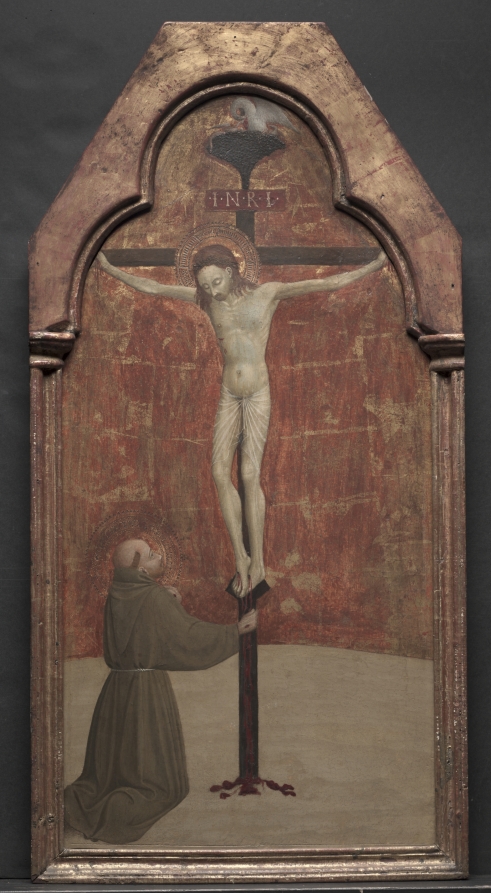
Sassetta · The Cleveland Museum of Art · Mr. and Mrs. William H. Marlatt Fund · CC0
- Name
- Sassetta
- Birth Name
- Stefano di Giovanni di Consolo
- Born
- around 1392
- Birthplace
- Siena or Cortona
- Died
- 1450 or 1451 (age 58 or 59)
- Place of death
- Siena
- Known for
- Painting
- Occupation
- painter.
- Fields
- painting.
- Movements
- Sienese school.
- Languages
- Italian.
VALÉORINE Encyclopedia
VALÉORINE documentary reading
Documentary summary
Stefano di Giovanni di Consolo, known as il Sassetta (c. 1392–1450) was a Tuscan painter of the Late Gothic of the Sienese School style, adapting some Renaissance innovations.
Admitted source layer · organised and presented by VALÉORINE
Note VALÉORINE
No house-authored Note is published until its assertions and sources pass the VALÉORINE evidence contract. The documentary article remains available in full while that enrichment is being consolidated.
Documentary enrichment in progress · no unsupported statement published
Reference Check
Propose documentary evidence for Sassetta. A contribution is never written directly as fact: identity, source, rights and evidence gates still decide.
Sign in to contribute
Documentary evidence
Evidence Panel
not yet certified
- Identity
- resolved
- Independent source families
- 0
- Admitted assertions
- 0
- Open conflicts
- 0
Authority files
getty · 500021319 · gnd · 118794620 · wikidata · Q362016 · wikipedia · Sassetta
In this article
Biography
Biography
Sano di Pietro and Giovanni di Stefano are recorded as having studied under Sassetta. The recorded working language is Italian. The field of work recorded is painting. Works named in the authority record are Mystic Marriage of Saint Francis, Madonna and Child with Angels, St. The Story of the founding of the Basilica of Santa Maria Maggiore in Rome, Virgin with Child and Four Saints, Annunciation, Floor mosaic of Stories of Joshua and Cortona Triptych by Sassetta. Work by Sassetta is recorded in the collections of National Gallery of Victoria, Städel Museum, Harvard University Center for Italian Renaissance Studies, Metropolitan Museum of Art and Diocesan Museum in Cortona.
Key facts
Key facts
• Name — Sassetta • Birth Name — Stefano di Giovanni di Consolo • Born — around 1392 • Birthplace — Siena or Cortona • Died — 1450 or 1451 (age 58 or 59) • Place of death — Siena • Known for — Painting
Life and Works
Life and Works
The name Sassetta has been associated with him, mistakenly, only since the 18th century but is now generally used for this artist. The date and birthplace of Sassetta are not known. Some say he was born in Siena although there is also a hypothesis that he was born in Cortona. His father, Giovanni, is called da Cartona which might entail that Cortona was the artist's birthplace. The meaning of his nickname Sassetta is obscure and is not cited in documents of his time but appears in sources from the eighteenth century. Sassetta was probably trained alongside artists like Benedetto di Bindo and Gregorio di Cecco but he had a style all of his own. He achieved a high level of technical refinement and was aware of artistic innovations of talented painters in Florence such as Gentile da Fabriano, Masolino and Masaccio. His work differs from the late Gothic style of many of his Sienese contemporaries. His first certain work, which originally had his signature, is the Arte della Lana altarpiece (ca. 1423–1426), fragments of which are now divided among various private and public collections. The Madonna of the Snow altarpiece for the Siena Cathedral was a prestigious commission for Sassetta, and is considered his second major work. Not only does he excel at infusing his figures with a natural light that convincingly molds their shape, he also has an handle on spatial relationships, creating a cohesive space. From this point on Sassetta's style returns to a rather decorative Gothic manner. The polyptych done by Sassetta in San Domenico in Cortona (around 1437) depicts scenes from the legend of St. Anthony the Abbot. He shows great skill in narration through his painting as well as combining a sophisticated color palette and rhythmic compositions. He died from pneumonia contracted while decorating the Assumption fresco on the Porta Romana of Siena. The work was finished by his pupil Sano di Pietro. Many consider Sassetta's fusing of traditional and contemporary elements as integral to the move from the Gothic to the Renaissance style of painting in Siena. Francesco di Giorgio e di Lorenzo, better known as Vecchietta, is said to have been his apprentice.
A Miracle of the Eucharist
A Miracle of the Eucharist
• Illustration — Miracle of the Eucharist Sassetta was a fiercely pious man. The painting is about the "marriage of righteousness and violence" and the "consequences of sinfulness, the perils of feigning faith and the power of God." The figure in black in the painting is an unbeliever, who has been found out in the process of receiving Communion. The officiating priest offers him the host on a plate, which is pictured miraculously spurting blood. The unbeliever has been struck dead instantly, and the creature above his face is a tiny black devil which has swooped down to snatch away his soul to the depths of Hell. The other men pictured are Carmelite monks, caught in expressions of shock, amazement and disgust. The painting is a "carefully staged, meticulously created illusion" which commemorates the Miracle of Bolsena which is said to have taken place in 1263. Sassetta's Altarpiece of the Eucharist was later divided between three museums (British, Hungarian and Italian), the Vatican, and a private collection.
The Borgo San Sepolcro Altarpiece
The Borgo San Sepolcro Altarpiece
• Illustration — Reconstruction of the Borgo san Sepolcro Altarpiece, reverse side The altarpiece was originally painted in Siena, and transported to Sansepolcro for to be placed in the church of San Francesco. In October 1900 the Berenson family purchased three panels created by Stefano di Giovanni. The Berensons' collection consisted of St. Francis in Glory, flanked by the standing Blessed Ranieri and St. John the Baptist, which scholars determined are only a part of a complex altar which had now become scattered among twelve collections throughout Europe and North America. It is generally accepted by the art historical community that Sassetta's San Francesco altarpiece was one of the largest and most expensive of the Quattrocento. The fact that it was produced by a Sienese artist in Siena, and shipped to the Tiber Valley town in late spring 1444 also speaks to Sassetta's fame in his time period. Bernard Berenson bequeathed many of Sassetta's painting from his Florence Villa to Harvard University, in what became the Center for Italian Renaissance Studies in Florence. A 3D computer-assisted reconstruction of the altarpiece's surviving parts is featured in Sassetta: The Borgo San Sepolcro Altarpiece, edited by Machtelt Israels and released in 2009.
Controversy
Controversy
There is some contention among art historians over which Sienese masters were directly responsible for which paintings. It has been questioned whether the Scenes from the life of St. Anthony of Egypt are rightly attributed to Sassetta, and critics such as Donald Bruce believe that artists of near-equal talent, such as the Griselda master, also deserve attention for their achievements in art at this period.
Selected works
Selected works
• Illustration — Saint Francis Abandons His Father. • Illustration — Sassetta, Madonna col Bambino e quattro santi • Meeting of The Meeting of St. Anthony the Great and St. Paul of Thebes (c. 1440), tempera on wood, National Gallery of Art, Washington D.C., USA • Saint Thomas Aquinas's Vision before the Cross, (1423), Pinacoteca Vaticana • Saint Thomas Aquinas inspired by the Holy Spirit, tempera on wood, Museum of Fine Arts, Budapest • Madonna of the Snows Altarpiece (c. 1430–1432), Galleria degli Uffizi, Florence • A predella of three works at the Detroit Institute of Arts • San Domenico da Cortona Polyptych (c. 1434), Diocesan Museum, Cortona, Italy • The Journey of the Magi (1435) Metropolitan Museum of Art, New York, USA • Saint Anthony the Hermit Tortured by Devils, Pinacoteca Nazionale, Siena • Virgin and Child Adored by Six Angels (1437–44), Louvre Museum, Paris, France • The Burning of a Heretic (1423), National Gallery of Victoria, Melbourne, Australia • Last Supper (1423), Pinacoteca Nazionale, Siena • Ecstasy of Saint Francis (1437–44), Villa I Tatti, Settignano, Italy • The Miracle of the Eucharist, Bowes Museum, Barnard Castle, United Kingdom • Saint Francis receiving Stigmata (1437–44), National Gallery, London, United Kingdom • Mystic Marriage of St. Francis (c. 1450), Musée Condé, Chantilly, France
Identity and origins
Identity and origins
The authorities additionally record the headings Sassetta, Il Sassetta, Stefano di Giovanni di Consolo da Cortona, Stefano Di Giovanni and Stefano di Giovanni di Consolo. His recorded language was Italian. One child is recorded: Giovanni di Stefano.
Work and production
Work and production
Works recorded as notable number 8: Mystic Marriage of Saint Francis, Madonna and Child with Angels, St. John The Baptist, St. Paul and St. The Story of the founding of the Basilica of Santa Maria Maggiore in Rome, Virgin with Child and Four Saints, Annunciation, Floor mosaic of Stories of Joshua, Cortona Triptych by Sassetta, Polyptich of Arte of the Lana and Sorrowful Madonna and Saint John.
Life and career
Dated record
Life and career
The full dated record · 2 entries
1392
Sassetta was born in 1392 at Siena.
1450
Sassetta died in 1450 at Siena.
Primary material
Documents and archives
authority file
- Gemeinsame Normdatei 118794620, Sassetta.
Unverified · Deutsche Nationalbibliothek
- Getty Union List of Artist Names 500021319, Sassetta.
Unverified · The Getty Research Institute
reference work
- Wikidata, structured authority record Q362016: Sassetta
Reputable secondary · Wikimedia Foundation
- “Sassetta”, English Wikipedia, consulted as further reading
Reputable secondary · Wikipedia
scholarly publication
- Sassetta, The Development of the Italian Schools of Painting, 1927
Scholarly · Crossref registry · 1927
Literature
Literature
Literature
Sassetta, Il, Benezit Dictionary of Artists, 2011
Sassetta, The Development of the Italian Schools of Painting, 1927
Scholarly footprint
Literature
Scholarly footprint
A count of publications is evidence of attention, not of standing, and is given here only as a measure.
References
Citations
References
Each reference names the institution holding it, so a reader may go to the document itself.
scholarly publication
Sassetta, The Development of the Italian Schools of Painting, 1927Crossref registry
Verifiedauthority file
Gemeinsame Normdatei 118794620, Sassetta.Deutsche Nationalbibliothek
Partially resolvedauthority file
Getty Union List of Artist Names 500021319, Sassetta.The Getty Research Institute
Partially resolvedreference work
Wikidata, structured authority record Q362016: SassettaWikimedia Foundation
Partially resolvedreference work
Partially resolved
Further particulars
Held on the record
Further particulars
Open the remaining particulars
Each of those relationships is stated by the authority record rather than inferred from style.
Those registers additionally record the forms Stefano di Giovanni di Consolo, Giovanni, Stefano di, Stefano, DiGiovanni, Stefano, Di Giovanni, Stefano, Stefano, di Giovanni and Sassetta, Stefano di Giovanni.
The Encyclopedia exists whether or not anything is for sale. Corrections are recorded rather than overwritten, and every version of this record is kept. Published 14 August 2026.
Elsewhere in Paintings
18,705 published records in this field, each with its sources named.
- Sascha WiederholdArtist
- Sasha BlonderArtist
- Sasha PivovarovaArtist
- Sasha PutryaArtist
- Satake YoshiatsuArtist
- Satine PhoenixArtist
- Sattar BahlulzadeArtist
- Saturnino Herrán GuinchardArtist
Best supported in this field
For owners
Own a work by Sassetta?
A specialist will read what you send and tell you what the house can establish, what it cannot, and whether the object is suited to sale. There is no charge and no obligation. The object stays with you throughout; nothing is shipped to us unless it is arranged in writing beforehand.