
Sano di Pietro
Sano di Pietro or Ansano di Pietro di Mencio (1405–1481) was an Italian painter of the Sienese school of painting. He was active for about half a century during the Quattrocento period and his contemporaries included Giovanni di Paolo and Sassetta.
Also recorded as Ansano di Pietro di Mencio · Ansano di Pietro · Sano Di Pietro · Sano Di Pietro Di Menico
Sano di Pietro
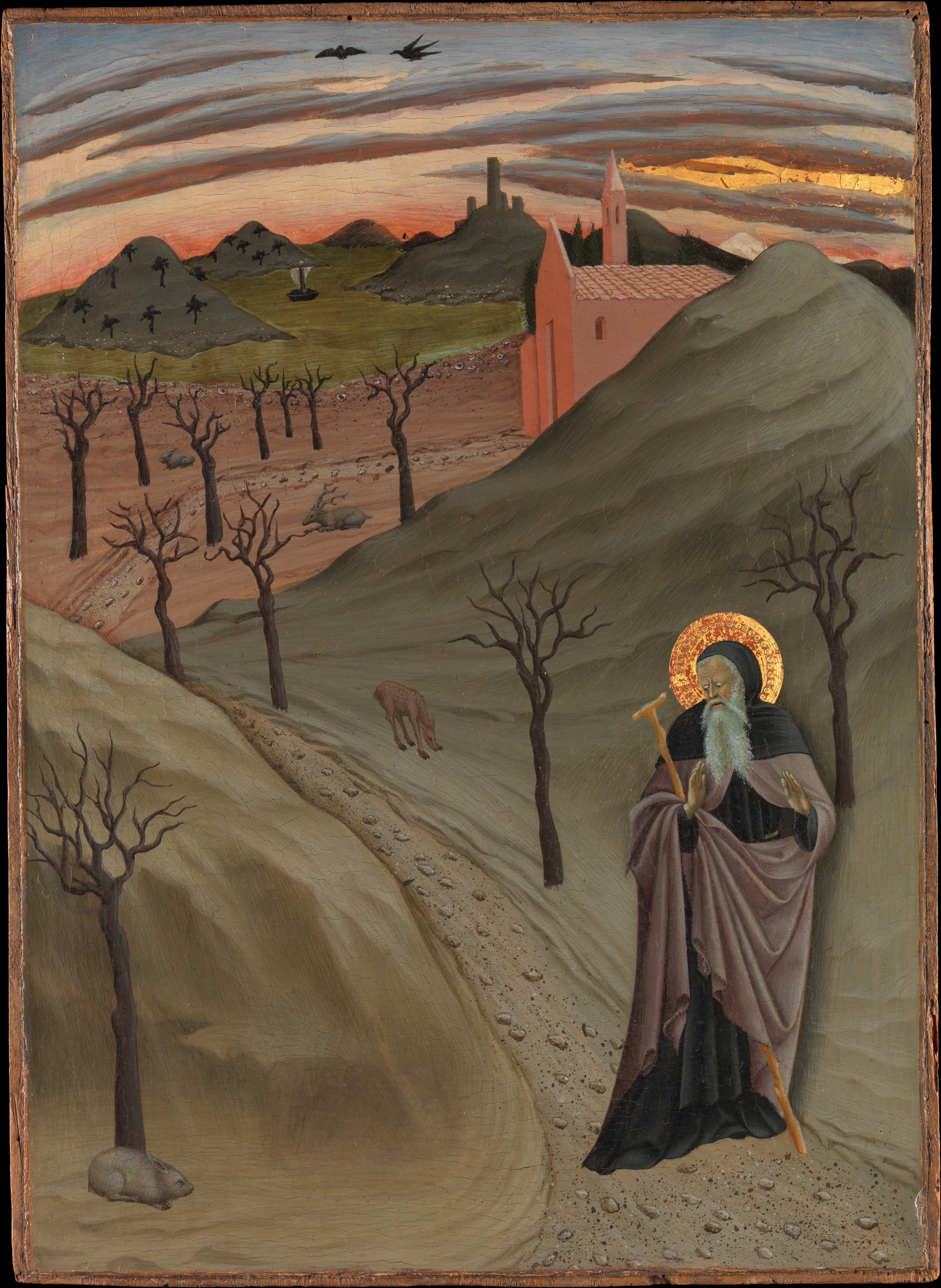
Sano di Pietro (Ansano di Pietro di Mencio) · The Metropolitan Museum of Art, New York · Robert Lehman Collection, 1975 · Public domain (CC0, Met Open Access)
- Born
- 1405 · Siena.
- Died
- 1481 · Siena.
- Nationality
- Republic of Siena
- Occupation
- painter · illuminator
- Movements
- Sienese school
- Teachers
- Sassetta
- Known for
- Saint Augustine · Saint Benedict · Nozze gentilizie · Coronation of Mary · Madonna with Saints · Life of Saint Bernardino
VALÉORINE Encyclopedia
VALÉORINE documentary reading
Documentary summary
Sano di Pietro or Ansano di Pietro di Mencio (1405–1481) was an Italian painter of the Sienese school of painting. He was active for about half a century during the Quattrocento period and his contemporaries included Giovanni di Paolo and Sassetta.
Admitted source layer · organised and presented by VALÉORINE
Note VALÉORINE
Sano di Pietro (1405–1481) was an illuminator and painter, a national of the Republic of Siena. The illuminator was born and died in Siena.
Sano di Pietro worked in Siena. The illuminator was associated with Sienese school.
Among the works are Coronation of Mary, Life of Saint Bernardino, Madonna with Saints and Nozze gentilizie, among others. Works are held at Art Institute of Chicago, Departmental Museum of archaeology Gilort (Jérôme) Carcopino and Metropolitan Museum of Art, among others.
Composed from admitted, traceable facts · 26 September 2026
VALÉORINE
Reference Check
Propose documentary evidence for Sano di Pietro. A contribution is never written directly as fact: identity, source, rights and evidence gates still decide.
Sign in to contribute
Documentary evidence
Documentary basis
Authority files
wikidata · Q1379714 · wikipedia · Sano di Pietro
In this article
Life
Life
Training under Sassetta is recorded. Places of work recorded in the authority are Siena. Works named in the authority record are Saint Augustine, Saint Benedict, Nozze gentilizie, Coronation of Mary, Madonna with Saints and Life of Saint Bernardino. Work by Sano di Pietro is recorded in the collections of Art Institute of Chicago, Nationalmuseum, Städel Museum, Metropolitan Museum of Art and Pinacoteca Nazionale, Siena.
Sano was born in 1405. His name entered the roll of painters in 1428 where it remained until his death in 1481. In addition to his own painting and overseeing the pupils and assistants in his workshop, Sano was part of the civic fabric of Siena; in 1431 and 1442 he was the leader of the San Donato district of Siena. Sano was also employed as an arbitrator; in 1475 he was called upon to settle a dispute between fellow painters Neroccio di Bartolommeo and Francesco di Giorgio Martini. However, he made a living as a painter. The workshop he ran produced a large number of artworks. He wasn't merely a painter of altarpieces. He also produced frescoes, miniatures, and book bindings. Sano died in 1481. His death notice read: • Pictor famosus et homo totus deditus Deo • A famous painter and a man wholly dedicated to God
Selected works
Selected works
• Illustration — The Angel of the Annunciation • Illustration — Madonna of Mercy • Illustration — Scenes from the Life of St Jerome • Illustration — Scenes from the Life of St Jerome • Illustration — Scenes from the Life of St Jerome • Illustration — Nativity (c. 1445) - Panel Pinacoteca, Vatican • Illustration — Flight to Egypt (c. 1445) - Panel Pinacoteca, Vatican • Gesuati Altarpiece - Pinacoteca Nazionale di Siena (with six predella panels in the Louvre) • Christ Carrying Cross, Philadelphia Museum of Art, Philadelphia • St Jerome (c. 1470) - Tempera on panel 95 x 51 cm. Museum of Fine Arts, Boston • Madonna and Child - Tempera on wood, Detroit Institute of Art, Detroit • Madonna and Christ Child with Saints - Tempera on wood, Lowe Art Museum, Coral Gables, Florida • Virgin and Christ Child with Saints Jerome and Bernardino of Siena, Museum of Fine Arts,Houston, Texas • Madonna and Christ Child with Saints, Denver Art Museum, Denver, Colorado
Predella of an altarpiece in five parts
Predella of an altarpiece in five parts
• Illustration — Birth of the Virgin (1448–52) - Tempera on wood, University of Michigan Museum of Art, Ann Arbor • Illustration — Presentation of the Virgin at the Temple (1448–52) - Tempera on wood, 32 x 46 cm. Pinacoteca, Vatican • Illustration — Return of the Virgin (1448–52) - Tempera on wood, 30 x 46 cm. Lindenau-Museum, Altenburg • Illustration — Marriage of the Virgin (1448–52) - Tempera on wood, 32 x 46 cm. Pinacoteca, Vatican • Illustration — Assumption of the Virgin (1448–52) - Tempera on wood, 32 x 47 cm. Lindenau-Museum, Altenburg
Work and production
Work and production
Works recorded as notable number 6: Saint Augustine, Saint Benedict, Nozze gentilizie, Coronation of Mary, Madonna with Saints and Life of Saint Bernardino.
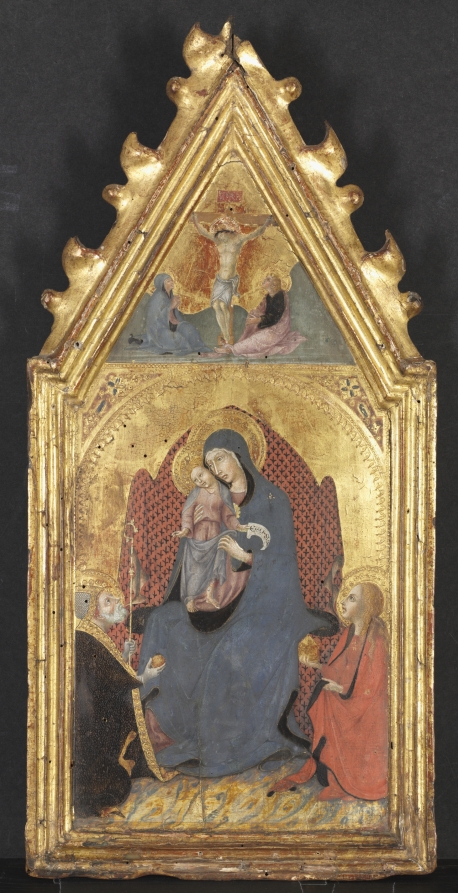
Virgin and Child Adored by Saints Mary Magdalene and Nicolas of Bari; Christ Crucified with the Virgin and Saint John the Evangelist, 1400s, by Sano di Pietro
Sano di Pietro · The Cleveland Museum of Art · Gift of Mrs. B. P. Bole, Mr. and Mrs. Guerdon S. Holden, Mrs. Windsor T. White, and the L. E. Holden Fund
Life and career
Dated record
Life and career
The full dated record · 2 entries
1405
Sano di Pietro born at Siena.
1481
Sano di Pietro died at Siena.
The Sienese School
• Illustration — Triptych of Madonna with Child, St. James and St. John the Evangelist. Brooklyn Museum of Art. • Illustration — Polittico in San Quirico d'Orcia's collegiata In the century before Sano's birth the Sienese school of painting had risen as a rival to that of the Florentines. The styles of the two schools were markedly different. Florence was said to be the more realistic of the two while Siena was said to be more fanciful. In fact the inscription above the Camopilla Gate leading into the city says; • Cor magis tibi Siena Pandit • Siena opens her heart still wider to thee Sienese painting was said to personify dreams. This can be seen in the hallmarks of the style of the Sienese School. Above all, the Sienese painters were known for their vibrant colors. They routinely used hues never seen in paintings before and rarely seen outside the city. They employed a richness of detail that can be quite unsettling for the first time viewer. The draperies of the clothing are elegant and numerous, but it is the patterns of the fabrics and the details on the necklines that can leave the viewer breathless. The paintings are at once sumptuous yet ethereal. This lightness of being displayed in the figures and even the landscapes themselves is the final hallmark of a painting from the Sienese School.
Reputation as a painter
In the 15th century in Siena, as elsewhere in Italy and Europe, he had his own workshop. In his workshop, he oversaw assistants and pupils that helped him finish the commissions he had received. Over 270 of Sano's works survived. It is one of the paradoxes about di Pietro that because he was so successful he is often overlooked. Many of his critics say that too many of his paintings resemble each other. However, he produced what the customer asked for, not what he might paint for himself. Many of these works were not produced by Sano alone. In his A History of Sienese Painting George Edgall writes: • "It should be pointed out, however, that the monotony • which one feels in looking at paintings labelled Sano • di Pietro is due to the workshop assistants." In his book, Sienese Quatrocento Painting, John Pope-Hennessey furthers the argument for the quality of Sano's own paintings. He says that when the viewer looks at a painting that has been attributed solely to di Pietro one can see his sensitivity and style. Sano was known for his use and mastery of color. One example of this is a polyptych made for the Church of the Gesuati. This painting is the first piece that can be attributed solely to him. The central figure of Mary is clad in a blue robe whose folds seem to shimmer with intensity. This intensity radiates out through the figures on either side of her. The second painting is "St. Bernardino Preaching in the Campo of Siena." In 1425, St. Bernardino gave seven sermons a day for seven weeks in the town square (campo) of Siena. Sano commemorated this event in his painting. The painting depicts a vast crowd at the center of town. The crowd is so large it seems to fall off the edge of the painting itself. The red of the clothing of St. Bernardino's audience seems to draw itself towards the pink of the building. Instead of clashing, these two colors complement each other. The warm colors are balanced by the blues in the sky and the canopy, both of which bisect the painting.
Collections
Sano di Pietro's paintings are housed in several institutions, including the National Gallery and the Cathedral Museum of Siena, the Pinacoteca Vaticana, the Brooklyn Museum of Art, the Lindenau-Museum of Altenburg, the Diocesan Museum of Pienza, the Clark Art Institute, the Museum of Fine Arts, Houston, the Museum of Fine Arts, Boston, the Detroit Institute of Arts, the Museum of Fine Arts, Budapest, the Birmingham Museum of Art, the Speed Art Museum, the Philadelphia Museum of Art, the Yale University Art Gallery, the Fitzwilliam Museum, the Musée des Beaux-Arts de Quimper, and the Pushkin State Museum of Fine Arts.
Notes from the source article
Cited by Wikipedia
Notes from the source article
These works are cited by the source article, in its own numbering. They are recorded as its citations, not as sources VALÉORINE has verified.
- 1.Brandi, Cesare. Tra Medioevo e Rinascimento: scritti sull'arte da Giotto a Jacopo della Quercia. Editoriale Jaca Book. 2006. 9788816407367.
- 2.van Marle, Raimond. The Italian School of Painting. Martinus Nijoff. 466. 1924.
- 3.Carli, Enzo. Sienese Painting. New York Graphis Society. 56. 1956.
- 4.Mather Jr., Frank Jewett. A History of Italian Painting. Holt, Rinehart and Winston. 59, 94. 1962.
- 5.George, George Harold. A History of Sienese Painting. L. MacVeagh. 211. 1932.
- 6.Cole, Bruce. Sienese Painting from its Origins to the Fifteenth Century. Harper and Row. 207. 1980.
- 7.Sallay, Dóra. Early Sienese paintings in Hungarian collections: 1420-1520. Central European University. 134. 2008.
- 8.Madonna and Child with Saints Jerome, John the Baptist, Bernardino and Bartholomew by. Artvee.
- 9.Brooklyn Museum. www.brooklynmuseum.org.
- 10.Virgin and Child. www.clarkart.edu.
- 11.Sano di Pietro: Virgin and Child with Saints Jerome and Bernardino of Siena and Six Angels.
- 12.Virgin and Child. collections.mfa.org.
- 13.Madonna and Child. www.dia.org.
- 14.Virgin and Child with Saint Jerome, Saint Bernardino of Siena and Two Angels. Museum of Fine Arts, Budapest.
- 15.Saint Benedict Birmingham Museum of Art.
- 16.The Initial M, with the Annunciation (page from an antiphonary). Speed Art Museum.
- 17.Christ Carrying the Cross. philamuseum.org.
- 18.Saint Anthony Abbot Tormented by Demons Yale University Art Gallery. artgallery.yale.edu.
- 19.making, ILLUMINATED: Manuscripts in the. MS 197 Leaves from Choir Books ILLUMINATED. www.fitzmuseum.cam.ac.uk.
- 20.Quimper, Museum of Fine Arts of the city of. Sano di Pietro The Virgin and Child. Museum of Fine Arts of the city of Quimper : Site Internet.
- 21.The Beheading of Saint John the Baptist. pushkinmuseum.art.
- 22.Exchange: The Nativity of the Virgin. exchange.umma.umich.edu.
Bibliography printed in the source article · 5
- Bernard Berenson, Essays in the Study of Sienese Painting (New York, F.F. Sherman, 1918).
- J. A. Crowe and G. B. Calvalcaselle, A History of Painting in Italy; Umbria, Florence and Siena from the Second to the Sixteenth Century (London, J. Murray, 1903).
- Timothy Hyman, Sienese Painting (New York, Thames and Hudson, 2003).
- Robert Oertel, Early Italian Painting to 1400 (New York, Frederick A. Praeger, 1968).
- Pope-Hennessy, John & Kanter, Laurence B. The Robert Lehman Collection I, Italian Paintings. The Metropolitan Museum of Art in association with Princeton University Press. 1987. 0870994794.
References
Citations
References
Each reference names the institution holding it, so a reader may go to the document itself.
reference work
Secondary witnessreference work
Secondary witness
The Encyclopedia exists whether or not anything is for sale. Corrections are recorded rather than overwritten, and every version of this record is kept. Published 17 August 2026.
Elsewhere in Paintings
18,452 published records in this field, each with its sources named.
- Sandra GamarraArtist
- Sandra RauchArtist
- Sandro BotticelliArtist
- Sanford Robinson GiffordArtist
- Sante CattaneoArtist
- Sante PerandaArtist
- Sante VandiArtist
- Santi MarcoArtist
Best supported in this field
For owners
Own a work by Sano di Pietro?
A specialist will read what you send and tell you what the house can establish, what it cannot, and whether the object is suited to sale. There is no charge and no obligation. The object stays with you throughout; nothing is shipped to us unless it is arranged in writing beforehand.