
quadriga
Illustration — Quadriga on the Austrian Parliament Building, Vienna A quadriga is a car or chariot drawn by four horses abreast and favoured for chariot racing in classical antiquity and the Roman Empire. The word derives from the Latin quadrigae, a contraction of quadriiugae, from quadri-: four, and iugum: yoke. In Latin the word quadrigae is almost always used in the plural and usually refers to the team of four horses rather than the chariot they pull.
quadriga

Brunswyk at German Wikipedia · Benutzer:Brunswyk · CC BY-SA 3.0 de
- Field
- horse-drawn vehicle · chariot
VALÉORINE Encyclopedia
VALÉORINE documentary reading
Documentary summary
Illustration — Quadriga on the Austrian Parliament Building, Vienna A quadriga is a car or chariot drawn by four horses abreast and favoured for chariot racing in classical antiquity and the Roman Empire. The word derives from the Latin quadrigae, a contraction of quadriiugae, from quadri-: four, and iugum: yoke. In Latin the word quadrigae is almost always used in the plural and usually refers to the team of four horses rather than the chariot they pull.
Admitted source layer · organised and presented by VALÉORINE
Note VALÉORINE
No house-authored Note is published until its assertions and sources pass the VALÉORINE evidence contract. The documentary article remains available in full while that enrichment is being consolidated.
Documentary enrichment in progress · no unsupported statement published
Reference Check
Propose documentary evidence for quadriga. A contribution is never written directly as fact: identity, source, rights and evidence gates still decide.
Sign in to contribute
World of VALÉORINE
Documentary connections
Only confirmed graph relationships appear here. Images are shown only when their identity and reuse rights both pass the documentary gate.


Documentary evidence
Evidence Panel
not yet certified
- Identity
- resolved
- Independent source families
- 0
- Admitted assertions
- 0
- Open conflicts
- 0
Authority files
gnd · 1065108044 · gnd · 1362804347 · wikidata · Q155987 · wikipedia · Quadriga
In this article
Variations
Variations
Though quadrigae were usually drawn by horses, occasionally, other animals or mythological creatures were employed in spectacles and in art. Elephants were sometimes used to draw quadrigae in the Roman imperial period, and more frequently elephant quadrigae were depicted on coins and other official images. In art and sculpture, quadrigae ridden in by the gods were appropriate to their characters; Neptune's quadriga was drawn, for example, by hippocampi (mythological sea-horses). • Illustration — The triumph of Neptune and Venus in a quadriga drawn by hippocampi in a mosaic from Utica in Africa, Bardo National Museum • Illustration — Venus riding in a quadriga drawn by elephants, 1st-century AD fresco from Pompeii • Illustration — Medallion of the co-augusti Diocletian and Maximian riding in a quadriga drawn by elephants and crowned by Victory • Illustration — Cybele and Attis riding on a quadriga drawn by lions on the 4th-century Parabiago plate, Archaeological Museum of Milan • Illustration — Buddy Bear Quadriga in Berlin, Kurfürstendamm 21
Modern quadrigas
Modern quadrigas
Some of the most significant full-size free-standing sculptures of quadrigas include, in approximate chronological order: • 1793 – The Berlin Quadriga was designed by Johann Gottfried Schadow in 1793 as the Quadriga of Victory, perhaps as a symbol of peace, represented by the olive wreath carried by Victory. Located atop the Brandenburg Gate in Berlin, Germany, it was seized by Napoleon during his occupation of Berlin in 1806, and taken to Paris. It was returned to Berlin by Field Marshal Gebhard von Blücher in 1814. Her olive wreath was supplemented with an Iron Cross. The statue suffered severe damage during the Second World War. The association of the Iron Cross with Prussian militarism convinced the Communist government of East Germany to remove this aspect of the statue after the war. The iron cross was restored after German reunification in 1990. • c. 1815 – The Carrousel quadriga is situated atop the Arc de Triomphe du Carrousel in Paris, France. The arch was built to commemorate the victories of Napoleon. The quadriga was sculpted by Baron François Joseph Bosio to commemorate the Restoration of the Bourbons. The restoration is represented by an allegorical goddess driving a quadriga, with gilded Victories accompanying it on each side. • 1819–1829 – The quadriga on the General Staff Building on the Palace Square in Saint Petersburg • 1828–1832 – The quadriga on the Alexandrinsky Theater, in Saint Petersburg • c. 1841 – The panther-driven quadriga on the Semperoper opera house in Dresden • 1845–1848 – The quadriga on top of Thorvaldsen Museum in Copenhagen by Herman Wilhelm Bissen and Stephan Ussing • Illustration — The quadriga driven by Apollo, a sculptural composition on the pediment of the Bolshoi Theatre, Moscow • c. 1850 – The quadriga on the Bolshoi, above the portico of the Bolshoi Theatre, designed by sculptor Peter Clodt von Jürgensburg • c. 1852 – The Siegestor (Victory Gate) in Munich is topped by a lion quadriga created by Martin von Wagner. • 1868 – The quadriga on the ducal palace in Braunschweig was destroyed in 1944 during the Second World War. It was reconstructed in 2008 and is considered the largest one in Europe. • 1888 – Quadriga de l'Aurora as part of the Font de la cascada that is in Parc de la Ciutadella, Barcelona. Erected by Josep Fontserè, with possible contributions by the young Antoni Gaudí. • 1893 – Columbus Quadriga atop the Peristyle Building, World's Columbian Exposition, Daniel Chester French, sculpture • 1895 – The quadriga of Brabant, situated on top from Parc du Cinquantenaire (1880–1905). Constructed to mark the 50 years of Belgian Independence, in Brussels, Belgium, was built by Thomas Vinçotte and Jules Lagae. • c. 1898 – Atop Soldiers' and Sailors' Arch at Grand Army Plaza in Brooklyn, New York, lady Columbia, an allegorical representation of the United States, rides in a chariot drawn by two horses. Two winged Victory figures, each leading a horse, trumpet Columbia's arrival. The sculptor was Frederick William MacMonnies. • c. 1900 – Two quadrigas on the Grand Palais in Paris, the work of French sculptor Georges Récipon • 1904 – Victory and Progress, horse-drawn chariots by J. Massey Rhind on the Wayne County Building in Detroit, Michigan, though each of the two chariots is drawn by three instead of the customary four horses. • Illustration — The Progress of the State quadriga, at the Minnesota State Capitol in Saint Paul, Minnesota • 1906 – Progress of the State at the Minnesota State Capitol is unique for being entirely covered in gold leaf, and is situated above a building entrance rather than a triumphal arch. It was sculpted by Daniel Chester French and Edward Clark Potter. • 1911–1935 – The Monument to Vittorio Emanuele II (Monument of Victor Emmanuel II, or Altare della Patria (Altar of the Nation), or Il Vittoriano) in Rome, Italy, features two statues of goddess Victoria riding on quadrigas. • 1912 – The Wellington Arch Quadriga is situated atop the Wellington Arch in London, England. It was designed by Adrian Jones. The sculpture shows a small boy, the son of Lord Michelham, the man who funded the sculpture, leading the quadriga, with Peace descending upon it from heaven. • 1919–1923 – The former Banco di Bilbao headquarters at no. 16 Calle de Alcalá in Madrid, now part of Banco Bilbao Vizcaya Argentaria, features two quadrigas on a commercial building. The building was designed by Ricardo Bastida, with the sculptor of the chariot Higinio Basterras, and other sculptures by Quentin de la Torre. The charioteers are helmeted men standing on the handrails of the chariots. Height to plinth: about 87 ft. • 1926 – The Palace of Justice in Rome, seat of the modern Supreme Court of Cassation, features a bronze quadriga by sculptor Ettore Ximenes. • 2002 – The Warsaw's Grand Theatre features a quadriga reflecting the original Antonio Corazzi's 1833 plans for the building, but not commissioned and executed until 2002. • 2020 — Kentucky State University unveiled statue replicas of the four Horses of Saint Mark which were positioned on a rise near the entrance to the university.
Gallery
Gallery
• Illustration — Brandenburg Gate Quadriga at night • Illustration — The Quadriga dell'Unità at Vittoriano, Rome • Illustration — Quadriga, Wellington Arch, London • Illustration — Brabant Raising the National Flag or Quadriga of Brabant, Parc du Cinquantenaire, Brussels • Illustration — Quadriga, Arc de Triomphe du Carrousel, Paris • Illustration — Quadriga, Grand Theatre, Warsaw • Illustration — Quadriga by Daniel Chester French, World's Columbian Exposition, 1893 • Illustration — The Seiugae of the Arch of Peace in Milan • Illustration — Quadriga in the Parc de la Ciutadella in Barcelona • Illustration — Wayne County Building, Detroit, Michigan, by J. Massey Rhind • Illustration — Soldiers' and Sailors' Arch Brooklyn, New York

The golden quadriga known as Progress of the State above an entrance to Minnesota State Capitol
Harvardton
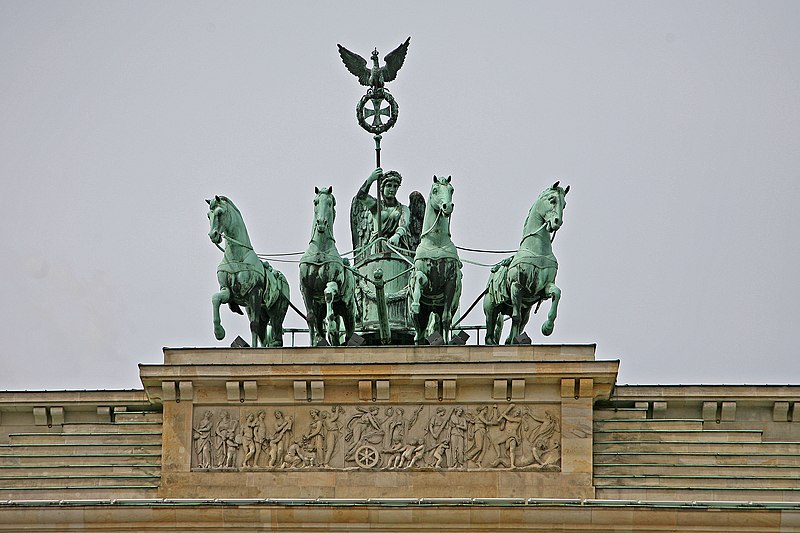
Berlin, Quadriga on the Brandenburg Gate. The Quadriga - based on the ancient model, a two-wheeled chariot with four horses and the goddess of victory Victoria - was created in 1793 by Johann Gottfried Schadow and the coppersmith Emanuel Jury.
W. Bulach
Classical sculpture
In Greek, a four-horse chariot was known as τέθριππον. The four-horse abreast arrangement in a quadriga is distinct from the more common four-in-hand array of two horses in the front plus two horses behind those. Quadrigae were raced in the ancient Olympic Games and other contests. They are represented in profile pulling the chariot of gods and heroes on Greek vases and in bas-relief. During the festival of the Halieia, the ancient Rhodians would sacrifice a quadriga-chariot by throwing it into the sea. The quadriga was adopted in ancient Roman chariot racing. Quadrigas were emblems of triumph. Victory or Fame are often depicted as the triumphant woman driving it. In classical mythology, the quadriga is the chariot of the gods. The god of the Sun Helios, often identified with Apollo, the god of light, was depicted driving his quadriga across the heavens, delivering daylight and dispersing the night.
Modern sculptural quadrigas are based on the four bronze Horses of Saint Mark or the "Triumphal Quadriga", a set of equine Roman or Greek sculptures. Their age is disputed. Originally erected in the Hippodrome of Constantinople, possibly on a triumphal arch, they are now in St Mark's Basilica in Venice. Venetian Crusaders looted these sculptures in the Fourth Crusade, which dates them to at least 1204, and placed them on the terrace of St Mark's Basilica. In 1797, Napoleon carried the quadriga off to Paris. They were returned after Napoleon's fall. Due to the effects of atmospheric pollution, the original quadriga was retired to a museum and replaced with a replica in the 1980s. Quadrigae also appear on the frieze of the Libyco-Punic Mausoleum of Dougga, which dates to the 2nd century BC. • Illustration — The original Horses of Saint Mark inside St Mark's Basilica, Venice • Illustration — Helios in his chariot, early 4th century BC, Athena's temple, Ilion • Illustration — Lucanian fresco from Paestum depicting a quadriga, 340–330 BC (National Archaeological Museum of Paestum) • Illustration — A Lucanian fresco from Paestum depicting a quadriga, 4th century BC • Illustration — A frieze on the 2nd-century BC Libyco-Punic Mausoleum of Dougga • Illustration — Jupiter and Minerva riding a quadriga drawn by pegasi on a 4th-century BC gold Etruscan bulla, Museo Gregoriano Etrusco • Illustration — A relief of a quadriga of Sun god Surya at Bodh Gaya, India • Illustration — Marcus Aurelius celebrating his Roman triumph in 176 AD over the enemies of the Marcomannic Wars, from his now destroyed triumphal arch in Rome, Capitoline Museums, 176–180 AD • Illustration — Apollo as the Sun god. Cast of the sarcofago matti (c. 220 AD), Museum of Roman Civilization • Illustration — Detail from a plaster cast of the late 4th-century so-called Sarcophagus of Stilicho, Museum of Roman Civilization • Illustration — Genesis: "And Pharaoh … made him to ride in the second chariot which he had; and they cried before him, bow the knee: and he made him ruler over all the land of Egypt." Miniature from the Paris Gregory, a 9th-century Greek manuscript, Bibliothèque nationale de France • Illustration — An 11th-century rook from Southern Italy in the form of Charlemagne in a quadriga, from the Charlemagne chessmen, Cabinet des Médailles
Primary material
Documents and archives
authority file
- Gemeinsame Normdatei 1065108044, Quadriga.
Unverified · Deutsche Nationalbibliothek
- Gemeinsame Normdatei 1362804347, Quadriga.
Unverified · Deutsche Nationalbibliothek
reference work
- “Quadriga”, English Wikipedia, consulted as further reading
Reputable secondary · Wikipedia
institutional register
- Wikidata, structured authority record Q155987: quadriga
Unverified · Wikimedia Foundation
Notes from the source article
Cited by Wikipedia
Notes from the source article
These works are cited by the source article, in its own numbering. They are recorded as its citations, not as sources VALÉORINE has verified.
- 1.According to Aulus Gellius 19.8, Julius Caesar considered it incorrect to use the word in the singular.
- 2.Lewis and Short Latin Dictionary, s.v. quadrigae.
- 3.Liddell, Scott, Jones Greek Lexicon, s.v. τέθριππος.
- 4.Farnell, Lewis, The Cults of the Greek States Vol. ΙV, Cambridge University Press, 2010, , p. 20, note b.
- 5.Smith, s.v. Helios
- 6.Annual Report of the American Scenic and Historic Preservation Society to the Legislature of the State of New York, Volume 18, by American Scenic and Historic Preservation Society, 1913, page 344.
- 7.A Point of View: The European dream has become a nightmare. BBC News. 18 May 2012.
- 8.Brandenburg Gate. Berlin – Offizielles Stadtportal der Hauptstadt Deutschlands – Berlin.de.
- 9.World's Columbian Exposition : Photographic Archive : The University of Chicago.
- 10.Sprague, Elmer, Brooklyn Public Monuments: Sculpture for Civic Memory and Urban Pride, Dog Ear Publishing, Indianapolis, IN, 2008 p. 76.
- 11.Rhind, John Massey. Victory and Progress. 31 May 2018.
- 12.Historic Adventures. mnhs.org.
- 13.KSU unveils rare replica of Quattro Cavalli statue. State Journal. August 24, 2020.
References
Citations
References
Each reference names the institution holding it, so a reader may go to the document itself.
authority file
Gemeinsame Normdatei 1065108044, Quadriga.Deutsche Nationalbibliothek
Partially resolvedauthority file
Gemeinsame Normdatei 1362804347, Quadriga.Deutsche Nationalbibliothek
Partially resolvedreference work
Partially resolvedinstitutional register
Wikidata, structured authority record Q155987: quadrigaWikimedia Foundation
Unverified
The Encyclopedia exists whether or not anything is for sale. Corrections are recorded rather than overwritten, and every version of this record is kept. Published 14 August 2026.
Elsewhere in Militaria
6,095 published records in this field, each with its sources named.
- QLZ-87B/QLB-06 grenade launcherTerminology
- QRSAMTerminology
- QSW-06Terminology
- QSZ-92Terminology
- quarrelTerminology
- quarterstaffTerminology
- Quds missileTerminology
- Queen Anne pistolTerminology
Best supported in this field
For owners
Own an object connected with quadriga?
A specialist will read what you send and tell you what the house can establish, what it cannot, and whether the object is suited to sale. There is no charge and no obligation. The object stays with you throughout; nothing is shipped to us unless it is arranged in writing beforehand.