
Ratha
Illustration — Krishna, Arjuna at Kurukshetra, 18th- to 19th-century painting. Ratha (Proto-Indo-Iranian: *Hrátʰas, Vedic Sanskrit: रथ; Avestan: raθa) is the Indo-Iranian term for a spoked-wheel chariot. The term has been used since antiquity for both fast chariots and other wheeled vehicles pulled by animals or humans, in particular the large temple cars or processional carts still used in Indian religious processions to carry images of a deity.
Ratha

Self · Public domain
- Field
- chariot.
VALÉORINE Encyclopedia
VALÉORINE documentary reading
Documentary summary
Illustration — Krishna, Arjuna at Kurukshetra, 18th- to 19th-century painting. Ratha (Proto-Indo-Iranian: *Hrátʰas, Vedic Sanskrit: रथ; Avestan: raθa) is the Indo-Iranian term for a spoked-wheel chariot. The term has been used since antiquity for both fast chariots and other wheeled vehicles pulled by animals or humans, in particular the large temple cars or processional carts still used in Indian religious processions to carry images of a deity.
Admitted source layer · organised and presented by VALÉORINE
Note VALÉORINE
No house-authored Note is published until its assertions and sources pass the VALÉORINE evidence contract. The documentary article remains available in full while that enrichment is being consolidated.
Documentary enrichment in progress · no unsupported statement published
Reference Check
Propose documentary evidence for Ratha. A contribution is never written directly as fact: identity, source, rights and evidence gates still decide.
Sign in to contribute
World of VALÉORINE
Documentary connections
Only confirmed graph relationships appear here. Images are shown only when their identity and reuse rights both pass the documentary gate.

Documentary evidence
Evidence Panel
not yet certified
- Identity
- resolved
- Independent source families
- 0
- Admitted assertions
- 0
- Open conflicts
- 0
Authority files
getty · 500779755 · wikidata · Q177336 · wikipedia · Ratha
In this article
Harappan Civilisation
Harappan Civilisation
• Illustration — Copper sculpture of a bull-cart and rider, from a hoard at Daimabad, Maharashtra - Late Harappan, c2000 BCE The Indus Valley Civilization sites of Daimabad and Harappa in the Indian subcontinent, there is evidence for the use of terracotta model carts as early as 3500 BC during the Ravi Phase. There is evidence of wheeled vehicles (especially miniature models) in the Indus Valley Civilization, but not of chariots. According to Kenoyer, The earliest Copper-Bronze Age carts remains that have been found at Sinauli have been dated to 1900 BCE, which were interpreted by some as horse-pulled "chariots", predating the arrival of the horse-centred Indo-Aryans. Others object, noting that solid wheels belong to carts, not chariots. The late Harappan site of Pirak, Pakistan, has to date offered the earliest evidence of true horses in South Asia, from c. 1700 BC.
Proto-Indo-Iranians
Proto-Indo-Iranians
• Illustration — The area of the spoke-wheeled chariot finds within the Sintashta-Petrovka culture is indicated in purple. Horse-drawn chariots, as well as its cult and associated rituals, were spread by the Indo-Iranians, and horses and horse-drawn chariots were introduced in India by the Indo-Aryans. The earliest evidence for chariots in southern Central Asia (on the Oxus river) dates to the Achaemenid period (apart from chariots harnessed by oxen, as seen on petroglyphs). No Andronovian chariot burial has been found south of the Oxus.
Remains
Remains
There are a few depictions of chariots among the petroglyphs in the sandstone of the Vindhya Range. Two depictions of chariots are found in Morhana Pahar, Mirzapur. One shows a team of two horses, with the head of a single driver visible. The other one is drawn by four horses, has six-spoked wheels, and shows a driver standing up in a large chariot box. This chariot is being attacked, with a figure wielding a shield and a mace standing at its path, and another figure armed with a bow and arrow threatening its right flank. It has been suggested (Sparreboom 1985:87) that the drawings record a story, most probably dating to the early centuries BC, from some center in the area of the Ganges–Yamuna plain into the territory of still neolithic hunting tribes. The drawings would then be a representation of foreign technology, comparable to the Arnhem Land Aboriginal rock paintings depicting Westerners. The very realistic chariots carved into the Sanchi stupas are dated to roughly the 1st century BCE.
In Hindu temple festivals
In Hindu temple festivals
Ratha or Rath also means a large, often very large, wheeled cart made of wood, on which the murti of a deity is carried in religious processions, some of which are very important festivals. The Ratha may be pulled by devotees with rope, or pulled by horses or elephants. Rathas are used mostly by the Hindu temples of South India for Rathoutsava (Temple car festival). During the festival, the temple deities are driven through the streets, accompanied by the chanting of mantra, shloka or bhajan. Ratha Yatra is a huge Hindu festival associated with Lord Jagannath held at Puri in the Indian state of Odisha during the months of June or July. • Illustration — The Rath Jatra in the Grand Avenue at the Jagannath Temple, Puri, 2007. • Illustration — The Towering Rajagopuram with one of the Temple Rathas • Illustration — The Great Thear (ஆழித் தேர்) of Sri Thyagarajaswami, Tiruvarur • Illustration — The Rath Yatra in Puri in modern times showing the three chariots of the deities with the Temple in the background • Illustration — Picture of Tirunelveli Nellaiappar Temple Golden Ratha • Illustration — Temple car (decorated), Sri Krishna temple, Udupi, Karnataka, India • Illustration — ISKCON Rath Yatra at Thiruvananthapuram, India. • Illustration — Tiruvarur The largest Temple Ratha car in Tamil Nadu • Illustration — Srivilliputtur Andal Ther - 2nd largest Temple Rath in Tamil Nadu • Illustration — Tirunelveli Nellaiappar Temple Car - 3rd largest Temple Ratha in Tamil Nadu • Illustration — Temple Ratha in Colombo, Sri Lanka • Illustration — Temple Ratha in Chennai, India • Illustration — Rath Yatra festival in New York City organized by ISKCON • Illustration — Construction of ratha • Illustration — Banashankari Amma Temple's wooden Ratha, Badami, Karnataka • Illustration — Decorated Ratha, Mundkur, Udupi District, Karnataka. • Illustration — Rato Machhindranath Jatra at Lalitpur, Nepal • Illustration — Chariot of Jagadishpur, in West Bengal.
Rathas buildings
Rathas buildings
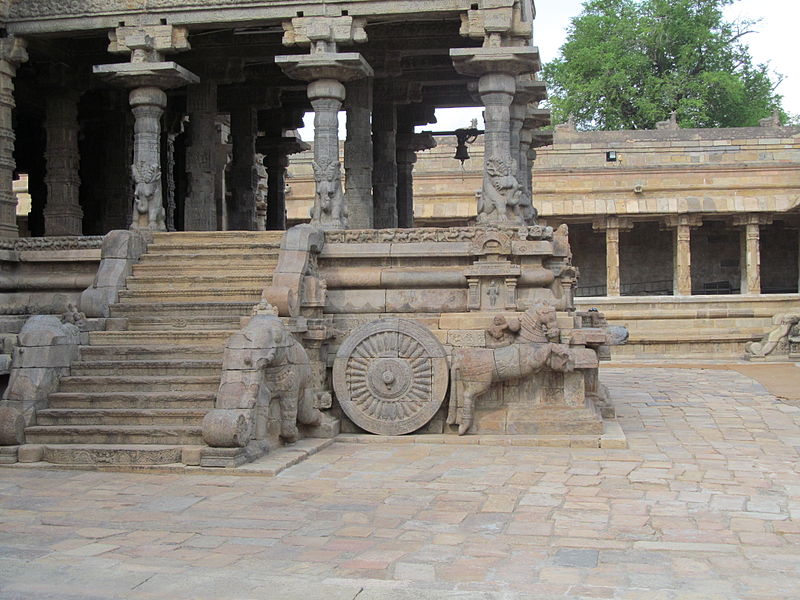
In some Hindu temples, there are shrines or buildings named rathas because they have the shape of a huge chariot or because they contain a divinity as does a temple chariot. The most known are the Pancha Rathas (=5 rathas) in Mahabalipuram, although not with the shape of a chariot. Another example is the Jaga mohan of the Konark Sun Temple in Konarâk, built on a platform with twelve sculptures of wheels, as a symbol of the chariot of the Sun. • Illustration — 'Five Rathas' at Mamallapuram, Tamil Nadu. • Illustration — Sculpture of an elephant drawn ratha, Hampi, Karnataka • Illustration — Airavatesvara Temple sanctum in the form of a chariot, Darasuram, Tamil Nadu • Illustration — Temple chariot of the Airavatesvara Temple in Darasuram, Tamil Nadu • Illustration — Konark Sun Temple Ratha wheel
Rathas in architecture
Rathas in architecture
• Illustration — Plans of the main types of buildings with rathas In Hindu temple architecture, a ratha is a facet or vertical offset projections on the tower (generally a Shikhara).
This is a photo of ASI monument number
Wiki.sivanandam

Przystanek Woodstock in 2015.
Ralf Lotys (Sicherlich)
Primary material
Documents and archives
reference work
- “Ratha”, English Wikipedia, consulted as further reading
Reputable secondary · Wikipedia
- Wikidata, structured authority record Q177336: Ratha
Reputable secondary · Wikidata
authority file
- Getty Union List of Artist Names 500779755, Ratha, Binod Bihari.
Unverified · The Getty Research Institute
Textual evidence
Textual evidence
• Illustration — Rama goes to the forest on a ratha. Chariots figure prominently in the Rigveda, evidencing their presence in India in the 2nd millennium BCE. Notably, the Rigveda differentiates between the Ratha (chariot) and the Anas (often translated as "cart"). Rigvedic chariots are described as made of the wood of salmali (Bombax ceiba; RV 10.85.20), Khadira and Simsapa (RV 3.53.19) trees. While the number of wheels varies, chariot measurements for each configuration are found in the Shulba Sutras. Chariots also feature prominently in later texts, including the other Vedas, the Puranas and the great epics of the Ramayana and Mahabharata. Indeed, most Hindu deities are portrayed as riding them. Among Rigvedic deities, notably Ushas "Dawn" rides in a chariot, as well as Agni in his function as a messenger between gods and men. In RV 6.61.13, the Sarasvati River is described as being wide and speedy like a chariot.
Notes from the source article
Cited by Wikipedia
Notes from the source article
These works are cited by the source article, in its own numbering. They are recorded as its citations, not as sources VALÉORINE has verified.
- 1.Bryant 2001
- 2.Kenoyer, Jonathan Mark. Rad und Wagen: Der Ursprung einer Innovation Wagen im Vorderen Orient und Europa. Verlagg Philipp von Zabem. 2004.
- 3.Ghosh, Baivab. The Identity of Aryan Culture (With Diagram). History Discussion - Discuss Anything About History. 2014-10-07.
- 4.Cf. Raulwing 2000
- 5.I. e., "Outside of linguistics there's no hope."
- 6.Raulwing 2000:83
- 7.Cf. Henri Paul Francfort in Fussman, G.; Kellens, J.; Francfort, H.-P.; Tremblay, X. (2005), p. 272-276
- 8.They were not used for warfare. H. P. Francfort, Fouilles de Shortugai, Recherches sur L'Asie Centrale Protohistorique Paris: Diffusion de Boccard, 1989, p. 452. Cf. Henri Paul Francfort in Fussman, G.; Kellens, J.; Francfort, H.-P.; Tremblay, X. (2005), p.272
- 9.H. P. Francfort in Fussman, G.; Kellens, J.; Francfort, H.-P.; Tremblay, X. (2005), p. 220 - 272; H.-P. Francfort, Fouilles de Shortugai
- 10.A discussion of the difference between ratha and anas is found e.g. in Kazanas, Nicholas. 2001. The AIT and Scholarship
- 11.Lochtefeld, James G. The Illustrated Encyclopedia of Hinduism: N-Z. Rosen. 567. 2002. 978-0-8239-3180-4.
Bibliography printed in the source article · 10
- Edwin Bryant (2001). The Quest for the Origins of Vedic Culture. Oxford University Press.
- Daniyal, Shoaib. Putting the horse before the cart: What the discovery of 4,000-year-old 'chariot' in UP signifies. Scroll.in. 14 June 2018.
- Flood, Gavin D. An Introduction to Hinduism. Cambridge University Press. 1996.
- Fussman, G.; Kellens, J.; Francfort, H.-P.; Tremblay, X. (2005). Aryas, Aryens et Iraniens en Asie Centrale. Institut Civilisation Indienne
- Kuz'mina. The Origin of the Indo-Iranians. Brill. 2007. 9789047420712.
- Olson, Carl. The Many Colors of Hinduism: A Thematic-historical Introduction. Rutgers University Press. 2007.
- Parpola, Asko. Royal "Chariot" Burials of Sanauli near Delhi and Archaeological Correlates of Prehistoric Indo-Iranian Languages. Studia Orientalia Electronica. 8. 176. 2020. 10.23993/store.98032.
- Peter Raulwing (2000). Horses, Chariots and Indo-Europeans, Foundations and Methods of Chariotry Research from the Viewpoint of Comparative Indo-European Linguistics. Archaeolingua, Series Minor 13, Budapest.
- Vasudha Venugopal ET bureau, https://economictimes.indiatimes.com/news/politics-and-nation/mahabharata-much-older-say-asi-archaeologists/articleshow/71658119.cms Mahabharata much older, say ASI Archaeologists , The Economic Times
- Witzel, Michael. Early 'Aryans' and their neighbors outside and inside India. Journal of Biosciences. 44. 3. 2019. 10.1007/s12038-019-9881-7.
References
Citations
References
Each reference names the institution holding it, so a reader may go to the document itself.
reference work
Partially resolvedauthority file
Getty Union List of Artist Names 500779755, Ratha, Binod Bihari.The Getty Research Institute
Partially resolvedreference work
Partially resolved
The Encyclopedia exists whether or not anything is for sale. Corrections are recorded rather than overwritten, and every version of this record is kept. Published 14 August 2026.
Elsewhere in Militaria
6,095 published records in this field, each with its sources named.
- rapierTerminology
- RARDENTerminology
- Rast-Gasser M1898Terminology
- rat-shotTerminology
- Rattan shieldTerminology
- Raven Arms MP-25Terminology
- raygunTerminology
- Raytheon CoyoteTerminology
Best supported in this field
For owners
Own an object connected with Ratha?
A specialist will read what you send and tell you what the house can establish, what it cannot, and whether the object is suited to sale. There is no charge and no obligation. The object stays with you throughout; nothing is shipped to us unless it is arranged in writing beforehand.