
Qassam rocket
The Qassam rocket (Ṣārūkh al-Qassām; also Kassam) is a simple, steel artillery rocket developed and deployed by the Izz ad-Din al-Qassam Brigades, the military arm of Hamas. Since the rocket was first manufactured in 2001 by Tito Masoud and Nidal Farhat, three models of the Qassam rocket have been produced and used. More generally, all types of Palestinian rockets fired into southern Israel, for example the Palestinian Islamic Jihad Al Quds rockets, are called Qassams by the Israeli media, and often by foreign media.
Qassam rocket
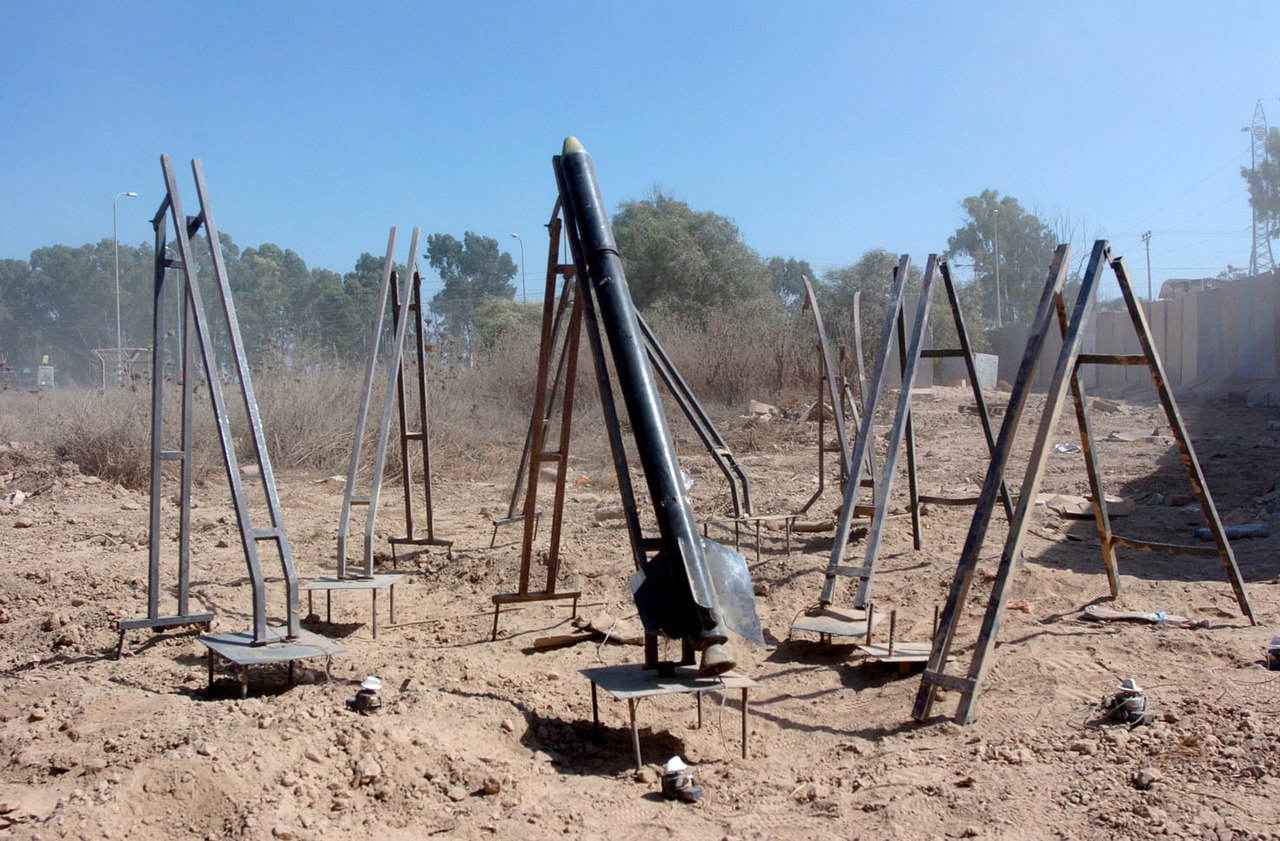
Israel Defense Forces · Eight Qassam Launchers in Gaza · CC BY-SA 2.0
- Name
- Qassam
- Field
- surface-to-surface missile · short-range ballistic missile · rocket artillery
VALÉORINE Encyclopedia
VALÉORINE documentary reading
Documentary summary
The Qassam rocket (Ṣārūkh al-Qassām; also Kassam) is a simple, steel artillery rocket developed and deployed by the Izz ad-Din al-Qassam Brigades, the military arm of Hamas. Since the rocket was first manufactured in 2001 by Tito Masoud and Nidal Farhat, three models of the Qassam rocket have been produced and used. More generally, all types of Palestinian rockets fired into southern Israel, for example the Palestinian Islamic Jihad Al Quds rockets, are called Qassams by the Israeli media, and often by foreign media.
Admitted source layer · organised and presented by VALÉORINE
Note VALÉORINE
No house-authored Note is published until its assertions and sources pass the VALÉORINE evidence contract. The documentary article remains available in full while that enrichment is being consolidated.
Documentary enrichment in progress · no unsupported statement published
Reference Check
Propose documentary evidence for Qassam rocket. A contribution is never written directly as fact: identity, source, rights and evidence gates still decide.
Sign in to contribute
Documentary evidence
Evidence Panel
not yet certified
- Identity
- resolved
- Independent source families
- 0
- Admitted assertions
- 0
- Open conflicts
- 0
Authority files
wikidata · Q333739 · wikipedia · Qassam rocket
In this article
Overview
Overview
Leading international human rights organizations have called Palestinian armed groups' use of Qassam rockets against civilians and civilian targets a war crime and a violation of international law. Many of the rocket's components are made of common materials such as sugar, fertilizer, firearms cartridges, springs, nails, and steel cylinders.
Key facts
Key facts
• Is Missile — yes • Name — Qassam • Designer — Izz ad-Din al-Qassam Brigades • Design Date — 2001 • Manufacturer — Palestinian militants • Production Date — 2001–current • Used By — Palestinian militants • Wars — Gaza–Israel conflict • Propellant — Solid fuel (sugar and potassium nitrate mix) • Filling — Explosive material with metal bearing balls; standard explosive material
Name
Name
Qassam rockets are named after the Izz ad-Din al-Qassam Brigades, the armed branch of Hamas, itself named for Izz ad-Din al-Qassam, a Syrian Muslim preacher whose death during a guerrilla raid against British Mandatory authorities in 1935 was one of the catalysts for the 1936–39 Arab revolt in Palestine.
Manufacture and deployment
Manufacture and deployment
Tito Masoud and Nidal Farhat manufactured the first Qassam-1 rocket, with a 2,500m range, in June 2001. This development in rocket manufacturing and development was a turning point in the war between Palestinian armed factions and Israel. The first Qassam produced was the Qassam-1, with a maximum range of 3 to. Hamas launched the first Qassam-1 rocket attack in October 2001, during the Second Intifada. The first time Palestinians launched rockets into Israel, rather than at an Israeli settlement in the Gaza Strip, occurred on February 10, 2002. One of the rockets landed in Kibbutz Saad. Two Qassam rockets landed in the southern Israeli city of Sderot, the first city hit, on March 5, 2002. Some rockets have hit as far as the edge of Ashkelon. By the end of December 2008, a total of 15 people had been killed by Palestinian rockets since attacks began in 2001. Since 2000, Palestinian rockets, which include the Qassam, alongside others such as the Grad rocket, have been used to kill 22 Israeli citizens and one Thai national (as of January 9, 2009).
Israeli
Israeli
• Illustration — A Qassam rocket is displayed in Sderot town hall against a background of pictures of residents killed in rocket attacks The introduction of the Qassam rocket was unexpected by Israeli politicians and military experts, and reactions have been mixed. In 2006, the Israeli Ministry of Defense viewed the Qassams as "more a psychological than physical threat." A 2008 study found that over half of Sderot's residents have been hurt, either physically or psychologically, by the use of Qassams. The Israel Defense Forces has reacted to the deployment of the Qassam rockets by deploying the Red Color early warning system in Sderot, Ashkelon, and other potential targets placed at risk. The system consists of an advanced radar that detects rockets as they are being launched, and loudspeakers warn civilians to take cover between 15 and 45 seconds before impact in an attempt to minimize the threat posed by the rockets. A system called Iron Dome, designed to intercept the rockets before they can hit their targets, has been in use since March 2011. A system based on lasers (Nautilus) was researched in a joint Israeli-American project in the early 2000s, but was discontinued. An online clock timer, developed by Aaron Friedman and Yehonatan Tsirolnik, that automatically resets when Palestinian rocket attacks on Israel occur uses information from the IDF Home Front Command system and counts time up from the last Palestinian rocket attack on Israel. It displays how long Israel has been rocket-free and shows the summed-up total numbers of Palestinian rocket attacks on Israel. "Israel has been under non-stop rocket attacks for years (..) Whenever a rocket is fired, it restarts. Sadly, this counter never really gets above an hour", Friedman said on July 18, 2014, during the 2014 Israel–Gaza conflict.
Palestinian
Palestinian
In 2012, Palestinian president Mahmoud Abbas stated "There is no justification for rockets from Gaza or anywhere else," adding that "Rocket attacks are in vain because they do not bring peace any closer."
Human rights groups
Human rights groups
Amnesty International labeled Palestinian groups' use of rockets during the 2014 Gaza war as a "war crime", stating that "Palestinian armed groups operating in the Gaza Strip fired thousands of indiscriminate rockets and mortars into Israel; firing munitions which cannot be aimed accurately into civilian areas is a war crime, and statements by Hamas and Palestinian armed groups also indicates that some attacks were intended to kill or injure civilians." Amnesty additionally "has documented that Palestinian armed groups have stored munitions in and fired indiscriminate rockets from residential areas in the Gaza Strip, and available evidence indicates that they continue to do both during the current hostilities, in violation of international humanitarian law (..) Under international humanitarian law, (..) Parties to the conflict must also take necessary precautions to protect civilians in their power from the effects of attack. This includes avoiding, to the maximum extent feasible, co-locating military objectives in the vicinity of densely populated civilian neighbourhoods. This means the parties should avoid endangering civilians by storing ammunition in, and launching attacks from, populated civilian areas." Human Rights Watch has called the use of Qassam rockets by Hamas against civilians and civilian targets illegal under international law. In a 2005 statement, the group said that "such weapons are therefore indiscriminate when used against targets in population centers. The absence of Israeli military forces in the areas where rockets have hit, as well as statements by leaders of Palestinian armed groups that population centers were being targeted, indicate that the armed groups deliberately attacked Israeli civilians and civilian objects." In another 2005 statement, the group noted that as the ruling authority of Gaza, Hamas was obligated to uphold the laws of war and should appropriately punish those responsible for serious violations". The international community considers indiscriminate attacks on civilians and civilian structures that do not discriminate between civilians and military targets as illegal under international law.:
Description
• Illustration — Rockets being exhibited The Qassam rocket is the best-known type of rocket deployed by Palestinian militants, mainly against Israeli civilians, but also some military targets during the Second Intifada of the Israeli–Palestinian conflict. According to Human Rights Watch, Qassam rockets are too inaccurate and prone to malfunction to be used against specific military targets in or near civilian areas, and are mainly launched for the purpose of "harming civilians". The utility of the Qassam rocket design is assumed to be ease and speed of manufacture, using common tools and components. To this end, the rockets are propelled by a solid mixture of sugar and potassium nitrate, a common fertilizer. The warhead is filled with smuggled or scavenged TNT and urea nitrate, another common fertilizer. The warhead's explosive material is similar to the civilian explosive ammonite. The rocket consists of a steel cylinder, containing a rectangular block of the propellant. A steel plate which forms and supports the nozzles is then spot-welded to the base of the cylinder. The warhead consists of a simple metal shell surrounding the explosives, and is triggered by a fuse constructed using a simple firearm cartridge, spring and a nail. Early designs used a single nozzle which screwed into the base; later rockets use a seven-nozzle design, with the nozzles drilled directly into the rocket baseplate. This alteration both increases the tolerance of the rocket to small nozzle design defects, and makes manufacture easier by allowing the use of a drill rather than a lathe during manufacture (because of the smaller nozzle size). Unlike many other rockets, the nozzles are not canted, which means the rocket does not spin about its longitudinal axis during flight. While this results in a significant decrease in accuracy, it greatly simplifies manufacture and the launch systems required. The cost of the materials used for manufacturing each Qassam was up to $800 or €500 per rocket in 2009.
Primary material
Documents and archives
reference work
- “Qassam rocket”, English Wikipedia, consulted as further reading
Reputable secondary · Wikipedia
authority record
- Wikidata, structured authority record Q333739: Qassam rocket
Unverified · Wikidata
References
Citations
References
Each reference names the institution holding it, so a reader may go to the document itself.
reference work
Partially resolvedauthority record
Unverified
Connections
Knowledge graph
Connections
Each connection was recorded deliberately, with the basis for it kept on the internal record.
Broader subject
2- rocket artilleryTerminology
Established from a fact already recorded on a verified source.
- short-range ballistic missileTerminology
Established from a fact already recorded on a verified source.
Further particulars
Held on the record
Further particulars
Open the remaining particulars
Qassam rocket is connected to 3 other published records in the VALÉORINE Encyclopedia.
Within the Encyclopedia
The Encyclopedia exists whether or not anything is for sale. Corrections are recorded rather than overwritten, and every version of this record is kept. Published 14 August 2026.
Elsewhere in Militaria
6,095 published records in this field, each with its sources named.
- PZA LoaraTerminology
- QaderTerminology
- Qare'aTerminology
- QasedTerminology
- Qassem BassirTerminology
- QauataTerminology
- QBB-95Terminology
- QBS-09Terminology
Best supported in this field
For owners
Own an object connected with Qassam rocket?
A specialist will read what you send and tell you what the house can establish, what it cannot, and whether the object is suited to sale. There is no charge and no obligation. The object stays with you throughout; nothing is shipped to us unless it is arranged in writing beforehand.