
multiple rocket launcher
Illustration — M142 HIMARS launching a GMLRS rocket at the White Sands Missile Range in 2005 A multiple rocket launcher (MRL) or multiple launch rocket system (MLRS) is a type of rocket artillery system that contains multiple launchers which are fixed to a single platform, and shoots its rocket ordnance in a fashion similar to a volley gun. Rockets are self-propelled in flight and have different capabilities than conventional artillery shells, such as longer effective range, lower recoil, typically considerably higher payload than a similarly sized gun artillery platform, or even carrying multiple warheads. Unguided rocket artillery is notoriously inaccurate and slow to reload compared to gun artillery.
Also recorded as MRL · multiple launch rocket system · MLRS
multiple rocket launcher
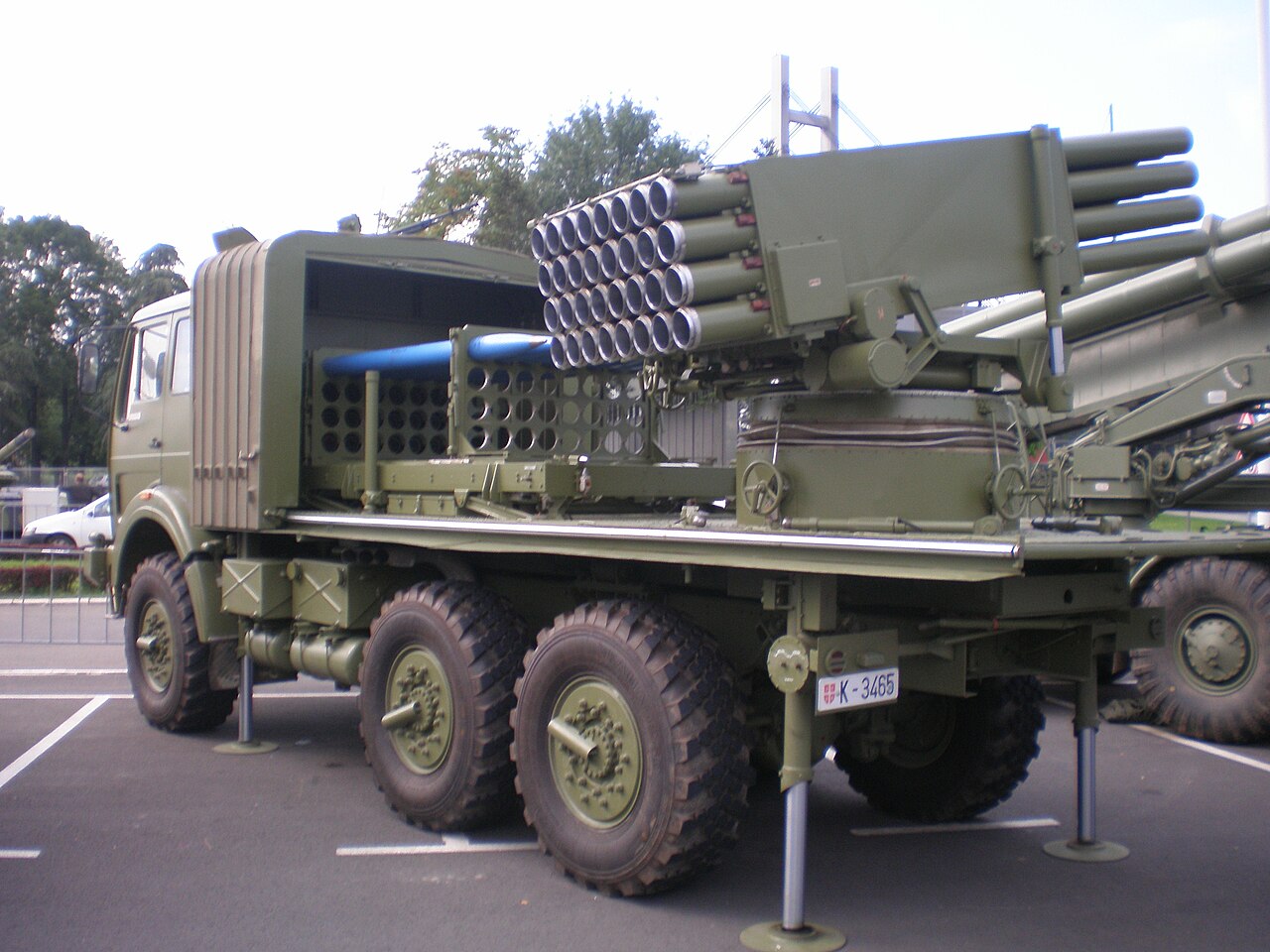
Srđan Popović · CC BY-SA 4.0
- Field
- rocket artillery.
VALÉORINE Encyclopedia
VALÉORINE documentary reading
Documentary summary
Illustration — M142 HIMARS launching a GMLRS rocket at the White Sands Missile Range in 2005 A multiple rocket launcher (MRL) or multiple launch rocket system (MLRS) is a type of rocket artillery system that contains multiple launchers which are fixed to a single platform, and shoots its rocket ordnance in a fashion similar to a volley gun. Rockets are self-propelled in flight and have different capabilities than conventional artillery shells, such as longer effective range, lower recoil, typically considerably higher payload than a similarly sized gun artillery platform, or even carrying multiple warheads. Unguided rocket artillery is notoriously inaccurate and slow to reload compared to gun artillery.
Admitted source layer · organised and presented by VALÉORINE
Note VALÉORINE
No house-authored Note is published until its assertions and sources pass the VALÉORINE evidence contract. The documentary article remains available in full while that enrichment is being consolidated.
Documentary enrichment in progress · no unsupported statement published
Reference Check
Propose documentary evidence for multiple rocket launcher. A contribution is never written directly as fact: identity, source, rights and evidence gates still decide.
Sign in to contribute
World of VALÉORINE
Documentary connections
Only confirmed graph relationships appear here. Images are shown only when their identity and reuse rights both pass the documentary gate.

Broader Term · incoming
30 cm Nebelwerfer 42
Term
This image was provided to Wikimedia Commons by the German Federal Archive (Deutsches Bundesarchiv) as part of a cooperation project . The German Federal Archive guarantees an authentic representation
Broader Term · incoming
Al-Najm al-Thaqib
Term

Broader Term · incoming
BM-14
Term
http://www.kskdivniy.ru/museum/

Broader Term · incoming
BM-21 Grad
Term
This image, which was originally posted to Picasa Web Albums , was reviewed on 9 May 2011 by the administrator or reviewer Tm , who confirmed that it was available on Picasa Web Albums under the above

Broader Term · incoming
BM-27 Uragan
Term
http://vitalykuzmin.net/?q=node/563

Broader Term · incoming
BM-30 Smerch
Term
Ru-Wikipedia, initial image was here

Broader Term · incoming
BMD-20
Term
Own work

Broader Term · incoming
Bofors 375 mm Rocket Launcher
Term
Own work

Broader Term · incoming
Falaq-1
Term
http://gallery.military.ir/albums/userpics/10187/_DSC3328.jpg

Broader Term · incoming
Falaq-2
Term
https://tasnimnews.ir/2534377
Broader Term · incoming
FIROS
Term
Broader Term · incoming
GMARS
Term
Broader Term · incoming
Jobaria Defense Systems Multiple Cradle Launcher
Term

Broader Term · incoming
K136 Kooryong
Term
2015.6.1 제8군단 해상사격 Firing Exercise Multiple Rocket Launcher, Republic of Korea Army 8th Corps

Broader Term · incoming
K239 Chunmoo
Term
YouTube : https://www.youtube.com/watch?v=G5_uVT97jGw t=250s – View/save archived versions on archive.org – The source is archived here ( - WayBack Machine)

Broader Term · incoming
Katyusha
Term
originally posted to Flickr as Katyusha Rocket Launcher - Artillery Museum - St. Petersburg - Russia
Documentary evidence
Evidence Panel
not yet certified
- Identity
- resolved
- Independent source families
- 0
- Admitted assertions
- 0
- Open conflicts
- 0
Authority files
wikidata · Q506219 · wikipedia · Multiple rocket launcher
In this article
History
History
A multiple rocket launcher helps compensate for this with its ability to launch multiple rockets in rapid succession, which, coupled with the large kill zone of each warhead, can easily deliver saturation fire over a target area. However, modern rockets can use GPS or inertial guidance to combine the advantages of rockets with the higher accuracy of precision-guided munitions.
• Illustration — An illustration of a handheld multiple rocket launcher constructed of basketry, as depicted in the 11th century book Wujing Zongyao of the Song dynasty • Illustration — Korean Joseon hwacha multiple rocket launcher (designed in 1409) in a museum The first multiple rocket launchers, known as Huo Che, were invented during the medieval Chinese Song dynasty, in which the Chinese fire lance was fixed backward on a pike or arrow and shot at an enemy as early as 1180.[1] This form of rocket was used during the Siege of Kaifeng (1232).[2] Chinese militaries later created multiple rocket launchers that fired up to 100 small fire-arrow rockets simultaneously. The typical powder section of the arrow-rockets was 1/3 to 1/2 ft (10 to 15 cm) long. Bamboo arrow shafts varied from 1.5 ft (45 cm) to 2.5 ft (75 cm) long and the striking distance reached 300 to 400 paces. The Chinese also enhanced rocket tips with poison and made sure that the launchers were mobile. They designed a multiple rocket launcher to be carried and operated by a single soldier. Various forms of MRLs evolved, including a launcher mounted on a wheelbarrow. The Joseon dynasty of Korea used an expanded variant of such a launcher (called a hwacha) made of 100 to 200 holes containing rocket arrows placed on a two-wheeled cart. The range of the fired arrows is estimated to have been 2,000 meters. The hwacha was used to great effect against invading armies during the Japanese invasions of 1592–1598, most notably the Battle of Haengju,[3] in which 40 hwachas were deployed to repel 30,000 Japanese soldiers.[4] European armies preferred relatively large single-launch rockets prior to World War II. Napoleonic armies of both sides followed the British adoption of Mysorean rockets as the Congreve rocket. These were explosive steel-cased bombardment rockets with minimal launchers. European navies developed naval multiple launcher mounts with steadily improving explosive rockets for light and coastal vessels. These weapons were largely replaced by conventional light artillery during the late nineteenth century. • Illustration — A painting showing the British forces confronted with Mysorean rockets
World War II
World War II
• Illustration — BM-13 Katyusha (in service since 1941) • Illustration — American T34 Calliope (designed in 1943) in action • Illustration — A German Panzerwerfer Sd.Kfz. 4 captured by the British during the Invasion of Normandy in 1944 • Illustration — Video of firing BM-27 Uragan in Russian service, 23 August 2018 The first self-propelled MRLs—and arguably the most famous—was the Soviet BM-13 Katyusha, first used during World War II and exported to Soviet allies afterwards. They were simple systems in which a rack of launch rails was mounted on the back of a truck. This set the template for modern MRLs. The Americans mounted tubular launchers atop M4 Sherman tanks to create the T34 Calliope rocket launching tank, only used in small numbers, as their closest equivalent to the Katyusha. The Germans began using a towed six-tube multiple rocket launcher during World War II, the Nebelwerfer, called the "Screaming Mimi" by the Allies. The system was developed before the war to skirt the limitations of the Treaty of Versailles. Later in the war, 15 cm Nebelwerfer 41s were mounted on modified Opel Maultier "Mule" halftracks, becoming Panzerwerfer 42 4/1s. Another version produced in limited numbers towards the end of the war was a conversion of the Schwerer Wehrmachtschlepper ("heavy military transport", sWS) halftrack to a configuration similar to the Panzerwerfer 42 4/1, mounting the 10-barreled 15 cm Nebelwerfer. Another German halftrack MRL system was inspired by the Russian BM-13. Keeping the Soviet 82 mm rocket caliber as well as the launch and rocket stabilisation designs, it was developed into a system of two rows of 12 guide rails mounted to a Maultier chassis, each row providing the capacity for 24 rockets, underslung as well as on top of the rails, for 48 rockets total. This vehicle was designated 8 cm Raketen-Vielfachwerfer (8 cm multiple rocket launcher). As the launch system was inspired by and looked similar to the BM-13, which the Germans had nicknamed "Stalin-Orgel" or "Stalin-Organ", the Vielfachwerfer soon became known as the "Himmler-Orgel", or "Himmler-Organ".
Types
Types
There are two main types of MRLs: • With tubes or pipes, usually made of steel, non-removable from launcher, with options to be reloaded on the battlefield with rockets loaded manually or semi-automatically. This was the most usual type until the 21st century. It is more convenient for battlefield usage because it does not require special tools to reload modules and test them before using them on launchers as with other types. • With containers, pods or modules that can be removed from the launcher and quickly replaced with same or different types of rockets and calibers. They are usually reloaded at a factory or within specially-equipped army workshops. These are more modern types of weapons as they are not necessarily related to just one type of rocket and give more options to commanders in the field to deal with different tactical situations using different types of rockets or to quickly reload. They are also easier to upgrade for different types of rockets.
Current usage
Current usage
Like all artillery, MRLs have a reputation of devastating morale on ill-disciplined or already-shaken troops.[5] The material effect depends on circumstances, as well-covered field fortifications may provide reasonable protection. • Illustration — Multiple Rocket Launcher System used by the Syrian Opposition Forces in July 2017 MRLs are still unable to properly engage reverse slope positions in mountain warfare because it is more difficult to determine the trajectory compared to that of a howitzer by adding or removing propellant increments. Simple MRL rocket types have a rather long minimum firing range for the same reason. An approach to lessen this limit is the addition of drag rings to the rocket nose. The increased drag slows the rocket down relative to a clean configuration and creates a less flat trajectory. Pre-packaged MRL munitions do not offer this option but some MRL types with individually loaded rockets do.[6] Improvised MRLs based on helicopter or aircraft-mounted rocket pods (typically of 57–80mm caliber) especially on light trucks and pickups (so-called "technicals") are often seen in civil wars when rebels make use of captured launchers and munitions.[7] Modern MRL systems can use modern land navigation (especially satellite navigation such as GPS) for quick and accurate positioning. The accurate determination of the battery position previously required such effort that making a dispersed operation of the battery was at times impractical. MRL systems with GPS can have their MRLs dispersed and fire from various positions at a single target, just as previously multiple batteries were often united on one target area. Radar may be used to track weather balloons to determine winds or to track special rockets that self-destruct in the air. The tracking allows determination of the influence of winds and propellant temperatures on the rockets' flight paths. These observations can then be factored into the firing solution for the rocket salvo for effect. Such tracking radars can also be used to predict the range error of individual rockets. Trajectory-correcting munitions may then benefit from this, as a directional radio may send a coded message to the rocket to deploy air brakes at just the right time to correct most of the range error. This requires that the rockets were originally aimed too far, as the range can only be shortened by the air brakes, not extended. A more sophisticated system makes use of radar data and a one-way radio datalink to initiate a two dimensional (range and azimuth) correction of the rocket's flight path with steering by fins or nose thrusters. The latter is more common with systems which can be used to upgrade old rockets and the IMI ACCULAR[8] is an example. • Illustration — Heavy flamethrower system TOS-1A MRL capable of using thermobaric warheads, mounted on a T-72 tank chassis, in action Fin-stabilised rockets also allow for easy course corrections using rudders or minute charges. Precision-guided munitions have been introduced to exploit this. Guidance principles such as satellite navigation, inertial navigation systems and semi-active laser seekers are used for this. This improves dispersion from a CEP of hundreds of meters at dozens of kilometers' range to just a few meters and largely independent of the range of the round (except for INS, as INS navigation creates a small dispersion that is about proportional to range). This in turn made great increases of rocket (or missile) ranges useful; previously dispersion had made rockets too inefficient and often too dangerous to friendly troops at long ranges. Long-range MRL missiles often fly a higher quasi-ballistic trajectory than shorter-ranged rockets and thus pose a de-confliction challenge, as they might collide with friendly aircraft in the air. The differences between an MRL missile and a large anti-tank guided missile, such as the Nimrod, have blurred due to guided MRL missiles such as the M31 GMLRS (guided unitary multiple launch rocket system), which passed flight tests in 2014.[9]
Primary material
Documents and archives
institutional register
- Internet Archive holdings naming multiple rocket launcher
Unverified · Internet Archive
- Wikidata, structured authority record Q506219: multiple rocket launcher
Unverified · Wikimedia Foundation
reference work
- “Multiple rocket launcher”, English Wikipedia, consulted as further reading
Reputable secondary · Wikipedia
Notes from the source article
Cited by Wikipedia
Notes from the source article
These works are cited by the source article, in its own numbering. They are recorded as its citations, not as sources VALÉORINE has verified.
- 1.James, Peter J. Ancient Inventions. Ballantine Books. 238. 1995. 978-0345401021.
- 2.Gruntman, Mike. Blazing the Trail: The Early History of Spacecraft and Rocketry. American Institute of Aeronautics. 5–6. 2005. 978-1563477058.
- 3.Time-Life. What Life was Like in the Land of the Dragon. 1998. 978-0783554587.
- 4.Ramsey, Syed. Tools of War: History of Weapons in Early Modern Times. Alpha Edition. 2016. 978-9386101679.
- 5.Prenatt, Jamie. Katyusha Russian Multiple Rocket Launchers 1941-Present. Osprey Publishing. 4. 2016.
- 6.Jane's Armour and Artillery 2011-2012 data sheets
- 7.Armament Research Services. Improvised Employment of S-5 Air-to-Surface Rockets in Land Warfare: A brief history and technical appraisal. 2014.
- 8.Richardson, Doug. Israel Military Industries exhibits reborn Accular guided rocket.
- 9.Lockheed Martin. Guided MLRS Unitary Rocket. 11 August 2014.
References
Citations
References
Each reference names the institution holding it, so a reader may go to the document itself.
institutional register
Internet Archive holdings naming multiple rocket launcherInternet Archive
Partially resolvedreference work
Partially resolvedinstitutional register
Wikidata, structured authority record Q506219: multiple rocket launcherWikimedia Foundation
Unverified
Connections
Knowledge graph
Connections
Each connection was recorded deliberately, with the basis for it kept on the internal record.
Broader subject
12- BM-21 GradTerminology
Established from a fact already recorded on a verified source.
- Falaq-1Terminology
Established from a fact already recorded on a verified source.
- Jobaria Defense Systems Multiple Cradle LauncherTerminology
Established from a fact already recorded on a verified source.
- KatyushaTerminology
Established from a fact already recorded on a verified source.
- KN-09Terminology
Established from a fact already recorded on a verified source.
- LRSVM TamnavaTerminology
Established from a fact already recorded on a verified source.
Further particulars
Held on the record
Further particulars
Open the remaining particulars
Multiple rocket launcher is connected to 50 other published records in the VALÉORINE Encyclopedia.
The Encyclopedia exists whether or not anything is for sale. Corrections are recorded rather than overwritten, and every version of this record is kept. Published 14 August 2026.
Elsewhere in Militaria
6,095 published records in this field, each with its sources named.
- MTs-116MTerminology
- MTs-255Terminology
- Mughal ArtilleryTerminology
- Multi Caliber Individual Weapon System (MCIWS)Terminology
- multiple-barrel firearmTerminology
- Murata rifleTerminology
- Musgrave PistolTerminology
- musketTerminology
Best supported in this field
For owners
Own an object connected with multiple rocket launcher?
A specialist will read what you send and tell you what the house can establish, what it cannot, and whether the object is suited to sale. There is no charge and no obligation. The object stays with you throughout; nothing is shipped to us unless it is arranged in writing beforehand.