
Prospero Fontana
Prospero Fontana (1512–1597) was an Italian painter of late Renaissance and Mannerist art. He is perhaps best known for his frescoes and architectural detailing. The speed in which he completed paintings earned him commissions where he worked with other prominent artists of the period.
Also recorded as Prospero Fontana Bolognese · Fontana · Prosper Fontana · P. Fontana
Prospero Fontana
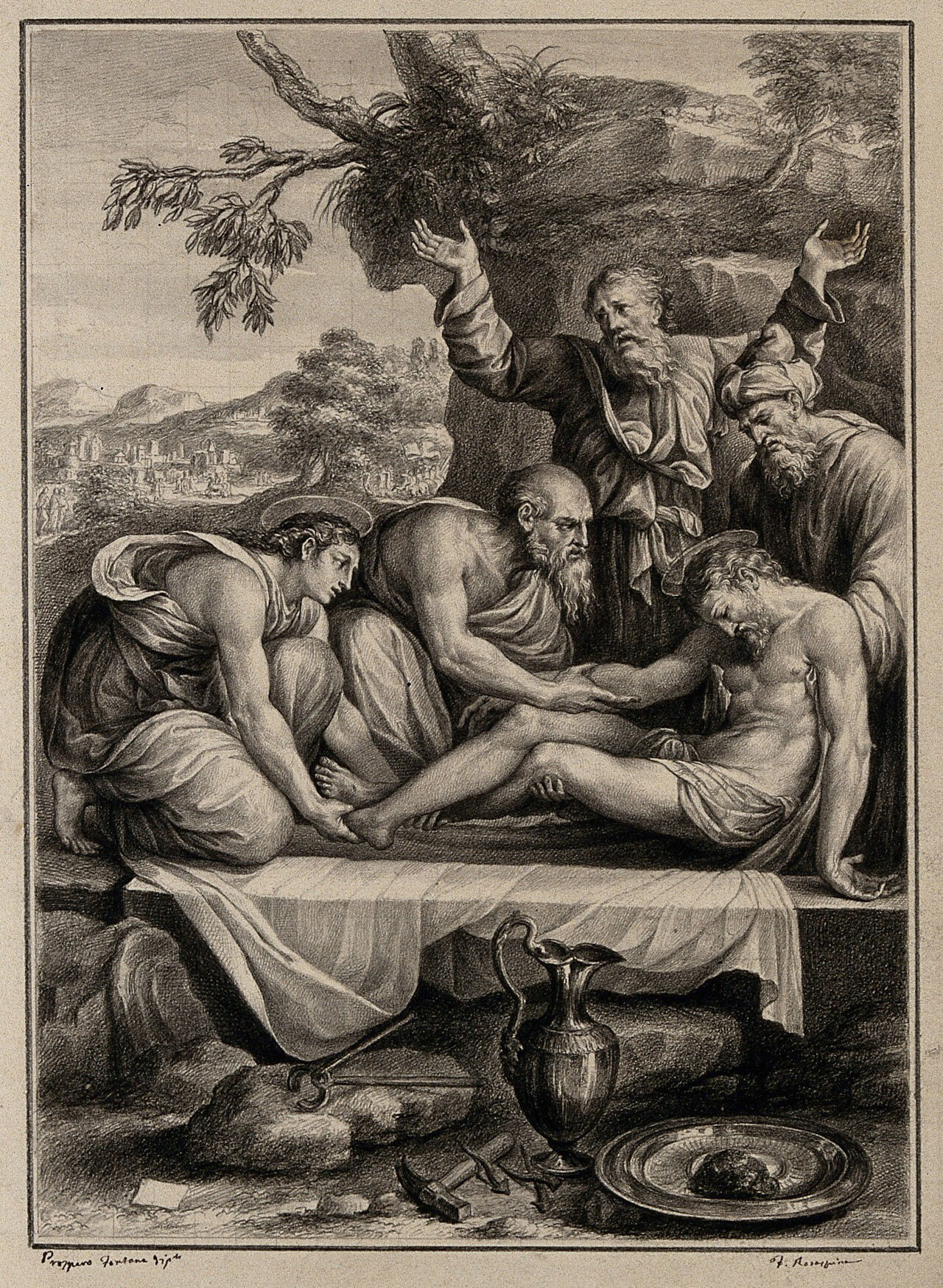
Prospero Fontana · Wellcome Collection, London · Wellcome Collection · Public Domain Mark
- Name
- Prospero Fontana
- Born
- 1512
- Birthplace
- Bologna
- Died
- 1597
- Field
- Painting
- Movement
- Mannerism
- Education
- Innocenzo da Imola
- Elected
- Accademia delle Arti del Disegno
- Occupation
- painter
- Fields
- painting · Mannerism · portrait
- Teachers
- Innocenzo di Pietro Francucci da Imola
- Known for
- Adoration of the Magi · Entombment of Christ
VALÉORINE Encyclopedia
VALÉORINE documentary reading
Documentary summary
Prospero Fontana (1512–1597) was an Italian painter of late Renaissance and Mannerist art. He is perhaps best known for his frescoes and architectural detailing. The speed in which he completed paintings earned him commissions where he worked with other prominent artists of the period.
Admitted source layer · organised and presented by VALÉORINE
Reference Check
Propose documentary evidence for Prospero Fontana. A contribution is never written directly as fact: identity, source, rights and evidence gates still decide.
Sign in to contribute
World of VALÉORINE
Documentary connections
Only confirmed graph relationships appear here. Images are shown only when their identity and reuse rights both pass the documentary gate.
Documentary evidence
Documentary basis
Authority files
wikidata · Q460751 · wikipedia · Prospero Fontana
In this article
Biography
Biography
He was a prominent figure in the city of Bologna, serving as official arbitrator in the business disputes of local artists. In his later career Fontana trained younger painters, including his own daughter Lavinia.
Training under Innocenzo di Pietro Francucci da Imola is recorded. Agostino Carracci, Ludovico Carracci and Denys Calvaert are recorded as having studied under Prospero Fontana. The recorded working language is Italian. The field of work recorded is painting, Mannerism and portrait. Subjects and genres recorded for the work are portrait. Works named in the authority record are Adoration of the Magi and Entombment of Christ. Work by Prospero Fontana is recorded in the collections of Minneapolis Institute of Art, National Gallery of Victoria, Nationalmuseum, Art Gallery of New South Wales and Capitoline Museums.
Key facts
Key facts
• Name — Prospero Fontana • Born — 1512 • Birthplace — Bologna • Died — 1597 • Place of death — Bologna • Field — Painting • Movement — Mannerism • Education — Innocenzo da Imola • Patrons — Pope Julius III • Elected — Accademia delle Arti del Disegno • Illustration — Prospero Fontana, The Deposition, 1563, oil on poplar panel, Art Gallery of New South Wales • Illustration — Holy Family with the Infant St. John the Baptist, c. 1548–51, oil on panel.
Professional life
Professional life
Prospero Fontana was likely taught by Innocenzo di Pietro Francucci da Imola, but there is a degree of uncertainty surrounding the relationship between the two men. As a teenager, Fontana was an assistant on Perino del Vaga's Palazzo Doria in Genoa. However, art historians cannot definitively identity Fontana's contributions to the decorations. In the 1550s, Fontana painted Pope Julius III's portrait and was pensioned at the pontifical court. He also decorated the Palazzo di Firenze for the Pope's brother, Balduino del Monte. During his time in Rome, he collaborated with Taddeo Zuccaro on the Villa Giulia in Rome (1553). J. A. Gere suggests that Fontana supervised the project and was responsible for the paintings in the North Room. Fontana worked with Giorgio Vasari on a few commissions, which are briefly described in the Lives of the Most Excellent Painters, Sculptors and Architects. Vasari notes that Fontana was unable to complete his work on the Chateau of Fontainebleau (1560) in France due to a health issue. Finished collaborative work includes the Palazzo Vecchio in Florence (1563–1565). Florian Härb observes the similarities between several of Vasari's drawings and Fontana's larger paintings, which indicate that the drawings were the basis for much of Fontana's commissions. There are multiple explanations offered by Härb and Charles Davis, including Fontana's admiration of Vasari's style and prominence in Renaissance Italy. In 1565, Fontana was elected to the Accademia delle Arti del Disegno in Florence. In 1576, Fontana was one of several artists and intellectuals consulted by Cardinal Gabriele Paleotti in the debate over the reformation of religious art. Pellegrino Tabaldi and Fontana worked on the Cappella Poggi in S Giacomo Maggiore in Bologna. Towards the end of his career, Fontana opened a school of art in Bologna. Some of his most notable students were Ludovico Carracci, Agostino Carracci, Lorenzo Sabbatini, and Denys Calvaert. In Bologna, Fontana served as an arbitrator and resolved professional disputes. Robert W. Gaston explains that this was a prestigious position at the time. Fontana died in Bologna in 1597. The altarpiece of the Adoration of the Magi, in the church of Santa Maria delle Grazie, is considered to be his masterpiece. A large quantity of his work remains in Bologna.
Style
Style
Fontana was well known for the speed in which he completed commissions. Carlo Cesare Malvasia criticized him for being careless and unprofessional. His early style is considered conservative. He gradually incorporated elements of Mannerism into his style after working with prominent artists of the movement. He is an early representative of the Bolognese school of painting. His style has been compared to that of Paolo Veronese.
Major works
Major works
• Holy Family with the Infant Saint John the Baptist, 1545, oil on canvas — Church of Santa Maria del Baraccano, Bologna • Beata Diana Andalò professing with Saint Dominic, 1545, oil on panel — San Domenico, Bologna • Disputa di Santa Caterina, 1551, oil on panel, 361 x 178 cm — Santa Maria del Baraccano, Bologna • Julius III, 1553, oil on panel — Biblioteca Universitaria, Bologna
Personal life
Personal life
Prospero's father, Silvio Fontana, was a stonemason. Prospero married Antonia de Bonardis in 1539. They had two daughters, Emilia and Lavinia. Emilia died in 1568, just five years after her wedding to Floriano Bertelli. Prospero taught his surviving daughter Lavinia how to paint in his workshop.
Identity
Identity
Prospero Fontana is recorded as painter.
Life and career
Dated record
Life and career
Explore 1512–1600
The full dated record · 3 entries
1512
Prospero Fontana was born in 1512 at Bologna.
1597
Prospero Fontana died in 1597 at Rome.
1600
frescos by Taddeo Zuccari and Prospero Fontana in Villa Giulia is dated 1600.
Places
Named by the record
Places
Only places the record itself states, plotted where the house gazetteer settles their coordinates. Nothing is inferred from a name or a nationality.
Bologna.
Birth place
Rome.
Death place
Artistic influences
The majority of the artists who trained and collaborated with Fontana were heavily influenced by Raphael. He also looked to the work of Antonio da Correggio, Sebastiano del Piombo, and Giulio Romano.
Primary material
Documents and archives
reference work
- Wikidata, structured authority record Q460751: Prospero Fontana
Reputable secondary · Wikimedia Foundation
- “Prospero Fontana”, English Wikipedia, consulted as further reading
Reputable secondary · Wikipedia
scholarly publication
- Prospero Fontana pittore-scenografo a Bologna (1543), Drammaturgia, 2014
Scholarly · Crossref registry · 2014
Notes from the source article
Cited by Wikipedia
Notes from the source article
These works are cited by the source article, in its own numbering. They are recorded as its citations, not as sources VALÉORINE has verified.
- 1.Gaston, Robert W. Prospero Fontana's Holy Family with saints. Art Journal. National Gallery of Victoria. 19. July 2, 2014.
- 2.Flick, Gert-Rudolf. Masters & Pupils: The Artistic Succession from Perugino to Manet, 1480-1880. Hogarth Arts. 94–5. 2008. 978-09554063-2-4.
- 3.Flick, Gert-Rudolf. Masters & Pupils: The Artistic Succession from Perugino to Manet, 1440-1880. Hogarth Arts. 78. 2008. 978-09554063-2-4.
- 4.Gere, J. A. The Decoration of the Villa Giulia. Burlington Magazine. 107. 745. 201–2, 205. April 1965. 874535.
- 5.Vasari, Giorgio. The Lives of the Most Excellent Painters, Sculptors, and Architects. VI.
- 6.Härb, Florian. Prospero Fontana Alias Giorgio Vasari: Collaboration and the Limits of Authorship. Francesco Salviati e la Bella Maniera. 577–608. 1998.
- 7.Grove's Dictionaries, Inc. Encyclopedia of Italian Renaissance & Mannerist Art. I: Abacco to Lysippus. 561. 2000. 978-0-333-76094-9.
- 8.Fortunati, Vera. Lavinia Fontana of Bologna 1552-1614. Electa. 14. 1998. 978-88-435-6394-4.
- 9.Flick, Gert-Rudolf. Masters & Pupils: The Artistic Succession from Perugino to Manet, 1480-1880. Hogarth Arts. 94–5. 2008. 978-09554063-2-4.
- 10.Fortunati, Vera. Lavinia Fontana of Bologna 1552-1614. Electa. 13. 1998. 978-88-435-6394-4.
- 11.Fontana family (ii) Grove Art. www.oxfordartonline.com. 10.1093/gao/9781884446054.article.t028831.
- 12.Murphy, Caroline P. Lavinia Fontana: A Painter and Her Patrons in Sixteenth-Century Bologna. Yale University Press. 16. 2003. 978-0-300-09913-3.
- 13.Murphy, Caroline P. Lavinia Fontana: A Painter and Her Patrons in Sixteenth-Century Bologna. Yale University Press. 19. 2003. 978-0-300-09913-3.
References
Citations
References
Each reference names the institution holding it, so a reader may go to the document itself.
scholarly publication
Institutional witnessreference work
Wikidata, structured authority record Q460751: Prospero FontanaWikimedia Foundation
Secondary witnessreference work
Secondary witness
Further particulars
Held on the record
Further particulars
Open the remaining particulars
He trained under Innocenzo di Pietro Francucci da Imola. Each of those relationships is stated by the authority record rather than inferred from style.
His recorded language was Italian. One child is recorded: Lavinia Fontana.
Identity and origins
Recognition and collections
Work by Prospero Fontana is
Minneapolis Institute of Art, National Gallery of Victoria, Nationalmuseum and Art Gallery of New South Wales
The Encyclopedia exists whether or not anything is for sale. Corrections are recorded rather than overwritten, and every version of this record is kept. Published 14 August 2026.
Elsewhere in Paintings
19,183 published records in this field, each with its sources named.
- Prosper BarbotArtist
- Prosper MarilhatArtist
- Prosper MériméeArtist
- Prosper Pierre-LouisArtist
- Prospero MinghettiArtist
- Prospero PiattiArtist
- ProtogenesArtist
- Prudence HewardArtist
Best supported in this field
For owners
Own a work by Prospero Fontana?
A specialist will read what you send and tell you what the house can establish, what it cannot, and whether the object is suited to sale. There is no charge and no obligation. The object stays with you throughout; nothing is shipped to us unless it is arranged in writing beforehand.