
Pietro della Vigna
Pietro della Vigna (also Pier delle Vigne, Petrus de Vineas or de Vineis; Capua, c. 1190 – San Miniato, 1249) was an Italian jurist and diplomat, who acted as chancellor and secretary (logothete) to Emperor Frederick II. Accused of lèse-majesté, he was imprisoned and blinded, committing suicide soon after. He appears as a character in the Inferno of the Divine Comedy by Dante Alighieri. • Illustration — Dante and Virgilius meet Pietro della Vigna in the forest of Self-Murderers, in Canto XIII of Hell, ca.
Pietro della Vigna

Wikimedia Commons · Public domain
- Born
- 1190 · Capua.
- Died
- 1249 · San Miniato.
- Nationality
- Kingdom of Sicily
- Occupation
- politician · writer · poet · diplomat · jurist
- Education
- University of Bologna
- Teachers
- Bene da Firenze
- Known for
- Constitutions of Melfi · Letters · Songs
- Languages
- medieval Latin · medieval Italian
Reference Check
Propose documentary evidence for Pietro della Vigna. A contribution is never written directly as fact: identity, source, rights and evidence gates still decide.
Sign in to contribute
World of VALÉORINE
Documentary connections
Only confirmed graph relationships appear here. Images are shown only when their identity and reuse rights both pass the documentary gate.

Documentary evidence
Documentary basis
Authority files
wikidata · Q1394860 · wikipedia · Pietro della Vigna
VALÉORINE Encyclopedia
The documentary record
Statements marked “Documentary record” are set in the article beside the passage they confirm. Each is read from the authority records of the institutions named here; select “Prove” to see the record it was read from, where in that record, and when.
Institutions cited
Bibliothèque nationale de France
Complete reading chain (JSON)In this article
Life and work
Life and work
1866 • Illustration — The Wood of the Self-Murderers: The Harpies and the Suicides, c. William Blake, Tate. 372 × 527mm. Shown is a scene from the Divine Comedy: Dante and Virgil discover Pietro's body encased in a tree.
Pietro della Vigna studied at University of Bologna. Training under Bene da Firenze is recorded. The recorded working language is medieval Latin and medieval Italian. Positions recorded include logothete. Works named in the authority record are Constitutions of Melfi, Letters and Songs.
Pietro della Vigna was born in 1190 in Capua under humble circumstances. He went on to study law at Bologna. Through his classical education, his ability to speak Latin and his poetic gifts, he then gained the favour of Emperor Frederick II, who made him his secretary, and afterwards judex magnae curiae, councillor, governor of Apulia, prothonotary and chancellor. The emperor sent him to Rome in 1232 and 1237 to negotiate with the pope; to Padua in 1239 to induce the citizens to accept imperial protection; and to England in 1234–1235 to arrange a marriage between Frederick II and Isabella of England, the sister of King Henry III of England. Della Vigna proved a skillful and trustworthy diplomat, and he persistently defended the emperor against his traducers and against the pope's menaces. But at the First Council of Lyon (1245), which had been summoned by Pope Innocent IV, della Vigna entrusted the defense of his master to the celebrated jurist Taddeo da Suessa, who failed to prevent his condemnation. Della Vigna was a distinguished man of culture. He encouraged science and the fine arts, and contributed much to the welfare of Italy by his legislative reforms. He was also the author of some vernacular poetry, of which two canzoni and a sonnet are still extant. His letters, mostly written in the name of the emperor and published by Iselin (Epistolarum libri vi, 2 v., Basel, 1740), contain much valuable information on the history and culture of the 13th century. A collection of the laws of Sicily, a Tractatus de potestate imperiali, and another treatise, On Consolation, in the style of Boethius, are also attributed to him. The Guelphic tradition accuses della Vigna, as well as the emperor and his court, of heresy. It was even stated, probably without any foundation, that they were the authors of the famous work De Tribus Impostoribus, wherein Moses, Jesus and Muhammad are criticised and their teachings are rejected.
Imprisonment and supposed suicide
Imprisonment and supposed suicide
Della Vigna was arrested in Cremona in March 1249, as a traitor (proditor). The reasons for the arrest have never been clarified; a conspiracy or accusation of corruption has been suggested. He was blinded by Frederick II in Pontremoli in the Piazzetta of San Geminiano. The exact circumstances of della Vigna's death, which occurred shortly after his downfall, are unknown; some sources claim that he may have been tortured to death or died as a result of being blinded, while others insist that he committed suicide in a prison tower of San Miniato.
Documentary record
Pietro della Vigna (died April 1249) is documented in the authority records of the Bibliothèque nationale de France. Pietro della Vigna died in April 1249.
In the Divine Comedy
In the Divine Comedy
As a suicide, he appears as one of the damned in the Woods of Suicide in Dante's Inferno, Circle VII, Ring II, Canto XIII: Violent against the self: suicides and profligates. Della Vigna reveals his identity to the travelers Dante and Virgil: "I am himself that held both keys of Frederick's heart / to lock and unlock and well I knew / to turn them with so exquisite an art." Dante's portrayal of della Vigna emphasises his skill as a rhetorician. His syntax is complex and tangled, like the thornbushes. At one point, Dante echoes it: "I think he thought that I was thinking", according to John Ciardi's translation. In placing him among the suicides rather than the traitors, Dante affirms that della Vigna was falsely or wrongly accused, in other words, being framed. In the 19th century, William Blake illustrated the Divine Comedy and depicted della Vigna in The Wood of the Self-Murderers: The Harpies and the Suicides.
Identity
Identity
Pietro della Vigna is recorded as politician, writer, poet, diplomat and jurist.
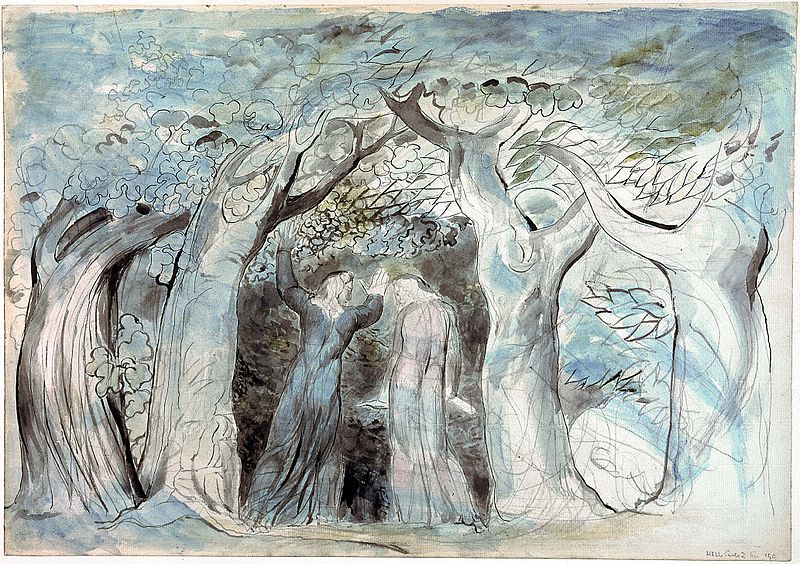
Illustrations to Dante's Divine Comedy object 3 Butlin 812-2 Dante and Virgil Penetrating the Forest
William Blake · The William Blake Archive

Gustave Doré, The Inferno, Canto 13, etching print
Gustave Doré · Wikipaintings
Life and career
Dated record
Life and career
The full dated record · 2 entries
1190
Pietro della Vigna born at Capua.
1249
Pietro della Vigna died at San Miniato.
Places
Named by the record
Places
Only places the record itself states, plotted where the house gazetteer settles their coordinates. Nothing is inferred from a name or a nationality.
Capua.
Birth place
San Miniato.
Death place
Text attribution
Licensing
Text attribution
Part of the biographical narrative on this page reuses licensed material. Its origin, revision and licence are recorded here.
The biographical narrative on this page is based on the Wikipedia article Pietro della Vigna, revision 1360106974 (EN edition), by its contributors. VALÉORINE has edited that text and built its own documentary record around it. The reused material is available under CC BY-SA 4.0, and this page's reuse of it is offered under the same licence. Everything else on this page — the chronology, the holdings, the evidence, the plates and the connections — is VALÉORINE's own record. Sources and licences.
Notes from the source article
Cited by Wikipedia
Notes from the source article
These works are cited by the source article, in its own numbering. They are recorded as its citations, not as sources VALÉORINE has verified.
References
Citations
References
Each reference names the institution holding it, so a reader may go to the document itself.
reference work
Secondary witnessreference work
Secondary witness
People, houses and institutions
Knowledge graph
People, houses and institutions
Teachers, collaborators, publishers and institutions recorded against this person, each on a stated basis.
Citizenship
1- Kingdom of SicilyPlace
Established from a fact already recorded on a verified source.
Studied at
1- University of BolognaOrganisation
Established from a fact already recorded on a verified source.
The Encyclopedia exists whether or not anything is for sale. Corrections are recorded rather than overwritten, and every version of this record is kept. Published 18 August 2026.
Elsewhere in Books
39,529 published records in this field, each with its sources named.
- Pietro CossaAuthor
- Pietro de' CrescenziAuthor
- Pietro DelitalaAuthor
- Pietro Della ValleAuthor
- Pietro GoriAuthor
- Pietro IngraoAuthor
- Pietro MetastasioAuthor
- Pietro Napoli SignorelliAuthor
Best supported in this field
For owners
Own a work by Pietro della Vigna?
A specialist will read what you send and tell you what the house can establish, what it cannot, and whether the object is suited to sale. There is no charge and no obligation. The object stays with you throughout; nothing is shipped to us unless it is arranged in writing beforehand.