
Giorgio Bassani
Giorgio Bassani (4 March 1916 – 13 April 2000) was an Italian novelist, poet, essayist, editor, and intellectual.
Giorgio Bassani
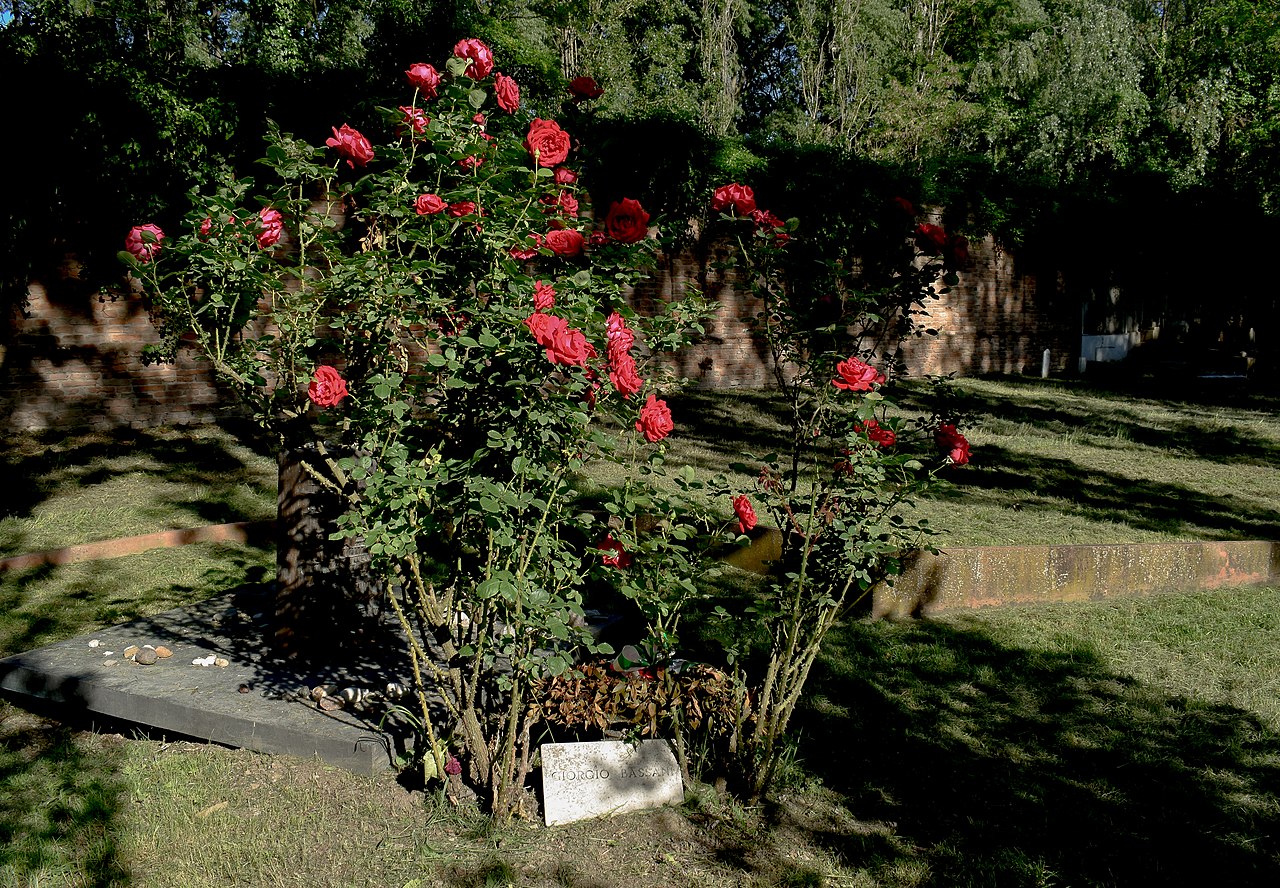
Nicola Quirico · CC BY-SA 4.0
- Name
- Giorgio Bassani
- Born
- 4 March 1916
- Birthplace
- Bologna, Italy
- Died
- 13 April 2000
- Place of death
- Rome, Italy
- Occupation
- * Author
- Nationality
- Italy · Kingdom of Italy
- Education
- University of Bologna
- Honours
- Strega Prize · Viareggio Prize · Bagutta Prize · Feltrinelli Prize · Nelly Sachs Prize · Premio Campiello
- Languages
- Italian
VALÉORINE Encyclopedia
VALÉORINE documentary reading
Documentary summary
Giorgio Bassani (4 March 1916 – 13 April 2000) was an Italian novelist, poet, essayist, editor, and intellectual.
Admitted source layer · organised and presented by VALÉORINE
Note VALÉORINE
No house-authored Note is published until its assertions and sources pass the VALÉORINE evidence contract. The documentary article remains available in full while that enrichment is being consolidated.
Documentary enrichment in progress · no unsupported statement published
Reference Check
Propose documentary evidence for Giorgio Bassani. A contribution is never written directly as fact: identity, source, rights and evidence gates still decide.
Sign in to contribute
World of VALÉORINE
Documentary connections
Only confirmed graph relationships appear here. Images are shown only when their identity and reuse rights both pass the documentary gate.

Documentary evidence
Evidence Panel
not yet certified
- Identity
- resolved
- Independent source families
- 0
- Admitted assertions
- 0
- Open conflicts
- 0
Authority files
wikidata · Q318309 · wikipedia · Giorgio Bassani
In this article
Key facts
Key facts
• Name — Giorgio Bassani • Born — 4 March 1916 • Birthplace — Bologna, Italy • Died — 13 April 2000 • Place of death — Rome, Italy • Occupation — * Author • editor • poet • essayist
Biography
Biography
Bassani was born in Bologna into a prosperous Jewish family of Ferrara, where he spent his childhood with his mother Dora, father Enrico (a doctor), brother Paolo, and sister Jenny. In 1934, he completed his studies at his secondary school, the liceo classico L. Ariosto in Ferrara. The high school's historical archive contains many documents and photos concerning his young life, which are displayed in the atrium that they dedicated to him. Music had been his first great passion, and he considered a career as a pianist; however, literature soon became the focus of his artistic interests. In 1935, he enrolled in the Faculty of Letters of the University of Bologna. Commuting to lectures by train (third class) from Ferrara, he studied under the art historian Roberto Longhi. His ideal of the "free intellectual" was the liberal historian and philosopher Benedetto Croce. Despite the anti-Semitic race laws which were introduced in 1938, he was able to graduate in 1939, writing a thesis on the nineteenth-century writer, journalist, radical and lexicographer Niccolò Tommaseo. As a Jew in 1939, however, work opportunities were now limited, and he became a schoolteacher in the Jewish School of Ferrara in via Vignatagliata. In 1940, his first book, Una città di pianura ("A City of the Plain"), was published under the pseudonym "Giacomo Marchi" in order to evade the race laws. He chose the name of Dora's brother, Giacomo Minerbi, and the surname of his maternal grandmother, Emma Marchi. During this period, along with friends he had made in Ferrara's intellectual circle, he became a clandestine political activist. His activity in the anti-fascist resistance led to his arrest in May 1943; he was released on 26 July, the day after Benito Mussolini was ousted from power. A little over a week later, he married Valeria Sinigallia, whom he had met playing tennis. They moved to Florence for a brief period, living under assumed names, then at the end of the year, to Rome, where he spent the rest of his life. His first volume of poems, Storie dei poveri amanti e altri versi, appeared in 1944; a second, Te lucis ante, followed in 1947. He edited the literary review Botteghe oscure for Princess Marguerite Caetani from its founding in 1948 until it ceased publication in 1960. In 1953, La passeggiata prima di cena appeared and in 1954, Gli ultimi anni di Clelia Trotti. In the same year, he became editor of Paragone, a journal founded by Longhi and his wife, Anna Banti. Bassani's writings reached a wider audience in 1956 with the publication of the Premio Strega-winning book of short stories, Cinque storie ferraresi (the five stories are Lida Mantovani, La passeggiata prima di cena, Una lapide in via Mazzini, Gli ultimi anni di Clelia Trotti, and Una notte del '43). As an editorial director of Feltrinelli, Bassani was responsible for the posthumous publication in 1958 of Giuseppe Tomasi di Lampedusa's Il Gattopardo, a novel which had been rejected by Elio Vittorini at Mondadori, and Einaudi. It became one of the great successes of post-war Italian literature. Bassani's enthusiastic editing of the text, following instructions from Elena Croce (daughter of Benedetto), who had offered him the manuscript, later became controversial; however, recent editions have been published which follow the manuscript more closely. Also in 1958, Bassani's novel Gli occhiali d'oro (made into a film in 1987) was published, an examination, in part, of the marginalisation of Jews and homosexuals. Together with stories from Cinque storie ferraresi (reworked and under the new title Dentro le mura (1973)), it was to form part of a series of works known collectively as Il romanzo di Ferrara, which explored the city, with its Christian and Jewish elements, its perspectives and its landscapes. The series includes: Il giardino dei Finzi-Contini (The Garden of the Finzi-Continis, 1962, Premio Viareggio prizewinner); Dietro la porta (1964); L'airone (1968) and L'odore del fieno (1972). These works realistically document the Italian Jewish community under Fascism in a style that manifests the difficulties of searching for truth in the meanderings of memory and moral conscience. In 1960, one of his short stories (Una notte del '43, from Cinque storie ferraresi) was adapted as the film Long Night in 1943. A stage adaptation of The Garden of the Finzi-Continis by opera composer Ricky Ian Gordon is set to premiere in January 2022. It is a co-production of National Yiddish Theatre Folksbiene and the New York City Opera. From 1965 to 1980, Giorgio Bassani was the president of the organization Italia Nostra. Bassani died in 2000 and was buried in the Jewish Cemetery in Ferrara, the same place where he located the graves of the family Finzi-Contini. He was survived by his estranged wife, Valeria and their two children, Paola (born 1 September 1945) and Enrico (born 29 June 1949). He had been with his companion, Portia Prebys, since shortly after they met in 1977. The city of Ferrara decided to commemorate his life by giving his name to the Communal Library and the Urban Park in the Northern part of the city. Bassani received the Charles Veillon, the Strega, the Campiello, the Viareggio and the Nelly Sachs prizes. He collaborated on several screenplays.
Identity
Identity
Giorgio Bassani is recorded as having received Strega Prize, Viareggio Prize and Bagutta Prize. Recognition and collections. Bassani received Strega Prize, Viareggio Prize, Bagutta Prize, Feltrinelli Prize, Nelly Sachs Prize and Premio Campiello.
Life and career
Dated record
Life and career
The full dated record · 2 entries
1916
Giorgio Bassani born at Bologna.
2000
Giorgio Bassani died at Rome.
Places
Named by the record
Places
Only places the record itself states, plotted where the house gazetteer settles their coordinates. Nothing is inferred from a name or a nationality.
Bologna.
Birth place
Rome.
Death place
Publications
• Within the Walls (Dentro le mura) – 1956 • The Gold-rimmed Spectacles (Gli occhiali d'oro) – 1958 • A Prospect of Ferrara (Cinque storie ferraresi) – 1962 • The Garden of the Finzi-Continis (Il giardino dei Finzi-Contini) – 1962 • The Heron (L'airone) – 1970 • Five Stories of Ferrara (Cinque storie ferraresi) – 1971 • The Smell of Hay (L'odore del fieno) – 1972 • Behind the Door (Dietro la porta) – 1972 • Il romanzo di Ferrara (1974; revised 1980). The Novel of Ferrara, trans. Jamie McKendrick (2018) • Rolls Royce and Other Poems (extracts from Epitaffio and In gran segreto) – 1982
Film adaptations
• Long Night in 1943 • The Garden of the Finzi-Continis • The Gold Rimmed Glasses
Awards
• 1956 - Strega Prize for "Cinque storie ferraresi" • 1962 - Viareggio Prize • 1969 - Nelly Sachs Prize • 1969 - Campiello Prize for "L'airone" • 1983 - Bagutta Prize for "In rima e senza" • 1987 - Pirandello Prize • 1992 - Feltrinelli Prize for Prose
References
Citations
References
Each reference names the institution holding it, so a reader may go to the document itself.
reference work
Wikidata, structured authority record Q318309: Giorgio BassaniWikimedia Foundation
Partially resolvedreference work
Partially resolved
People, houses and institutions
Knowledge graph
People, houses and institutions
Teachers, collaborators, publishers and institutions recorded against this person, each on a stated basis.
Studied at
1- University of BolognaOrganisation
Established from a fact already recorded on a verified source.
The Encyclopedia exists whether or not anything is for sale. Corrections are recorded rather than overwritten, and every version of this record is kept. Published 14 August 2026.
Elsewhere in Books
39,200 published records in this field, each with its sources named.
- Giorgio AnselmoAuthor
- Giorgio AntonucciAuthor
- Giorgio BaffoAuthor
- Giorgio Bàrberi SquarottiAuthor
- Giorgio CaproniAuthor
- Giorgio FontanaAuthor
- Giorgio OrelliAuthor
- Giorgio ScerbanencoAuthor
Best supported in this field
For owners
Own a work by Giorgio Bassani?
A specialist will read what you send and tell you what the house can establish, what it cannot, and whether the object is suited to sale. There is no charge and no obligation. The object stays with you throughout; nothing is shipped to us unless it is arranged in writing beforehand.