
Peter Molitor
Illustration — Self-portrait (1877) Peter Joseph Molitor (19 September 1821 in Koblenz – 15 May 1898 in Oberlahnstein) was a German painter, associated with the Düsseldorfer Malerschule.
Also recorded as Peter molitor · Peter Joseph Molitor
Peter Molitor

HOWI - Horsch, Willy · Own work (own photography, Mittelrhein-Museum Koblenz) · CC BY-SA 3.0
- Died
- 1898 · Oberlahnstein.
- Nationality
- Germany
- Occupation
- painter
- Languages
- German
VALÉORINE Encyclopedia
VALÉORINE documentary reading
Documentary summary
Illustration — Self-portrait (1877) Peter Joseph Molitor (19 September 1821 in Koblenz – 15 May 1898 in Oberlahnstein) was a German painter, associated with the Düsseldorfer Malerschule.
Admitted source layer · organised and presented by VALÉORINE
Note VALÉORINE
No house-authored Note is published until its assertions and sources pass the VALÉORINE evidence contract. The documentary article remains available in full while that enrichment is being consolidated.
Documentary enrichment in progress · no unsupported statement published
Reference Check
Propose documentary evidence for Peter Molitor. A contribution is never written directly as fact: identity, source, rights and evidence gates still decide.
Sign in to contribute
Documentary evidence
Evidence Panel
not yet certified
- Identity
- unresolved
- Independent source families
- 0
- Admitted assertions
- 0
- Open conflicts
- 0
Authority files
wikidata · Q19965603 · wikipedia · Peter Molitor
In this article
Life and work
Life and work
• Illustration — "The Boy Werner" He was the son of Peter Ferdinand Marcus Molitor (1772–1838), a baker, originally from Meudt, and his wife, Maria Anna née Aleff. His father also served on the Koblenz city council. It is likely that he displayed artistic talent at an early age and received lessons from private tutors. At that time, Koblenz lacked a fine arts academy, so when he had become relatively proficient at the age of sixteen, he left home to continue his training at the Kunstakademie Düsseldorf, under the direction of Friedrich Wilhelm von Schadow. He was there for less than a year when his studies were interrupted. His parents died within a few months of each other, so he had to return home to attend to the family's business. He was able to return to the Akademie in 1841 and studied portrait painting with Karl Ferdinand Sohn. He also developed an interest in history painting. His studies were completed in 1844, and his first known painting, depicting Werner of Oberwesel, dates from the following year. Except for a visit to Munich, nothing is known of his whereabouts from then until he returned to Koblenz around 1850. In 1851, thanks to the religious artist Ernst Deger, he was able to get work assisting Alfred Rethel, a fellow student from the Akademie, with a project at the Aachen Town Hall, which had been started in 1847 but was delayed due to Rethel's poor health. Back in Koblenz, in 1854, he married Amalia Schneider, daughter of the court carpenter, Jakob Franz Schneider. In 1857, with his wife and infant daughter, he accepted another job offer from Deger and moved to Kapellen (now part of Koblenz), where their son, Franz Molitor (artist), was born. This project involved wall paintings commissioned by King Frederick William IV of Prussia for Stolzenfels Castle. • Illustration — Cleric Leading a Blind Woman After completing his work there, he returned to Düsseldorf with his young family, where their third child, a son, was born in 1860. That same year, he joined the progressive artists' association, Malkasten. Until 1882, he participated in the construction of the St. Nikolaus (Koblenz), commuting between Düsseldorf and Koblenz. The Passion Cycle, a series of ten large wall paintings, occupied him for six years. Some of the stained glass windows based on his drawings were destroyed in World War II. In 1891, he resigned from Malkasten without stating a reason. From then until 1895, he was occupied with creating small format drawings on behalf of the Verein zur Verbreitung religiöser Bilder. The drawings were then turned into engravings by Josef Kohlschein, and reproduced for distribution. In 1897, he sold his home in Düsseldorf and went to live with relatives in Oberlahnstein, near Lahneck Castle. Nine months later, he died of a stroke, aged seventy-six.
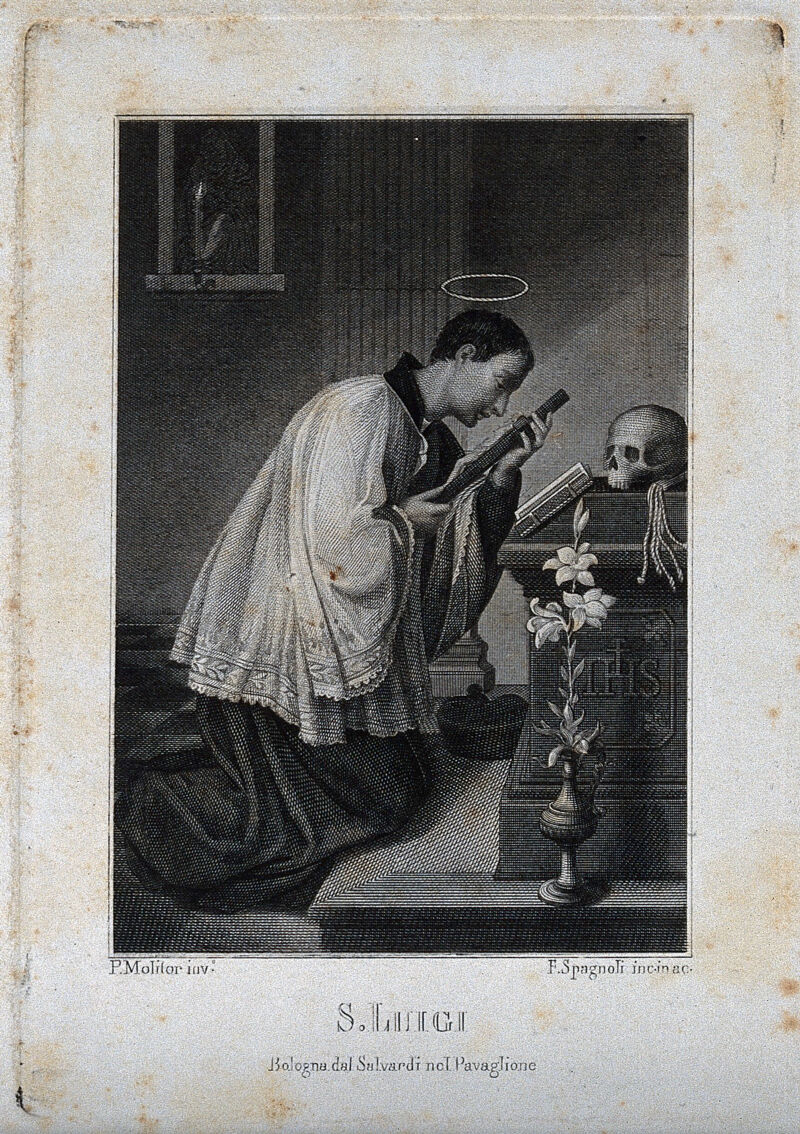
Saint Aloysius Gonzaga. Steel engraving by F. Spagnoli after P. Molitor., by Peter Molitor
Peter Molitor · Wellcome Collection, London · Wellcome Collection
Places
Named by the record
Places
Only places the record itself states, plotted where the house gazetteer settles their coordinates. Nothing is inferred from a name or a nationality.
Koblenz.
Birth place
Oberlahnstein.
Death place
Notes from the source article
Cited by Wikipedia
Notes from the source article
These works are cited by the source article, in its own numbering. They are recorded as its citations, not as sources VALÉORINE has verified.
- 1.Christine Klaus: Peter Joseph Molitor (1821–1898) – ein Koblenzer Maler. Lebensdaten unter Verweis auf das Standesamt Koblenz, das Stadtarchiv Koblenz und das Zivilstandsregister.
- 2.Christine Klaus: Peter Joseph Molitor (1821–1898) – ein Koblenzer Maler. Angabe unter Verweis auf Handbuch für die Bewohner der Stadt Koblenz des Jahres 1828.
- 3.Katharina Thielen: Notablnpolitik in Koblenz. Partizipationschancen in der reaktionären Rheinprovinz (1815-1848), Trier 2020, S. 257.
- 4.Herbert Dellwing, Reinhard Kallenbach: Denkmaltopographie Bundesrepublik Deutschland. Band 3.2: Koblenz Innenstadt. Worms 2004, ISBN 3-86134-390-8, S. 154.
- 5.Christine Klaus: Peter Joseph Molitor (1821–1898) – ein Koblenzer Maler.
- 6.Eduard Sebald u. a.: Die Kunstdenkmäler von Rheinland-Pfalz, Band 9: Die Kunstdenkmäler des Rhein-Hunsrück-Kreises. Teil 2: Ehemaliger Kreis St. Goar, Stadt Oberwesel, Landesamt für Denkmalpflege Rheinland-Pfalz (Hrsg.), Deutscher Kunstverlag 1977, ISBN 3-422-00576-5, S. 690 f.
- 7.Christine Klaus: Peter Joseph Molitor (1821–1898) – ein Koblenzer Maler. Angaben unter Verweis auf die Korrespondenz Alfred Rethels mit seinem Bruder Otto Rethel (März 1851) und seiner Braut (August 1851). In: Josef Ponten: Alfred Rethels Briefe. Eine Auswahl. Berlin 1912, S. 151–153 und 165.
- 8.Künstlerindex Auktionshaus Michael Zeller Aktueller Buchstabe L.
- 9.Ulrike Weber, Dellwing u. Liessem: Kulturdenkmäler in Rheinland-Pfalz. Denkmaltopographie Bundesrepublik Deutschland. Band 3.3: Stadt Koblenz. Stadtteile. Wernersche Verlagsgesellschaft, Worms 2013, ISBN 978-3-88462-345-9, S. 34–36.
- 10.Christine Klaus: Peter Joseph Molitor (1821–1898) ein Koblenzer Maler. Angabe unter Verweis auf Alfons Friedrich (Hrsg.): Klotten und seine Geschichte. Zur 1300-Jahr-Feier des Ortes. Briedel 1997 (= Schriftenreihe Ortschroniken des Trierer Landes 29), S. 254.
References
Citations
References
Each reference names the institution holding it, so a reader may go to the document itself.
reference work
Partially resolvedreference work
Partially resolved
The Encyclopedia exists whether or not anything is for sale. Corrections are recorded rather than overwritten, and every version of this record is kept. Published 25 August 2026.
Elsewhere in Paintings
18,623 published records in this field, each with its sources named.
- Peter MalkinArtist
- Peter MaxArtist
- Peter Michal BohúňArtist
- Peter MiegArtist
- Peter MonamyArtist
- Peter Nicolai ArboArtist
- Peter OliverArtist
- Peter PaillouArtist
Best supported in this field
For owners
Own a work by Peter Molitor?
A specialist will read what you send and tell you what the house can establish, what it cannot, and whether the object is suited to sale. There is no charge and no obligation. The object stays with you throughout; nothing is shipped to us unless it is arranged in writing beforehand.