
Peiraikos
Illustration — A kitchen scene by Pieter Aertsen, who was compared to Peiraikos Peiraikos, or Piraeicus or Peiraeicus, was an Ancient Greek painter of uncertain date and location. He was the chief representative of what is called rhopography (ῥοπογραφία), or the painting of petty subjects, such as still-life. None of his work is known to have survived and he is known only from a brief discussion by the Latin author Pliny the Elder.
Also recorded as Piraeicus · Peiraiikos · Pyreicus
Peiraikos
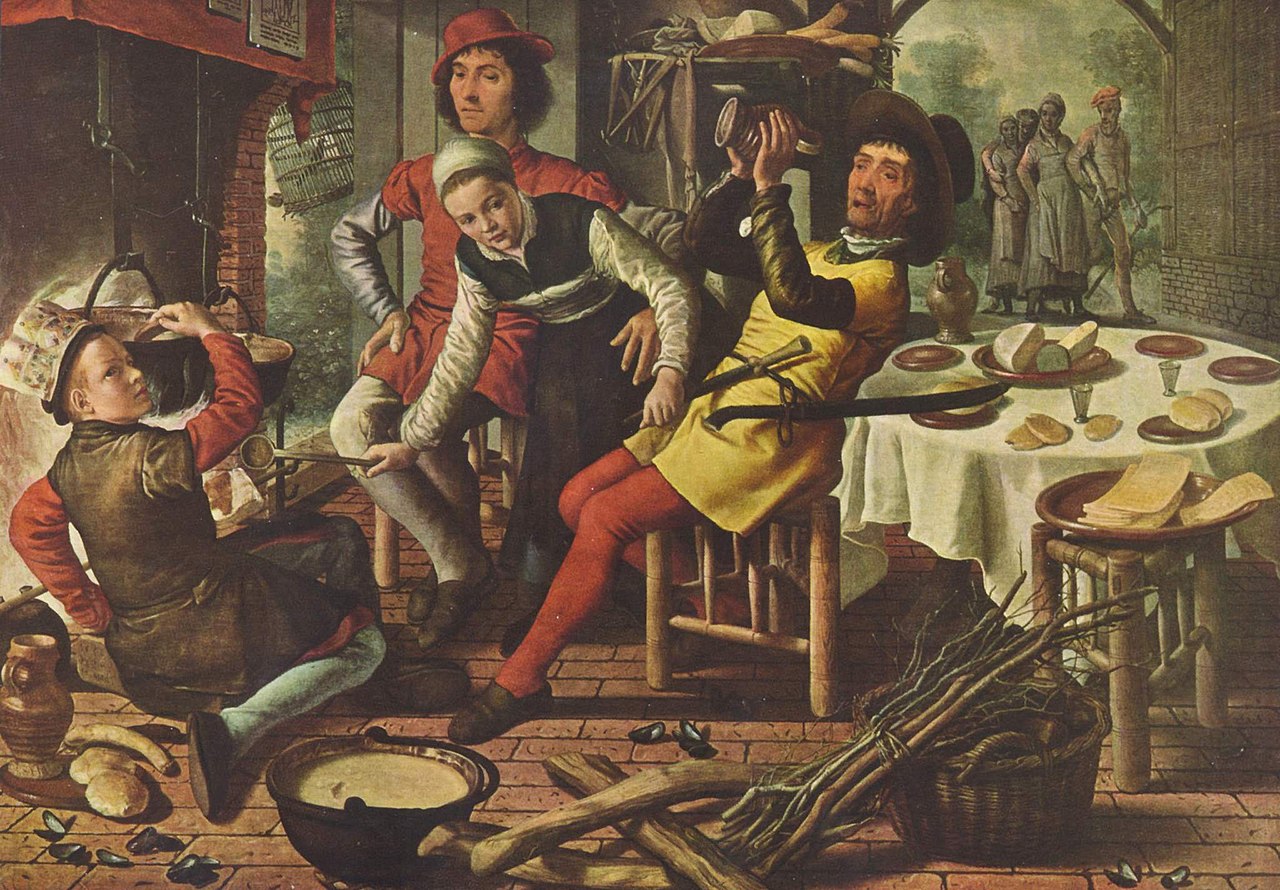
Pieter Aertsen · The Yorck Project (2002) 10.000 Meisterwerke der Malerei (DVD-ROM), distributed by DIRECTMEDIA Publishing GmbH. ISBN: 3936122202. · Public domain
- Occupation
- painter
- Fields
- rhyparography
VALÉORINE Encyclopedia
VALÉORINE documentary reading
Documentary summary
Illustration — A kitchen scene by Pieter Aertsen, who was compared to Peiraikos Peiraikos, or Piraeicus or Peiraeicus, was an Ancient Greek painter of uncertain date and location. He was the chief representative of what is called rhopography (ῥοπογραφία), or the painting of petty subjects, such as still-life. None of his work is known to have survived and he is known only from a brief discussion by the Latin author Pliny the Elder.
Admitted source layer · organised and presented by VALÉORINE
Reference Check
Propose documentary evidence for Peiraikos. A contribution is never written directly as fact: identity, source, rights and evidence gates still decide.
Sign in to contribute
Documentary evidence
Documentary basis
Authority files
getty · 500123616 · wikidata · Q3905609 · wikipedia · Peiraikos
In this article
In Early Modern art criticism
In Early Modern art criticism
Pliny's passage comes in the middle of his discussion of painting in Book XXXV of his Natural History, completed about 78 AD: It is well to add an account of the artists who won fame with the brush in painting smaller pictures. Amongst them was Peiraikos. In mastery of his art but few take rank above him, yet by his choice of a path he has perhaps marred his own success, for he followed a humble line, winning however the highest glory that it had to bring. He painted barbers' shops, cobblers' stalls, asses, eatables and similar subjects, earning for himself the name of rhyparographos [painter of dirt/low things]. In these subjects he could give consummate pleasure, selling them for more than other artists received for their large pictures. In the terms of later art history, he painted cabinet paintings of genre subjects. Generally speaking, Pliny seems to derive his information from Varro (116 BC – 27 BC), and Peiraikos may have been contemporary with or somewhat earlier than him, placing the painter at the end of the Hellenistic period or in the early Graeco-Roman period. From his tone, it seems that "Pliny does not know how to judge Piraeicus". Early Modern commentators were to take both approving and disapproving attitudes to later artists compared to him, often assuming that Pliny's meaning followed their own. Peiraikos' subjects may well have been given a comic treatment, but this is not clear. Some equivalent subjects survive in Roman art, especially in shops and shopfronts in Pompeii, small sections of floor mosaics, and in the reliefs of men at work on the Tomb of Eurysaces the Baker in Rome (c. 50–20 BC), but it is interesting to know that such subjects were popular with collectors at the top end of the Roman art market. Propertius makes a reference to a painter of "small art" in his Elegies, but the surviving text is corrupt, and it is generally thought to intend a reference to the 5th century BC Athenian painter Parrhasios, whose trompe-l'œil painted curtain fooled Xeuxis, an anecdote reported in another passage of Pliny.
Peiraikos became frequently referred to in discussions of art in the late Renaissance and especially the Baroque periods, when genre subjects were becoming popular again, and the need for classical authority was still strongly felt. The ambiguous tone of Pliny's comments allowed later writers to enlist Pliny on either side of the argument for and against Peiraikos' humble modern equivalents. One of the first artists to specialize in genre subjects, Pieter Aertsen was an innovative late-16th-century painter of kitchen scenes, who was compared to Peiraikos by the Dutch Renaissance humanist Hadrianus Junius (Adriaen de Jonghe, 1511–1575) in his Batavia, published posthumously in 1588, which compares Aertsen at each point of Pliny's description in a wholly laudatory manner. An article by Zoran Kwak argues that a painting by his son Pieter Pietersz the Elder (1540–1603), normally called Market Scene with the Journey to Emmaus, which features prominently a half-naked figure who is clearly a cook (with Jesus and his companions as smaller figures behind him), in fact represents a self-portrait in a partly comic spirit, depicted as Peiraikos. Pieter van Laer (1599 – c. 1642) was a Dutch Golden Age painter of genre scenes, active for over a decade in Rome, where his nickname was Il Bamboccio. Artists working in his style, who often painted just such scenes of everyday life as Pliny lists, became known as the Bamboccianti, painters in Bamboccio's manner. Peiraikos is often mentioned in the controversies over the Bamboccianti, for example by Salvator Rosa in his Satires, and later by the Dutch biographer of artists, Samuel Dirksz van Hoogstraten in his Inleyding tot de Hooge Schoole der Schilderkonst (Introduction to the Academy of Painting), Rotterdam 1678. As genre painting became an important element of Dutch Golden Age painting, Peiraikos was used to provide classical precedent for such work, in the relatively few discussions of the appropriateness of such art by Karel van Mander in his Schilder-boeck (1604) and Arnold Houbraken in his The Great Theatre of Dutch Painters (1718–1719). Having originally been often rather cheap, by the late 17th century the best Dutch genre scenes became sought after by collectors across Europe at very high prices, a development following Pliny's account of Peiraikos that was bemoaned by Lessing in his Laocoon (1763), mentioning Dutch painting specifically. • Illustration — Diego Velázquez, An Old Woman Cooking Eggs, 1618 In Spain, where bodegones or genre tavern scenes had become popular, Peiraikos was referred to by Francisco Pacheco and later Antonio Palomino in the same way, with Palomino comparing Velasquez to him. A reference by the Jesuit writer Baltasar Gracián, comparing Peiraikos to an unnamed contemporary painter also seems to refer to Velasquez. In Italy he is mentioned in passing by Cardinal Gabriele Paleotti, whose De sacris et profanis imaginibus (1582, "Discourse on Sacred and Profane Images") was one of the treatises setting out the Counter-Reformation church's views on the proper role and content of art. Giovanni Battista Agucchi, the secretary of Cardinal Odoardo Farnese and a mover and shaker in the Roman art scene, called Jacopo Bassano the modern Peiraikos, contrasting the pair to Caravaggio and Demetrios of Alopeka, who sculpted "warts and all" portraits of important figures. In France, André Félibien was an influential codifier of the theory of the hierarchy of genres in art, and cited Pliny on Peiraikos, assuming the disapproval of his predecessor. A passage in the diary of Paul Klee meditates on Peiraikos as an "artist-martyr". In literature, Rabelais in Gargantua and Pantagruel (Prologue, Book V, c. 1564) compares himself to Peiraikos as a specialist in low subjects: "... and yet for Aesop a Place was found, and the Office of Mythologist; in like manner, inasmuch as I do not aspire to a higher Degree, I pray that they may not disdain to receive me in the Office of small Riparographer and Follower of Piraeicus" (or "Puny Riparographer, or Riffraff-scribler of the Sect of Pyrricus" as his translator Peter Motteux put it in 1694).
Rhyparographer
Rhyparographer
The term used by Pliny has been anglicized as "rhyparographer", "A painter of low or mean subjects", which the OED first records in 1656, with "rhyparography" in 1678.
Primary material
Documents and archives
authority file
- Getty Union List of Artist Names 500123616, Peiraikos.
General reference · The Getty Research Institute
reference work
- “Peiraikos”, English Wikipedia, consulted as further reading
Reputable secondary · Wikipedia
institutional register
- Wikidata, structured authority record Q3905609: Peiraikos
General reference · Wikimedia Foundation
Notes from the source article
Cited by Wikipedia
Notes from the source article
These works are cited by the source article, in its own numbering. They are recorded as its citations, not as sources VALÉORINE has verified.
- 1.Harry Thurston Peck, Harpers Dictionary of Classical Antiquities (1898), Piraeĭcus
- 2.Hobey-Hamsher
- 3.Pliny the Elder, Natural History, xxxv.112
- 4.Sellers, E., Introduction to "Pliny" (edition as quoted), p. lxxxiv
- 5.Hénin, 135 - "Pline ne sait comment juger Piraeicus"
- 6.Modern scholars have also interpreted Pliny's cryptic remarks with enthusiasm: his "humble line" has been taken as the inability to draw properly, and "consummate pleasure" (consummata voluptas) seen as a verbal play on the pleasure of eating, https://books.google.com/books?id=54cYuI6aRuoC&dq=Piraeicus&pg=PA537
- 7.Kettering, 701
- 8.Plommer, 99, gives a quick survey of the Hellenistic and Roman still-life tradition.
- 9.Elegies III.ix.12
- 10.Hobey-Hamsher
- 11.Courtwright, 500; Sullivan, 237-239
- 12.Sullivan, 236, and the rest of the article
- 13.Sullivan, 240. The whole article provides an extended discussion of the reception of early genre paintings and their context in contemporary art theory. The popularity of Pliny in Northern Europe in particular is discussed on pp. 240-241
- 14.Kwak, 223–228. The painting's location is unknown, and it was last known in a private collection in Berlin in 1929.
- 15.Levine, 571 note 14
- 16.Kettering, 701 and 712, note 40
- 17.Hénin, 135, n. 79
- 18.Kettering, 701 and 712, note 40
- 19.Quoted and discussed in Saporta, 114–119
- 20.Saporta, 118, citing Svetlana Alpers
- 21.Book 1, p. 73 in the 2012 English translation from Getty, google books
- 22.Sohm, 458
- 23.Hénin, 136 and note 80
- 24.Saporta, 119, with quotation
- 25.Saporta, 118-119; and
- 26.Quoted, OED, "Rhyparographer"
- 27.OED, "Rhyparographer", "Rhyparography"
References
Citations
References
Each reference names the institution holding it, so a reader may go to the document itself.
authority file
Getty Union List of Artist Names 500123616, Peiraikos.The Getty Research Institute
Secondary witnessreference work
Secondary witnessinstitutional register
Wikidata, structured authority record Q3905609: PeiraikosWikimedia Foundation
General reference
The Encyclopedia exists whether or not anything is for sale. Corrections are recorded rather than overwritten, and every version of this record is kept. Published 18 August 2026.
Elsewhere in Paintings
19,183 published records in this field, each with its sources named.
- Pegeen Vail GuggenheimArtist
- Pegi Nicol MacLeodArtist
- Pehr HilleströmArtist
- Pehr HörbergArtist
- PejacArtist
- Pekka HalonenArtist
- Pélagie GbaguidiArtist
- Pellegrino AretusiArtist
Best supported in this field
For owners
Own a work by Peiraikos?
A specialist will read what you send and tell you what the house can establish, what it cannot, and whether the object is suited to sale. There is no charge and no obligation. The object stays with you throughout; nothing is shipped to us unless it is arranged in writing beforehand.