
Osip Brik
Osip Maksimovich Brik (Russian: Осип Максимович Брик; 28 January [O.S. 16 January] 1888 – 22 February 1945) was a Russian avant garde writer, literary critic and lawyer, known for being an important member of the Russian formalist school, though he also identified himself as one of the Futurists.
Also recorded as Osip Maksimovich Brik
Osip Brik

Маяковский В. В. Выступления на диспуте «Леф или блеф?» 23 марта 1927 г. / Публ. А. В. Февральского Новое о Маяковском. — М.: Изд-во АН СССР, 1958. — Т. I. — С. 47—70. — (Лит. наследство · Public domain
- Born
- 1888. · Moscow.
- Died
- 1945. · Moscow.
- Nationality
- Russian Empire and Soviet Union.
- Occupation
- writer, lawyer, literary critic, screenwriter, literary historian and poet.
- Languages
- Russian.
VALÉORINE Encyclopedia
VALÉORINE documentary reading
Documentary summary
Osip Maksimovich Brik (Russian: Осип Максимович Брик; 28 January [O.S. 16 January] 1888 – 22 February 1945) was a Russian avant garde writer, literary critic and lawyer, known for being an important member of the Russian formalist school, though he also identified himself as one of the Futurists.
Admitted source layer · organised and presented by VALÉORINE
Note VALÉORINE
No house-authored Note is published until its assertions and sources pass the VALÉORINE evidence contract. The documentary article remains available in full while that enrichment is being consolidated.
Documentary enrichment in progress · no unsupported statement published
Reference Check
Propose documentary evidence for Osip Brik. A contribution is never written directly as fact: identity, source, rights and evidence gates still decide.
Sign in to contribute
World of VALÉORINE
Documentary connections
Only confirmed graph relationships appear here. Images are shown only when their identity and reuse rights both pass the documentary gate.
Documentary evidence
Evidence Panel
not yet certified
- Identity
- resolved
- Independent source families
- 0
- Admitted assertions
- 0
- Open conflicts
- 0
Authority files
loc · no2015059775 · wikidata · Q738721 · wikipedia · Osip Brik
In this article
Life and career
Life and career
Brik was born and grew up in Moscow, the son of a wealthy Jewish jeweler. In the university, Brik studied law; his friend Roman Jakobson wrote: "For his doctoral thesis he wanted to write about the sociology and juridical status of prostitutes and would frequent the boulevards. All the prostitutes there knew him, and he always defended them, for free, in all their affairs, in their confrontations with the police and so on." But he soon found himself far more interested in poetry and poetics and devoted all his time to it, becoming one of the founders of OPOJAZ and writing one of the first important formalist studies of sounds in poetry, Zvukovye povtory ("Sound repetitions," 1917). He had a strongly anti-author stance, once going so far as to say that if Pushkin had not written Eugene Onegin, somebody else would have; he wrote that "there are no poets or literary figures, there is poetry and literature." He was also interested in photography and film: "In 1918, Brik was a member of IZO Narkompros (Visual Arts Section of the People's Committee for Education).... Brik was especially close to Alexander Rodchenko and did much to make his photographic work known." He was also active in films and wrote several screenplays, including one for Potomok Cingis-khana (The Descendant of Genghis Khan) (with Ivan Novokshonov), directed by Vsevolod Pudovkin (1928). He met his future wife, Lilya Kagan, when he was 17 and she 14; they were married on 26 March 1912. (Her sister Elsa was a notable French writer and married to Louis Aragon) The daughter of a prosperous Jewish jurist, the handsome, erotically obsessed, highly cultivated Lili grew up with an overwhelming ambition prevalent among women of the Russian intelligentsia: to be perpetuated in human memory by being the muse of a famous poet.... The two made a pact to love each other "in the Chernyshevsky manner" – a reference to one of nineteenth-century Russia's most famous radical thinkers, who was an early advocate of "open marriages." Living at the heart of an artistic bohemia and receiving the intelligentsia in the salon of his delectable wife, Osip Brik, true to his promise, calmly accepted his wife's infidelities from the start. In fact, upon hearing his wife confess that she had gone to bed with the famous young poet Vladimir Mayakovsky, Brik exclaimed "How could you refuse anything to that man?"... In 1918, when Mayakovsky and the Briks became inseparable, he simply moved in with them. Throughout the rest of his life, he made his home at a succession of flats that the Briks occupied. Mayakovsky's sexual relationship with Lili lasted from 1917 to 1923, and afterwards he continued to have a close friendship with the couple: "For the rest of his life, 'Osia' Brik remained the poet's most trusted adviser, his most fervent proselytizer, and also a co-founder with him of the most dynamic avant-garde journal of the early Soviet era, Left Front of Art," or LEF, which was also an official publication for the group with the same name, and a platform for Russian Constructivist art. Brik was not only a literary modernist, he was strongly left-wing in politics. In December 1918 Brik was involved with Mayakovsky in discussions with the Vyborg District party school of the Russian Communist Party (RKP(b)) to set up a Futurist organisation affiliated to the party. Named Komfut the organisation was formally founded in January 1919, but was swiftly dissolved following the intervention of Anatoly Lunacharsky. Later, on 8 June 1920, he joined the Cheka. Jakobson wrote of this period: It was from Bogatyrev, who visited me in Prague in December 1921, that I learned Brik was in the Cheka. And he told me that Pasternak, who often visited the Briks, had said to him: "Still, it's become rather terrifying. You come in, and Lili says: 'Wait a while, we'll have dinner as soon as Osja comes back from the Cheka.'" At the end of 1922 I met the Briks in Berlin. Osja said to me: "Now there's an institution where a man loses his sentimentality," and began relating to me several rather bloody episodes. This was the first time he made a rather repulsive impression on me. Working in the Cheka had ruined him. After Joseph Stalin's rise to power, the Communist regime openly encouraged exclusively socialist realism methods and initiated a campaign to stamp out all culture the Communist Party perceived as dangerous. Most avant garde artists and thinkers suffered persecution, and Brik did not escape this fate. In the 1930s he eked out a living writing articles on Mayakovsky and book reviews; he died in 1945 of a heart attack while climbing the stairs to his Moscow apartment. His works were not republished in Russia until the mid-1990s. Edward J. Brown summed his career up thus: "He wrote little, but his articles on poetic form... are brilliant formalist analyses of poetic language... and he was probably the most articulate exponent in Lef of the theories of 'social demand' and 'literature of fact.' A man of surpassing intelligence, he was apparently not strong either in performance or in principle."
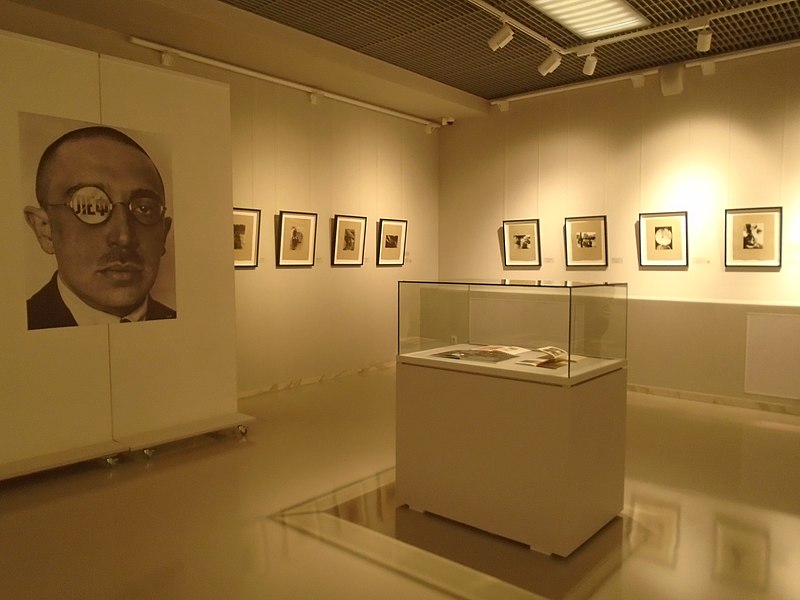
Выставка «Александр Родченко. Из коллекции Still Art Foundation» в Галерее современного искусства, Казань.
Vyacheslav Kirillin

Выставка «Александр Родченко. Из коллекции Still Art Foundation» в Галерее современного искусства, Казань.
Vyacheslav Kirillin
Life and career
Dated record
Life and career
The full dated record · 2 entries
1888
Osip Brik born at Moscow.
1945
Osip Brik died at Moscow.
Primary material
Documents and archives
authority file
- Library of Congress Name Authority File, Osip Brik--in memoriam (USE Brikovskiĭ sbornik) (no2015059775).
Unverified · Library of Congress
- VIAF cluster 97096911 for Osip Brik, aggregating national library name authorities.
Unverified · OCLC
reference work
- Wikidata, structured authority record Q738721: Osip Brik
Reputable secondary · Wikimedia Foundation
- “Osip Brik”, English Wikipedia, consulted as further reading
Reputable secondary · Wikipedia
Notes from the source article
Cited by Wikipedia
Notes from the source article
These works are cited by the source article, in its own numbering. They are recorded as its citations, not as sources VALÉORINE has verified.
- 1.Howard, Jeremy. Oxford Art Online. Oxford University Press. 2003. 10.1093/gao/9781884446054.article.t011338.
- 2.Gershon David Hundert, The YIVO Encyclopedia of Jews in Eastern Europe, vol. 1 (Yale University Press, 2008: ), p. 237
- 3.Francine du Plessix Gray, Them (Penguin, 2006: ), p. 51.
- 4.Roman Jakobson, My Futurist Years (Marsilio Publishers, 1997: ), p. 43.
- 5.Graham Roberts, The Last Soviet Avant-Garde: OBERIU – Fact, Fiction, Metafiction (Cambridge University Press, 2006: ), p. 28.
- 6.Diane Neumaier, Beyond Memory: Soviet Nonconformist Photography and Photo-related Works of Art (Rutgers University Press, 2004: ), p. 172.
- 7.Литературная Сибирь / Сост. Трушкин В., Волкова В. – Иркутск: Вост.-Сиб. кн. изд-во, 1986. – С. 262.
- 8.Jurij Striedter, Literary Structure, Evolution, and Value: Russian Formalism and Czech Structuralism Reconsidered (Harvard University Press, 1989: ), p. 266.
- 9.Francine du Plessix Gray, Them, pp. 51–52.
- 10.Francine du Plessix Gray, Them, p. 51.
- 11.Jangfeldt, Bengt. Majakovskij and Futurism 1917–21. Almqvist & Wiksell International. 1976.
- 12.Поэт и Женщина Международная Еврейская Газета - МЕГ. 2013-07-21.
- 13.Roman Jakobson, My Futurist Years, p. 45.
- 14.Vahan D. Barooshian, Brik and Mayakovsky (Mouton, 1978: ), p. 122.
- 15.Smith, Gudmund J. W. Creativity and Breast Cancer. Creativity Research Journal. 14. 2. 157–162. 2002. 1040-0419.
- 16.Edward J. Brown in Victor Terras (ed.), Handbook of Russian Literature (Yale University Press, 1990: ), p. 278.
Bibliography printed in the source article · 1
- Two Essays on Poetic Language, Ann Arbor, 1964
References
Citations
References
Each reference names the institution holding it, so a reader may go to the document itself.
authority file
Library of Congress Name Authority File, Osip Brik--in memoriam (USE Brikovskiĭ sbornik) (no2015059775).Library of Congress
Partially resolvedauthority file
Partially resolvedreference work
Wikidata, structured authority record Q738721: Osip BrikWikimedia Foundation
Partially resolvedreference work
Partially resolved
The Encyclopedia exists whether or not anything is for sale. Corrections are recorded rather than overwritten, and every version of this record is kept. Published 14 August 2026.
Elsewhere in Books
38,661 published records in this field, each with its sources named.
- Oscar Zeta AcostaAuthor
- Ōshio HeihachirōAuthor
- Osip AptekmanAuthor
- Osip BodyanskyAuthor
- Osip DymovAuthor
- Osip MandelstamAuthor
- Osiris Rodríguez CastillosAuthor
- Oskar BaumAuthor
Best supported in this field
For owners
Own a work by Osip Brik?
A specialist will read what you send and tell you what the house can establish, what it cannot, and whether the object is suited to sale. There is no charge and no obligation. The object stays with you throughout; nothing is shipped to us unless it is arranged in writing beforehand.