
Opanas Zalyvakha
Opanas Ivanovych Zalyvakha (26 November 1925 – 24 April 2007) was a Ukrainian artist and Soviet dissident, member of Artistic Youths' Club (1960 - 1964).
Also recorded as Opanas Ivanovych Zalyvakha · Afanasy Zalyvakha
Opanas Zalyvakha
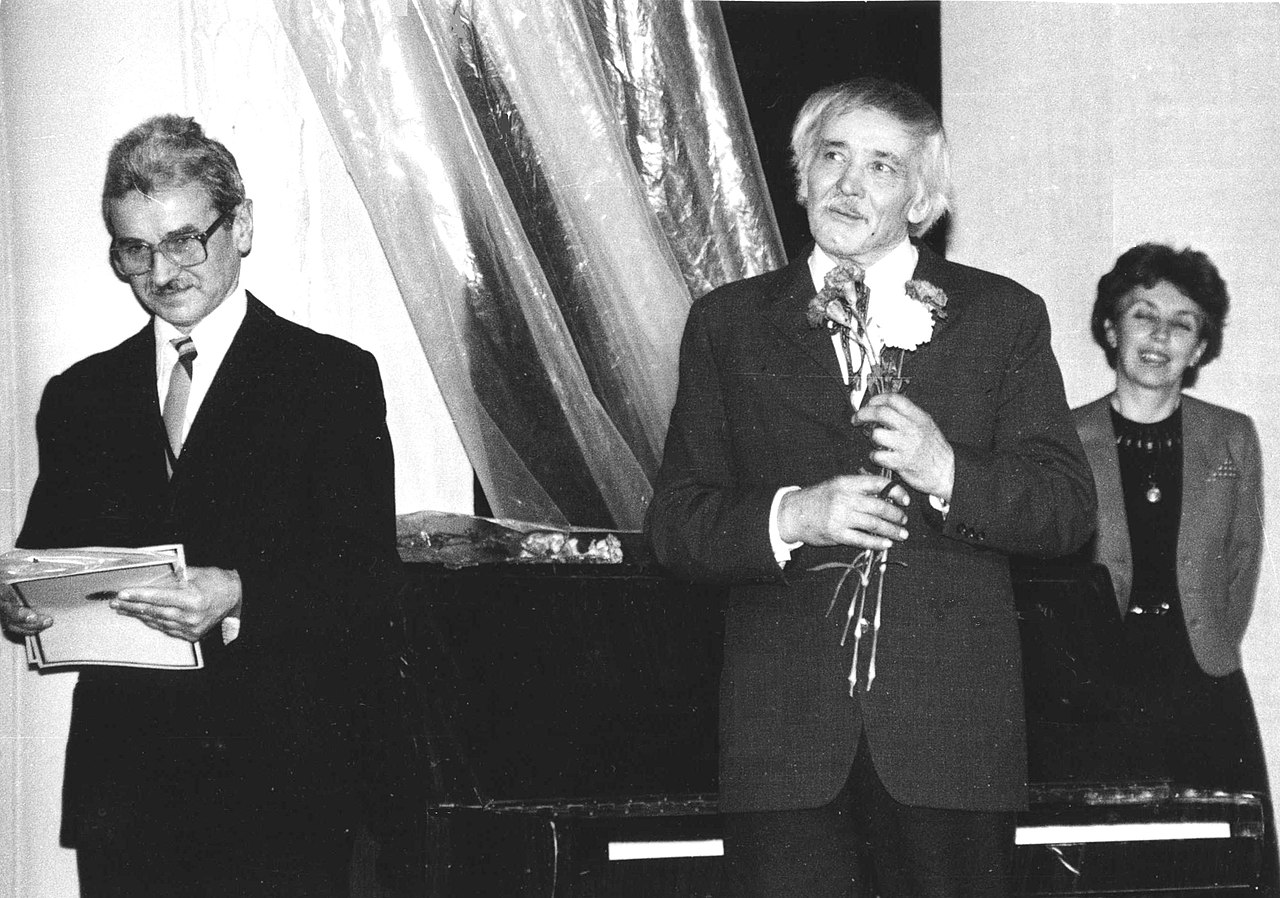
Валентин · CC BY-SA 4.0
- Name
- Opanas Zalyvakha
- Born
- 26 November 1925
- Birthplace
- Husynka, Kharkiv Oblast, Ukrainian SSR, Soviet Union
- Died
- 24 April 2007
- Place of death
- Ivano-Frankivsk, Ukraine
- Education
- Saint Petersburg Repin Academy of Arts
- Movement
- Sixtiers, Ukrainian underground
- Nationality
- Soviet Union · Ukraine
- Occupation
- painter
- Languages
- Ukrainian
VALÉORINE Encyclopedia
VALÉORINE documentary reading
Documentary summary
Opanas Ivanovych Zalyvakha (26 November 1925 – 24 April 2007) was a Ukrainian artist and Soviet dissident, member of Artistic Youths' Club (1960 - 1964).
Admitted source layer · organised and presented by VALÉORINE
Reference Check
Propose documentary evidence for Opanas Zalyvakha. A contribution is never written directly as fact: identity, source, rights and evidence gates still decide.
Sign in to contribute
World of VALÉORINE
Documentary connections
Only confirmed graph relationships appear here. Images are shown only when their identity and reuse rights both pass the documentary gate.
Documentary evidence
Documentary basis
Authority files
wikidata · Q12105584 · wikipedia · Opanas Zalyvakha
In this article
Key facts
Key facts
• Name — Opanas Zalyvakha • Native Name — Опанас Іванович Заливаха • Born — 26 November 1925 • Birthplace — Husynka, Kharkiv Oblast, Ukrainian SSR, Soviet Union • Died — 24 April 2007 • Place of death — Ivano-Frankivsk, Ukraine • Education — Saint Petersburg Repin Academy of Arts • Movement — Sixtiers, Ukrainian underground
Biography
Biography
Opanas Zalyvakha was born in the village of Husynka, Kharkiv Oblast. He spent his youth in Siberia, where his family fled from the Holodomor in 1933. His education as a painter stated at the arts school in Blagoveshchensk. Zalyvakha later studied at an arts college in Irkutsk, and during World War II attended courses of the Leningrad Academy of Arts, which was at the time evacuated to Samarkand. He was expelled from the academy for failing to attend a meeting with a candidate from the Communist Party, but was able to get restored as a student and finally graduated in 1960. In 1957, Zalyvakha completed his training in Kosiv (Hutsul region). During that period he also got acquainted with works of Ukrainian literature, including Taras Shevchenko's Kobzar and Mykhailo Kotsiubynsky's Intermezzo. After completing his studies, he worked for a year as an artist at the Tyumen Art Fund, after which he moved to Ivano-Frankivsk. Here, the artist's first exhibition took place at the regional museum of local history. It lasted two weeks. Opanas Zalyvakha placed a notebook for comments in the hall and received mixed reviews. The exhibition was closed after only 10 days on the order of local authorities, as the artists' style was demed to be too modern and national-oriented. Some of his early works found their way abroad and gained popularity, and Zalyvakha received an invitation to organise an exhibition in New York. In 1962, Zalyvakha joined activities of the Artistic Youths' Club in Kyiv, which would eventually become a centre of dissident activities. There he befriended Alla Horska, Liudmyla Semykina, Halyna Sevruk, Ivan Svitlychnyi and Yevhen Sverstiuk. Together with Horska, Semykina, Sevruk and Halyna Zubchenko, he worked on the stained glass window "Shevchenko. Mother", created for the 150th anniversary of Taras Shevchenko in the lobby of the Red Building of Kyiv National University. However, a commission convened by the Communist Party leadership qualified it as ideologically hostile, so the stained glass window was destroyed by the university administration. In August 1965 Zalyvakha and Svitlychnyi were arrested on accusations of anti-Soviet agitation and sentenced to 5 years of imprisonment in labour camps of Mordovia. Among Zalyvakha's cellmates in prison was the dissdent Mykhailo Soroka. Zalyvakha was forbidden to paint, and his bookplates were confiscated. Although his colleagues repeatedly appealed for Opanas to be allowed to paint, they never received permission. He recalled his imprisonment: "I was already living in a general prison called the USSR. First there was boarding school, then university in Leningrad. And everywhere they gave you food rations, of course, if you were “obedient”. And then in prison they also gave you rations. The authorities always tried to allocate rations in everything: in food and in creativity. That's how the state was. Everything was allocated according to the quota." In 1968, he signed the ‘Letter of 139’, an open public letter addressed to Leonid Brezhnev, Alexei Kosygin and Nikolai Podgorny demanding an end to the practice of illegal political trials. In the winter of 1969, Alla Horska visited Opanas Zalyvakha in the Mordovian concentration camp zone. On 28 August 1970, when he was released from prison, she played an active role in organising a grand welcome for him at the 'Natalka' restaurant in Kyiv. She was murdered that same year. Following his release, Zalyvakha remained in contact with dissident groups, and was constantly supervised by the KGB. In 1980 the artist's home was searched by the secret police, whose agents confiscated his library and part of his works. In the late years of perestroika and after Ukraine declared independence, his work received well-deserved recognition, and exhibitions of his works were organised in Ukraine and abroad, encompassing cities such as Lviv, Ivano-Frankivsk, Kyiv, Toronto, London and New York. In 1989 Zalyvakha became a laureate of Vasyl Stus Prize. In 1995, he was awarded the Taras Shevchenko State Prize of Ukraine. The artist's first album was released in 2003 by the 'Smoloskyp' publishing house. His works are present in collections of numerous museums and art galleries in Ukraine. Zalyvakha died on 24 April 2007 in Ivano-Frankivsk.
Personal life
Personal life
After his release from prison in 1970, Zalyvakha married Daryna Voznyak, a niece of Stepan Bandera, who was also persecuted by Soviet authorities. The couple raised a son, Yaroslav, and a daughter, Yaryna. Daryna Voznyak died on 30 January 2020 at the age of 78.
Exhibitions
Exhibitions
In 2024, an exhibition of Zalyvakha's worksopened at the Mercury Art Centre in Lviv.
Commemoration
Commemoration
• Illustration — Monument of Opanas Zalyvakha in Ivano-Frankivsk, 2025 A street where Zalyvakha resided in Lviv, previously named after Oleg Koshevoy, has been renamed in his honour. On 23 November 2017, a monument to the artist (sculptor Ihor Semak) was erected on the pedestrian part of Nezalezhnosti Street in Ivano-Frankivsk. In 2023, Matrosov Street in Kyiv was renamed Opanas Zalyvakha Street. In 2024, Griboedov Street in Druzhkivka was renamed Opanas Zalyvakha Street.
Places
Named by the record
Places
Only places the record itself states, plotted where the house gazetteer settles their coordinates. Nothing is inferred from a name or a nationality.
Husynka.
Birth place
Ivano-Frankivsk.
Death place
Book illustrations
• Palimpsests by Vasyl Stus, • The Prodigal Sons of Ukraine by Yevhen Sverstiuk.
Primary material
Documents and archives
reference work
- “Opanas Zalyvakha”, English Wikipedia, consulted as further reading
Reputable secondary · Wikipedia
authority record
- Wikidata, structured authority record Q12105584: Opanas Zalyvakha
General reference · Wikidata
Citations
References
Each reference names the institution holding it, so a reader may go to the document itself.
reference work
Secondary witnessauthority record
General reference
The Encyclopedia exists whether or not anything is for sale. Corrections are recorded rather than overwritten, and every version of this record is kept. Published 19 August 2026.
Elsewhere in Paintings
19,183 published records in this field, each with its sources named.
- Onorato CarlandiArtist
- Onorio MarinariArtist
- OnufriArtist
- Ōoka ShunbokuArtist
- Ophrah ShemeshArtist
- Oqtay ŞıxəliyevArtist
- OraziArtist
- Orazio CambiasiArtist
Best supported in this field
For owners
Own a work by Opanas Zalyvakha?
A specialist will read what you send and tell you what the house can establish, what it cannot, and whether the object is suited to sale. There is no charge and no obligation. The object stays with you throughout; nothing is shipped to us unless it is arranged in writing beforehand.